
Sign up to save your podcasts
Or

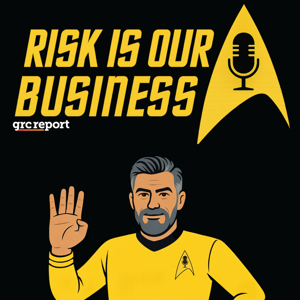

In this episode of Risk Is Our Business, Captain Michael Rasmussen welcomes aboard Mark Heywood, writer, presenter, creative director, novelist, screenwriter, and former global crisis-management leader, for a conversation that travels well beyond the neutral zone of traditional risk models. Together, they explore why risk and resilience can’t be governed by left-brain logic alone, and why the future of the discipline requires imagination, narrative, and the kind of storytelling that has steered starships and boardrooms alike.
Mark draws from his dual life in operational resilience and the arts to explain what happens when organizations rely solely on spreadsheets, heat maps, and linear thinking. They discuss how right-brain capabilities (creativity, empathy, narrative framing, and world-building) are essential for helping leaders actually understand risk, not just document it. From micro-simulations and tabletop exercises to gamification and immersive storytelling, Mark outlines how to design experiences that engage decision-makers emotionally as well as analytically.
The episode charts a course into the future where logic and imagination operate in tandem, where resilience teams think like screenwriters, and where storytelling becomes a strategic asset for preparing organizations to face the unexpected at warp speed.
 View all episodes
 By Michael Rasmussen
5
44 ratings
In this episode of Risk Is Our Business, Captain Michael Rasmussen welcomes aboard Mark Heywood, writer, presenter, creative director, novelist, screenwriter, and former global crisis-management leader, for a conversation that travels well beyond the neutral zone of traditional risk models. Together, they explore why risk and resilience can’t be governed by left-brain logic alone, and why the future of the discipline requires imagination, narrative, and the kind of storytelling that has steered starships and boardrooms alike.
Mark draws from his dual life in operational resilience and the arts to explain what happens when organizations rely solely on spreadsheets, heat maps, and linear thinking. They discuss how right-brain capabilities (creativity, empathy, narrative framing, and world-building) are essential for helping leaders actually understand risk, not just document it. From micro-simulations and tabletop exercises to gamification and immersive storytelling, Mark outlines how to design experiences that engage decision-makers emotionally as well as analytically.
The episode charts a course into the future where logic and imagination operate in tandem, where resilience teams think like screenwriters, and where storytelling becomes a strategic asset for preparing organizations to face the unexpected at warp speed.
229,204 Listeners
14,200 Listeners
793 Listeners

112,593 Listeners
189 Listeners

2,473 Listeners
74 Listeners

9,909 Listeners
0 Listeners

27 Listeners
219 Listeners
2 Listeners
170 Listeners