
Sign up to save your podcasts
Or



In October and November 1942, the Allies fought a famous battle against German and Italian troops close to the small Egyptian village of El Alamein.
General Bernard Montgomery, the British commander, knew that victory was crucial. But his offensive was in danger of stalling almost as soon as it began.
Witness speaks to Len Burritt who was then a 24 year old wireless operator with the British Seventh Armoured Division.
(Photo: A German tank is knocked out and British troops rush up with fixed bayonets to capture the German crew at the Battle of El Alamein. Credit: Getty Images)
Using archive recordings we tell the story of Britain's most famous hangman. During the 1940s and 50s, he was responsible for the execution of some of Britain's most notorious murderers and was sent to Germany to hang more than 200 Nazi war criminals after WW2. He said he was always determined to treat prisoners with dignity and respect whatever their crime. He initially appeared to support the abolition of the death penalty.
In the 1930s, many parts of Britain were suffering the effects of the Great Depression.
But conditions were particularly harsh in the town of Jarrow, in the north-east of England.
In 1936, 200 men marched the 300 miles from Jarrow to London to protest against mass unemployment and to demand that new industries be established in their town. They called it the Jarrow Crusade.
Witness delves into the BBC archives to hear the voices of the marchers.
Presenter / Producer Rob Walker
First broadcast on the BBC World Service in 2015
(Photo: Marchers on the Jarrow Crusade. Credit: Keystone/Getty Images)
In 1930, the USSR created a Jewish Autonomous Region in Siberia, as a homeland for Soviet Jews. Dina Newman talks to someone who grew up there.
In October 1929, Wall Street crashed and the greatest depression the world had ever seen began. Harry Leslie Smith tells Witness his story of growing up in extreme poverty in the north of England, and how his sister died of TB in a workhouse infirmary, too poor for proper medical care.
Photo: unemployed men queue for work at a dockyard during the Great Depression (Credit:Fox Photos/Getty Images)
World-famous prima ballerina Alicia Alonso talks to Witness about her long and successful career on the stage, and how in 1959 she founded the prestigious Cuban National Ballet.
(Photo: Alicia Alonso courtesy of A. Alonso)
In 1945 the English physicist was exposed as a nuclear spy for the Soviet Union. Alan Nunn May had been working on Britain's top-secret nuclear project during WW2. Witness hears from his step-son, Paul Broda.
(Photo: Alan Nunn May. Credit: Keystone/Getty Images)
In October 1945, countries ratified the founding charter of a new organsation, the United Nations, that it was hoped would ensure there was never a world war again. Earlier that year thousands of delegates from around the world had met in San Francisco to hammer out the charter. Witness talks to two people who worked for the UN that year; and to historian Stephen Schlesinger.
Photo: a delegate from Saudi Arabia addresses the UN's founding conference in San Francisco (Credit: the UN)
In October 1975, 90% of all women in Iceland took part in a nationwide protest over inequality. Vigdis Finnbogadottir, later Iceland's first female president, talks about that momentous day.
(Photo Credit: The Icelandic Women's History Archives)
In October 1995 during Sri Lanka's brutal civil war Tamil Tiger rebels attacked a remote Sinhalese village. Witness hears from a survivor and from journalist, Amal Jayasinghe. Some listeners might find parts of the programme disturbing.
(Photo: Villagers flee Kotiyagala in Sri Lanka's southeast. Credit: Sena VIDANAGAM/AFP/Getty Images)
From the publisher's feed
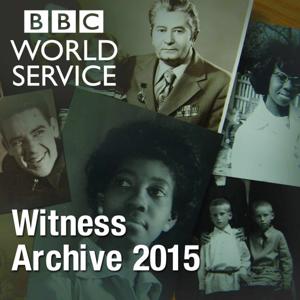
History as told by the people who were there. All the programmes from 2015.

7,618 Listeners
1,089 Listeners

1,050 Listeners

5,485 Listeners
1,795 Listeners

1,825 Listeners
1,037 Listeners
1,907 Listeners

3,219 Listeners
19 Listeners
1,004 Listeners

2,265 Listeners