
Sign up to save your podcasts
Or

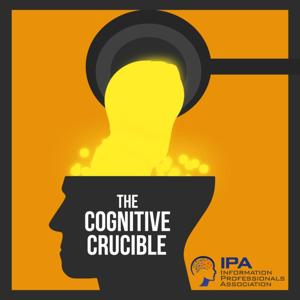

During this episode, Dr. Paul Lopata of the Laboratory for Physical Sciences in College Park Maryland discusses the origins of quantum mechanics including philosophical underpinnings and a recap of the famous double-slit experiment which prompted physicists to start thinking about light as having both wave and particle properties. Paul connects quantum theory and cognitive security using words and concepts like trust, probabilistic reasoning, and making decisions with limited information, and in the presence of risk. He also describes advances in quantum computing and cryptography, prime numbers, Shor's algorithm, and NP-hard problems.
Resources:
Link to full show notes and resources
https://information-professionals.org/episode/cognitive-crucible-episode-77
Guest Bio: Dr. Paul Lopata is a quantum research scientist at the Laboratory for Physical Sciences in College Park Maryland. Previously, Paul served as the Principal Director for Quantum Science in the Office of the Under Secretary of Defense for Research and Engineering where he focused on quantum technology modernization. He was also Executive Secretary for the Defense Science Board's Task Force on Applications of Quantum Technologies.
About: The Information Professionals Association (IPA) is a non-profit organization dedicated to exploring the role of information activities, such as influence and cognitive security, within the national security sector and helping to bridge the divide between operations and research. Its goal is to increase interdisciplinary collaboration between scholars and practitioners and policymakers with an interest in this domain.
For more information, please contact us at [email protected].
Or, connect directly with The Cognitive Crucible podcast host, John Bicknell, on LinkedIn.
Disclosure: As an Amazon Associate, 1) IPA earns from qualifying purchases, 2) IPA gets commissions for purchases made through links in this post.
 View all episodes
 By Information Professionals Association

4.9
5757 ratings
During this episode, Dr. Paul Lopata of the Laboratory for Physical Sciences in College Park Maryland discusses the origins of quantum mechanics including philosophical underpinnings and a recap of the famous double-slit experiment which prompted physicists to start thinking about light as having both wave and particle properties. Paul connects quantum theory and cognitive security using words and concepts like trust, probabilistic reasoning, and making decisions with limited information, and in the presence of risk. He also describes advances in quantum computing and cryptography, prime numbers, Shor's algorithm, and NP-hard problems.
Resources:
Link to full show notes and resources
https://information-professionals.org/episode/cognitive-crucible-episode-77
Guest Bio: Dr. Paul Lopata is a quantum research scientist at the Laboratory for Physical Sciences in College Park Maryland. Previously, Paul served as the Principal Director for Quantum Science in the Office of the Under Secretary of Defense for Research and Engineering where he focused on quantum technology modernization. He was also Executive Secretary for the Defense Science Board's Task Force on Applications of Quantum Technologies.
About: The Information Professionals Association (IPA) is a non-profit organization dedicated to exploring the role of information activities, such as influence and cognitive security, within the national security sector and helping to bridge the divide between operations and research. Its goal is to increase interdisciplinary collaboration between scholars and practitioners and policymakers with an interest in this domain.
For more information, please contact us at [email protected].
Or, connect directly with The Cognitive Crucible podcast host, John Bicknell, on LinkedIn.
Disclosure: As an Amazon Associate, 1) IPA earns from qualifying purchases, 2) IPA gets commissions for purchases made through links in this post.

32,110 Listeners
2,372 Listeners
14,283 Listeners
26,254 Listeners

1,067 Listeners

781 Listeners
717 Listeners
423 Listeners
406 Listeners

15,571 Listeners

16,096 Listeners
22 Listeners
498 Listeners

296 Listeners
267 Listeners