
Sign up to save your podcasts
Or

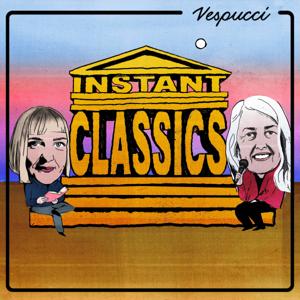

The Ancient Greeks, it’s often said, invented theatre - and the plays they wrote are still big box office today, particularly when you have a Hollywood star in the main part. In this episode, Mary and Charlotte wonder what a day at the theatre in Ancient Athens was actually like. Did it bear any resemblance to theatre-going experience in the West End or Broadway today?
The more one gets into the nitty-gritty of Greek theatre festivals - the military parades, hymn singing, displays of war booty, processions of unmarried girls, orphans, and large phalluses - the more alien it seems. The fact that it took place in the open air and the actors wore masks is the least of it.
So what was really going on when the Athenians got together to watch a play? Why was the state so involved? And would Mary and Charlotte, as women, have even been allowed in?
@instaclassicpod for Insta, TikTok and YouTube
@insta_classics for X
email: [email protected]
On Greek theatre, the context and the practicalities… Good accessible introductions are:
The Cambridge Companion to Greek and Roman Theatre, ed. McDonald and Walton (Cambridge UP pb, 2011)
The Cambridge Companion to Greek Tragedy, ed. Easterling (Cambridge UP pb, 1997)
There is a crucial academic article on the pre-performance ceremonies by Simon Goldhill: 'The Great Dionysia and Civic Ideology', reprinted in Nothing to Do with Dionysos? Athenian Drama in Its Social Context, ed. Winkler and Zeitlin (Princeton UP, pb 1992)
Greek Tragedy: Suffering Under the Sun by Edith Hall
Instant Classics handmade by Vespucci
Producer: Jonty Claypole
Executive Producer: Natalia Rodriguez Ford
Video Editor: Jak Ford
Theme music: Casey Gibson
Learn more about your ad choices. Visit podcastchoices.com/adchoices
 View all episodes
 By Vespucci

4.9
153153 ratings
The Ancient Greeks, it’s often said, invented theatre - and the plays they wrote are still big box office today, particularly when you have a Hollywood star in the main part. In this episode, Mary and Charlotte wonder what a day at the theatre in Ancient Athens was actually like. Did it bear any resemblance to theatre-going experience in the West End or Broadway today?
The more one gets into the nitty-gritty of Greek theatre festivals - the military parades, hymn singing, displays of war booty, processions of unmarried girls, orphans, and large phalluses - the more alien it seems. The fact that it took place in the open air and the actors wore masks is the least of it.
So what was really going on when the Athenians got together to watch a play? Why was the state so involved? And would Mary and Charlotte, as women, have even been allowed in?
@instaclassicpod for Insta, TikTok and YouTube
@insta_classics for X
email: [email protected]
On Greek theatre, the context and the practicalities… Good accessible introductions are:
The Cambridge Companion to Greek and Roman Theatre, ed. McDonald and Walton (Cambridge UP pb, 2011)
The Cambridge Companion to Greek Tragedy, ed. Easterling (Cambridge UP pb, 1997)
There is a crucial academic article on the pre-performance ceremonies by Simon Goldhill: 'The Great Dionysia and Civic Ideology', reprinted in Nothing to Do with Dionysos? Athenian Drama in Its Social Context, ed. Winkler and Zeitlin (Princeton UP, pb 1992)
Greek Tragedy: Suffering Under the Sun by Edith Hall
Instant Classics handmade by Vespucci
Producer: Jonty Claypole
Executive Producer: Natalia Rodriguez Ford
Video Editor: Jak Ford
Theme music: Casey Gibson
Learn more about your ad choices. Visit podcastchoices.com/adchoices

5,576 Listeners

3,196 Listeners

488 Listeners

428 Listeners

4,791 Listeners

1,415 Listeners

3,245 Listeners

146 Listeners
3,358 Listeners
15,506 Listeners

1,920 Listeners
2,060 Listeners

3,858 Listeners

1,153 Listeners

248 Listeners