
Sign up to save your podcasts
Or

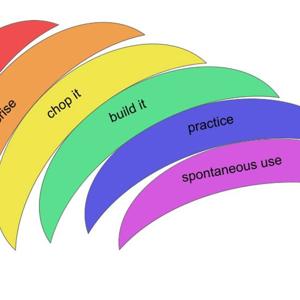


Not 'we teach Japanese', but 'we learn Japanese'. This refocuses the goal to the learning. But why learn it if you don't use it? So I changed my language to 'we use Japanese'. However there is use, use and use. I explain how I understand three versions of 'use'.
Grades, scores and ranking students are a version of rewarding winners. The students already know who is best, medium and not so great in their class. Progress that is ongoing enables a sense of growth, takes away shame and offers a map toward next steps.
This is a short 5 minute pitch about the stacker rings (or cups). It includes the labels and how they support novel creative language use.
Complexity - words to conversation
Word, sentence, complex sentence, simple conversation, complex conversation.
Number - how many words or sentences
1-3, 4-10, 11-20, 21-50, 50+
Independence - Blooms re-worded with student help.
Repeat/copy, memorise, make it up with help, make it up independently, make it up on the spot.
Who said baby toys were just for babies? My current iteration of solutions to the problem of making learning progressions make sense to students, worked a treat. Students helped me label the rings for three stacks, then we worked together to decide how many rings one student's work sample got, and what that student's next steps might be.
Baby stacker rings. Think of the baby toy, where multi-coloured rings are stacked on a pole. Rather than having the three different graphics - a rainbow for independence, a tower for complexity and a flower for variety - I am experimenting with the same visual, this time as baby stacker rings. My hope is that the hands on manipulation of each of the three trajectories will help students monitor their own learning. Good luck to me, I will let you know how it goes.
TIF (Teacher Impact Fellowship) is an optional year after TEP (Teacher Excellence Program) that is run by the Victorian Academy of Teaching and Leadership. I did TEP in 2023, and have been accepted into TIF this year. My project is about learning progressions for Languages. In particular I am leveraging student voice to generate progressions that make sense to students so that, ultimately, students can monitor and drive their own language learning.
My thoughts are offered as a way for you to also develop your own thinking. I hold my ideas lightly, meaning I am ready to change them as I notice new evidence or the influence of other perspectives. My hope is that you can listen to my current thoughts to also generate your own perspectives.
This episode brings a specifically Languages lens to explicit instruction with some examples that might help it make more sense in the Languages classroom. There is no agenda or expectation here. It is offered to provide information around this educational trend so that you can use your own professional judgement about what might be useful or not.
Archer, A., & Hughes, C. (2011). Explicit Instruction: Effective and Efficient Teaching. New York: Guilford Publications.
Sherrington, T. (2019). Rosenshine’s principles in action. John Catt Educational. https://search.ebscohost.com/login.aspx?direct=true&scope=site&db=nlebk&db=nlabk&AN=2548550
'Explicit instruction' is a popular current term in education, however it is often thought of as the part of a lesson when the teacher does the talking to introduce new content. It is actually a much broader set of lesson components. I quote or refer to the following books:
Archer, A., & Hughes, C. (2011). Explicit Instruction: Effective and Efficient Teaching. New York: Guilford Publications.
Sherrington, T. (2019). Rosenshine’s principles in action. John Catt Educational. https://search.ebscohost.com/login.aspx?direct=true&scope=site&db=nlebk&db=nlabk&AN=2548550
When we hear 'evidence based' we usually think of research. Classroom based evidence is also a basis for teaching practice. When there is an alignment of between the two, then the research evidence helps to clarify something that already seemed natural. Sometimes there is alignment, and the evidence clarifies something that already seems natural. Sometimes there is a discord, and there is a 'push back' feeling. Being aware of confirmation bias (how uncritically we take on something that aligns with our pre-conceptions), imagine this as a 'conversation' between the two evidence sources, then choose your action for your context.
From the publisher's feed
USING a language is the point of Language learning. What can Language teachers do to create the space in our classrooms for students to become confident spontaneous users of Language? This honest,…