
Sign up to save your podcasts
Or



Based on Podcast App listening data
In 1875, Bass Reeves became one of the first Black men to serve as a deputy U.S. marshal in the West. Reeves had been born into slavery, but after a violent confrontation with his owner, he fled to Indian Territory, in present-day Oklahoma. There, for three decades he used his knowledge of Indian languages and his expert marksmanship to hunt down murderers, horse thieves, and bootleggers across 75,000 square miles of remote terrain. As stories of his exploits spread across the frontier, he would become one of the most renowned and feared lawmen in the history of the West.
See Privacy Policy at https://art19.com/privacy and California Privacy Notice at https://art19.com/privacy#do-not-sell-my-info.
In 1865, James Butler Hickok, an Army scout and itinerant gambler better known as “Wild Bill,” shot a man dead in the town square of Springfield, Missouri. The gunfight became known as the first recorded quick draw duel, and Hickok became famous overnight. He parlayed his newfound fame into a job as a deputy U.S. marshal, and before long he was one of the most recognizable lawmen on the frontier. But Hickok’s reputation as a fearless gunslinger and a high-stakes gambler put a target on his back – one that haunted him to the end of his days.
See Privacy Policy at https://art19.com/privacy and California Privacy Notice at https://art19.com/privacy#do-not-sell-my-info.
In 1821, a little-known backwoods hunter named David Crockett won a seat in the Tennessee legislature, despite having little formal education and virtually no political experience beyond his gift for spinning a good story. It marked an unlikely turning point for a man who would become a symbol of the American frontier, which was then rapidly expanding as settlers pushed into land long inhabited by Indigenous peoples.
Ultimately, Crockett's frontier persona would prove his greatest political asset, eventually carrying him all the way to Congress. But once there, he would break with his own party over Native removal, before heading to Texas for one final, fateful stand at the Alamo.
See Privacy Policy at https://art19.com/privacy and California Privacy Notice at https://art19.com/privacy#do-not-sell-my-info.
Today George Washington is remembered as the quintessential “Founding Father,” but his path to becoming an American hero was far from certain. Throughout the Revolution, Washington and countless others—including women, free and enslaved Black people, and Indigenous nations—had to make difficult choices about where their loyalties lay and what kind of future they hoped to secure. To help us uncover these often-overlooked stories, Lindsay is joined by Dr. Scott Stephenson, President and CEO of Philadelphia’s Museum of the American Revolution, where the nation’s founding is explored as an ongoing experiment in liberty, equality, and self-government.
See Privacy Policy at https://art19.com/privacy and California Privacy Notice at https://art19.com/privacy#do-not-sell-my-info.
After six long years of war, the Continental Army was exhausted, and Congress had run out of money. George Washington feared that without a decisive victory, the cause of independence would be lost.
But there was fresh cause for hope in the summer of 1781, as a massive French fleet sailed for the Chesapeake Bay. French and American commanders devised a plan to trap the British Army on a peninsula in Yorktown, Virginia.
See Privacy Policy at https://art19.com/privacy and California Privacy Notice at https://art19.com/privacy#do-not-sell-my-info.
In the aftermath of America’s victory at Saratoga, France entered the Revolutionary War, transforming the colonial rebellion into a global conflict. British officials decided that the path to victory lay in the South. As the fighting shifted to the Carolinas, a brutal civil war erupted, pitting families and neighbors against one another in cycles of violence and retribution.
By 1779, the Patriot cause hung in the balance, undermined by rampant inflation, soldier mutinies, and one of the most notorious incidents of treason in American history.
See Privacy Policy at https://art19.com/privacy and California Privacy Notice at https://art19.com/privacy#do-not-sell-my-info.
In 1777, as Americans sought the support of France, Benjamin Franklin struggled to convince officials in Paris to form a military alliance with the new United States. Meanwhile, British General John Burgoyne planned a grand strategy to crush the rebellion by conquering the Hudson River Valley. That summer, his troops fought the Continental Army in a battle that would turn the tide of the American Revolution.
But late that year, American forces faced a winter of peril as George Washington led his exhausted army into quarters at Valley Forge, where the soldiers endured disease, freezing conditions, and the threat of starvation.
See Privacy Policy at https://art19.com/privacy and California Privacy Notice at https://art19.com/privacy#do-not-sell-my-info.
In July 1776, the British Royal Navy began landing a massive armada in New York Harbor, setting up the biggest battle of the Revolutionary War. In response, General George Washington faced the daunting challenge of preparing his motley army to defend New York and keep the colonists’ hopes alive.
In the months that followed, faith in the cause of independence began to waver, and the Continental Army teetered on the brink of collapse. But on Christmas night, the Patriots made a bold strike against the British Army that began with a daring crossing of the icy Delaware River.
See Privacy Policy at https://art19.com/privacy and California Privacy Notice at https://art19.com/privacy#do-not-sell-my-info.
In the aftermath of the Battles of Lexington and Concord, colonial militiamen converged on Boston to confront the veteran British Army. But over the next six months, newly appointed commander-in-chief George Washington struggled to transform a patchwork of amateur militias into a unified national army.
As the conflict wore on, Americans debated whether to escalate the fight and take the unprecedented step of declaring their independence.
See Privacy Policy at https://art19.com/privacy and California Privacy Notice at https://art19.com/privacy#do-not-sell-my-info.
In 1765, King George III and his ministers in the British Parliament sparked outrage in the American Colonies when they announced they were issuing the Stamp Act, the first direct tax on the Colonies. American critics decried the “taxation without representation,” and Boston radicals staged protests, boycotts, and attacks on tax collectors.
After a decade of growing tension over taxes, representation, and imperial control, the first shots of the Revolutionary War rang out in the Massachusetts countryside, as colonial militiamen confronted British regulars on the Lexington village green.
See Privacy Policy at https://art19.com/privacy and California Privacy Notice at https://art19.com/privacy#do-not-sell-my-info.
From the publisher's feed
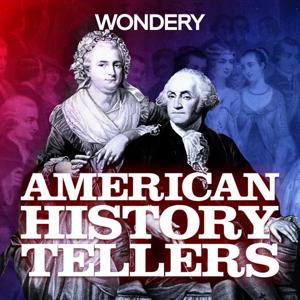
The Cold War, Prohibition, the Gold Rush, the Space Race. Every part of your life - the words you speak, the ideas you share - can be traced to our history, but how well do you really know the…
Audible subscribers can listen to all episodes of American History Tellers ad-free right now. Join Audible today by downloading the Audible app.
Ranked by our users in the last 21 days
10,443 Listeners

30,160 Listeners
778 Listeners
466 Listeners
783 Listeners
3,995 Listeners
6,169 Listeners
12,830 Listeners
3,642 Listeners

19,112 Listeners

2,150 Listeners
2,931 Listeners

115 Listeners

3,044 Listeners
22,950 Listeners

4,221 Listeners

905 Listeners

1,467 Listeners

7,779 Listeners

256 Listeners

2,524 Listeners

2,828 Listeners

251 Listeners
2,164 Listeners

1,599 Listeners

848 Listeners

1,530 Listeners

239 Listeners
596 Listeners

69 Listeners

535 Listeners

874 Listeners

163 Listeners