
Sign up to save your podcasts
Or



Daniel Sturgis selects two books by American author Nicholson Baker - his first novel 'The Mezzanine' published in 1988 and 'Room Temperature' in 1990. Both portray the mindful meanderings of the protagonist, from tender moments to an astonishing level of detail, often with a good dollop of amusement. In 'The Mezzanine', we spend a lunch hour with Howie as he fixates on the micro-details of staplers, Scotch tape, escalators and an assortment of other office paraphernalia, as well as his family, returning continually to his astonishment that both his shoelaces have broken within days of one another. 'Room Temperature' takes place across a mere 20 minutes as Howie recalls a series of domestic specifics, largely around his wife Patty, as he nurses their baby Bug.
DANIEL STURGIS
danielsturgis.co.uk
BOOKS, WRITERS, SCREEN
'A Mark on the Wall' 1917 Virginia Woolf
'Fly' 2010 Season 3, Episode 10 from 'Breaking Bad'
'City Poet: The Life and Times of Frank O'Hara' 1993 by Brad Gooch
'The Diary of a Nobody' 1892 George and Weedon Grossmith
'Great Expectations' 1860 by Charles Dickens
John Updike
'Mr Bean' series 1990 starring Rowan Atkinson
'No Lab: A Novel' 2019 by Richard Roth
'The Journal of a Disappointed Man' 1919 by W. N. P. Barbellion
Paul Auster
ARTISTS, DESIGNERS, CRITICS
Barney Bubbles
Benjamin Buchloh
Dan Walsh
Emma Hart
Francesco Borromini
Gerhard Richter
Ian Hamilton Finlay
Frances Richardson
Jeremy Moon
Le Corbusier
Leonardo da Vinci
Michael Bracewell
Patrick Caulfield
Peter Kinley
Pontormo
Prunella Clough
Shila Khatami
Sonia Delaunay
GALLERIES
Chelsea Space, London
Luca Tommasi, Milan
Martina Geccelli
PS Project Space, Amsterdam
Raumx, London
Rocket Gallery, London
Frances Richardson selects two short texts by Virginia Woolf - 'The Mark on the Wall' published in 1917 and 'Solid Objects' in 1918. Both begin with a black dot which becomes a jumping off point for musing about the structures and systems which govern our livelihoods. The first text has the narrator enjoying their own wondering about the identity of the mark on the wall, pulling away from the dreariness of logical thinking, championing instead, the inventiveness and possibilities in imaginative thinking. While the second text revolves around two politicians, one of whom finds a piece of smoothed glass at the seaside. He becomes obsessed with observation and collecting, giving up his political aspirations for a more materially intimate life - what an excellent idea for many of that lot !
FRANCES RICHARDSON
francesrichardson.co.uk
karstenschubert.com
ARTISTS
Alicja Kwade
Alison Wilding
Brancusi
Charlotte Posenenski
Jane Hayes Greenwood
Peter Dreher
Robert Morris
BOOKS
'Drive Your Plow Over the Bones of the Dead' 2009 and 'Flights' 2007 by Olga Tokarczuk
Jane Hayes Greenwood selects 'The Argonauts' by Maggie Nelson. Published in 2015, it is a whirlwind fusion of contemporary queer theory, autobiography, philosophy, art, motherhood and, perhaps best of all, a beautiful love story.
JANE HAYES GREENWOOD
janehayesgreenwood.com
ARTISTS, THINKERS, PUBLICATIONS
Ambit Magazine
Dana Schutz
D W Winnicott
Edward Burra
Emma Cousin
Esther Leslie
Harry Dodge
Jane Gallop
Kristian Day
Lindsey Mendick
Ludwig Wittgenstein
Melanie Jackson
Olivia Bax
Roland Barthes 'A Lovers Discourse' 1977
Rosalind Krauss
Stanley Spence
ART GALLERIES
Block 336
City and Guilds of London Art School
Goldsmiths CCA
Grand Union
Peter von Kant Gallery
Saatchi Gallery
Tate Modern
Grace Woodcock selects 'Mind of my Mind' by Octavia Butler. Published in 1977, it details the development of a new species of telepaths led by Mary, a mixed-race young woman raised in poverty. In our conversation, we discuss what distinguishes Octavia Butler as a unique sci-fi voice as we focus on Grace's debut London solo exhibition GUT-BRAIN at Castor, exploring the ideas behind her research-led practice around the body, mind, tech, science and alternative medicine.
0:00-0:20 Summary of the book 'Mind of my Mind', wondering how to make the book into a movie, afro-futurism, what it might be like to be in someone else's mind, hybridity, blue-blackness, meaning through action, transcending racial delineation, transracial, breeding programme elitism, shapeshifting gender and race, jealousy of the next generation.
20:00-45:00 Grace's art practice, retro futurism, the current dystopian edge, pills for sex, pushing the limits of what it is to be human, NASA spaceship design, how sliding doors came about, shaping of sculptures around the body, memories in objects wrt Japanese Shinto, hidden materials, potential medicinal elements, gut as the original brain, the fate of the sea urchin brain, multiples, subconscious, conversation pits, the gut as a surveillance system for the body
45:00-55:00 other stuff about Grace, from her influences to the books she's reading now!
GRACE WOODCOCK
gracewoodcock.com
castor.gallery
BOOKS
Aldous Huxley 'Brave New World' by 1932
Jonathan Crary '24/7: Late Capitalism and the Ends of Sleep' 2013
Mark Fisher 'Capitalist Realism' 2009
Octavia E Butler 'The Patternist Series' 1976-1980, 'The Parable Series' 1993-1998, 'Bloodchild & Other Stories' 1995
Phillip K Dick 'The Man in the High Castle' 1962
Svetlanda Boym 'The Future of Nostalgia' 2001
Tibor Fischer 'The Collector Collector' 1997
FILMS & SERIES
'Barbarella' 1968
'Forbidden Planet' 1956
'Gattaca' 1997
'Star Treck' 1966-1969
'The Devil Girl from Mars' 1954
'The Jetsons' 1962-63
'The Man in the High Castle' 2015-2019
'The Truman Show' 1998
ARTISTS & THINKERS
Alison Wilding
Anicka Yi
Diane Simpson
Ernesto Neto
Glenn Ligon
Hannah Levy
Ittah Yoda
Keith Piper - BLK Art Group
Pakui Hardware
Paloma Proudfoot
Rafal Zajko
Saelia Aparicio
Wilhelm Reich - Orgone Theory
Emma Cousin selects the seminal novel 'Nausea' by Jean-Paul Sartre. Published in 1938, it describes Antoine Roquentin's existential crisis which plays out in the library, streets and cafes of Bouville, which literally means 'mud town'. In a world devoid of God, lacking in meaning, Antoine shrinks further and further inside himself as he struggles in his search for purpose, finally deciding the best use of his life is to write a really critical book. Like 'Nausea' I guess ! In our conversation, we focus on Emma's post-lockdown solo show at Goldsmith's CCA, though her ideas - from biology to geometry - and her approach to working across drawing, painting, curating and podcasting, encompass her whole studio practice.
0:00-0:30 Summary of 'Nausea', fluid consciousness, isolation, observation, madness, body, dangling arms, a mouth as thin of a dead snake, spreading cheeks, vomit, nausea, seat as a dead donkey, natural states, the shortcomings of the autodidact, humanism, experiences, projectile vomiting, experimentation in colour, shift, change, the future, elitism, Rembrandt
0:30-1:10 Emma's art practice - contemporary dance, verbing reaching, showing an idea, actively working something out, bodily boundaries, breasts, skin, grounding of figures, 'New Dirt', colour, background as a surround, 'Wash your Hands' for Ambit magazine, wall drawing, social classes, 2D & 3D composition, drawing, drawing, drawing, 'Trigonometry', 'Flower Moon' animation for exhibition, failing meditation, the physical highs and memories thru gardening
1:10-1:20 other Emma stuff - Morandi, folk music, 'Bread and Jam', 'Chats in Lockdown' podcast, activism, what Emma's reading now!
EMMA COUSIN
emmacousin.info
BOOKS & WRITERS & THINKERS (get ready for a long list!)
Albert Camus 'The Myth of Sisyphus' 1942
Anne Carson
Derek Jarman 'Modern Nature : Journals 1989-1990' 2018
Eula Biss 'On Immunity : An Inoculation' 2014
Elias Canetti 'Earwitness : Fifty Characters' 1974 & 'Crowds and Power' 1960
Edwin A Abbott 'Flatland : A Romance of Many Dimensions' 1884
Friedrich Nietzsche
Gregory Bateson 'Steps to an Ecology of Mind' 1972
Honoré de Balzac
JG Ballard 'High Rise' 1975
Joanna Pocock 'Surrender : The Call of the American West' 2019
John Berger 'A Painter of our Time' 1958
Maurice Merleau-Ponty 'The Phenomenology of Perception' 1945
René Descartes
Richard Power 'The Overstory' 2018
Samuel Beckett
Sergei Eisenstein 'On Disney' 1986
Simone de Beauvoir
Thomas Mann 'Death in Venice' 1912
William Petter Blatty 'The Exorcist' 1971
OTHER ARTISTS
Amy Sillman
Andrea V Wright
Appau Jnr Boakye-Yiadom
Georgio Morandi
Hardeep Pandhal
John Cage, composer, artist, music theorist
Lindsey Mendick
Mark Morris, dancer and choreographer
Michael Tippett, composer
Paul Carey-Kent, art critic, curator
Rembrandt Harmenszoon van Rijn
William Blake
PODCAST
'Chats in Lockdown' hosted by Emma Cousin
Dr Charley Peters selects ‘The Yellow Wallpaper’ by Charlotte Perkins Gilman. Published in 1892, it was inspired by the author’s own experience of post natal depression and the resulting inappropriate treatment she battled against. The short story describes one woman’s descent into madness as she is overtaken by the yellow wallpaper she loathes. Her supposedly devoted husband keeps her isolated in a room, based on the authority of a nasty little cluster of so called expert mental health physicians including his learned self. This only worsens her condition. Charley identifies with the main character’s need for stimulation, for creativity and for a way of being that doesn’t fall subject to a cold logic. She describes the the book as a testament to creativity as a type of freedom, of intellectual freedom, of social freedom. It's also a timely selection as we emerge from lockdown which has been, amongst other things, a challenging time of coping with isolation.
0:00 - 0:22 the book, post natal depression, social repression, marriage, isolation, feminism, inspiration, pattern, gothic horror, human rights, social reform, independence
0:22 - 0:28 project for Hospital Rooms at Bluebird House, a mental health unit in Southampton
0:28 - 0:30 the decorative, design, contrasting unplanned
0:30 - 0:37 Charley's process, creating a ground, building up a painting, blending, tone, 'sb|2m2h (smiling back, too much to handle)' 2020, 'eod/\qtpi (end of discussion, cutie pie)' 2020
0:37 - 0:43 collaboration with Tobias Revell and Wesley Goatley at 'Emergence', London College of Communication as part of London Design Festival 2019, 'charismatic megapigment' 2019, webcam, abstraction, symbol, machine intelligence
0:43 - 0:55 Charley's wider practice, colour, intuition, shape, abstract painting, finishing the painting, physical reaction, phd, drawing, unlearning, boredom
0:55 - 1:03 Charley's writing and influences, Agnes Martin, sensitivity, emptying out, minimalism, Instantloveland, Lee Krasner, female trailblazers, resilience, creative spirit, energy, robots, Judas Priest, cartoons, growing up in Birmingham, staying indoors, painting leather jackets
1:03 - 1:08 Upcoming exhibitions, virtual exhibitions, skateboard auction and what Charley's reading RIGHT NOW!
CHARLEY PETERS
charleypeters.com
BOOKS & WRITERS
‘Women and Economics’ 1898 by Charlotte Perkins Gilman
‘The Home, it’s Work and Influence’ 1903 by Charlotte Perkins Gilman
‘What Diantha Did’ 1909 by Charlotte Perkins Gilman
‘Herland’ 1915 by Charlotte Perkins Gilman
‘Uncle Tom’s Cabin’ 1852 by Harriet Beecher Stowe
‘A Room of One’s Own’ 1929 by Virginia Wolf
‘Do You Compute’ 2019 by Ryan Mungia and Steven Heller
COMMISSIONS
Bluebird House for Hospital Rooms
Centrepoint for House of Vans
ARTISTS
Eva Hesse 1936-1970
Agnes Martin 1912-2004
Lee Krasner ‘Living Colour’ exhibition
Clare Price, Alison Goodyear, EC as collaborators for Instantloveland article
GALLERIES
The Barbican
405 Gallery
Hauser & Wirth
Frog tape !!!
Welcome back to Art Fictions ! Jordan Baseman selects ‘Strangers on a Train’ by Patricia Highsmith. Published in 1950, the book tells of Bruno and Guy who happen meet on a train and, between whiskies and cigarettes, Bruno suggests they swap murders. I’ll kill your pesky wife if you kill my horrid father. Seems fair though somewhat macabre, not at all the sort of thing a nice young woman from Texas ought to be writing about and very much against the law. What starts badly ends even worse as the double murders lead to Bruno drowning in the sea and Guy drowning in guilt. Jordan is very much taken by the book’s single focussed account of the two men as we contrast the multitude of aspects found in any one person, which he depicts as simply as possible in his short films. Alfred Hitchcock’s adaption of the book into film makes for further pondering about social status and the American post war context.
0:00 - 0:28 the book, the film, post war America, context, no happy endings, celebrity, image, good and evil, Trump, complexity of the self, psychoanalysis, expectations of wealth and material goods
0:28 - 0:55 Jordan's films, portraiture, self portraiture, construction, artifice, film production techniques, interplay of visuals and audio
0:55 - 1:06 influences, artists, books, where to see Jordan's work
JORDAN BASEMAN
Jordanbaseman.co.uk
mattsgallery.org
‘Blackout’
‘Gendersick’
‘Veil’
‘The Sun Always Shines on the Righteous’
‘The Dandy Doctrine’
‘The Last Walk’
BOOKS & WRITERS
‘Difficult Women’ 2017 by Roxane Gay
‘Critical Path’ 1981 by Buckminster Fuller
Czenzi Ormonde, author and screenwriter
Phyllis Nagy, screenwriter
Raymond Chandler, author and screenwriter
Roxane Gay, author, professor, editor, social commentator
Stephen King
Jonathan Franzen
SCREEN
‘Strangers on a Train’ 1951 directed by Alfred Hitchcock
‘The Wizard of Oz’ 1939 directed by Victor Fleming
‘The Hitch Hiker’ 1953 directed by Ida Lupino
‘Match Point’ 2005 directed by Woody Allen
‘The Midnight Gospel’ 2020 animation series on Netflix
ARTISTS
Robert Mapplethorpe 1946-1989
Jennifer West – film, installation, performance, zines
‘Christ’s Entry into Journalism’ by Kara Walker at MoMA
MUSIC
‘Extreme Love’ by Holly Hendron
‘Horses’ by Patti Smith
Michael Stipe
In this final episode of Series 1, Alice Browne selects 'Seawater and the Dragon' by Luciana Chetwynd and the Chetwynd Children. Published in 1973, the children's book tells of a feared dragon and his monster buddies who find an ally in naughty boy Seawater, and together, they all go on to become darlings of the village. As a painter of measured inaccuracies, Alice identifies with the book's wobbly illustrations, their over the top colours and contradictory perspectives. Along with the narrative, she too brings fantasy and reality onto the same surface, as well as a range of devices which explore how a painting might be put together. Together, we make some unexpected connections such as the way human presence brings about colour changes on cave walls, like a peculiar form of cave painting. And how Socrates might align with Seawater and the practice of an artist. Alice's use of symbols present a rich dossier of playfulness, for our eyes and our imaginations to wander around the canvas and compose our own personal stories. (Mixed Tapes is an introductory series recorded in lockdown with variations in audio quality, however, this episode is the only exception, being recorded before lockdown.)
ALICE BROWNE
alicebrowne.com
@alicerbrowne (instagram)
'DPM' 2019
'Mighty-Connect-Discovery (Spaghetti Factory)' 2018
'After The Last Word/ Vindolanda' 2018
BOOKS
'Earthsea' by Ursula K Le Guin
'New Dark Age : Technology and the End of the Future' by James Bridle
'One Hundred Years of Solitude' by Gabriel Garcia Marquez
GALLERIES / EXHIBITIONS
flatlandgallery.com (solo exhibition 'Camouflage')
tintypegallery.com (solo exhibition 'Found')
Tom Wilmott selects 'The Exorcist' by William Peter Blatty. Published in 1971, the novel portrays the wildly disturbing behaviour of 12 year old Regan, whose mother seeks help from a plethora of medical specialists until, in desperation, she arranges a priest to perform an exorcism of her daughter to cast out the devil. In a fascinating and deeply personal reading of the book, Tom sees the devil as a stand in for depression. We discuss the lengths to which he has shaped his practice in a dedicated effort to keeping his own destructive side at bay and maintain mental wellness. Resulting in a non-commercial art practice, his unique approach has also given rise to charitable initiatives including Painting Pro Bono and Painting Per Diem. (Mixed Tapes is an introductory series recorded in lockdown with variations in audio quality.)
TOM WILMOTT
- tomwilmott.co.uk
- instagram tomrtwilmott
BOOKS
- 'Tell Them I Said No' by Martin Herbert
- 'On Being an Artist' by Michael Craig-Martin
- 'On Truth' by George Orwell
ARTISTS / GALLERIES
- Agnes Martin 1912-2004
- After Nyne Gallery
- Bedwyr Williams (featured on 'Chats in Lockdown' with Emma Cousin podcast Episode 11 May 2020)
- Douglas Gordon b.1966 (represented by Gagosian Gallery, '24 Hour Psycho' 1993, 'What Have I Done' solo exhibition at Hayward Gallery, Between Darkness and Light (After William Blake) 1997 featured double sided film showing 'The Exorcist', 1973 directed by William Friedkin and 'The Song of Bernadette', 1943 directed by Henry King)
- Ed Harris (directed and starred in 'Pollock' 2002)
- Robert Motherwell 1915-1991
- Helen Frankenthaler 1928-2011
- Robert Ryman 1930-2019
- Rosalind Davis (featured on 'Art Fictions' podcast Episode 2)
Andrea Wright selects 'Flatland : A Romance of Many Dimensions' by theologian, schoolmaster and Anglican priest Edwin A Abbott. Published in 1884, the novella tells a story of geometry and the pettiness of the class system in equal tones of giggly satire and eye rolling dismay. We venture into Andrea's Irish ancestry and the shifts throughout her family's history, as well as her own vast experience from jazz singer to fashion stylist. She is an artist dedicated to the act of doing. Her reading of philosophy wouldn't make sense without the physical making and experimentation that is essential to her practice. We discuss her art as creating a voice for lost industries and the memory embedded in spaces as well as her exhibitions with Thorpe Stavri, The Koppel Project and Dateagle. (Mixed Tapes is an introductory series recorded in lockdown with variations in audio quality.)
ANDREA V WRIGHT
andreavwright.com
instagram andreavwright
BOOKS
- 'A Little History of Philosophy' by Nigel Warburton
- Carlos Castaneda
- ‘Narcissis and Goldmunn’ by Herman Hess
- ‘Notes on the Index’ by Rosalind Krauss
- ‘On the Road’ by Jack Karoac
- ‘Species of Spaces and Other Pieces’ by Georges Perec
- ‘The Eyes of the Skin’ by Juhani Pallasmaa
GALLERIES/CURATORS
- Alexander Stavrou (‘Substance Bundle’ at The Koppel Project)
- Dateagle (‘Prevent this Tragedy’)
- David Cass (‘Surface’ at Projection Room)
- PLOP Residency (Oli Epp)
- Thorpe Stavri (‘Index’ at World Unit Whitechapel)
ARTISTS
- Matthew Burrows (Artist Support Pledge 2020), Jordan Baseman (‘Radio Influenza’ 2019 with The Wellcome Collection), Professor Maria Lalic (Bath School of Art & Design), Donald Judd (1928-1994)
From the publisher's feed
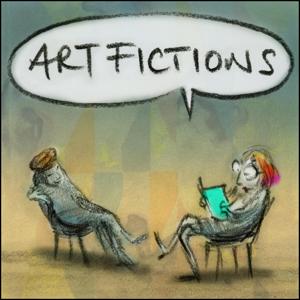
ART FICTIONS is a monthly, contemporary art meets literature programme, created by artist Jillian Knipe. Each guest artist selects a piece of fiction, which we both explore, then use as a lens…

90,967 Listeners

24,548 Listeners
206 Listeners
444 Listeners

497 Listeners
1,192 Listeners
1,795 Listeners
366 Listeners
142 Listeners

758 Listeners

3,000 Listeners
3 Listeners

4 Listeners
27 Listeners