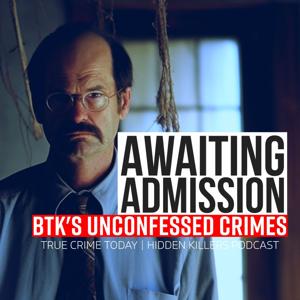
Awaiting Admission: BTK's Unconfessed Crimes | The Dennis Rader Story

Awaiting Admission: BTK's Unconfessed Crimes | The Dennis Rader Story

By True Crime TodayNewsTrue CrimeNews Commentary
Download on the App Store

Awaiting Admission: BTK's Unconfessed Crimes | The Dennis Rader Story episodes

  • Why Osage PD Was 'Playing' With BTK Evidence On TV
    In a recent episode of the podcast "Hidden Killers," host Tony Brueski was joined by former FBI Special Agent and regular contributor Jennifer Coffindaffer. Their discussion raised some provocative questions about the display of evidence on national television, specifically in the ongoing investigation of the notorious serial killer BTK (Bind, Torture, Kill).
    Brueski opened the conversation by discussing a rather controversial moment where evidence, specifically a pantyhose, was showcased on the Banfield show. “I’ve talked to like 10 FBI agents since this happened and everyone I’ve talked to has said they just utterly cringed when they saw him playing with the pantyhose on Banfield,” Brueski revealed. The aim, as he mentioned, was to garner national attention, hoping that it would spur the investigation forward.
     
    Jennifer Coffindaffer responded emphatically, calling out the action as a definitive no-no. "You don't do that to gain the attention," she said, shedding light on the ethical concerns surrounding such an act. She elaborated on how the media circus surrounding the case can often derail from its primary objective: truth and justice for the victims and their families.
     
    Coffindaffer shared her reservations about the manner in which certain cases are being investigated and discussed in the media. "When I say looked hard into it in terms of what the investigative authorities [are saying], KBI says that the woman in Hayes is absolutely not connected to BTK," she mentioned. Her emphasis was on the emotional toll these media speculations can take on families, who have to wrestle with the horrifying possibilities their loved ones might have faced.
     
    The conversation further delved into the formation of task forces to handle such high-profile cases. Coffindaffer, drawing from her extensive FBI background, shared her confusion regarding the inclusion of media personnel in these task forces. "I would never ever [consider] informing these task forces nor would my bosses... want the media involved," she explained. Her primary concern being that media professionals lack the authority and tools required for effective investigative work.
     
    The duo raised valid concerns about the implications such liberties in evidence handling and media involvement could have on the outcome of cases. As Brueski pointed out, mishandling investigations, especially outside of a jurisdiction, can jeopardize the case's standing in court. Coffindaffer shared this sentiment, stating, "from the media standpoint, there's absolutely no purpose, zero purpose."
     
    A poignant moment in the conversation emerged when Coffindaffer emphasized the personal nature of these investigations for law enforcement professionals. She painted a vivid picture of investigators who pour their heart and soul into their cases, seeking justice and truth, often setting aside the glamour of media limelight.
     
    In conclusion, the "Hidden Killers" podcast shed light on the complexities surrounding high-profile criminal investigations. While media attention can indeed propel investigations forward, there's a thin line between informative reporting and turning investigations into a spectacle. The core question that emerged was: In our quest for justice, are we sometimes blurring the boundaries of ethics and sensationalism?
    So, as one continues to ponder the discussions of the episode, the lingering question remains: Are our current investigative methods prioritizing spectacle over substance?
    Want to listen to ALL of our podcasts AD-FREE? Subscribe through APPLE PODCASTS, and try it for three days free: https://tinyurl.com/ycw626tj
    Follow Our Other Cases: https://www.truecrimetodaypod.com
    The latest on Catching the Long Island Serial Killer, Awaiting Admission: BTK’s Unconfessed Crimes, Chad & Lori Daybell, The Murder of Ana Walshe, Alex Murdaugh, Bryan Kohberger, Lucy Letby, Kouri Richins, Justice for Harmony Montgomery, The Murder of Stephen Smith, The Murder of Madeline Kingsbury, and much more! Listen at https://www.truecrimetodaypod.com

    9 min
  • What Does BTK's Reaction to DA's Statement Tell Us About His Guilt?
    Could the infamous BTK (Bind, Torture, Kill) killer, Dennis Rader, be back in the headlines with a potential new set of crimes? Or is this all just part of his macabre play for attention?
     
     Dennis Rader, known as the BTK serial killer, made headlines throughout the 1970s to the early 2000s for his heinous crimes. Convicted of ten counts of first-degree murder, Rader's modus operandi was to bind, torture, and kill his victims. But in a recent episode of the podcast "Hidden Killers," host Tony Brueski revealed a rather shocking exchange that took place between Rader and Eddie Virden, the sheriff of Osage.
     
     Brueski recalled, “I was talking to under Sheriff Gary Upton... Eddie Virden...was actually waiting to talk to BTK in prison in Kansas right as the press conference was being given by the district attorney.” The DA had announced there wasn't enough evidence currently to convict Rader of any new crimes. And Rader's chilling response to Virden? "So, looks like you don't have enough evidence for a case."
     
     Such a response might seem defiant, bordering on cocky. It signals the start of what seems to be a game – a dark and twisted game that Rader, apparently, might be keen to play. Bob Motta, Defense Attorney and host of the podcast Defense Diaries, weighed in on the matter. "I think that was exactly what it was. I think it's him... playing the game, which a lot of these guys do."
     
     Motta further hinted at the possibility that Rader's craving for attention might be driving this behavior. "I have to believe that he's reading all of his press clippings... I think that there's like an aspect of him that loves the fact that his case is front page news every day." But what happens when this desire for attention blurs the lines between truth and manipulation? Could Rader be taking credit for crimes he didn't commit or setting the authorities on false leads?
     
     Motta discussed the pattern seen with other high-profile criminals, specifically mentioning Israel Keyes. Keyes had numerous taped interviews with the federal authorities, and many believe he might have been misleading them, sending them on wild goose chases. Motta pointed out, "I just always personally...think he's [Rader] going to make it difficult on them, and I think that he's going to toy with them at every opportunity that he can."
     
     This behavior pattern isn't new. Serial killers, especially those with a penchant for playing games with law enforcement, often engage in such tactics. They thrive on the power dynamics, turning investigations into personal contests of wit and will.
     
     But as Motta succinctly summarized, "Now whether he did it or not, he wants to play the game and everybody is his pawn."
     
     This revelation provides a stark reminder of the complexities in dealing with individuals like Rader. Investigations aren't merely about gathering evidence but navigating the intricate psychological web spun by the perpetrator.
     
     As authorities continue to probe into potential new crimes linked to BTK, one can't help but wonder: Is this a genuine pursuit of justice, or is it merely a new chapter in Dennis Rader's twisted game?
    Want to listen to ALL of our podcasts AD-FREE? Subscribe through APPLE PODCASTS, and try it for three days free: https://tinyurl.com/ycw626tj
    Follow Our Other Cases: https://www.truecrimetodaypod.com
    The latest on Catching the Long Island Serial Killer, Awaiting Admission: BTK’s Unconfessed Crimes, Chad & Lori Daybell, The Murder of Ana Walshe, Alex Murdaugh, Bryan Kohberger, Lucy Letby, Kouri Richins, Justice for Harmony Montgomery, The Murder of Stephen Smith, The Murder of Madeline Kingsbury, and much more! Listen at https://www.truecrimetodaypod.com
    4 min
  • Is There Really A STRONG NEW Case Against BTK?
    Is notorious serial killer Dennis Rader, better known as BTK, responsible for even more unsolved disappearances? A deep dive into the concerns over evidence collection and the heart-wrenching quest for answers unveils the true complexity of such high-profile cases. The "Hidden Killers" podcast, featuring retired FBI Special Agent Robin Dreeke, provides a rare window into the professional and emotional challenges investigators face.
     
     In a recent episode of "Hidden Killers," a significant point of contention arose surrounding BTK's potential link to the 1976 disappearance of Cynthia Kinney. The District Attorney for Osage and Pawnee counties, Mike Fisher, voiced his reservations about implicating Dennis Rader in the case, due to the lack of substantial evidence to press charges. Meanwhile, Sheriff Eddie Virden of Osage County, having spearheaded a nationwide task force, seems convinced of Rader's involvement in not just Kinney's disappearance, but potentially other cold cases.
     
     The heart of the matter, as presented by hosts Tony Brueski and Robin Dreeke, revolves around two central issues. Firstly, there's the concern of procedural integrity. The manner in which evidence has been collected, especially as the Osage County Sheriff's Office apparently stepped outside their jurisdiction, raises serious questions. Are the obtained search warrants valid? Would the evidence be admissible in court, given the concerns about how it was collected?
     
     Robin Dreeke touched upon the nuances, emphasizing, "If it's been done that way, yeah, that's a concern." He further elaborated on the danger of investigators becoming overly emotionally invested in cases, potentially leading to oversights or missteps in the process. In a particularly poignant moment, Dreeke noted, "Emotionally being invested in this versus being professionally invested in this and doing things the right way... there's much bigger things that could go wrong here."
     
     In light of such concerns, the episode delved into the quintessential challenge of balancing the pursuit of justice with procedural propriety. While the pressing urgency to "right wrongs in society" is paramount, there are processes and rules designed to ensure that justice isn't just served, but served right.
     
     Further adding to the conundrum is the revelation that some leads, directly linked to BTK, have been gathering dust for years. The existence of "trophies" — a chilling term used by killers to refer to mementos from their victims — buried in Rader's backyard shed was noted in a 2008 letter. Yet, it took until 2023 for any action to be taken on this information.
     
     One could argue, why the delay? Dreeke offers a simple, albeit troubling, answer: resources. "There are not nearly enough people working these things to do it all," he states. The demands of prioritizing, often driven by public and media outcry, means some cases, or leads, are left by the wayside.
     
     Reflecting on his time with the FBI, Dreeke offers insight into the agonizing choices that law enforcement personnel must make daily, juggling a multitude of "urgent" tasks. They're in a perpetual race against time, forced to make heart-wrenching decisions about where to allocate their attention. While the public's cries for justice echo loudly, law enforcement is constrained by the practicalities of resource allocation and the ever-present, towering backlog of cases.
     
     It's a haunting reminder that behind every unresolved case, there's a team of individuals grappling with the knowledge that they couldn't do it all. As Dreeke poignantly remarked, referencing the film "The Guardian": "Sometimes you just can't do it all." The pursuit of justice is never black and white, and as the podcast episode reveals, even the most notorious cases aren't exempt from the shadows of uncertainty.
    Want to listen to ALL of our podcasts AD-FREE? Subscribe through APPLE PODCASTS, and try it for three days free: https://tinyurl.com/ycw626tj
    Follow Our Other Cases: https://www.truecrimetodaypod.com
    The latest on Catching the Long Island Serial Killer, Awaiting Admission: BTK’s Unconfessed Crimes, Chad & Lori Daybell, The Murder of Ana Walshe, Alex Murdaugh, Bryan Kohberger, Lucy Letby, Kouri Richins, Justice for Harmony Montgomery, The Murder of Stephen Smith, The Murder of Madeline Kingsbury, and much more! Listen at https://www.truecrimetodaypod.com
    11 min
  • Will There Ever Be Enough Evidence to Prosecute BTK Again?
    In a recent episode of the podcast "Hidden Killers," host Tony Brueski delved into the controversial investigation into the infamous BTK (Bind, Torture, Kill) serial killer, Dennis Rader, and his possible connection to four other unsolved homicides. Guest Neama Rahmani, an attorney and former Federal prosecutor, offered an insightful take on the complexities and implications surrounding the matter.
     
     "The Osage County Sheriff's Office seems to be making quite a spectacle of the investigation, don't they?" Brueski opened, highlighting the media frenzy surrounding the case and the somewhat dramatic methods the Sheriff's Office has employed.
     
     Rahmani was quick to point out a significant rift between law enforcement and the District Attorney. "Officers investigate, but they shouldn't be playing lawyer," he said, expressing concern over the sheriff's overreaching jurisdiction, the legitimacy of the search warrants, and the actual evidence in hand. Such discrepancies might just be giving defense lawyers the leverage they need to get a potential case dismissed.
     
     Brueski furthered the debate by questioning the intent behind reopening an investigation against a man already serving multiple life sentences. "What's the endgame here?" Rahmani mused. "Unless you're gunning for a death sentence, what do you gain from prosecuting Rader for one of these murders?" He painted a vivid picture of Rader reveling in the courtroom attention, given his history of seeking the limelight.
     
     The conversation turned to the type of evidence the Sheriff's Office might be relying on. Brueski described decades-old Polaroid pictures of Rader donning his victims' clothing. While such photos might look damning to the general public, Rahmani was skeptical about their legal weight. "Is a Polaroid from 40 years ago strong enough to convict someone of murder?" he questioned, emphasizing that the optics and the reality of a courtroom are often worlds apart.
     
     Yet, one of the most intriguing points Rahmani raised was about Rader's own confessions. The BTK killer has been nothing if not vocal about his crimes, often offering chilling details about his murders. "He's been given offers of immunity if he just comes clean," Rahmani shared. So, why the silence on these new allegations? "What is he hiding? What reason does he have not to admit to these other killings if he did them?" Rahmani posited.
     
     For victims' families, the reopening of cold cases linked to such a notorious figure offers a glimmer of hope. The promise of closure, justice, or perhaps just a definitive answer is invaluable. Yet, the intersection of media, law enforcement's ambitions, and a killer's penchant for drama muddies the waters. As Rahmani pointedly asked, "Unless it's a provable case beyond a reasonable doubt, why make a questionable case that adds nothing to Rader's sentence?"
     
     In the labyrinth of legal intricacies, public perception, and the haunting shadow of the BTK killer, the true path to justice remains elusive. Are we genuinely unearthing hidden truths, or are we merely giving a monster another moment in the spotlight?
     
     How do we differentiate between the pursuit of justice and the hunger for sensationalism?
    Want to listen to ALL of our podcasts AD-FREE? Subscribe through APPLE PODCASTS, and try it for three days free: https://tinyurl.com/ycw626tj
    Follow Our Other Cases: https://www.truecrimetodaypod.com
    The latest on Catching the Long Island Serial Killer, Awaiting Admission: BTK’s Unconfessed Crimes, Chad & Lori Daybell, The Murder of Ana Walshe, Alex Murdaugh, Bryan Kohberger, Lucy Letby, Kouri Richins, Justice for Harmony Montgomery, The Murder of Stephen Smith, The Murder of Madeline Kingsbury, and much more! Listen at https://www.truecrimetodaypod.com
    6 min
  • BTK Task Force Member Joni Johnston Talks Next Steps In Investigation
    In the recent episode of the podcast "Hidden Killers," Tony Brueski engaged in a chilling conversation with Clinical and forensic psychologist & licensed private investigator Joni Johnston about the notorious BTK (Bind, Torture, Kill) murderer, Dennis Rader. As more potential victims and connections to Rader emerge, the question that looms large is: how many secrets does the BTK killer still keep?
     
     The conversation unveiled Johnston's association with a nationwide task force formed to probe deeper into the BTK's unresolved crimes. She revealed, "We all signed nondisclosure agreements... our role is just to look at the evidence... to see if there is any connection between Dennis Rader and some of the crimes that... appear to be potentially connected to him."
     
     Gary Upton, a key informant, had previously pointed out that there might be four potential connections to Rader. The Cynthia Kinney case stands out among them, primarily because of the eerie drawings by Rader that mirror some aspects of the crime scene.
     
     "The challenging thing when you're talking about drawings... is we know that serial killers... will journal or they'll draw, you know, both fantasies that they have as well as potentially crimes they've committed," Johnston said, highlighting the unsettling intersection of fantasy and reality in Rader's drawings and photographs. These artifacts often act as a macabre catalog of a serial killer's conquests, but discerning fact from fiction is no straightforward task.
     
     Diving deeper into the psyche of Rader, Johnston reflected on the duality of his nature: the sadist in him that derived pleasure from torturing his victims, and the side that seemed to derive an equal amount of satisfaction by envisioning himself as the victim. She theorized, "This is somebody who is attempting to... relive the pleasure he experienced at the time by almost acting out his own kind of play or movie."
     
     But why, despite being offered immunity, has Rader not come forward to clarify these potential connections? With his physical health deteriorating but mental faculties still sharp, the motivations behind his silence remain an enigma. While Johnston believes that only Rader can answer that question definitively, Kerry Rawson, Rader’s daughter, has been invaluable in aiding the task force and law enforcement over the years, suggesting she might have some insight.
     
     Johnston further alluded to suspicions about Rader initiating his violent streak during his Navy tenure overseas, a period he hasn’t spoken about. She emphasized, "I don't think we can rule him out, but it does raise a question."
     
     Brueski then brought up an intriguing point about Rader’s current relationship with media attention. It appears Rader has found a renewed interest in the limelight, offering unsolicited insights into various cases. This behavior begs the question: is he genuinely trying to help, or is this another twisted game?
     
     A significant concern raised during the discussion was the role of potential media opportunism, specifically the risk of a reality TV show influencing the investigation. Responding to this, Johnston candidly expressed her hopes that the integrity of the task force remains uncompromised, emphasizing, "The check or the reality check is always going to be the evidence or lack thereof."
     
     The quest for the truth, bolstered by evidence from Wichita's untouched archives, remains the primary objective. Johnston concluded with a heartfelt sentiment, hoping for "directions of closure for some of these families."
     
     But as we reflect on the chilling details discussed in "Hidden Killers", another unsettling question arises: how many more "hidden killers" remain buried in the annals of crime, waiting to be uncovered?
    Want to listen to ALL of our podcasts AD-FREE? Subscribe through APPLE PODCASTS, and try it for three days free: https://tinyurl.com/ycw626tj
    Follow Our Other Cases: https://www.truecrimetodaypod.com
    The latest on Catching the Long Island Serial Killer, Awaiting Admission: BTK’s Unconfessed Crimes, Chad & Lori Daybell, The Murder of Ana Walshe, Alex Murdaugh, Bryan Kohberger, Lucy Letby, Kouri Richins, Justice for Harmony Montgomery, The Murder of Stephen Smith, The Murder of Madeline Kingsbury, and much more! Listen at https://www.truecrimetodaypod.com
    8 min
  • Will Possible BTK Victim's Families See Justice for Murder?
    In a revealing discussion on the podcast "Hidden Killers," Tony Brueski seeks insights from former felony prosecutor and attorney, Eric Faddis, about the murky waters surrounding decades-old cold cases, the BTK killer, and the intricacies of investigative processes. Their conversation casts a light on the somber realities facing the families who seek closure and the complexities entangled within the legal framework.
     
     The District Attorney's recent decision to hand over investigations to the Oklahoma State Bureau of Investigation (OSBI) regarding a case from 1976 has rekindled the public's interest. But as Faddis points out, "Sometimes those entities are not as adept in terms of investigating homicides. They do a lot of lab work, analysis, and ballistic stuff, but they don't always do on-the-ground investigation."
     
     Dennis Rader, infamously known as the BTK killer, has been a name associated with numerous chilling crimes. His association with the 1976 case brings forth the question: "Is there another victim? If in fact, he is the guy and he is behind bars or if it is someone else out there again, we're talking about 1976, does it really go high in the priority list of the OSBI to investigate this?" Brueski poses.
     
     Faddis offers a pragmatic perspective, suggesting that while this case carries national prominence, it is not certain if authorities will invest significant resources into it, especially when the main suspect, BTK, is already behind bars.
     
     The conversation takes an even darker turn when discussing the "trophies" that BTK mentioned in a 2008 letter he wrote from prison. Sheriff Eddie Bearden affirmed that the locations provided by BTK were being investigated to recover those "trophies". Brueski's poignant question resonates deeply: "2008 is when this letter was written... why didn't we look into some of these things sooner? Why now?"
     
     Faddis's response highlights an unsettling reality, "Hearing BTK refer to these things as trophies was just… I shudder when I hear that word. It's dehumanizing, callous, and horrible." The fact that these leads are only being pursued now raises significant concerns about lost time and potentially missed justice.
     
     As they delve deeper, both Brueski and Faddis touch on a heart-wrenching truth: the delay in investigations potentially robs already victimized families of any sense of closure or justice. "It's just heartbreaking to see that just the passage of time could have divested those victims and their families from the justice they so deserve," laments Faddis.
     
     In the end, while the podcast episode offers no straightforward solutions, it brings to the fore vital questions about the priorities of law enforcement agencies, the complexities of navigating old cases, and the unending pain endured by families that are still waiting for justice. Whether the OSBI will prioritize this case and bring answers remains to be seen, but the discussion serves as a somber reminder that justice delayed can often feel like justice denied.
    Want to listen to ALL of our podcasts AD-FREE? Subscribe through APPLE PODCASTS, and try it for three days free: https://tinyurl.com/ycw626tj
    Follow Our Other Cases: https://www.truecrimetodaypod.com
    The latest on Catching the Long Island Serial Killer, Awaiting Admission: BTK’s Unconfessed Crimes, Chad & Lori Daybell, The Murder of Ana Walshe, Alex Murdaugh, Bryan Kohberger, Lucy Letby, Kouri Richins, Justice for Harmony Montgomery, The Murder of Stephen Smith, The Murder of Madeline Kingsbury, and much more! Listen at https://www.truecrimetodaypod.com
    7 min
  • Is New BTK Investigation Giving False Hope to Victim Families?
    In a stunning revelation on the popular podcast "Hidden Killers," Tony Brueski revealed that the chilling figure of BTK - Dennis Rader - might have had more victims than previously known. Brueski's intense conversation with Bob Motta, Defense Attorney and host of the podcast Defense Diaries, left listeners grappling with a myriad of new details and insights into the ongoing investigation.
     
     "Dennis Rader, BTK being looked at again... Four cases is what he is saying that he believes could very likely be linked to Dennis Rader," Brueski stated. One such case is that of Cynthia Dawn Kinney, who went missing in 1976. The only piece of evidence linking her disappearance to Rader was an obscure reference about a "bad wash day" he made, alluding to his time installing ADT alarm systems across the street from where Kinney lived. "We do see some evidence that Rader was in the area at the time," says Brueski.
     
     However, what is striking about the renewed interest in these cases is not just the implication that there might be more victims, but the level of sophistication and tenacity that investigators are employing to unearth evidence. Motta highlighted how advances in DNA technology could be instrumental in these cases. "The advantages, the leaps and bounds that DNA technology has taken... the hope is going to be that they're going to be able to do direct comparisons."
     
     Furthermore, a national task force has been assembled to look into these cases, comprising many experts known to Brueski and Motta. Among them is Kerri Rawson, Dennis Rader's own daughter, who has been proactively aiding federal agencies with information. Motta spoke highly of Rawson's resilience: "She's an amazing person... the fact that she survived that trauma and is putting it all to very good use these days is admirable." There's an underlying sense of tragedy as Rawson, in her bid to help victims, faces societal backlash due to her lineage.
     
     One pivotal avenue the investigation is taking involves a series of photographs taken by Rader himself. These photos capture Rader wearing his victim's clothing. The aim? To determine if any of the clothing pieces could belong to victims he hasn't been charged for. "One of the bigger things that it seems they're taking a look at are those pictures," said Brueski. The challenge lies in the age of these photos – taken in the 1970s or 1980s – and how they can conclusively link them to potential victims.
     
     In response to Brueski's query on whether a mere photo would suffice as evidence, Motta asserted that while it could be powerful, it's not enough on its own. "If you can get a few pieces of extremely powerful circumstantial evidence, it'll probably be enough." Motta drew parallels with the case of John Wayne Gacy, where unique items and medical records were essential in identifying victims from skeletal remains.
     
     Both Brueski and Motta's conversation touched upon the overarching importance of building a solid case. But for many, the pressing question isn't just about convicting Rader again. It's about giving families, who've lost their loved ones under mysterious circumstances, a chance at closure.
     
     So, as the task force dives deep into old evidence and new technology in hopes of shedding light on these cold cases, we are left with an unsettling thought: What if there are still secrets hidden in the shadows of BTK's grisly past?
    Want to listen to ALL of our podcasts AD-FREE? Subscribe through APPLE PODCASTS, and try it for three days free: https://tinyurl.com/ycw626tj
    Follow Our Other Cases: https://www.truecrimetodaypod.com
    The latest on Catching the Long Island Serial Killer, Awaiting Admission: BTK’s Unconfessed Crimes, Chad & Lori Daybell, The Murder of Ana Walshe, Alex Murdaugh, Bryan Kohberger, Lucy Letby, Kouri Richins, Justice for Harmony Montgomery, The Murder of Stephen Smith, The Murder of Madeline Kingsbury, and much more! Listen at https://www.truecrimetodaypod.com
    8 min
  • Could Osage Sheriff's Over-Zealous Investigation Work Lead to Problems With Convicting BTK?
    It's a chilling question that hangs in the cold air of unresolved cases: could Dennis Rader, infamously known as the BTK (Bind, Torture, Kill) Killer, be responsible for more unsolved murders than previously known? This was the central topic of discussion on a recent episode of the podcast "Hidden Killers," hosted by Tony Brueski. The conversation included insightful input from former Felony Prosecutor and attorney, Eric Faddis, who shed light on the ongoing debate surrounding a cold case from 1976 – the tragic death of Cynthia Dawn Kinney.
     
     The family of Cynthia Dawn Kinney has been seeking closure for nearly half a century. Their beloved daughter's demise in 1976 has remained an unresolved mystery. However, recent interests have shifted towards Dennis Rader, the notorious BTK Killer, as the possible perpetrator. Brueski probes, “Nobody has ever been found though. But there is a lot of evidence from BTK's writings that he was in the area at the time.” He added that the writings of Rader align disturbingly well with the speculated events leading to Kinney's death.
     
     Yet, as Faddis was quick to point out, navigating through the intricacies of cold cases presents unique challenges. “Evidence erodes, witnesses are lost or die… and it becomes a lot harder to prove the case,” Faddis noted. Adding layers to this complex narrative is the apparent discord between the Sheriff's office of Osage County and the District Attorney. The sheriff's office staunchly believes that BTK is the prime suspect in this case. In stark contrast, the DA's office cautions restraint, asserting that there isn't sufficient evidence to substantiate such claims.
     
     Such a divisive stance, Faddis argues, is detrimental, especially when pursuing a serial killer in the context of a cold case murder. “We need a unified front in law enforcement… and we don't have that right now,” he stated.
     
     Addressing concerns surrounding Sheriff Eddie Virden's approach to the investigation, Faddis emphasized the need for a delicate balance between passion and professionalism. He hinted at concerns within the legal community about how evidence was gathered by the Osage County Sheriff, especially when operating beyond their jurisdiction. The validity of the search warrants obtained, and the authority of the Osage County Sheriff's office in collecting evidence from outside their domain, have also come under scrutiny.
     
     Faddis went on to describe the potential pitfalls of overzealous law enforcement: “Oftentimes, these small mistakes can be a linchpin for these cases to be dismissed once they get into the court system.” Such oversight, he suggests, could be at the heart of the DA's reluctance to name BTK as the prime suspect in the Kinney case. The necessity of a meticulous review of the evidence collection process, ensuring its adherence to constitutional norms, becomes paramount.
     
     This sentiment resonated with Brueski's take on the situation, emphasizing the need for both departments to remain on the same page. “Both can have the same goal, but... both can destroy each other as well if they don't play by the rules,” Brueski warned.
     
     While the possibility of Dennis Rader being connected to another tragic death sends shivers down the spine, the pursuit of justice, it seems, is fraught with challenges. The debate shines a light on the often-conflicting motivations of different branches of law enforcement, and the intricate dance of passion, protocol, and the pursuit of justice.
     
     It remains to be seen if the BTK Killer will be definitively linked to Cynthia Dawn Kinney's murder. However, the call for a united front in law enforcement, underpinned by meticulous evidence gathering and careful deliberation, is louder than ever.
    Want to listen to ALL of our podcasts AD-FREE? Subscribe through APPLE PODCASTS, and try it for three days free: https://tinyurl.com/ycw626tj
    Follow Our Other Cases: https://www.truecrimetodaypod.com
    The latest on Catching the Long Island Serial Killer, Awaiting Admission: BTK’s Unconfessed Crimes, Chad & Lori Daybell, The Murder of Ana Walshe, Alex Murdaugh, Bryan Kohberger, Lucy Letby, Kouri Richins, Justice for Harmony Montgomery, The Murder of Stephen Smith, The Murder of Madeline Kingsbury, and much more! Listen at https://www.truecrimetodaypod.com
    5 min
  • Is Publicity Helping or Hurting the New BTK Investigation?
    Has the hunt for a notorious serial killer's additional victims become a media spectacle, sacrificing the emotional well-being of affected families in the process? That's the question weighing heavily on many following the latest revelations regarding the BTK killer, Dennis Rader, in a recent episode of the podcast "Hidden Killers."
     
     Dennis Rader, infamously known as the BTK (Bind, Torture, Kill) murderer, is back in the spotlight after journal entries alluded to possible other victims. Among the speculated victims is Cynthia Dawn Kinney, who disappeared in 1976, leaving her aging family desperate for answers.
     
     Tony Brueski, the podcast host, discussed the fervor around potential new evidence with psychotherapist and author Shavaun Scott. The two delved into whether the excitement in potentially linking more victims to Rader is based on genuine evidence or merely sensationalism fueled by a public hungry for resolution.
     
     Brueski highlights the peculiar enthusiasm surrounding the possibility of Rader having more victims: "Maybe there'll be some closure here. That's been the speculation with some of the journal entries that he's had," but quickly juxtaposes this with the poignant reality, saying "at the end of the day, that's who matters more than everybody getting excited because maybe BTK killed more people, which is a weird thing to get excited about."
     
     Scott emphasized that while passionate investigators often make the most significant breakthroughs, the situation with Rader appears different. "Nobody [has] real evidence other than speculation and these horrendous drawings and the things that Dennis Rader has written," she noted. The trauma it causes to the victim's families, especially those like Kinney's, can be immense, with Scott pointing out that sometimes the lack of evidence means that a resolution is never achieved.
     
     Adding another layer of complexity to the story, Brueski shared an exclusive insight into Rader's reaction to recent developments. Following a statement from the District Attorney about the lack of evidence to prosecute Rader, the killer reportedly responded with a cocky retort, hinting at the possibility of him playing a game with authorities and the public.
     
     Scott wasn't surprised by Rader's reaction, noting, "the man loves playing games." Interviews with his daughter suggest she believes he's continually toying with investigators and the media, leading to increased frustration and anguish for families of potential victims.
     
     The overarching concern voiced by Brueski and Scott is the media's potential role in sensationalizing the situation, furthering the emotional torment of families like Kinney's. The pursuit for truth is essential, but there must be a balance between unearthing the truth and not giving perpetrators like Rader more platforms to manipulate and play games.
     
     Brueski summarized the predicament aptly: "I applaud [Osage County Police Department] for somebody digging if they think they found something but at the same point, it also seems like, you better be damn sure that you are looking at something legit and this is not just to get some headlines."
     
     As investigations continue and media interest remains unabated, one has to ponder: How can we balance the relentless quest for truth with the much-needed sensitivity towards families who have been through decades of torment?
     
     In the ongoing saga of the BTK's potential additional victims, the answer remains elusive. One thing is certain: in the quest for truth, the emotional well-being of victims' families must never be compromised.
     
     How many more families must endure this torment before a definitive answer is reached?
    Want to listen to ALL of our podcasts AD-FREE? Subscribe through APPLE PODCASTS, and try it for three days free: https://tinyurl.com/ycw626tj
    Follow Our Other Cases: https://www.truecrimetodaypod.com
    The latest on Catching the Long Island Serial Killer, Awaiting Admission: BTK’s Unconfessed Crimes, Chad & Lori Daybell, The Murder of Ana Walshe, Alex Murdaugh, Bryan Kohberger, Lucy Letby, Kouri Richins, Justice for Harmony Montgomery, The Murder of Stephen Smith, The Murder of Madeline Kingsbury, and much more! Listen at https://www.truecrimetodaypod.com
    8 min
  • WEEK IN REVIEW-What Breadcrumbs Exist In Former BTK Testimony That Could Lead To Answers?
    Welcome to the "Week In Review," where we delve into the true stories behind this week's headlines. Your host, Tony Brueski, joins hands with a rotating roster of guests, sharing their insights and analysis on a collection of intriguing, perplexing, and often chilling stories that made the news.
        
     This is not your average news recap. With the sharp investigative lens of Tony and his guests, the show uncovers layers beneath the headlines, offering a comprehensive perspective that traditional news can often miss. From high-profile criminal trials to in-depth examinations of ongoing investigations, this podcast takes listeners on a fascinating journey through the world of true crime and current events.
        
     Each episode navigates through multiple stories, illuminating their details with factual reporting, expert commentary, and engaging conversation. Tony and his guests discuss each case's nuances, complexities, and human elements, delivering a multi-dimensional understanding to their audience.

     Whether you are a dedicated follower of true crime or an everyday listener interested in the stories shaping our world, the "Week In Review" brings you the perfect balance of intrigue, information, and intelligent conversation. Expect thoughtful analysis, informed opinions, and thought-provoking discussions beyond the 24-hour news cycle.
    Want to listen to ALL of our podcasts AD-FREE? Subscribe through APPLE PODCASTS, and try it for three days free: https://tinyurl.com/ycw626tj
    Follow Our Other Cases: https://www.truecrimetodaypod.com
    The latest on Catching the Long Island Serial Killer, Awaiting Admission: BTK’s Unconfessed Crimes, Chad & Lori Daybell, The Murder of Ana Walshe, Alex Murdaugh, Bryan Kohberger, Lucy Letby, Kouri Richins, Justice for Harmony Montgomery, The Murder of Stephen Smith, The Murder of Madeline Kingsbury, and much more! Listen at https://www.truecrimetodaypod.com

    7 min

About Awaiting Admission: BTK's Unconfessed Crimes | The Dennis Rader Story

From the publisher's feed

In the annals of crime, few names evoke the same chilling shiver as that of the BTK Killer, Dennis Rader. Known for his sadistic modus operandi to "bind, torture, and kill," Dennis Rader was a shadowy figure of terror in Wichita, Kansas. Yet, even after his capture in 2005 and his subsequent confession to ten heinous crimes, many questions remained unanswered. "Awaiting Admission: BTK's Unconfessed Crimes" dives deep into this intricate web of uncertainty, shining a light on the shadows that still linger.

More shows like Awaiting Admission: BTK's Unconfessed Crimes | The Dennis Rader Story

Killer Stories with Harvey Guillén by Spotify Studios

Killer Stories with Harvey Guillén

29,101 Listeners

True Crime Today | Daily True Crime News & Interviews by Real Story Media

True Crime Today | Daily True Crime News & Interviews

611 Listeners

BTK by Maleigha Shelton

BTK

6 Listeners

Hidden Killers Live! Daily True Crime News & Breakdowns by Hidden Killers Podcast

Hidden Killers Live! Daily True Crime News & Breakdowns

94 Listeners

Hidden Killers With Tony Brueski | True Crime News & Commentary by True Crime Today

Hidden Killers With Tony Brueski | True Crime News & Commentary

904 Listeners

The Murder Of Stephen Smith by True Crime Today

The Murder Of Stephen Smith

23 Listeners

The Gilgo Beach Murders: The Case Against Rex Heuermann by True Crime Today

The Gilgo Beach Murders: The Case Against Rex Heuermann

93 Listeners

Nightmare In Wisconsin: Taylor Shabusiness Trial by True Crime Today

Nightmare In Wisconsin: Taylor Shabusiness Trial

11 Listeners

Malevolent Mormon Mommys | The Case Against Ruby Franke & Jodi Hildebrandt by True Crime Today

Malevolent Mormon Mommys | The Case Against Ruby Franke & Jodi Hildebrandt

62 Listeners

The Downfall Of Diddy | The Case Against Sean 'Puffy P Diddy' Combs by The Downfall Of Diddy

The Downfall Of Diddy | The Case Against Sean 'Puffy P Diddy' Combs

225 Listeners

The Trial Of Karen Read | Justice For John O'Keefe by True Crime Today

The Trial Of Karen Read | Justice For John O'Keefe

608 Listeners

Mind Behind The Crime | The Psychology Of Killers by True Crime Today

Mind Behind The Crime | The Psychology Of Killers

7 Listeners

Pure Evil: The Sentencing Of Aiden Fucci by True Crime Today

Pure Evil: The Sentencing Of Aiden Fucci

8 Listeners

The Murder Of Maddie Soto by Hidden Killers Podcast

The Murder Of Maddie Soto

17 Listeners

The Suitcase Murder | The Trial Of Sarah Boone by Hidden Killers Podcast

The Suitcase Murder | The Trial Of Sarah Boone

5 Listeners

Justice For Harmony | The Trial Of Adam Montgomery by Hidden Killers Podcast

Justice For Harmony | The Trial Of Adam Montgomery

12 Listeners

The Mysterious Murder Of Dr. John Forsyth by Hidden Killers Podcast

The Mysterious Murder Of Dr. John Forsyth

6 Listeners

The Murder Of Sandra Birchmore by Hidden Killers Podcast

The Murder Of Sandra Birchmore

11 Listeners

Who Killed 2Pac? | The Murder of Tupac Shakur by True Crime Today

Who Killed 2Pac? | The Murder of Tupac Shakur

7 Listeners

BTK - SERIAL KILLER by Inception Point AI

BTK - SERIAL KILLER

4 Listeners

The Trial Of Barry Morphew by Hidden Killers Podcast

The Trial Of Barry Morphew

5 Listeners