
Sign up to save your podcasts
Or

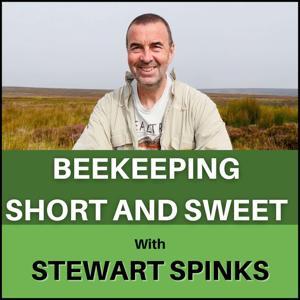


Based on Podcast App listening data
Hi, I’m Stewart Spinks and welcome to Episode 84 of my podcast, Beekeeping Short and Sweet, This week I have a question for you, how big is your brood box? Having just taken ownership of my first 14 by 12 hives I thought I would take a look at how this brood box compares to the other hives I have, so stay tuned for some interesting results.
Catch up with my latest podcasts here
First up this week a little moaning whinge, I’m still suffering from a bad back and it’s really frustrating me, I managed to get the 14 by 12 hives moved finally but the journey and humping the hives around has caused my back problem to flare up again so I’m stuck resting up when I’d really like to be out changing floors still.
Ok, that’s my moaning over with, it’s no good moaning about it for long, it is what it is and I just have to work around it. Looking back at my week there are some really positive highlights, for one, I managed to get the 14 by 12 hives moved as I mentioned and the apiary looks fantastic now the hives are on the stands. I do need to get over and inspect them as I wasn’t able to last week because of the back issue and that has been a major issue for the last seven days. Elsewhere I did get into the BS Honey nuc and check out the two, three frame nucs and as I suspected, the mini colony that looked a little out of sorts were completely broodless and there were no signs of the queen, no eggs and I certainly didn’t spot the queen. As time was getting little short, and to be honest as I was getting a little frustrated, I decided to remove the core divider and let the two, three frame colonies unite themselves. I’ve done this on a number of times now and despite beekeepers telling me that they will fight, they always seem to sort themselves out and settle down, maybe it’s because they are being united laterally rather than vertically, who knows. All I know is, one side was queen right and the other queenless so hopefully they’ve got themselves sorted now.
The collection of the 14 by 12 hives went well, I travelled over to collect them from a beekeeper near Peterborough so it’s about a four-hour return journey for me and of course there are the obligatory conversations about beekeeping to be had that it delayed me a little too. In the end I didn’t leave for home until nearly 9pm and had to make a quick stop for some fuel so didn’t get tot he apiary until around 11:30pm but it was a pleasant moonlit night and quite mild still. The bees travelled back just with their open mesh floors, no travel screens this time as although it was a mild night, travelling at speed in the open back of the truck meant they were quite cool enough, no overheating and no need to spray with water to help them keep cool.
If you’ve seen the Patreon videos you’ll be well familiar with the apiary site by now, in amongst the fishing lakes nicely secluded and completely protected by locked gates. The beauty of having completed the work to open up the apiary meant that I could literally drive the truck right up to the hive stand and simply lift the hive off the back of the truck and down onto the stand, no walking through brambles and nettles as it would have been previously.
If you’re moving hives to new sites it’s important to give them a little time to orientate themselves to their new location before disturbing them with inspections and the like. My intention was to give them forty-eight hours and then go back to inspect them but as I say, the back pain has just got worse and I was in no fit state to get into the hives.
I’ll hopefully get back to them this weekend and inspect them, they’re also going to need feeding and although it’s getting late I do have some heavy sugar syrup to feed them and the forecast does look ok for the next couple of weeks. By that, I mean overnight temperatures are going to hold up in low double figures so the bees won’t yet be forming cluster
Support the show
Hi, I’m Stewart Spinks and welcome to Episode 83 of my podcast, Beekeeping Short and Sweet, and this week I’m returning to the topic of Sugar Syrup and the various types available out there if you choose not to make your own and I’ve also been continuing the apiary clean up at the fishing lakes.
The distractions continue and caused quite a disruption to my planned workload over the weekend. Late last Wednesday I finished tweaking the podcast, yes, I do in fact attempt to polish it by editing and adjusting it, anyway, I scheduled the podcast for release to my Patreon page for Friday and then jumped in the truck to head out to move a couple of beehives from the fishing lakes apiary so I could continue cleaning out the brambles, and again the truck let me down, this time as I turned the key to start up all I got in return was a very loud, fast clicking sounds like those clacking toys I remember from way back, you know the ones, two plastic balls dangling from a handle each attached to a piece of cord. The idea being you shake them violently and they hit each other bouncing back and forth making a kind of castanet type noise only most of the time they would smash you on the back of the hand, anyway, that’s the noise I was hearing from my engine. A little research initially had me thinking it was going to be an expensive starter motor replacement but eventually it turned out to be an almost flat battery. The only problem was that the research had taken a while and after a couple of days of tinkering and cursing I finally gave up and called in my brother who fairly quickly got to the issue. I don’t know why the battery had failed, it’s never happened before but it seemed I needed a new battery. I popped down to our local battery specialist store, a place called Multicell, I’d called earlier in the day to make sure they had the right battery in stock and when I visited spoke to the same guy that I’d chatted to on the phone. He offered to test the battery for me rather than simply swap it out as a new battery was going to cost over a hundred pounds.
He used a really neat, handheld computer gadget which tested the voltage and capacity of the battery and discovered that all I needed to do was give the battery a good charge and he said it would be fine. It’s always nice to find a company that isn’t just out to sell you kit that you don’t necessarily need, I’ve used Multicell before, they supplied me with the battery for my ProVap Oxalic Acid sublimator and were really helpful with that as well.
Back home, I used the same battery charger I use on the ProVap cell and left it overnight to charge and all now appears to be sorted. It does leave me feeling slightly nervous each time I get in the truck to start it but so far, touch wood, it’s been fine. I think I might get a cheaper version of the tester that he used so I can keep an eye on the capacity of the battery every week or two, just until I feel confident with it again.
All of this meant the recording schedule went out of the window too, and my aim of swapping out all of the floors in the apiaries is a long way off. The very good news is that Tony, the fisheries manager at the lakes apiary has very kindly taken his brush cutting tractor through the Number one apiary and finished in forty minutes what would have taken me at least a day to do. I’ll probably have posted some pictures on my Patreon page by the time the podcast is released so do take a look there at what has been happening.
Unfortunately, my back problem has reappeared, some of you will know I suffered two prolapsed discs a few years ago, I’m 6’3” tall and have always struggled with backaches but the prolapsed discs were another level up. It’s meant that every year or so I seem to have a couple of weeks of stiffness and pain which once rested seems fine again and the Doctor said, once you have a weakened back it’s likely to always be vulnerable. That said I have been to pilates classes
Support the show
Hi, I’m Stewart Spinks and welcome to Episode 82 of my podcast, Beekeeping Short and Sweet. Following on from last week, today, I’m talking about Autumn preparations and looking at the sugar syrup I used to feed my bees through the Autumn to help the bees get through to next Spring.
Catch up with the very latest podcasts here
My Cycle Ride Challenge can be found here
It’s been another busy week here in Norfolk and I’m spending a bit more time at the workshop sorting out replacement floors for my colonies prior to them settling down for Winter. It’s not so much the floors that need sorting, rather, the varroa inserts. I wonder how many of you out there are like me in that you have a range of kit, none of which is standard and so specific bits of equipment are not interchangeable. The main point of my focus this week has been setting up floors in preparation for December Oxalic Acid treatments. In order to carry out the treatment, I need to insert the varroa boards beneath my open mesh floors. You would think this to be a simple task, grab a board and slide it home, but no, over the years I’ve acquired equipment, bought at sales, been given some stuff too and of course, none of the manufacturers makes to the exact same spec. So specifically looking at floors I have inserts that will fit, for example, an economy Thorne’s floor but that board is too small for a Maisemore open mesh floor and the board that fits the Maisemore open mesh floor is way too big for the floors I was given recently by a beekeeper who was retiring. Now last year, Pete and I walked around the apiaries and measured the floors in use and cut new varroa inserts for them all. We’ve used 5mm ply which worked great. Some of the floors I have came with plastic core inserts and over the years these have simply degraded and crumbled so we needed to replace some inserts anyway. All of the floor inserts were numbered and I managed to get some plastic numbers to staple onto the floors, only, we didn’t get round to stapling the numbers to the floors, I know, I only have myself to blame, well, actually I have Pete and Steph to blame but I take full responsibility and promise to do better this year. Add to that, we carried out the usual Spring cleaning and replaced most of the floors and the situation has become quite confused, and that’s the polite description of the muddle I find myself in. It’s obviously time to take action, it’s no good waiting until December when we want to treat with the ProVap Oxalic Acid Sublimator and end up with a truckload of plywood inserts and waste time offering up each size to the rear of the floors to see which one might fit, that’s not really how I want to spend my December days at all!
So, this week I’ve been getting organised, We’re going to visit each apiary site in turn and swap out each floor with a newly scraped, scorched, painted and numbered floor. Each one has been assigned a ply insert which has been numbered accordingly. It’s so simply you’ll be wondering why I didn’t do it last year, well that was indeed my intention but I do tend to get a little distracted as you may be aware.
Talking of distractions, I’m taking part in a challenge to cycle 300 miles during the month of September along with lots of other people in aid of Cancer Research UK, 300 miles might not seem a long way but when you’ve been away from cycling as long as I have it’s a good little challenge to have. I’ve not advertised the fundraising aspect as I wanted it as a personal challenge really but I will be making a personal donation to Cancer Research UK to thank them for their encouragement and the obvious good work that th
Support the show
Hi, I’m Stewart Spinks and welcome to Episode 81 of my podcast, Beekeeping Short and Sweet. This week I’m looking at feeders for getting those all important stores into our colonies in time for the coming Autumn and Winter.
Catch up with more of my beekeeping journey by checking out the continually growing content list on my Patreon page www.patreon.com/norfolkhoney
Welcome back everyone to another podcast and a special hello to everyone studying at Penn State University over in the USA, particularly, hello to my daughter Beth who’s studying at Penn State and who I’ve not seen since last Christmas although with Skype and FaceTime it sometimes feels like she never went away. Hi Beth, stay tuned cos I know you’re desperate to hear how I’m going to be feeding my bees this Autumn!
Before I get into the detail of the feeders here’s this weeks beekeeping update, a quieter week last week, colonies appear to have realised Summer is over and are settling down in preparation for the months ahead, not a single queen cell to be seen in any colony inspected and all of them appear to be queen right at long last. I did spend a hot sunny morning with Pete cutting away brambles from a neglected tractor at the Alpaca apiary. The tractor sits at the entrance to the apiary but for various reasons it hasn’t been used for a few years and Pete has had his eye on it for a while so I suggested to the owners they might like to move it on and that’s why Pete and I spent an hour cutting away brambles and nettles to reveal the tractor in all it’s glory. I have to say, I wouldn’t mind have a run around in it myself to cut down some of the nettles and thistles that have grown so high this summer, some of the thistles are six feet tall! I think they’ve done so well because the apiary also happens to be beside the alpaca poo pile, plenty of fertiliser feeding into the ground so everything is looking very lush.
Anyway, the plan is to get the tractor working again, it currently has a dead battery, and to then get the nettles, thistles and brambles around the apiary all chopped down before Pete makes off with the tractor, then at least I might be able to get a mower in and keep on top of it. The apiary also happens to be the last remaining orchard area of the old farm that once stood here and it’s full of pear trees, I’m hoping that if I can clear a few more trees we might get a crop of nice pears for next year. Maybe I’ll be allowed to have a drive of the tractor too, if that happens I’ll be sure to get the camera running as it’s likely to end badly, probably knocking hives and feeders full of syrup off stands!
With that thought in mind I should turn my attention to the main topic of today’s podcast that of feeders and feed for the bees in the Autumn. I guess firstly it would be useful to discuss why we feed at all during the Autumn months and it is fundamentally as a result of removing a honey crop from our bees. For me, it provides an income, albeit relatively small compared with many commercial bee farmers, and as such is an important part of my beekeeping practices. I know there are many hobbyist beekeepers who leave a super full of honey on their bees to overwinter and that’s fine, if you are one of those beekeepers then a lot of what I’m discussing simply won’t be relevant as you already have food stores set up on your hives. For other beekeepers who do want to take a honey crop from their bees for personal use or for friends and family it will probably mean reducing the amount of available food stores for your bees to what remains in the brood box unless of course you have had a good year and want to remove maybe just one or two supers and leave one behind for the bees. As with many tasks and processes in beekeeping there are many ways of doing things and provided you’re not reducing the bees to a level where they may starve out I don’t think any one method should be thou
Support the show
Hi, I’m Stewart Spinks and welcome to Episode 79 of my podcast, Beekeeping Short and Sweet. I’ve got lots happening this week, wasps robbing, starving bees, an emergency location system and it’s pizza night at the beekeeping group.
I recently posted a 60-second video to my Patreon page showing some wasps raiding a very weak colony, so weak in fact that the bees could do nothing to prevent the robbing. The colony was in fact a drone laying queen colony and was one I had decided to unite but the wasps got in first and fast! Within a week of checking them, they were all but dead and the wasps were on every frame stripping it bare.
The question then comes of what to do with the hive, I think I’ve mentioned before about leaving it, as removing it runs the risk of just having thousands of wasps suddenly finding themselves without a location to rob and moving on to the next unsuspecting colony, so that’s what I’ve done. I had the same situation at another apiary, the wasps do seem to have enjoyed a very good year this year, I suspect it was the very early start that we all benefitted from. Anyway, at this other location, I decided to shut the entrance and was going to remove the hive but at that time was suffering from a rather sore back so left it in place. When I returned a week later, I found that the wasps were able to squeeze through the varroa mesh floor and get inside. They were amazingly small wasps but even so, I was surprised that they were able to get in. I had decided to remove this colony from the apiary instead of leaving it because all of the other colonies were very strong and I don’t think the wasps would have had any chance of getting in at all. And this is a good point to dwell on and mention, particularly for beginner beekeepers, there are lots of books out there giving advice and even more so-called expert beekeepers giving even more advice and sometimes it can be difficult to see the wood from the trees, but no two situations will be exactly the same, or at least very rarely the same, and making a decision as to what to do can seem quite confusing. The advice I would give is to do nothing, well, at least to start with. If you’re unsure as to what you should do just pause and grab a drink, have a sit down and think about what you’re actually seeing, take on board all the words of wisdom you’ve read and advice you’ve been given and set it against what you actually have in your apiary and then make a choice about the course of action you what to take and the reasons why you’re doing what your doing.
You won’t always get it right but at least you will have had a good think about it and arrived at a reasoned decision. If it doesn’t go to plan, add it to the growing list of things you’ve tried, save the experience for the next time you’re confronted with a similar situation and give something else a go.
Still, on the subject of wasps, I’ve decided I’m not going to use any wasp traps anymore, of any sort, in fact, I don’t think I’ll use any traps of any sort, I’m thinking here of Asian Hornet traps as well.
I did put out a couple of wasp traps this year but they seem to gather in a wide range of insects other than the targeted wasps, it appears I’m killing a whole range of insects that really don’t deserve to be killed and as I’ve mentioned before, strong colonies don’t suffer from wasp problems. The reason for not using hornet traps is the same, and I’m not able to visit my apiaries on a daily basis to check them so it makes the exercise pointless really. I think I have more chance of spotting an Asian hornet hawking in front of the hives than catching one in a trap. It’s just my decision but I would say that most beekeepers would probably do better concentrating on making their colonies stronger than setting out traps to catch the Autumn wasp population along with a myriad of other innocent bystanders!
All the colonies that needed treatments now have the Apivar strips in them, I
Support the show
This week I’m in the honey room preparing cut comb and chunk honey, cleaning up after extraction week and I’ve also been in the kitchen cooking up a fabulous Honey, Taleggio Cheese and Red Onion Tart so keep listening for the recipe.
I’ve definitely seen a change in the activity within our colonies this last week, the local forage has all but disappeared and quite a number of our bees are now heading into urban gardens to seek out the strange and the unusual for those last few drops of nectar and tiny bundles of pollen.
One of the most unusual plants I’ve seen honeybees foraging on here locally is a giant spike of a flower which must measure at least three metres tall and is the thickness of a telegraph pole. It turned out to be a tree Echium, it was huge, if you get a chance to take a look online then do, it was enormous. It was actually at a local garden centre which specialises in exotic plants and while many of our native plants such as bramble are all but finished a lot of these plants seemed to be in full flower still. A real blessing for many different pollinators.
I’d like to plant one of these giant Echium’s but I don’t think my garden or wallet will take the strain, maybe I’ll stick with native varieties, Vipers Bugloss being the most well known I suspect.
It’s meant the bees are currently chasing around finding tiny amounts of forage and waiting for the Ivy to flower, I’ve actually seen some Ivy at the allotments apiary almost in flower, certainly, the buds are very swollen and ready, it won’t be long I’m sure. This presents a challenge to the bees and beekeeper where it is in large quantities. It’s a much needed Autumn, nectar and pollen source for the bees and they do really well on it until the temperatures cool down and at that point, the Ivy honey granulates solid in the comb making it quite difficult for some colonies to utilise effectively. In some colonies, it can form a solid block preventing bees from move over or around it to get to liquid honey. And this is where beekeepers who heft and don’t notice the hive hasn’t really become lighter through the winter find the bees had a full brood box of solid Ivy honey but starved.
Not all colonies struggle with Ivy and some seem to not only work it well but thrive on it through the colder months. It can also provide a late Autumn surplus for the beekeeper to harvest, I know a lot of beekeepers dislike the taste but actually, I find it a really nice flavour, strong tasting with a slightly medicinal finish, that sounds like a wine tasting! One trick you can use to reduce the strong flavour is to either blend it with other honey or leave it in the bucket for a few months when the strong taste seems to mellow somewhat. Either way, I really like it.
Back to this week though and some of my colonies have become quite grumpy, in fact, horribly grumpy, so much so I would class a couple of them as “double glovers”, it’s an expression that refers to the need to put on two pairs of nitrile gloves instead of the usual single pair. I made the mistake of picking up some supers for extraction without putting my boots on and cracking the supers off the clearer boards really wound them up and you just know they’re going to find the one vulnerable place you’ve left exposed! After several minutes of collecting supers with bees stinging my ankles I looked like I was walking barefoot across sun-baked sand, hopping and cursing as I went, funny now, but at the time, not so amusing!
The colonies will calm down again quite quickly, it’s that sudden loss of forage and this immediately followed by the beekeeper removing surplus honey that seems to get them a little feisty. We have the remaining treatments to put on this week, as I mentioned in previous podcasts we’re using Apivar and this needs to go in the hives after the honey has been removed hence the slight delay in some apiaries as we remove supers for extraction.
As we sorted through
Support the show
Hi, I’m Stewart Spinks and welcome to Episode 77 of my podcast, Beekeeping Short and Sweet.
Who’d have thought we’d be extracting honey so soon, the Summer season has flown by and I’m heading into the honey room to get set up to extract the Summer supers over the weekend? Listen on for a rundown of my extraction set up and how I extract from over sixty colonies in a room that measures just 3 metres square.
Check Out my Patreon Page HERE
Equipment discussed in today's Podcast:
Stainless Steel Tables
Scales
Apimelter
Brush Uncapper
Extractor
Double Strainer
100kg Settling Tank
Honey Creamer
Bottling Machine
Before we head into the honey room I wanted to say a big thank you to Craig from Jedburgh, one of our Patreon supporters who very kindly drove down to Norfolk this week to spend a few days helping out and inspecting bees. Craig is new to beekeeping and has been absorbing all or my videos and podcasts on Patreon and offered to lend a hand for a few days so not wanting to turn away any help I swapped around the workload a little so we could get over to the workshop and clean up the rather large stack of frames and boxes that needed cleaning instead of extracting honey.
A lot of the boxes are left over from the early season oilseed rape extraction where we had to cut out the comb and honey as it had granulated in the frames and couldn’t be extracted in the normal way. This leaves lots of frames that need to be roughly scrapped and tied into bundles before being boiled and cleaned ready to take fresh foundation in the Spring next year before going back out onto the hives. We also scrape out the supers and scorch them lightly as part of our ongoing disease management and this also entails removing frame runners and either washing them before replacing or if they’re too badly damaged we replace them. I think I might have mentioned before that I’m switching my super frames over to Manley frames, these are the straight, wide sided frames instead of the more traditional SN1’s or SN4’s, SN1’s are the narrow straight sided frames for supers and SN4’s are the Hoffman style spacing. It’s interesting that there are so many different types of frames that you could use and each beekeeper no doubt has a favourite. The same applies to the frame runners in the supers, I’ve always used castellated runners with set spacing for ten frames although I have tried eleven and nine frame runners. The point here is you start of using frames with foundation that have eleven frames meaning the frames are placed closer together and hopefully the bees draw out the foundation perfectly straight before progressing to ten frame runners and finally nine frame runners thereby getting more honey per frame which ultimately means less frames to extract.
The trouble with this is if you have more than a few supers it can get a bit confusing when you think you’ve got ten frame spacing and it’s eleven or nine. Add to that the need to get everything organised and in it’s prope
Support the show
Hi, I’m Stewart Spinks and welcome to Episode 76 of my podcast, Beekeeping Short and Sweet. August has arrived and it’s time to start thinking about jobs that need to be completed in order to prepare the colonies for the colder months ahead.
Another week and it’s been a period of changeable weather, a few more thundery showers mixed in with some bright, warm Summery days, fairly typical for the time of year really. We seem to have moved on from the heatwave and I don’t think we’ll see temperatures of that order again this Summer, never say never of course but the next few weeks look like being “Unsettled” as the weather presenters on tv would say.
The ongoing saga of the newly mated queen that was attacked and recovered to mate and start laying eggs continues. I inspected the nuc a few days ago and found the queen had settled down and was laying, but not as rapidly as I would have hoped and there were a couple of frames that had plenty of space but no eggs. I actually spotted her and watch for some time and she wandered around the frame of empty cells dipping her head into an occasional cell but seemingly unimpressed with it walked on without laying. She did this for several minutes and I didn’t see her lay a single egg. Now, this could be down to several reasons but on the very next frame, I found a partially drawn queen cell with a growing larvae inside and on the next frame a sealed queen cell. Both queen cells were in what would be traditionally viewed as supercedure queen cell positions, about a third down from the top bar roughly central in the frame. It then becomes a guessing game to decide what the bees are up to. Is there a problem with the queen that isn’t visible to me, has she an issue in laying eggs, there were certainly eggs in cells so she hadn’t stopped entirely and they were definitely fertilised eggs producing workers. Sometimes we just have to accept the bees know best and let them get on with it. So I took the decision that indeed the bees know best and that these were in fact a supercedure cells and not swarm cells and left one of them to see what happens. I posted a video of the inspection to my Patreon page so do take a look at it there.
I also discovered a potential problem with some of the other newly emerged virgin queens last week. These were the ones we’ve been holding back in the hair roller cages as part of the Nicot system. It was time to release the queens from the cages and having experienced the attack on the first queen when I used the sugar syrup dunk method I decided to simply plug the end of the cage with fondant and let the bees gradually eat their way through to release the queen. Well, I checked last weekend and to my horror, the cap on the end of the roller cage, which is permanently attached to the cage by a small tab, had managed to curl back round and block the bees from getting to the fondant. This obviously meant the queen couldn’t get out either so I took the decision to release them onto a frame by uncapping them and running them down onto the brood frame. It worked fine, fine in all cases except one. This particular queen was in a super hurry to get out and no sooner than I’d opened the end of the cage, she was out, wings beating furiously, and in a flash, she was gone! She took to the air and disappeared over the blackberry bushes. I did that, desperate, childlike jumping in the air trying to catch her with my hands kind of move but she was too fast and was gone. It must have looked quite comical looking back at it. Oh well, these things happen.
The remaining queens all released without incident so I’m anticipating there will be eggs and young larvae the next time I inspect. Not like the earlier season matings which had been very protracted and in a lot of cases unsuccessful. I’ve mentioned it before but this year has seen a lot of Drone Laying Queens again but predominantly from the Spring matings, the Summer bred queens have all mated successfully
Support the show
Hi, I’m Stewart Spinks and welcome to Episode 75 of my podcast, Beekeeping Short and Sweet.
I’m sat in my office preparing this week’s podcast in 32 degrees heat which for us beekeepers here in Norfolk in the UK is somewhat uncomfortable but as I gradually melt my thoughts are turning to Late Summer Treatments in preparation for the coming Autumn and Winter months ahead. I’d like to share with you my plans for treating my bees against varroa and talk a little about preparing my bees for the colder months ahead.
Veterinary Medicines For Honeybees can be found listed HERE
Thorne Beekeeping Supplies for Apivar Varroa Treatment
Check Out my new weekly podcasts each week as they are released here
It’s been another interesting week of beekeeping, the hottest so far this Summer and it’s seen me heading out super early to carry out inspections before dashing back to shade and shelter away from the burning sun. It’s no over-exaggeration to say it can be quite dangerous being out beekeeping in such conditions and while I understand many beekeepers tend their bees in these kinds of conditions on a regular basis when you’re not familiar with this kind of heat and humidity it can catch you out quite quickly. Dehydration being the number one problem I think, so having plenty of drinks has helped. Of course, if you only have a couple of hives to inspect you can delay inspecting until the cooler part of the late evening or perhaps get up a little earlier and get started before the sun gets too hot. That’s exactly what I’ve been doing, inspecting from 6:30 in the morning until about 10 o’clock or thereabouts. By that time the heat is really starting to hit home and I struggle to see the bees through the sweat in my eyes! Even with the 70’s style bandana, I struggle so it makes sense to just stop and go back another time.
Most of my colonies will be fine if left alone, not many are attempting to swarm now so I’m happy to leave them an extra day or so.
You might recall from last week’s podcast that I had to reduce a virgin queen from a queenless nuc colony that set upon her and would have surely killed her if not for my intervention, I popped her back into the hair roller cage with a plug of fondant and crossed my fingers in the hope she would be uninjured and able to be accepted, get out and mate and settle into building a colony of her own. Well, I went back at the weekend and had a look fully expecting her to be either dead or too seriously damaged to be able to mate but I was very pleasantly surprised to see that not only was she alive but she had indeed been out to mate, had successfully returned and was already laying eggs by the frame load. It must have been a very quick mating from being released from the cage, especially when compared to quite a number of queens this year who seem to have taken forever to start laying. But I’m so happy she survived and I’ll now need to move them over to a larger box so she can continue to build the colonies strength.
In other news, my queen mother that was donating all of the eggs for my queen rearing program disappeared last week, she finally got the better of me and swarmed. It’s the first few weeks I’ve seen swarm cells in that colony and thought I had removed all of the swarm cells but obviously missed one. I can’t be too disappointed as she was a yellow dot queen and it was the first time this colony had tried swarming in almost three years, I guess I must have become complacent in thinking they were never going to swarm. The good news is, I’ve been able to raise several batches of queens from her so she lives on in her daughters, all that remains now is to assess how these queens dev
Support the show
From the publisher's feed
A Beekeeping Podcast for the Inquisitive Beekeeper with a Short Attention Span! BeeFarmer, YouTuber (The Norfolk Honey Company, Patreon Host (www.patreon.com/norfolkhoney), Beekeeping mentor to…
Ranked by our users in the last 21 days

281 Listeners
233 Listeners

252 Listeners
296 Listeners

175 Listeners
226 Listeners
128 Listeners

293 Listeners

5 Listeners
124 Listeners

196 Listeners
17 Listeners
5 Listeners
17 Listeners

97 Listeners