
Sign up to save your podcasts
Or



Based on Podcast App listening data
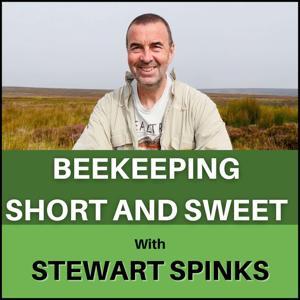
Hi, I’m Stewart Spinks and welcome to Episode 74 of my podcast, Beekeeping Short and Sweet.
Catch up with the latest episodes HERE
This week I’m following up on a question posted by one of our Patrons regarding swarm management and general inspections through the active season. If inspecting your bee hive gives you a feeling of impending doom each time, stay tuned and I’ll hopefully give you some pointers to make the whole task more relaxed.
Before we get into the detail of Ben’s question I thought I’d recap on another busy week. Queen rearing has been interesting this week, we had half a dozen emerged virgin queens trapped in the Nicot hair roller cages that needed to be moved into queenless nucs and I attempted a new method of introduction which involved liberally covering the virgin queen with sugar syrup and simply letting her run onto a frame whereby the workers would get stuck into the sugar syrup and start cleaning the new queen thus accepting her and not attacking her.
This is the first time I’ve attempted something like this but the benefits of a successful introduction means saving a few days compared to a normal caged introduction. Having set up the nuc as queenless the day before I did as instructed and pretty much covered the queen in syrup, bless her, she really was covered, the syrup ran down onto the frame where the workers immediately started cleaning it up. I took this was the opportunity to run the virgin queen onto the same frame in the middle of the syrup and sure enough, the workers immediately set about licking the sugar syrup off the queen and generally cleaning her up. Success, I have to say I was feeling pretty smug about the whole operation and particularly glad that we had chosen to capture the exercise on video to post to the Patreon site for everyone to see.
That was until about twenty seconds after I ran the queen out of the cage and into the syrup. It all seemed fine but then one worker took exception to this new queen in their presence and started harassing her, first the worker climbed all over her and then started curling down her abdomen to try to sting her, I left it for a couple of seconds longer as it was only one worker but this worker obviously didn’t like her proposed new queen because when she couldn’t get enough purchase to sting her she started to bite her and it became more and more vicious and frantic. Then another worker decided to join in and that for me was enough. I wasn’t going to stand by and watch them attack my beautiful new virgin queen. The problem was the instigator of the attack had now got such a strong bite of the virgin queen's wing when I picked up the worker the queen came with her. I actually had to walk away from the nuc and spend several seconds encouraging the worker to let go which she did eventually and I was able to get he virgin queen safely into a cage for her own protection.
Now as I said, I’ve not attempted this before so it’s all been very new to me. Having considered everything I did, I have come to the conclusion that firstly, the nuc was far too large for the introduction of this virgin queen in this manner and secondly maybe I should have left them queenless for a longer period of time before trying to introduce a virgin queen who’s pheromones are not as strong as a fully mated queen, who knows. Suffice to say, the rest of the virgin queens for introduction were put into cages and introduced in a more traditional way. I’ll be back to check on them over the weekend so we’ll see if they’ve been released and accepted or not.
It’s been the last push to getting supers on colonies where needed, always a tricky proposition as I don’t like giving them too much space now we’re heading to the end of the Summer nectar flow. I want the bees to fill every last space in the supers they have before they move on to another one otherwise they’ll have supers half-filled and u
Support the show
Hi, I’m Stewart Spinks and welcome to Episode 73 of my podcast, Beekeeping Short and Sweet.
It’s our monthly Questions and Answers session today so stay tuned for some cracking questions and hopefully my helpful replies.
Before we get into the questions my weekly round-up has the distinct taste of disaster about it and not really about beekeeping! As you may have seen by the pictures I’ve posted, the Ranger pick up has had yet another major malfunction, this time it’s the clutch. I was driving along quite happily, had to change down a gear and that was followed by a bang and very rough grinding sound and feel as if I had missed putting it into gear properly. So I took it out of gear and it wouldn’t go back in. I pulled over to the side of the road and discovered a puddle of what I guess was clutch fluid beneath the engine bay. It’s beginning to feel like I’m rebuilding the truck this year, anyway, I was lucky to be able to get the truck transported back to the local garage where it remains currently waiting to have a new clutch fitted. Another major hole in my wallet, oh well.
I must get back to the queen rearing apiary by the weekend though as I have six developing queen cells in one of the queen rearing colonies and they will be well capped and getting ready to emerge. The last thing I want is for those to emerge and destroy each other before I get a chance to sort them out. As with most things in queen rearing, once you start the clock ticking you can’t easily put everything on hold.
First up is Simon Rice, who asks
When queen rearing with larvae transfers, how do you stop the wax builders from creating burr comb between and around your queen cells please? I have had a number of attempts to raise queen cells this summer and each time they have enveloped the queen cells in this way.
Thank you.
Hi Simon and many thanks for your question;
This is an all too familiar issue when queen rearing and I’ve struggled with this problem myself including this season where I had three perfectly viable queen cells completely encased in brace comb. I spoke to a fellow queen rearing beekeeper who suggested putting a frame of foundation in a couple of frames away from the queen cells to give them something to draw out and the last time I tried it they worked the foundation and not the queen cells, so it might just be the answer! Give it a try and see how you get on.
Next up is a question from Ben Hoen who says,
For me as a new beekeeper, this year has been hard. I overwintered all three of my hives, but two swarmed early in the year when I was at work, and then both threw after swarms too while I was away. One of those did not successfully re-mate so it is hopelessly queenless currently, and the other I am waiting to find out if it mated successfully.
It would be helpful to get a general description for swarm management. For example, how often do you inspect the hives? How thorough of an inspection to do you make? (every frame, or just by tipping the box up) Do you shake the bees off the frames during an inspection, or do you find you can do what you need while still having a frame covered with bees? Other than queen cups, what are you looking for? If you find any queen cups do you knock them down? Is there anything else you can do to reduce the likelihood of swarming? For example, if you learn to "give them more space" do you find that swarm pressures are usually eliminated? Finally, on this last point, can you outline some of the methods you rely on to "give them more space"? Thanks!!!
Wow, Ben, that’s quite a question, and one I’m going to save for next week. You ask some really important questions and it would take up an entire podcast to go through all of your questions with the fullest of answers. So, all I would say is, be patient, hold on until next week and
Support the show
Hi, I’m Stewart Spinks and welcome to Episode 72 of my podcast, Beekeeping Short and Sweet. It’s July and the final month of our Summer nectar flow, the bees are busy filling Supers and we’ve been hit by another bout of CBPV. There are jobs that need attention for this month too, so keep listening for this week's updates.
Welcome back to another weekly podcast and we somehow find ourselves in July and what is for me the final month of our Summer honey production. I’ve moved all of the bees back to their permanent apiary sites and were in the process now of assessing colonies in preparation for the Autumn shutdown. It might seem a little early to be thinking of the coming Autumn and Winter but believe me, it will soon be here and if you’ve not got yourself prepared those precious few weeks in the late Autumn will become a panic as you try to treat and feed bees to ensure a successful Winter period.
If you're interested in submitting honey samples to the National Honey Monitoring Scheme check out their website here
There are, of course, jobs to do this month too but they all lead to setting up colonies to survive the darker months and ensure strong colonies for next Spring.
I was visited this week by a fellow beekeeper from Australia was explaining that they have active bees foraging for around 11 months of the year, imagine that! To have flying bees pretty much all year round and no really cold months seems on the face of it a perfect scenario but I’m sure it brings its own challenges. This past week has also brought some interesting beekeeping letters through the post, I recently signed up to the UK’s Centre for Ecology and Hydrology’s National Honey Monitoring Scheme, looking at their website for some details to share I found their introduction pretty much explains exactly what they are doing.
The National Honey Monitoring Scheme aims to use honeybees to monitor long-term changes in the condition and health of the UK countryside. However, we need the help of beekeepers if this scheme is to work. Initially set up in 2018, the Honey Monitoring Scheme is a long-term programme that uses advanced analytical techniques to identify the species of plant pollen present in honey samples. This will tell us what bees are feeding on in different parts of the country and at different times of year. This information will help us identify possible threats to bees linked with floral resources.
The CEH website goes on to explain what the scheme will do:
So I received a submissions pack which contains a couple of tubes that they need filled with honey samples and from that they can identify exactly the plants my bees have been foraging on. What’s is really exciting is that they will share this information with me onece the testing has been completed. Due to the size and complexity of the project I won’t get the results for some time but as soon as I do I will share them with you. If you’d like to take part in the National Honey Monitoring Scheme do check out their website www.ceh.ac.uk and look for the link to the relevant page, I’ll leave a link in the podcast notes to help direct you to their site.
The other letter I received was from a university student called Amy who is carrying out a third year dissertation project involving Varroa mites and was a request for samples. The project is looking into genetic diversification of Varroa and haplotypes within the species, that’s mites with a distinct mitochondrial DNA. It seems there is some
Support the show
Hi, I’m Stewart Spinks and welcome to Episode 71 of my podcast, Beekeeping Short and Sweet. The queen rearing is in full swing and I need to create more finisher colonies, stay tuned for more queen rearing chat and simple details of how to unite two colonies.
More rain, thunder and lightning this past week, the night skies were lit up brightly overnight midweek and we had some very short sharp torrential rainfall. Being Summer, it tired up very quickly and by the following morning the roads were dry and you would know it had rained at all. The bees on the field beans have done their work and it’s time to get them moved to take advantage of the Summer flow from Blackberries, Limes and Sweet Chestnut but as I was getting prepared for that I ran into a problem.
I’ve had to have another costly job fixed on the Ranger. My Ford Ranger pick up has been a real workhorse for me this past year but I guess it’s at the age now where parts and components start to wear out and need replacing. I noticed a bit of a strange metallic grinding sound when I was at the field beans last week and figured something was going wrong, remember I’m not very mechanically minded but it was obvious something was not working as it should. It only happened when I turned the steering wheel when I was in four by four so I ended up crawling under the front of the truck in my bee suit and discovered that the black rubber sleeve things near the front wheels on both sides had split all the way around and you could see all the workings inside, a bit like when you watch a hospital operation on someone's joints and you can see all the tendons and sinews. Anyway, probably too descriptive there but this is an audio podcast after all. I always find these things tend to get worse if I don’t sort them immediately and this did seem quite serious, balls joints and things exposed to the elements and me driving across muddy fields wasn’t going to help. I booked a slot at my local garage, I say local, it’s about five miles away but I’ve always taken my vehicles to this particular garage and like any of these types of jobs you need to be able to trust the people who do the work. So, my thanks to the Spixworth MOT bay team who have taken care of my vehicles over the years. So, back to the story, apparently, these black rubber sleeves are called CV joint gaiters and cover the joints that connect the wheel to the other more technical bits, Sprout, the mechanic who looked at it for me did one of those long but sharp, intake of breath things and then tutted a few times. I’m not sure why they call him Sprout, he’s a little older than me I would guess so 55-60 and I think he’s stopped growing so that can’t be it. Maybe he likes Brussel sprouts, I’ll have to ask next time I go over.
Anyway, after a quick consultation, the truck was booked in and the job completed on Tuesday this week. Another dent to the bank balance but it’s not a job I could do myself, changing the light bulbs seems a challenge to me at the best of times. Once sorted the various metallic grinding noises were gone and everything is once again protected. Sprout said the noise was because the grease had been washed out of the joint which made sense.
Anyway, the reason for recounting the story is just to say when these things crop up they are not likely to go away on their own so it’s always best to get it sorted as soon as possible even though I could have done without the expense.
Talking of expense you might recall I was trying to get hold of a reptile incubator to incubate my sealed queen cells, well, one popped up on eBay and I managed to negotiate a decent price so that’s arriving this week and is quite exciting.
It’s one of the reasons I’ve been chasing around trying to get prepared with the finisher colonies. It’s all been kicking off again this week, normal for this time of year and with so many things to manage it sometimes gets away from me. Anyway, we now have around 18 o
Support the show
Hi, I’m Stewart Spinks and welcome to Episode 70 of my podcast, Beekeeping Short and Sweet. June Gap, what June Gap? The Blackberries are in flower locally here and that hopefully signals the beginning of the Summer flow, All we need now is some warm weather and the supers will begin to fill again. This week, I’m looking forward to a weekend of queen rearing so keep listening to hear how I’m preparing for that.
Catch up with the very latest podcasts on my Patreon page here.
The Fondant Mentioned in the podcast can be found on the Happy Valley Honey Website
This past week I’ve seen a heap of chatter on social media about bees starving across the UK and to be honest it’s got me quite steamed up. I love the various social media feeds and get a lot of help and support from beekeepers across the world who I would never have been able to connect with if it wasn’t for the interweb.
But as with all things, there are always those who will not just impose themselves on it but almost bully their way along oblivious to how others might take their comments. They have the approach of, “You do it my way or you’re doing it the wrong way”. It’s not so much trolling, where someone picks on you specifically but rather a broad brush stroke attack, hitting as many people as possible with their self serving views. Steph has an expression for people like that but she’s told me I can’t repeat it on my podcast!
Anyway, before I get too deep into a rant I should pause and just rewind a little. We have this phenomenon called the June Gap, for those of you that haven’t heard it before it’s when the Spring forage finishes and we wait impatiently for the Summer flowering plants to get going. Sometimes the bees can get a little grumpy at this time, usually around mid-June as the name implies, so if your bees are being a little less friendly at the moment it may be due to the lack of forage.
That said, it’s a very variable problem if it’s a problem at all and here’s why you shouldn’t dash out and pour a gallon of sugar syrup into your bees without checking first.
If we look back at the Spring it’s been a very good start, the bees exploded into life and forage was abundant and varied. Sure we had some swarming issues and I’m still trying to get my head around the problems of new queens mating, or rather new queens not mating but that’s another issue. Specifically, the bees had plenty of time to fill up brood frames with honey and stash a surplus in the supers above.
But not all bees are made the same and this is one of the reasons you might be hearing cries of “Feed the bees”.
I have a range of what I term Norfolk Mixed bees, that is to say, a mixed gene pool with no specific subspecies dominating, all this despite my attempts to get back to near-native bees but that’s another tale. Within the various queens currently installed in my hives, I have dark bees, light bees and stripy bees, a real mix of genes and as a result a real mix of traits. One of these traits is a propensity to create brood, frames and frames and frames of brood. I have one particular colony that is in a commercial brood box and all twelve frames I have in it are full of brood. What I mean, to be specific is the frame is filled corner to corner with brood, not a drop of honey or pollen to be seen.
I have other colonies that are currently on about 6 frames of brood in a more traditional pattern of brood in the middle of the frame with an arc of pollen and honey around the top of the brood. The frames on the outside of the brood nest are full of stores, more honey and pollen.
More bees don’t necessarily mean more honey surplus though, the colony with only brood seems to be able to only produce brood, they didn’t contribute at all to the Spring honey crop and have for the most part sat in their box just producing brood. On the fac
Support the show
Hi, I’m Stewart Spinks and welcome to Episode 69 of my podcast, Beekeeping Short and Sweet. What a wet week we’re having, and guess which idiot decided it would be a good idea to move nucs to the mating apiary in preparation for the queen rearing. Stay tuned for my queen rearing update, getting stuck in the mud and other beekeeping disasters!
Check out all my latest Podcasts HERE
Apipasta Bee Fondant can be found Here
BS Honey 2 in 1 Nuc boxes can be found Here
Utterly drenched, that was me on Wednesday evening. To be honest, that was also me on Tuesday evening as well. This week has been crazy busy, mainly due to my own procrastination, I’ve been meaning to set up the queen rearing apiary for some time but just not got round to it and with the season racing away from me I just had to get out this week and get it sorted.
The first task was to set up the stands, but let me rewind a little and talk you through what I’m setting up. Here in Norfolk, I’m surrounded by beekeepers and each one of them has a mix of bee types ranging from pure Italian Ligustica, Germanic Carniolan’s, a few near natives but mostly the good old Norfolk Mix. Open mated and a collection of genes from around the world no doubt. Here am I, trying to get back to a near-native or perhaps better described as a locally adapt mix of bees but as you know by now I have a preference for the darker bee so I’m trying to be ruthless this year and move on any stripy or light coloured queens. Some of them perform quite well but my bees are not yet consistent enough and I’d love to be able to share them with other beekeepers but not until I’m sure of what I’m producing.
Anyway, in order to attempt to give myself a fighting chance, I’m moving around a dozen colonies containing dark drones into my mating apiary area at the fishing lakes. The plan is to flood the mating site with as many darker drones as possible to try to edge out any light or stripy drones. I’m also adding a few super frames to the brood boxes of these colonies to encourage the girls to build drone comb from the bottom and produce an excess of drones beyond the more normal levels that you might find in these colonies.
Close by to this apiary I have my mating apiary, it’s just a clearing with a load of nuc boxes filled with nucleus colonies ready to take virgin queens when the time comes, currently they’re all queen right and I’m balancing colonies for strength by shifting a few frames of brood from one to the other and adding a few frames of foundation here and there where needed.
Just switching topic for a moment, I had an email from our National Bee Unit yesterday advising that in this cooler, rainy spell nucleus colonies might be starving, if you’d seen my nucs you’d wonder where they’ve got all their stores from! at least two frames of food each so I’m not worried about the starvation issue at all. Different areas around the UK have struggled so if you have recently made up a nuc or a split it’s worth checking up on them, if they’re low on food give them a bag of fondant and they’ll be fine I’m sure.
Happy Valley Honey’s Apipasta is my favourite at the moment and well worth checking out. I’ll drop a link in the podcast notes for you. If you want it quickly, give Paul a call and make sure to mention where you heard about it. Paul has supported both my videos and these podcasts and he has some excellent products so do give him your support if you are able.
Anyway, back to the queen rearing apiary. I have stands set up to take four nuc boxes, these vary from my own Commercial plywood nucs to the BS Honey 2 in 1 nucs, it’s just what I have available. The stands are a new addition for me, remember I’m fairly useless at woodwork so thei
Support the show
Hi, I’m Stewart Spinks and welcome to Episode 68 of my podcast, Beekeeping Short and Sweet. The weeks are flying by quickly now as we rush headlong into June and It’s time for our monthly Questions and Answers roundup.
If you'd like to support us and help us create more content please check out our Patreon page www.patreon.com/norfolkhoney
Sign up to my beekeeping newsletter at www.norfolk-honey.co.uk
The syrup I mention in the podcast can be found at Happy Valley Honey's Website HERE
The bees appear to have finished their manic swarming session at last and things have begun to settle down a little as new queens are mated and starting to come into lay. I have noticed that several of my new queens appear to have been poorly mated, you can see this by the laying pattern that develops, sporadic eggs and larvae scattered around the frames rather than a well-mated queen who will lay a full side of a frame with eggs before moving on to the next frame. I’m really not too sure how or why this happens, I guess with open mating it’s still very much left to chance and a percentage of queens will fail to get sufficiently well mated. I also have a couple of drone laying queens where they don’t appear to be laying any fertilised eggs at all so unfortunately those will have to go and we’ll start over again with those nucleus colonies. June is my month for some serious queen rearing, this year we aim to produce some very specific darker queens and it will be interesting to see the phenotype of the emerging queens, that’s basically what they look like, and also the traits that they express. I’m going to be ruthless this year and anything that’s not completely dark is not going to pass.
I’ll talk some more about my queen rearing strategy and processes over the next couple of weeks but for now we need to get stuck in to the monthly batch of questions submitted by my very kind supporters on our Patreon page, this is where you can access lots more content and at the same time support our efforts to produce more beekeeping content to post. I’ll leave details of how you can support us in the podcast notes that accompany this podcast. Please do take time to check it out and if you can sign up that would be great.
Our first question comes from Mark Deeble, who sent in the following;
Hi - If you live in a part of the country (on an exposed coast) where it is always windy and never gets above 20 degrees, would you provide insulation above the crown board year-round. If so, can the insulation (2" 'wool' type) sit directly on the crown board? Many thanks!
Hi Mark and thank you for your question, interestingly, I was chatting to another beekeeper a couple of days ago about insulating hives as we were talking about the poly hives I’m using at the moment. I’m not certain I would add insulation to the hive, rather, I think, I would look for a locally raised bee that was best able to cope with those conditions. You don’t say exactly the location but I know several beekeepers in Scotland and Wales who probably have the conditions you describe and they don’t insulate their hives but have near-native or native bees that are well suited to those conditions. I think the issue with insulation is it’s great for the bees inside the hive but once they get out into the cooler conditions are they going to cope? Depending on the type of bees your currently running, I would perhaps give them some insulation short term but look to raise queens from local stock or find a local beekeeper near you who have locally adapted bees.
Next up is a question from Eva Loysen;
Hi Stewart - I've read that Autumn is the best time to unite a weak colony with a stronger one. However, my weak one is tiny and I'm wondering if I could combine them now? Many thanks.
Hi Eva and thanks for
Support the show
Hi, I’m Stewart Spinks and welcome to Episode 67 of my podcast, Beekeeping Short and Sweet. After our first extraction session of the season, it’s time to consider what the month ahead will bring and also a brief update on how we’re doing so far.
Check out my Patreon page here www.patreon.com/norfolkhoney
So we’re just out of the honey room and I’ve enjoyed a decent early season crop of Oilseed Rape honey, even with the numerous splits and swarms we still managed to extract plenty of honey. I say extract, those of you that have been watching the latest videos on my Patreon page will have seen just how much we had to cut out of the frames. Oilseed rape is a terrific early season honey but it does granulate very quickly in the comb. I’m not too disappointed though as I want to have a crack at making my own foundation this year, so need to stockpile plenty of fresh wax for the Autumn and Winter months. The honey room looks like a tazmanian devil has been let loose with a bucket of honey, I’m not sure how I manage to get it everywhere but it just seems to have a mind of its own, so that’s another cleaning job to add to the list. We’ve moved around 30 hives from the Oilseed rape site, I managed to pick the one morning that the skies decided to open up and it rained almost continuously for the entire time we were trying to move the bees. On the plus side, the bees were fairly calm and for the most part stayed in their hives, the flip side of the coin meant despite wearing waterproof walking boots the rain went down my trouser legs and puddled inside my boots making my feet squelch with each step, luckily I can report I didn’t suffer any permanent damage such as trench foot. We were moving the bees to a site of late planted field beans, the top field has a very nice grass track for us to drive along and a fairly flat, hard standing area for the pallets to sit on acting as stands for the hives. We weren’t so lucky with the lower site, the field has been left fallow for the year and the farmer had been over it and drilled some grasses or something into the field, I had to call him to make sure it was ok to drive across, which he confirmed, I obviously didn’t want to upset him on my first day, but the result was my truck tyres collected an additional four or five inches of muddy circumference as we drove across the field and my boots gradually got heavier and heavier with each step until it felt like I was about four inches taller. All that said, the very good news is the field beans have literally just started to flower and we’ve had some much-needed rain which I’m sure will help the plants produce lots of nectar and the weather for the next couple of weeks looks set fair so I’m certain the bees will be all over it. I watched the bees on their orientation flights yesterday, it was lovely to sit and just chill out for 20 minutes watching the bees as they fly out and locate themselves to their hives. I’m certain today and into the weekend they’ll be foraging in earnest with overnight temperatures staying in the double-digit area, sunrise is around 4:30 am so they’ll have some very long days coming up, I must make sure those extra supers are ready, another job for the “to do” list.
Talking of the jobs list, this month is an unusual one as historically, we used to describe it as the June Gap, where forage became more difficult to find and sometimes colonies needed feeding. Oh, one point about taking off the Spring crop, make sure you leave something for the bees, I noticed a couple of my colonies were literally all brood in the brood box with no stores at all, if I had taken all of the stored honey in the supers they would probably be starving right now. That is, if I hadn’t taken them to the field beans of course, but if the weather happened to have turned cold and wet preventing the bees from flying they would most certainly have starved, just be sure to take a close
Support the show
Hi, I’m Stewart Spinks and welcome to Episode 66 of my podcast, Beekeeping Short and Sweet. It’s been a busy week as we clear some of the supers ready for extraction and begin the process of moving hives to field beans.
Join me each week for my latest podcast www.patreon.com/norfolkhoney
This has to be one of the more exciting weeks of the year, as if beekeeping isn’t exciting enough, of course. We’ve been through the long, cold Winter……. well, it wasn’t that long or cold really and that seems a distant memory now. And I always get excited about the start of the new season, but then we get really busy and this year seems to have been quite swarmy, to say the least. I’ve managed to use that to my advantage and have seen a significant increase in colony numbers by making quite a number of splits and collecting several swarms that I missed from my own colonies.
I’ve had an above average number of phone calls relating to collecting swarms, the majority of them being bumblebee nests. It always surprises me that more people struggle with the simple identification of our bumblebees. That said I guess people aren’t quite so connected with the natural world perhaps as they once were, I was very lucky growing up as my grandparents lived in the countryside, we visited regularly and I didn’t have the distraction of technology in quite the way that young people have these days.
Anyway, back to the excitement of this week. Firstly, my thanks to Steph and Pete, without whose help I’d really struggle. It’s always nice to have someone to lend a hand but also someone to chat to about beekeeping, it can get quite isolating if you are on your own beekeeping. I think it’s just that we get so busy we don’t normally have much time to stop and strike up conversations. I have to acknowledge here that technology really helps bridge that void sometimes, so I’m not averse to using the mobile phone when I’m out in the apiaries, as long as I can get a signal that is.
So, I have my willing helpers on hand to assist with the lifting and being on Oilseed Rape we certainly need a helping hand. Some of the boxes were very heavy indeed.
What I thought I would do today is explain the process that I use to go from a hive full of bees to honey in buckets. I think my methods for handling the various parts of the job can be adopted and adapted by most new or growing beekeepers, and I’m changing and adapting my various methods myself as our business grows and develops.
I was chatting to Pete yesterday and describing one of my funniest extraction day memories that I had when my brother came over to help me. This was many, many years ago now and shows how we have taken some fairly large steps to get where we are now. We had removed the supers from the few hives we had, I think there must have been maybe 10 supers of honey to extract so you can see we were a very small enterprise back then. I had an old, galvanised extractor and settling tank, not something you could use these days, everything has to be stainless steel or food-grade plastic but back then we were both a lot poorer and a lot more naive about the ways of extracting honey.
Anyway, I was living in a semi-detached house with a very nice but small sun lounge on the back of the property, south facing and lovely to sit in and have a glass of beer in the late evenings. This, however, was turned into our honey room and piled high with equipment and honey boxes. We had picked a lovely day for extracting but of course, we had to keep the doors and windows shut to prevent any bees from sniffing out the honey and invading our workspace. Well, by the time we had really got started the sun was up, the room was hot and getting hotter by the minute and we were stripped to shorts and t-shirts. I think that’s probably as much detail as I should go into regarding personal items of clothing but being keen to maintain a good&
Support the show
Hi, I’m Stewart Spinks and welcome to Episode 65 of my podcast, Beekeeping Short and Sweet. I’m gearing up to start my queen rearing program at the end of this month and so I thought I’d go over my selection criteria and maybe this year we’ll get some fantastic new queens.
The books I refer to are available here:
Queen Bee: Biology, Rearing and Breeding by David Woodward
The Principles of Bee Improvement by Jo Widdicombe
( These are affiliate links which cost you no more than you would normally pay for the books but I get a very small commission should you choose to make a purchase).
There’s an old beekeeping saying that goes something like “A swarm in May is worth a load of Hay, a swarm in June is worth a Silver spoon and a swarm in July isn’t worth a fly”.
I guess the meaning of the proverb is the earlier the swarm the more productive they can be. That’s not to say July swarms can’t be built up and be ready for the following Spring but May swarms can easily grow into full sized colonies and give a super of honey if everything falls into place.
Thinking back to the proverb and swarms in May, I’m going to need a barn to put all that hay in because my bees have really been going for it this Spring.
I’m not complaining, I’ve managed to either split colonies or collect swarms and have reached my target number of colonies for the year with plenty of time still to come so it’s currently looking quite positive. It would be easy to get pessimistic with all the posts by beekeepers proclaiming they’re having the best Spring ever with no swarming and more honey than they’ve ever seen before but just remind yourself that these are the exception and if you’ve seen my latest videos on Patreon you’ll see how things can quickly go sideways.
I had lots of good intentions for a bumper Spring honey crop and certainly the bees on the oilseed rape have been doing a fine job, it’s just they also decided they wanted to take advantage of the early windfall of resources and get their reproduction in early and who can blame them. Those swarms now have really good chance of building up strongly to see out the Winter to come. I can’t believe I said Winter already, oh well, always looking forward.
And that brings me on to today’s topic of my queen rearing plans for this year and how I intend to select my colonies firstly for the queen mother colony, that’s the donor colony that will supply the young larvae that will become new queens. And then the equally important colonies that will supply the drones to mate with the newly emerged virgin queens.
I’ve got quite a number of queen rearing books now, some of them really quite old, but my two favourite books for queen rearing are David Woodward’s Queen Bee: Biology, Rearing and Breeding, this is my “Go To” book when I need to remind myself what the heck I’m supposed to be doing.
The second book is a relatively new book by Jo Widdicombe called The Principles of Bee Improvement and I particularly like the simple Five qualities for selection used in the book from the Bee Improvement Programme for Cornwall or BIPCO for short.
I’ll leave full details of the two books in the podcast notes beneath the podcast on my Patreon page if you’d like to take a look at them.
Looking back at my experiences this year so far, they haven’t much different from other years in that colonies will swarm but it’s been the cocktail of that very mild Winter, the early warm Spring weather, followed by a rather chilly period in early May that we are just coming out of.
I think all of this helped the bees decide to swarm and regardless of how many swarm cells I removed the bees were building them up again faster than I could tear them down. The result has been quite frantic. Like I said, it’s a positive outcome for me as I’m now filling brood boxes and nucs with bees I would otherw
Support the show
From the publisher's feed
A Beekeeping Podcast for the Inquisitive Beekeeper with a Short Attention Span! BeeFarmer, YouTuber (The Norfolk Honey Company, Patreon Host (www.patreon.com/norfolkhoney), Beekeeping mentor to…
Ranked by our users in the last 21 days
280 Listeners
233 Listeners
253 Listeners
297 Listeners

175 Listeners
225 Listeners
128 Listeners
294 Listeners

5 Listeners
124 Listeners

197 Listeners
17 Listeners
5 Listeners
17 Listeners

95 Listeners