
Sign up to save your podcasts
Or



Based on Podcast App listening data
Having just discovered my first overwintered queen less colony I wanted to discuss Winter losses and how to bounce back this Spring.
For the very latest Podcast check out my page here www.patreon.com/norfolkhoney
You can also sign up to my fortnightly newsletter via my website www.norfolk-honey.co.uk
Well, It’s been another week for record breaking temperatures here in the UK, we’ve hit temperatures in excess of 20 degrees centigrade where the seasonal average should be more like 6 or 7 degrees.
A lot has been made of the fact that last year we were in the grips of a very Icy blast from continental Europe which was named “The beast from the East” with overnight temperatures down in the negative double figures and snow and ice covering the hives, what an incredible change. It has given beekeepers a fantastic opportunity to get out and check colonies way earlier than anyone would normally suggest and this is where a dose of common sense is required. Temperatures are once again falling and the forecast is that there may even be snow next week in some parts of the UK.
I grabbed for one of the beekeeping books from my shelf that has a month by month guide for beginner beekeepers, each month has jobs to do and what to look out for. In the section for February it suggests hefting to gauge the weight and making sure the entrance is not blocked by dead bees and snow.
Sensibly, there is no mention of inspecting bee hives as you might expect.
If you’re a beginner beekeeper and have such a book or you’re looking online at what to do each month, remember it’s just a guide, you must take in to account the local conditions that you face and not just plow on with instructions without giving it some thought.
I’ve had probably the best Winter I can remember in a very long time, just one colony that appears queen less and without brood, all the rest are alive and well. Some of those colonies are a little on the small side and would possibly have succumbed in a harsher Winter but this year with the very mild weather and the addition of some fondant to help them along they have seen out February and now head into March.
They are a long way from being safe, March can be such a fickle month, one day warm and inviting, the next cold and harsh, so we have to be wary and not relax our guard but for the most part they should cope. Last year I wasn’t so lucky and suffered the lose of far more colonies, and it occurred to me that this can be such a very difficult time for beekeepers regardless of the number of colonies.
I’m always devastated when I lose a colony of honeybees even though I have nearly 70 and I’m sure it feels as bad if not worse if you are a beekeeper with just one or two colonies and suffer the lose of one or both.
Very often it’s not the beekeepers fault, colonies die out for a number of reasons and I’ve talked about these previously. Sometimes it is the beekeepers fault, maybe through lack of experience or bad timing but as long as it is learning experience and you’re able to take steps to try to prevent it happening again it can be viewed as a positive learning experience.
So having suffered this loss what do you do. Firstly, the hive or hives need to be blocked up and moved to a position ready for cleaning, whether it be one hive or ten hives, get them away from the apiary ready fro cleaning but first remember to block up the entrance, you really don’t want other bees robbing out a dead hive, again, I’ve discussed the reasons for this in previous podcasts but disease in honeybees spreads very quickly so don’t give it a helping hand by leaving the lid off the cookie jar.
Once you have the hive in a location for cleaning out the first step is to check out what was going on inside, it’s time to turn detective and try to work out what happened and why the colony failed to get through the winter.
When you take off the roof and crown board you may det&
Support the show
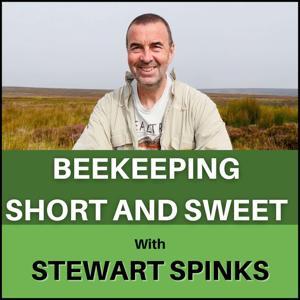
Hi I’m Stewart Spinks and welcome to episode 53 of my podcast, Beekeeping Short and Sweet. As we head into the last week of February we’re expecting to be wearing shorts and T shirts as the crazy warm weather continues, the bees enjoy an early break from the Winter’s cold and I’ve finally found somewhere to expand and build my beekeeping business.
Welcome back to the podcast, the crazy weather continues, average top temperatures for February in our region are historically around 7 to 7.5 degrees C according to the Met Office data I was checking this morning and it looks likely we’ll double that this week with temperatures hitting 14 and possibly 15 degrees or higher. Winter hasn’t finished with us yet I’m sure, but I always look at February as the month where the Snow and Ice takes hold and we freeze our way into March but this year it looks like we’re on a mini heatwave as warm air is being dragged up from the Canary Islands and I’m sure lots of beekeepers will be jumping at the chance to have a look in their beehives.
This is where you expect me to say don’t inspect but I know some of you just can’t help yourselves so what I would say is make sure you’re going in with a plan and know exactly what you are looking for and why you’re inspecting. I’ve touched on why and how to inspect this early in the season before so I’m not going through all of that again today, just be sure to go carefully and quickly with your goal in mind.
I’ve been round all of my colonies and put fondant on the ones I wanted to feed. Everything’s looking good and with just the one colony currently being queen less we appear to heading out of February with plenty of strong hives for the start of the new season.
So I won’t be inspecting any bees this weekend, although I might have a quick look at the CBPV nuc I have at my allotment. I saw the bees flying from the nuc yesterday so they are still alive but I think the virus still has a firm grip on them. One of the benefits of living in the UK is we have a very active core of beekeeping associations all helping their beekeeping members to improve and develop their skills as beekeepers. One such association is the Cambridgeshire Beekeeping Association who hold an Annual one day event in March with guest speakers talking about a range of topics, this year I’m particularly interested to listen to Professor Giles Budge from Newcastle University who is talking about the ongoing research into Chronic Bee Paralysis Virus. This is the research to which I contributed a sample of my bees. Hopefully they can come up with a plan to help beekeepers who find this infection in their colonies.
The other reason for heading to the Cambridgeshire talks is they always provide a fantastic lunch! Food is never far away from my thoughts. On the subject of food, particularly food with honey as an ingredient, I saw a fantastic recipe for honey and peach pie on the tv last night. One of my favourite tv celebrity chefs, Rick Stein made this really simple dish so I’m going to give it a try and will post my efforts on video to the patreon page as normal. I hope those of you that have subscribe to the Patreon page have enjoyed my cookery exploits this Winter, I’ve certainly enjoyed making them. The Honey and Peach Pie looks really simple to make and has very few ingredients, I’ll post a blog with my efforts and recipe in the next couple of weeks so you can have a go too if you want to.
It’s going to be a busy couple of months coming up as I’ve been putting off some essential preparatory work for the new season. I’ve still not made up all of the frames and hive parts that I’ve recently bought and there is still some cleaning to be done. The reason for the delay is also the reason I have some exciting news to share this week. I don’t very often share personal stuff but it’s all relevant beekeeping challenges and I’m sure I’m not alone in the frustrations I’ve faced over the past few years.
As yo
Support the show
Today I’m celebrating my podcast’s first birthday! Fifty Two podcasts recorded and published.
I’ve covered quite a varied number of beekeeping topics over the past year and also attempted a few interviews which have been a little nerve wracking! I’m not a journalist or professional presenter, just a beekeeper looking to share my knowledge and views with other interested listeners. Hopefully I’ll be able to try out a few more interviews in the coming year.
You may be aware that I am sending out a fortnightly beekeeping newsletter with the same name as the podcast, Beekeeping Short and Sweet, it’s early days at the moment and I’m trying to keep it light and image rich, so no massive pages of text to trawl through just a few interesting pictures with hopefully some useful links. I’ll be promoting various events and offers through the newsletter too, so do sign up, it’s quick and easy, just go to my website and leave your details when the sign up pop up appears.
Websites I referred to in the podcast:
www.norfolk-honey.co.uk
www.beetradeex.co.uk
www.scientificbeekeeping.com
Talking of events, we are fast approaching the Spring Sales events here in the UK, The first major event on Saturday 9th March is called BeeTradex, billed as The Biggest Beekeeping Show in 2019 it is a one day trade show with various lectures and talks being given. It’s held at the agricultural show grounds at Stoneleigh Park in Warwickshire. It’s also a chance to pick up a bargain from one of the beekeeping equipment manufacturers or suppliers as they usually have discounts available. One of the nicest things about BeeTradex is that it gives me the chance to catch up with friends within the industry and also chat with fellow beekeepers who I would not normally have a chance to get together with. If you’re going along please do stop me and say hello. I’ll pop the Beetradex website link in the show notes.
With the temperatures on the rise, the bees have certainly been getting out and about, clusters have been breaking up, not that we’ve had many very cold days but the nights have been chilly falling to below freezing. I was out putting some fondant on some colonies a few days ago and was happy to see so many colonies with large numbers of bees, I would say an average of six seams of bees but some were around 9 seams which is excellent. That can obviously lead to a food shortage, particularly if the colony gets quite active in the warmer weather but fails to find any early food source. We’ve had lots of snowdrops in flower locally and now the crocus is exploding into flower with this milder weather. A vital source of food and we’re very lucky to have so many crocus plants flowering near our apiaries. It seems to be the number one Spring flowering plant of choice for our Norwich City council who appear to have planted millions of bulbs over the last few years all around our fine City.
That said, it is still February and the weather can as easily turn cold and wintery again so let’s not get too far ahead of ourselves. I spoke to a beekeeper a couple of days ago who said if the weather stays warm he was going to inspect at the weekend, I think this is a little too soon, I’m certainly not going to be inspecting my colonies although there are a couple I’m keeping a close eye on.
The first colony is the nuc I have in my allotment apiary, that’s the one with the Chronic Bee Paralysis Virus, I popped some fondant on them last week, they’re still alive although the entrance was badly clogged up with dead bees so I think they are still suffering. I’d like to get into them as early as possible and see what’s going on.
The other colony is at one of my out apiaries, I was out treating with the Oxalic Acid trickle method a while back and as I finished treating this particular hive and was putting the roof back on a larger than normal bees flew across my eye line. The more experienced beekeepers out there will&
Support the show
Hi I’m Stewart Spinks and welcome to episode 51 of my podcast, Beekeeping Short and Sweet. This week it’s time to look at some of my favourite queen rearing techniques and one that I’ve particularly struggled with.
Gain access to more content, videos, early release podcasts and more at www.patreon.com/norfolkhoney
The Nicot System that I am using was kindly supplied to me by Bee Equipment, online beekeeping equipment suppliers, https://bee-equipment.co.uk/
Welcome back to another weekly podcast, seems strange to think that it’s been a full year since I started my podcasts, next week sees podcast 52 and with the exception of a couple of week’s break over Christmas I’ve managed to stick to my commitment of delivering to you a weekly podcast about beekeeping, I’m delighted to have reached this milestone but I couldn’t have done it without the support from those of you who take the time out of your busy schedules to drop me an occasional message of support, so thank you for that.
If there’s anyone out there listening who would like to support me further do take a look at my patreon page where you can gain access to more content and as we’re heading towards the start of the new season there’s never been a better time to get on board and through the active season I’ll be producing at least three videos per week with only one of those being available on YouTube the rest will only be available on my patreon page, As usual I’ll post a link in the notes to accompany this podcast.
So, Queen Rearing….
It might seem a little early to be talking about queen rearing, it is only the beginning of February, but, the season will soon be upon us and if you haven’t planned what you are going to do you could find yourself missing the boat and playing catch up instead of enjoying a full season.
I thought I would just talk through some of the queen rearing techniques I’ve used over recent times and give you some thoughts on which technique might best suit you and your beekeeping.
I’ll try to go through them in terms of the quantity of queen cells you want for your season starting with the back garden beekeeper with just a couple of colonies and work through to the methods that have the ability to produce hundreds of queen cells.
Support the show
Today is the 1st of February, well, actually, it’s the 29th January but the first release of this episode is on the 1st of February, if you get what I mean. That means we are just weeks away from a possible start to the new season and our first inspections. Now I’m not suggesting you leap in to your hives in February and I’m also not suggesting that you don’t, but, from February onwards everything is so weather dependant. If we get a warm, Spring like day, then go ahead and have a quick look. If you’ve not listened to last week’s podcast, that’s podcast 49, check it out because that one explains what I do during my first inspections.
There are things to be getting on with and it won’t harm if you go around hefting each hive to heck up on it. That said, hefting needs some explanation because if you’re not experienced with it you may draw the wrong conclusions from it and lose colonies. That sounds rather dramatic, and I’m not trying to scare you but let me explain.
If you only have a few hives it’s quite possible you can remember the general feel of each colony as you heft them through the Winter, which reminds me, if you haven’t hefted any of your colonies at all over Winter it might not help that much if you start now. You see, what you’re looking for is a comparison between the last time you hefted and now, also, a comparison between colonies within the apiary is helpful. But this is where inexperience can give you a false impression. Let’s imagine I have an apiary with ten bee hives in it all the same type, Commercials.
I’ve been hefting them regularly throughout the Winter so far, every other week since the beginning of December. So far they have all appeared to be around the same weight, not overly heavy but not what you might call light.
This time however things have changed.
six of the colonies all appear to have about the same weight, one appears extremely light by comparison and three feel quite heavy.
Let’s start with the light one, remember if you’re going to remove the crown board always have your bee suit on and smoker lit and at the ready. You may never need them but the one day you don’t do this will be the day the colony gets grumpy and chases you down the garden path.
So, the light colony, when I look inside I find a reasonably large cluster, alive and well. I would do no more than pop a large pack of fondant on to the holes in the crown board and leave them to it. I have fondant in 1kg packages so I would place two packs on this colony. It appears they are well and healthy and just a bit light on stores. Close them up and check on them again next week.
The first of the heavy hives has a smaller cluster of bees than the one we just looked at however, checking on the frame next to the cluster I find it is full of liquid food stores and the bees have been using it. This colony appears to be fine, just a frugal colony that doesn’t use as much of their stores as other colonies. I can close them up without doing anything.
The second heavy hive has a smaller cluster, still alive but tight up against the side wall of the hive. Checking the frame nearest the cluster there is very little food in it apart from a large band of solid Ivy honey that has crystallised in the cells. looking at other frames in the box there appears to be plenty of liquid honey for them but the bees just don’t seem able to move over to it. This appears to be the start of isolation starvation and we’ve caught them just in time.
Isolation starvation is pretty common, a cluster of bees finds itself trapped away from food stores and for me I find it’s normally because they can’t bridge across solid stores of Ivy and get stuck in a spell of cold weather.
It could also be that the bees, having eaten their way through a couple of central frames, move the cluster towards the warm side of the hive where the sun has started to warm it up but in doing so leave an empty void with no food.
Support the show
Be Warned! Oxalic Acid Sublimation for the treatment of Varroa is a healthy and safety exercise first and foremost. You must take every precaution to ensure the safety of both yourself and those around you.
Today we're on location treating our colonies with Oxalic Acid Sublimation using the ProVap220 which is available from my website www.norfolk-honey.co.uk/provap220
Pete and I travelled to my University apiary to treat my colonies with Oxalic Acid to try to kill more varroa mites before the season kicks off. Remember, we are trying to kill phoretic mites which are those hitching a lift on the backs (and underside) of our honeybees.
Following lots of reading it appears that 2.25g of Oxalic Acid Dihydrate was the best dose to use to kill the maximum number of varroa whilst at the same time keeping honeybee mortality to a minimum. You can watch the video of our treatment process on my Patreon page www.patreon.com/norfolkhoney or my YouTube channel "The Norfolk Honey Company".
We rely upon the support of patrons on our Patreon page to continue to provide content for all beekeepers. If you feel you could support us please do take a look at that page where options start from as little as $1.
The paper that I refer to in the podcast can be found here: Hasan Al Toufailia, Luciano Scandian & Francis L W Ratnieks (2015) Towards integrated control of varroa: 2)comparing application methods and doses of oxalic acid on the mortality of phoretic Varroa destructor mites and their honey bee hosts, Journal of Apicultural Research, 54:2, 108-120, DOI: 10.1080/00218839.2015.1106777
Support the show
Hi I’m Stewart Spinks and welcome to my podcast, Beekeeping Short and Sweet. This week I’m looking forward to the start of the new season with some thoughts of what to look out for in that first inspection of the season.
Although it’s quite cold outside and the frosts have begun in earnest, the sun is shining brightly today unlike yesterday when we had quite dense fog for most of the day, and it’s beginning to look a lot like Spring will be here soon.
The Hazel catkins are in full flower right now and a gentle tap showers the air with a cloud of pollen. I’ve collected some to look at under the microscope and to show how easy microscopy is, especially if you keep an eye out for my online beginners course coming soon.
Anyway, with it looking really lovely and sunny outside my mind drifted towards the start of the new season, it’s still some way off as this is still late January but just like those Summer holidays you book in Winter, they come around very quickly and are gone in a flash. So I Thought I would take a look ahead to what I’ll be doing in a few weeks time when we start to see the daytime temperatures increase and the bees start to get out in earnest.
Keeping a watchful eye on your colonies through the Winter is essential, although this doesn’t have to happen on a weekly basis it’s good to check up on them regularly to make sure there are flying bees and they have enough food stores. As the warmer weather approaches the temptation to carry out a thorough inspection grips many beginner beekeepers and too many put their bees in a dangerous position by inspecting far too early in the season.
The reason the colonies are put in danger isn’t because the beekeeper is clumsy or that there is some hidden risk it’s simply that the bee hive gets opened when the outside air temperature is far too cold to be carrying out any meaningful inspection.
As we head into Spring, the colonies should be building up nicely, with an increased brood area as the queen increases her egg laying day by day. Unfortunately this coincides with the Winter bees, those that have kept the colony alive throughout the dark , cold days of December, January and February, dying out and reducing the overall number of bees in the hive. Those bees left have to work harder to keep the larvae fed and protected, this mainly means protected from the cold outside temperatures. Remember the brood area is going to be kept at something like 34-35 degrees C and if you’re splitting open the brood nest in temperatures of single figures the bees are going to have a really difficult time in bringing the brood area back up to the correct temperature. the result of this is that it leads to something called Chilled Brood. What tends to happen is the bees will only be able to get the temperature of the brood area up from the middle out and so larvae on the outer perimeter of the brood nest are left in temperatures that are far too low for them to survive.
When you finally get back in to the colony to inspect you may find a ring of brood on the outside of the brood nest area that has died, that’s chilled brood and generally the fault of the beekeeper.
Better to sit on your hands and not inspect the bees until the daytime temperature is at least 15 degrees C, some beekeepers call it T shirt weather but I saw a chap out a few days ago in a T shirt and it must have been around 8 degrees C, so better to go by the thermometer rather than the goosebumps.
You’ll already know if you have a live colony in the hive as you’ll have been watching them over the previous few weeks so that first inspection is to check how they have coped through the Winter.
Pick a day when it’s not blowing a gale too, nothing chills a brood nest quicker than a keen beekeeper in a Spring brisk breeze. So wait for a calm, warm day and aim for the warmest part of the day, around lunchtime if possible.
The plan here is to be
Support the show
Planning for the new season is an important part of every year, making sure everything is in place for a successful start to the new beekeeping season.
My plans are fairly straighforward but it's always important to get something committed to paper so you know where you're heading. Once you have it fixed you can go back to your plan and make sure you're on track.
Support the show
This week is a brief review of this season's beekeeping. Another season gone and another Christmas upon us. I'm grateful for all the help and support I've had over the last year and want to thank everyone who has supported me in trying to bring beekeeping to as many people as possible.
Support the show
More beekeeping chat about preparing our hives for the Winter oxalic acid treatments, the local beekeeping club has it's Christmas party and a start of a discussion about the Honey Regulations 2015
Support the show
From the publisher's feed
A Beekeeping Podcast for the Inquisitive Beekeeper with a Short Attention Span! BeeFarmer, YouTuber (The Norfolk Honey Company, Patreon Host (www.patreon.com/norfolkhoney), Beekeeping mentor to…
Ranked by our users in the last 21 days

281 Listeners
233 Listeners

252 Listeners
296 Listeners

175 Listeners
226 Listeners
128 Listeners

293 Listeners

5 Listeners
124 Listeners

196 Listeners
17 Listeners
5 Listeners
17 Listeners

97 Listeners