
Sign up to save your podcasts
Or

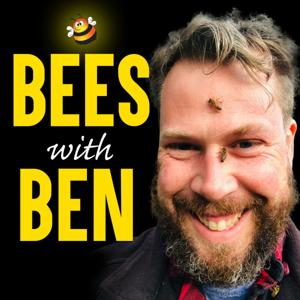


The Mystery of Toxic Honeys with Dr. Andrew Knill"**
Welcome to another buzzing episode of "Bees with Ben," a podcast where we delve into the fascinating world of bees and their impact on our ecosystem. This week, we're joined by renowned scientist Dr. Andrew Knill, who brings his expertise to a rather intriguing topic: toxic honeys and the effects of Patterson's Curse nectar in honey.
**A Deep Dive into Toxic Honeys:**
Dr. Knill starts by exploring the broader concept of toxic honeys, a phenomenon that has intrigued scientists and beekeepers alike. He explains how certain plants, when foraged by bees, can lead to the production of honey with unusual properties. These honeys, while rare, can range from being mildly psychoactive to potentially harmful.
Patterson's Curse – A Blessing or a Curse?
Our focus then shifts to Patterson's Curse, a plant known for its vibrant beauty and its controversial role in honey production. Dr. Knill discusses the dual nature of this plant - how it's both a bane for farmers and a boon for beekeepers in certain regions. He delves into the chemistry of Patterson's Curse nectar and how it influences the honey produced.
Dr. Knill shares insights from his recent research on how bees interact with Patterson's Curse and how they are affected by its nectar. The conversation takes an intriguing turn as we discuss the effects of this honey on human health. Dr. Knill breaks down the myths and realities, providing a balanced view on the potential risks and benefits.
Don't forget to subscribe for more insightful episodes of "Bees with Ben." We'd love to hear your thoughts on this episode, so feel free to leave a comment or reach out on our social media platforms. Stay tuned for our next episode, where we'll explore another fascinating aspect of beekeeping and the wonders of the bee world.
This week’s episode of the Bees with Ben podcast features a question-and-answer session between Ben and his special studio guest, Brent Nixon, who has driven down from Ballarat South for the occasion.
Naturally, Ben’s first question for Brent is how he started out with bees? Brent explains that he grew up in a family of cattle breeders and wanted to breed something for himself. He studied genetics at university, including the pioneering work of Gregor Mendel, the father of modern genetics. Many people don’t realize that Mendel, who was a monk, also conducted research with bees, which were often kept at monasteries to produce beeswax candles, in addition to honey. Mendel was attempting to breed bees using a cage, which wasn’t really effective, but his early work was taken up by Brother Adam of Buckfast Abbey in the UK - the creator of the ‘Buckfast bee’. Brent became fascinated with breeding bees, but although he had the theoretical knowledge, he had never been inside a hive.
Then about 8 years ago, his wife’s uncle, who was a beekeeper, found him a swarm - located about 10 metres up a tree. Brent was given a half suit and positioned under the swarm, with instructions to catch the bees in a box, while the uncle clambered up the tree to dislodge the insects. Somehow, Brent managed to catch the queen, and the beekeeper told him to put the box down, and that the rest of the swarm would soon follow, which they did.
Today, Brent has his own podcast called ‘Breeding the Honey Bee’, which is named after the famous book written by Brother Adam. He has recorded 11 episodes to date, including an interview with the head beekeeper at Buckfast Abbey.
Ben is quizzed about the development of his business and the transition from part-time to his main source of income. He says he started off slowly and built his business on diversification; he vividly remembers making beeswax candles in his kitchen and struggling to clean the wax off the lino floor (Brent interjects that he thinks he ruined the plumbing in his first house as some beeswax went down the sink). Ben goes on to say that one of the main problems is that the business is so seasonal, and that he struggled to get through the winter in the early years. He cautions that he has seen beekeeping businesses go too hard and too quick, and ultimately fall over.
https://nixonqueenbees.com.au/?fbclid=IwAR3LekNglAfD_R-psKhjH102qzkBorcgBHJqcJ6D8e5NAqiyKgroh9sFL1k
https://nixonqueenbees.com.au/pages/podcast?fbclid=IwAR0vDUhGW0Axip2VCqp4TEi7tK6rQa06rWOAC-XQINwri6qXuSUUdeXn3G8
https://www.facebook.com/groups/1150361712418055
In this week’s episode of the Bees with Ben podcast, Ben is fortunate to have as his guest a man with a wealth of experience in all areas of the beekeeping industry, with a glittering array of credentials! Steve Fuller is an Executive Councillor of the NSW Apiarists’ Association Inc., President of the Northern Coast branch of NSWAA, an Advisory panel member for Agrifutures’ Australia (Honey Bee and Pollination), Secretary of the Crop Pollination Association of Australia, and a participant in the 5 BEES programme run by Wheen Bee. Phew! Along with his brother Wayne, he owns and operates Bee Services in northern NSW, which has been in business for more than 40 years producing organic honey and offering pollination services for a wide variety of crops. The company currently manages about 5,000 hives and has around 20 employees.
Steve outlines his fascinating journey in the beekeeping industry, and his absolute love for bees, but it is his unique perspective as an industry leader, and business owner, with respect to the varroa outbreak in NSW last year that dominates the podcast. Steve reveals that prior to the discovery of varroa in Australia on 22 June last year he was already prepping his business for the possibility of a varroa incursion, because he thought it was likely to happen sooner rather than later. Incredibly, although he was told of the outbreak as soon as it was discovered, he was not able to say anything about it for 3 days, until sufficient infrastructure was in place. On day 4, after attending a conference in Queensland, Steve drove to the Local Command Centre (LCC) in Maitland
The bee industry had plans in place for many years, but Steve stresses that a plan, no matter how detailed or effective, is not the same as the real thing. Plus, most of the people in bee organizations are volunteers with their own businesses to think about. Early on the DPI engaged the services of rural firefighters, who have considerable experience managing disasters. Steve was working 7 days straight before being forced to have 2 days off.
Steve says that inspecting hives in those early days wasn’t a problem; the problem was identifying where hives were, so that there was a real chance of encircling and eventually eliminating the outbreak. He tells Ben that feral hives are the hardest to control because they can be anywhere, and that baiting is not effective unless the bees have no other food source. By September 2022, Steve was already conceding that total elimination of the mites may not be possible. The stark reality is that just one mite on the back of a truck can spread the infestation anywhere in the country, as female mites are already pregnant when they leave the cells in brood comb.
Steve was still working at the LLC when he was told of the discovery of varroa in his own backyard - in the berry producing area around Coffs Harbour. For those who think life is easy as a beekeeper,
Steve lost 1,400 hives in the bushfires, then 200 more in the north coast floods the following year, and another 800 in further flooding. He had 300 hives euthanized in a red zone of the varroa outbreak and lost another 2-300 due to mismanagement associated with the outbreak. Although he was reimbursed for the hives that were euthanized, he was only paid what the hives were worth, and not recompensed for the income that they would have generated. He had another 600 hives in the purple zone, and reckons he lost about $1 million by having bees caught up in that area.
Today’s very special guest on the Bees with Ben podcast is Corinne Jordan from The Bee Lady
Apiaries (visit honeybeelady.com). Corinne founded this family-owned business in 2008 after initially
researching beekeeping as a potential vocation for her son (who subsequently proved to be allergic
to bee venom) and then developing a passion for honey bees herself! Located about halfway
between Brisbane and the Gold Coast, at the mouth of the Logan River, she is blessed with near
perfect weather and an extended beekeeping season. This suited her interest in breeding queens,
and around 2012 she decided to refocus from honey production (with an apiary containing 50-100
hives) to selective breeding and queen production. In her ideal climate, queen breeding can take
place just about all year round.
Corinne says it takes determination, resilience, good record keeping and keen observational skills to
be a successful queen breeder, as well as fine motor control, and that the bees must always come
first. She says that it requires a lot of effort for little financial reward, but that the greatest rewards
are derived through resultant stock improvements. She tells Ben that breeding is an evolving activity,
since it is impossible to focus on a range of traits at any one time; she is currently working on
resistance to chalkbrood and EFB. All her breeding is conducted by instrumental insemination. She
catches the drones on their return from mating flights, then extracts the semen and inserts this into
virgin queens that have been first anaesthetised with carbon dioxide. The queens generally start to
lay just 5 days later. Corinne produces an average of about 150 queens per season, and still to this
day struggles with introducing the artificially inseminated queens to their hives, as colonies often do
not recognise them as they would a queen that has undergone a normal mating flight.
In her short down season (usually between May to July), one of Corinne’s pastimes is to catch up on
bee research around the world. It was in this way that she discovered the work of Dr Kaira Wagoner
(of the University of North Carolina) on varroa sensitive hygiene. Essentially, this refers to the ability
of some bees to detect the presence of the varroa mite in brood, whereupon they uncap the cells
and remove infected larvae, thereby breaking the mites’ breeding cycle. One of the difficulties in
selecting for varroa resistance in Australia has always been that we have had no active mite
population, however, Corinne remained intrigued by the prospect of breeding resistant stock (she
had been selecting for hygienic behaviour in general since 2014), in part since she was convinced
that varroa would one day inevitably reach Australia. Dr Wagoner’s research identified elevated
levels of 2 hydrocarbons in brood infected with varroa; she managed to synthesize these compounds
and produce a spray which could be applied to brood capping. Bees which exhibit varroa sensitive
hygiene (VSH) will recognise the odour of these chemicals just as if varroa was present and eliminate
the brood accordingly. This is something of a game changer since it does not require the presence of
the mites to test for VSH. Corinne subsequently reached out to Dr Wagoner and has been included in
field tests for the spray. Initial tests indicate that about 4% of honey bee colonies exhibit VSH,
however Corinne is now seeking funding for large-scale trials - she estimates it will cost about
$250,000 for the first year, and has set up a special website for the project, beegenetics.com
Corinne is well placed to conduct this research with a number of unique assets. She has a proven
track record, insemination skills and an apiary with high quality stock. She has the support of
industry groups as well as 'Flow' and will donate the resultant queens to raise further funds.
If you are able to assist with this vital project, please head to beegenetics.com for further details.
Ben’s guest in this episode of the Bees with Ben podcast is Simon Wynn-Taylor from Steritech. The
company’s website (steritech.com.au) details some of the history of this family-owned Australian
business, which emerged in Melbourne in the 1970s as the pioneer for gamma irradiation processing
and has continued to pave the way for sterilization and decontamination processing. Steritech now
operates 3 gamma irradiation plants and 6 ethylene oxide sterilization chambers across 4 sites in
Melbourne, New South Wales and Queensland, and is the most prominent contract sterilization and
decontamination processor in the Asia-Pacific region, and one of the world’s largest. The business
services an extensive variety of industries and companies worldwide and routinely processes over
1,000 different products.
For the agricultural sector, this means the safe and effective elimination of contamination and pests,
in order to meet biosecurity and quarantine requirements and allow export both within Australia
and overseas. Steritech introduced the first whole pallet irradiator customised to treat fresh fruits
and vegetables in the world, located in Queensland. The facility provides phytosanitary treatments
for fresh produce that does not require the cold chain to be broken during treatment and is a
valuable tool for pursuing the highest possible quality and freshness.
Similarly, Steritech’s sterilization processes have important applications in the fields of medicine,
pharmaceuticals and cosmetics by minimizing any risks associated with microbiological
contamination. The company provides essential treatments for imported goods, as well as assisting
to keep a large range of pet foods and packaging also free from contamination.
But what about beekeepers? Well, gamma radiation has been proven to be the most effective
method of eliminating pathogens and insects from contaminated equipment, meaning that in many
instances beekeepers can avoid the costly exercise of replacing hives. Gamma irradiation kills small
hive beetle, American foulbrood and European foulbrood, amongst other pests, and is used by many
beekeepers as an important form of regular maintenance.
Incidentally, it was back in 1982, during a large outbreak of AFB, that Steritech was involved in the
first commercial gamma irradiation of bee boxes in the world, when 1,400 boxes were treated as an
alternative to simply burning them. Since then, Steritech has successfully treated hundreds of
thousands of hives, and the process is recognized by all relevant state departments as a proven
method of eliminating AFB and EFB. Unlike chemical treatments, which may not reach every part of
the equipment, gamma irradiation penetrates all areas of the bee equipment and leaves no
residues.
Ben says he gets about half a dozen pallets ‘zapped’ per year and has been using the process for
many years. Simon operates from the relatively new facility in Maryfield, on the northern outskirts
of Melbourne, which is situated about 20 minutes from the large fresh produce market at Epping.
Sterilization treatments are particularly instrumental in preventing the spread of fruit fly and thereby
ensuring that local produce can be exported to other important markets. Simon says the concrete
bunker at Maryfield which ensures that all radiation is contained has walls up to 5 metres thick, and
that the amount of concrete used in its construction was equivalent to one concrete truck every 30
minutes for 30 days! He says it is important to remember that Steritech is happy to service all
customers - down to the smallest of beekeepers. And the strangest thing he has had to treat? It’s
hard to beat the Swedish metal band whose guitars had to be irradiated since they were covered in
animal blood! For further details visit steritech.com.au
This week’s fascinating episode of the Bees with Ben podcast features Dr Bridget Goodwin from the
Australian Apitherapy Association (go to apitherapyaustralia.net). For those listeners unfamiliar with
apitherapy, this involves the ‘use of products from the bee hive as medicine’. Dr Goodwin explains
that there is a tendency for people to view bee products as rather innocuous whereas they are in
fact medicinally highly active. The Australian Apitherapy Association website details that apitherapy
has been traditionally used in Chinese medicine for 5,000 years (it was the original form of
acupuncture) and was used by the ancient Egyptians. In the modern day, apitherapy is an accepted
part of the national medical system of many countries. Korea, Turkey, Romania, and Japan all have
established apitherapy practices and even hospitals. So, Australia is perhaps a little behind in this
regard.
Everything that bees make has medicinal applications, and the beneficial properties of bee pollen,
bee venom, royal jelly, propolis and apilarnil (drone larvae) are well established. Unlike some forms
of alternative medicine, apitherapy is backed by some incredible scientific research. For example, in
2020 the young West Australian PhD scholar, Dr Ciara Duffy, made world news with her research on
how bee venom shrinks breast cancer tumours. Earlier in 2016, Sydney University chemist, Professor
Colin Duke, published extensively on the tumour shrinking properties of Kangaroo Island propolis.
Apitherapy may be used to combat cancer and to heal wounds, as well as in dentistry and veterinary
science.
Dr Goodwin tells Ben that the ‘bees found her’ rather by accident just before the Covid lockdowns
when she was asked to work on a patient’s skin cancer. She had been researching Korean skin care
preparations including bee products and decided to give something similar as after care. The results
were astonishing - the patient’s skin healed beautifully with no scarring - so Dr Goodwin was left
pondering what had happened and embarked on further research into apitherapy. This led to
training with international expert Dr Stefan Stangaciu of Romania (who can be found on
apitherapy.com), a thesis on treating basal cell carcinoma with bee products and eventually to the
formation of the Australian Apitherapy Association. Since then, by her own admission Dr Goodwin
has been swept up by the bee community and the Australian Apitherapy Association has established
important links internationally.
Dr Goodwin credits increased interest in apitherapy in part with the increasing failure of antibiotics,
and the World Health Organisation has encouraged member nations to seek alternative
medications. She says bee products have the advantage of being completely natural and non-toxic;
bees naturally seek out medicinal plants and incorporate beneficial compounds into the products
they manufacture. The use of honey in hospitals to assist in healing wounds is widespread and
common knowledge, but for more than 20 years a professor of pediatrics in Egypt has been treating
asthma, bronchitis and pneumonia in children by nebulizing honey. He has also used honey to treat
cataracts.
There is so much absorbing information crammed into this podcast - like the advent of apitourism in
Europe and ‘bee hive air therapy’, which involves merely breathing in air from a hive and has been
shown to be very helpful for people suffering from long Covid and chronic pulmonary disease.
The Australian Apitherapy Association is a voluntary organization and relies on the support of the
public. Membership is only $120, and the 3 rd conference is to be held by Zoom in November. On July
1 and 2 this year, the Association is proud to offer some very special training with none other than
Dr Stefan Stangaciu himself in Hahndorf, South Australia. Visit apitherapyaustralia.net
This week’s episode of the Bees with Ben podcast features Michael Colvin of ‘High Meadow’.
Michael was born and bred in Guyra, on top of the Great Dividing Range in the New England region
of NSW. He was raised on a fine wool property near the small town of Wards Mistake, and has a
passion for regenerative agriculture, having managed organic beef and sheep enterprises. Michael
also loves his bees and is the President of the New England branch of the Amateur Beekeepers
Association. For the last 12 years, Michael has been employed in a full-time capacity as a fencer;
about 6 months ago he purchased a small excavator in order to diversify somewhat. About 3 or 4
years back, he also started up a small business selling local ‘cold country’ honey. High Meadow is
actually the family farm situated near Guyra at an altitude of 1300 m above sea level, which results
in mild summers and cool winters. The business produces raw, unfiltered honey from chemical free
hives located on selected sites across the Northern Tablelands from Dorrigo in the east to Inverell in
the west. The High Meadow website, highmeadow.com.au, explains that the bees are only kept on
sites where the land managers practice chemical free, regenerative agriculture. High Meadow honey
is harvested during a limited season and is said to have a truly local flavour and pollen profile. It is
cold extracted, raw and unfiltered to preserve the delicate aromas and enzymes, as well as the
natural yeasts and pollens.
Michael describes his location as being ‘a little north of halfway between Brisbane and Sydney and
about two-and-a-half hours’ inland from Coffs Harbour’. He says he currently maintains just under
50 hives and had an awesome season last spring and summer, with a yield of about 16 kg per 8
frames. Guyra is notable for having the highest caravan park in Australia, and routinely gets a couple
of inches of snow in winter. Michael says it’s not easy to keep bees in this area because there is such
a short warm season; from Christmas onwards this necessitates making sure the bees have enough
supplies to get them through to next spring. Once the queen starts laying in spring, the advent of a
cold snap can see a hive run through a full box of honey within 2-3 weeks. The bulk of Michael’s bees
are therefore now located at a site which is around 6 degrees warmer, where they cruise through
winter without a problem.
Michael tells us that he has not been directly impacted by the varroa mite incursion in northern
NSW; in the first couple of weeks after the mites were identified he travelled to Newcastle and spent
4 days working as a volunteer inspecting hives. He says he had a great time and met a lot of
interesting people. He also relays that to date it is estimated that just over 2,100 volunteers have
contributed the equivalent of 47 years of hours worked towards controlling the outbreak. Michael is
quietly confident that we will eventually eliminate the mites; he’s got a ‘good feeling that we will get
round it’.
When asked about his aspirations for the business, Michael replies that he would like to build it up
to the point where he no longer has to fence; he says that he doesn’t want to go too quick, as he
doesn’t want to sell bulk honey if possible. He and his partner Alison, a Research Fellow at the
University of New England, do everything themselves (Alison loves the business side of the
enterprise) and they are gaining some good traction locally. Last weekend they went to Moree to
attend a festival, where they had a great reception and picked up another stockist for their products.
In fact, the highmeadow.com.au website lists a dozen stockists across the New England region.
Runny honey, creamed honey, honeycomb and pure beeswax may also be purchased online from
the website.
https://www.highmeadow.com.au/
Ben’s special guest this week on the Bees with Ben podcast is Stuart Sutherland from Electrotherm
Pty Ltd. Electrotherm is an Australian manufacturer of specialized industrial heater jackets and pads.
The company was established in 1991 with the aim of introducing energy efficiency to the traditional
industrial heating market; their customer base includes industry, government, defence and research.
And these unique heater jackets have an important application in the honey industry. As Ben
explains, there is nothing more infuriating than when your honey stocks turn brick-hard in winter.
Stuart tells us that he originally hails from south Wales (not New South Wales) and started his
working life as a carpenter, working in joinery workshops across the UK producing stairs, windows
and period mouldings before moving into shopfitting and a stint building boats in South Africa.
Electrotherm was started by Mike Bell, an electrical engineer, who Stuart describes as a very
inventive man, and Stuart took over the business about a year ago. Whereas many heating products
utilize an element that is essentially a curly wire, Electrotherm’s products employ a very different
carbon graphite element that looks like a black cloth and was originally developed to prevent icing in
the wingtips of aircraft (it is also used as subfloor heating for houses in Europe). This has great
advantages over the resistance wire format.
Electrotherm is very thorough in its product development and employs stringent quality control The
heater jackets are made from a very tough PVC-coated fabric - they must be able to tolerate
considerable heat as the jackets can get up to 90 o C. Based in Seaford, near Melbourne.
Electrotherm’s products are popular within the honey industry, as well as industrial chemistry,
where heater jackets are commonly used to ensure glues, epoxy resins, polyurethanes and the like
do not get too viscous in colder weather. Another of their customers uses heater jackets on skin
creams and pharmaceuticals so that they do not become hard and difficult to work with.
Electrotherm are always looking to improve and expand their product range, and are happy to take
on custom work. Stuart will also be displaying his products at the Victorian Apiarists’ Association
annual conference in Bendigo from 5-7 July. He views this as a great opportunity to meet people and
to listen to his customers, which in turn will help to refine his product.
And Stuart also has a very special offer for all of Ben’s listeners, but you will need to wait for the end
of the podcast to hear it!
For more information about Electrotherm’s innovative products visit: electrotherm.com.au
And to find out more about the 122 nd VAA Annual Conference go to:
https://www.vicbeekeepers.com.au/page-18116
https://electrotherm.com.au/
This week’s guest on the Bees with Ben podcast is Helen Charles from friendswithhoney.com.au.
Helen is passionate about educating people about bees and has recently been working on a
community project to encourage bees in a permaculture garden. She even roped in the local men’s
shed in Brighton East to help construct the hives, and apparently the men had a ball!
Helen explains that she has always been interested in nature and was introduced to bees by family
members in Canada who run a commercial beekeeping enterprise. She was also into gardening and
noticed a lot of bees in her area; she joined a local beekeeping club, got some bees from Ben, and
hasn’t looked back! She says she loves the fact that she is always learning.
Helen’s website, friendswithhoney.com.au, extols the principals of biodiversity, sustainability,
pollination and citizen science, and is devoted to developing and delivering programs, experiences,
events and workshops that link these themes with beekeeping. She explains to Ben that citizen
science is all about offering the power of science to people and allowing members of the public to
make a contribution. She has been working on an app called inaturalist that allows the user to
upload data, which is then analyzed and added to the Atlas of Living Australia, an important tool for
scientists and land managers. New species have even been identified through this process.
Helen obviously loves sharing her knowledge of bees; she is also a certified permaculture designer
and the list of programs and events on the friendswithhoney website include a course on basic
beekeeping and a series of workshops entitled the ‘Powerful Pollinators Program’. A ‘Bee for
biodiversity workshop’ examines the differences between native bees and introduced bees, as well
as delving into the history of the honey bee in Australia and detailing how to support our hard-
working pollinators.
Along with her hives in suburbia, Helen also has an apiary in regional Victoria at Amphitheatre in the
Goldfields region, which is located on rural conservation land. Unlike urban Melbourne, where there
is a relatively constant supply of floral resources, Helen says this presents somewhat of a challenge
in rural Victoria, and she has been busy planting native species of vegetation that will create
resources for the bees to forage on throughout the year, her main goal being pollination rather than
honey production.
Finally, Helen and her partner Ben - who is an award-winning country singer and musician – have a
very special event planned for World Bee Day on May 20. They have been composing some cool
songs about bees and are performing a special kids’ show at the Arcobar at 10:00am (located at 8
Arco Lane, Heatherton). This free special event should be a blast, so get along and have a waggle
dance with Helen and Ben! Further details at the www.friendswithhoney.com.au website or at arcobar.com.au
Ben is back, with a new edition of the Bees with Ben podcast! A scheduled break of around 2 weeks
quickly turned into over 3 months, with a hectic season that really finished with a bang. In fact, Ben has
just pulled the last boxes of honey from his hives, with a fantastic season of mealy stringybark
(Eucalyptus cephalocarpa) in the Yarra Valley. Stringybark honey is relatively slow to crystallize, and
Ben has a good income stream selling honeycomb. Much of the demand is in late winter and early
spring (when people start to get hay fever), so to avoid crystallization during storage (crystallized
honey has a sandy texture and is not as attractive on the shelf), Ben freezes the honeycomb, which
does not denature the product and results in perfect honeycomb once thawed.
Ben has also recently been busy controlling European wasps around Melbourne. These pests not
only have a painful sting but can give the local honey bees a hard time. Fortunately, they have a very
limited foraging radius - only about 150 metres - so it is not usually too difficult to locate their nest
sites. European wasps are extremely invasive, and a colony is capable of producing around 50
queens. Plus, they love warm weather, and with Australia heading into a new phase of el nino, it’s
likely to be a very busy season ahead.
After 3 years of wet and windy la nina weather patterns, Australian beekeepers are all too familiar
with the need to provide supplementary food to bees, so it is particularly appropriate that Ben’s
guest in this episode is George from Mineral Bee (www.mineralbee.com.au). Although now a
resident of Sydney’s northern beaches, George originally hails from Limerick in Ireland; he
remembers being fascinated by his neighbour’s beekeeping activities, and acquired his first hive at
the age of 8. He explains that in Ireland, honey bees hibernate during winter, and the hives are
constructed somewhat differently to cope with the colder environment. Irish bees are adapted to
the climate and are quite black and a little more aggressive than Australian honey bees. In Ireland it
is impossible to avoid supplementary feeding, but sugar syrup alone has none of the minerals and
trace elements present in honey or pollen; Mineral Bee was born out of a desire to create an
additive which would make sugar syrup equivalent to honey. Rather than use synthetic ingredients,
an entirely natural and organic product was developed using minerals and trace elements sourced
from seawater. These are carefully extracted by a process which avoids denaturing or degrading
these essential substances. The result is a product which, when added to sugar syrup or drinking
water at the rate of 10ml per litre, mirrors the mineral and trace element content of pollen and
honey. And the bees love it!
From the publisher's feed
1,048 Listeners
37,610 Listeners
770 Listeners
194 Listeners
1,219 Listeners

316 Listeners
235 Listeners
130 Listeners

319 Listeners
12,486 Listeners