
Sign up to save your podcasts
Or

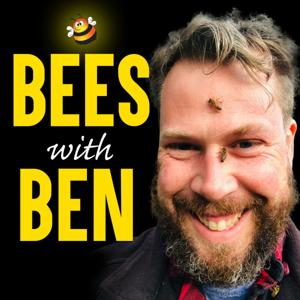


As Ben observes, there are so many ways in which beekeepers can no learn about the hobby: books,
clubs, mentoring, and of course the internet. And a good source of online information for
beekeepers in this country is the Facebook group ‘Backyard Beekeeping Australia’. Barry Roberts,
the founder of the group, is the special guest on episode 99 of the Bees with Ben podcast.
The group was founded in 2018 and now boasts more than 19,500 members, making it the largest
Australian Facebook group supporting backyard beekeepers. It is focussed upon educating
beekeepers and assisting them to improve their beekeeping techniques. Barry says that he originally
created the group because the existing local Facebook pages were dominated by commercial
apiarists and he wanted to provide a hobbyist perspective. Initially, he spent a lot of time putting
together a library of resources and materials. Membership is open to anyone; currently about 90%
are local beekeepers, but overseas members are also encouraged, particularly since they are able to
provide valuable insights into the management of pests and diseases with which we have
comparatively little experience.
Barry believes the identification and control of pests and diseases is something that many hobbyists
struggle with. He details the effectiveness of ripe bananas (which give off the gas ethylene) in
eliminating European foul brood and chalkbrood, and the lack of clear direction provided by the
authorities. Ben brings up the bee vaccine developed in the US - this will be the subject of a
forthcoming article.
Ben and Barry discuss a range of topics, from the upcoming honey season to the divide between
commercial and hobbyist beekeepers, and the decline of honey on the supermarket shelves. But the
current varroa outbreak in NSW is never far from the surface, and this is the basis of a fascinating
discourse.
Comparisons to Covid have become commonplace, and Barry tells Ben that living with varroa will be
similar to living with Covid, in that if it is not quickly eradicated, it is here for good and you will never
get rid of it. If that happens, then beekeepers will be forced to absorb additional workload to
implement a range of ongoing control methods.
Barry’s best guess, based upon the limited information supplied by officials, is that they have
‘already thrown in the towel’ given the removal of the standstill order in NSW. He notes that the
impending almond pollination could well be a ‘super spreader’ event, and that the almond industry
is putting a lot of pressure on Victoria to open up to the importation of bees from NSW. Barry says
that varroa may be contained, due to an ‘absolute fluke’, but that he is concerned that there are
queen breeders in the contaminated zones, and that queens are routinely posted hundreds of
kilometres away. Given the lack of real compensation available, he finds it highly doubtful that a
commercial apiarist with hundreds or perhaps thousands of hives, is going to admit to purchasing
queens from someone in the ‘red’ zones.
https://www.facebook.com/groups/BackyardBeekeepingAustralia/
A ‘viral video’ may be described as a video that rapidly gains popularity through a process of sharing
on the internet, through a variety of platforms such as social media, emails and websites like
YouTube. But how does a video qualify as viral? The most basic measure is the total number of
views, but the goalposts have changed over the years. In the early 2000s, a video could have been
considered viral if it hit a million views, but by 2011 YouTube personality Kevin Nalty considered the
benchmark to be ‘more than five million views in a three to seven day period’. Some viral videos can
also earn their owners some serious pocket money; one such video entitled ‘David after Dentist’
(depicting the humorous effects of anaesthetic) earned more than $100,000.
And so we come to the subject of the Bees with Ben podcast episode 98; joining Ben in the studio is
owner of DAP Pest Control and TikTok celebrity Dale Arnel. Dale has been in pest control for about
11 years and specialises in the installation of termite barriers. However, his favourite pest is the
European wasp - he is also a budding beekeeper.
Dale describes in some detail the difficulties of working in tight crawl spaces, and explains that the
termites found around Melbourne are subterranean in nature and come up from the ground,
building little mud ‘leads’ (or tubes) so that they can gain access to floors and walls. Ben reckons that
beekeepers are not designed to crawl around under houses and says that although he is also a
licensed pest controller, he has a couple of major issues in that he is claustrophobic and scared of
heights!
Back to our viral video. About three months back, Dale had a call from a client who had a wasp
problem in Healesville on Melbourne’s eastern fringe. She sent through a photo, which depicted a
nest that looked about the size of three basketballs, and Dale thought this may be a good subject for
a video. Upon arriving at the abandoned house - which Dale says looked like it could have been
haunted - large numbers of wasps were observed flying in and out of windows and the roof, so Dale
got suited up and went inside to investigate.
The resultant video records Dale’s initial reaction when he opens the bathroom door. The photo was
‘nothing like real life’ as the nest took up a whole corner of the room, measuring approximately 1.7
metres across and protruding out of the wall ‘like a verandah’! Dale says it looked like it some sort of
pulsating alien and felt like it was somehow telling him to stay away. He explains that European
wasp nests are normally subterranean and above ground nests usually attract attention and are
dealt with before they reach these mammoth proportions. Hidden away inside this vacant dwelling
and protected from the elements, Dale says this nest contained tens of thousands of wasps and,
“Was going to survive the winter and keep going!”
https://www.tiktok.com/@dappestcontrol/video/7076821304434822401?is_copy_url=1&is_from_webapp=v1
https://www.dappestcontrol.com.au/
A ‘sommelier’ is typically associated with wine - a highly trained and knowledgeable professional normally only found in fine restaurants, who specialises in the service of wine, as well as pairing wine with food.
It follows equally that the term could also refer to an expert in honey, trained to distinguish all the different nuances of flavour, texture and aroma. Melbourne-based Jessica Locarnini is in fact a qualified honey sommelier, and she is the featured guest on episode 97 of the Bees with Ben podcast. Jessica received official certification from the American Honey Tasting Society after completing sensory analysis training in the US - learning to detect hundreds of different aromas and even distinguish the type of flowers from which nectar and pollen were originally collected purely from the honey produced.
On website honeymerchant.com.au, Jess explains that she returned to Australia with an even deeper appreciation for the complex flavours of Australian honey: ‘Australian beekeepers work their magic in a land of extremes filled with challenges like fire, flood and drought while being surrounded by some of the most diverse landscapes and flora on the planet. All this is reflected in the unique and varied flavours of our honey.’ In an interview with goodfood online in 2021, Jess runs through the evaluation process using a wine glass in which has been placed a sample of honey. She first holds it up to the light, then examine the aroma, and finally rolls a small sample round in her mouth. It certainly sounds like she could be talking about wine, as adjectives such as ‘caramel’, ‘camphorous’, ‘spicy’ and ‘medicinal’ start to emerge. In fact, Jess finds many similarities between tasting honey and wine: both have complex aromas and flavours, and honey tasters also use a palette cleanser between samples (in this case, green apple).
‘When you smell honey, it inevitably evokes memory,’ she says.
Locarnini now works with beekeepers to promote the unique character of local honeys, and is dedicated to developing an appreciation for our honeys through tasting, pairing and education. She likes to pair honey with cheese of a similar intensity, one such example being orange blossom honey with goat’s curd. ‘And you can increase the textural experience of a good crumbly cheddar with honey that has crystalised.’
But she is also mindful of the need to conserve our unique Australian environment, and the health of our bees. Jess joins Ben in the studio for this truly fascinating and engaging episode, in which she walks Ben through a ‘live, non-visual honey tasting’ that she reckons could well be a first for a podcast. It will certainly be a revelation for many listeners. Ben describes Jess as, ‘An absolute guru.’ She responds by saying that being a ‘honey sommelier’ is her super power!
http://honeymerchant.com.au
https://www.instagram.com/honeymerchant/
"Given the recent Varroa incident in NSW, Daz and Mandi, from Mandi's New Zealand Postcode Honey have kindly offered to help inform us with some sensible, down to earth advice. With over 25 years experience in beekeeping, 15 years working with varroa and experience beekeeping in Australia, NZ and the USA, Daz and Mandi will give a short no nonsense chat and then we will open up the discussion so your questions can be answered. Basically, there is NO need to panic and we are just taking this opportunity to become more informed and hope you go away feeling more at ease around the idea of varroa".
Fight the Mite: An Unparalleled Threat to
https://www.indiegogo.com/projects/help-save-australia-s-bee-population/x/29654681#/
https://www.hivebuddy.com.au/
https://www.facebook.com/MandisNewZealandPostcodeHoney/
Way back in episode 16 of the Bees with Ben podcast, Ben introduced Richard Noel as a
dear friend, a lovely English chap, an ex-paramedic, a landscape gardener, and now
passionate beekeeper with a full-time bee-oriented business. A few years back, Ben was
lucky enough to stay with Richard for a week at his home in Corseul, a town in Brittany,
northwest France, and during this period Ben was able to see the effects of varroa mites upon
Richard’s bees, and to gain some insight into Richard’s management regime. It was only
natural, therefore, that when varroa was discovered in Newcastle on the New South Wales
coast last week that Ben immediately called Richard for his thoughts on this incursion, and
out of that this extraordinary podcast episode was quickly organised (episode 95) which was
also live-streamed on Richards YouTube channel.
Ben starts by stating the current position with respect to the outbreak: two infested hives have
been discovered and as at 6:00 p.m. on Sunday 26 June the movement of hives is prohibited
throughout the state of NSW.
Referring to this as a ‘lockdown’ in one of several references that parallel Covid, Richard is
immediately concerned about unregistered and feral hives - and the fact that he has heard
there is a national park close to the site of the incursion. He also wants to know about winter
temperatures in the region, since in Europe there is a ‘brood break’ during which the mites
cannot reproduce. This seems unlikely in Newcastle’s climate.
Richard says that ironically because Australia has healthy bees, we may also have healthy
mites. He says there is no single correct answer, and if the outbreak spreads.
There are so many issues raised by the possibility of a widespread outbreak in Australia
including, for example, whether there is a list of approved mite treatments, and how these
should be administered. The almond pollination season is only weeks away, and with the
movement of hives in NSW prohibited, this billion-dollar industry is now in jeopardy.
Richard emphasises the need for an arsenal of mite control measures, but says brood breaks
are very valuable, and that oxalic acid is a ‘soft’ treatment that is cheap, organic and
effective. He says it is very difficult to produce queens able to reliably pass on VSH due
simply to the genetic variation in the field, but that if you maintain strong, prolific colonies,
you will go a long way towards keeping varroa at bay.
Both Ben and Richard are agreed that Australian authorities must throw everything possible
at this current incursion while they have the chance. Although Richard has never known life
without varroa, he acknowledges that life would be very much easier without it.
Australian beekeepers pondering a future with varroa will find this podcast instructive.
YouTube link available here https://youtu.be/0KLsbeSTEL8
Kris Fricke is our featured guest on episode 94 of the Bees with Ben podcast. Kris became a
professional apiarist in 2005 and has kept bees in both California and Australia - at one time
maintaining more than 500 hives. He has also worked with bees on projects in various parts
of the African continent, amongst other destinations. In 2015, Kris founded Bee Aid
International after attending a conference on African Beekeeping held in Arusha, Tanzania.
He realised that there were many communities desperate for quality training, but a general
lack of government funding for these local projects. Thinking outside the square, Kris
decided to seek alternative funding through charitable donations.
Citing impact reports that indicate a 56-66% increase in income for the entire community for
previously completed projects, Kris believes that beekeeping is the epitome of the ‘teach a
man to fish’ proverb. Every member of the community can benefit: beekeepers can create a
new avenue of self-employed income; they may also train others in the art; carpenters may
specialise in the construction of hives; garment makers can fashion protective clothing; and
metalsmiths can manufacture tools. And then there are the retailers who take the honey to
market, as well as the cottage industry that can develop around a range of products made
from beeswax. Kris’ ambition is to one day be able to work on development projects full
time.
Kris also hosts a podcast entitled The Apinautica, which is part travelogue, part
documentation of his beekeeping exploits in developing countries. Ben recently caught up
with Kris at the Australian Bee Congress in Sydney and arranged to interview him for this
podcast.
The podcast starts in a very unusual way - no spoilers but this has never happened to us
before and is unlikely to ever again. You’ll have to listen to find out!
https://anchor.fm/beedev/
https://m.facebook.com/worldbeedev
After a break for a couple of weeks, Bee’s with Ben is back with episode 93 of the podcast. In the
interim, Ben attended the Australian Bee Congress in Sydney. This was just the fourth event of its
kind, despite the inaugural one being held way back in 1972, but bee enthusiasts will only have to
wait four years for the next congress, and Ben encourages anyone with an interest to take part.
There were some fascinating speakers along with innovative trade shows. A couple of things that
stood out for Ben were plastic ‘nuc’ boxes and research into a pheromone lure for African small hive
beetle. A revolutionary refrigerated method of moving hives, complete with misting systems, will be
the subject of a future podcast! One big talking point surrounded the price of honey on a wholesale
level, as there is plenty of surplus around at the moment; another was the glut of inferior imported
product which is damaging local markets. The congress also represented a great opportunity to
network and meet new people - or to simply put a face to a name. Alex Mazur is a young Ukrainian
who has already enjoyed an extraordinary career with bees, and we were thrilled when he agreed to
participate in this episode of the podcast. Upholding the family tradition, Alex is a fourth-generation beekeeper. After moving to Australia
about three years ago, he spent a year with Warren Taylor’s company, Australian Queen Bee
Exporters, the largest beekeeping business in Australia, with 15 employees managing close to 10,000
hives and producing an incredible 120,000 queens per season. For the last two years he has worked
with another veteran Australian beekeeper, Terry Brown of Browns Bees Australia Beekeeping
Supplies.
Alex says that sunflower honey is the most common variant produced in Ukraine (predictably, given
the widespread cultivation of sunflowers); it is bright yellow in colour and good for creaming as it
crystallises fast. Sunflower honey does not have a strong taste, and apparently is not popular in
Ukraine, with the locals preferring something ‘special’ like manuka or jarrah; Alex explains that often
people don’t understand that quality is more important than variety or brand.
Of course, Australian beekeepers do not have to deal with the ravages of the varroa mite, but one of
the major differences that Alex has experienced is the need to wear protective clothing, which he
usually never did at home, as our bees are somewhat more aggressive.
And his favourite part of the conference? Alex was particularly interested in the honey
‘fingerprinting’ project initiated in WA and thinks that laboratory analysis could potentially be of
great benefit in proving origin and quality and therefore could have a big influence on price.
As a professional beekeeper who is a relative newcomer to our shores, Alex has a unique perspective
on Australian bees and beekeeping, and this makes for an intriguing and informative podcast.
Our guest for episode 92 of the Bees with Ben podcast is Carmel from ‘CMG Honeybee’. Carmel hails from Melbourne’s west and had a varied career before turning her passion for bees into a business. Originally from Kangaroo Island in South Australia, where she grew up on eighty acres and was always surrounded by wildlife and the bush, Carmel moved to Queensland after completing high school to study music. She worked as a professional musician in a marching band before studying hairdressing, and then moved down south when her then husband was offered a job in Melbourne more than thirty years ago.
Since then she has raised a family as a single mum, working first as a hairdresser and then in various capacities at Yarraville West Primary School, where she also ran the choir and a class in face painting! She supplemented her income with a second job as a security officer.
Carmel’s journey into beekeeping came about largely by accident in November 2012, when she discovered a swarm that had taken up residence in a wall cavity of her rented property. She was acutely aware of the problems caused overseas by Colony Collapse Disorder, and determined to save the bees, which her landlord wanted to poison. She had heard of a rather colourful character called Adrian who had host hives around Melbourne and used to ride a rickshaw around Footscray; Carmel was face painting at a festival when she learned that Adrian and some other beekeepers were in attendance, and met up with a lady named Angela Castella who by coincidence lived on the same estate and taught her how to catch swarms.
Covid was difficult for CMG, as Carmel lost half her business through the inability to conduct school talks and incursions. Cash flow is a real problem in the beekeeping industry and winter can be a struggle. However, Carmel has learnt the benefit of investing in herself, and is undertaking some business training which she believes will stand her in good stead. She also advocates regular exercise and a healthy diet, along with clear boundaries, and the segregation of working hours and personal time - creating a balance between work, rest and play.
Moving forward, Carmel says that she has a hive in a childcare centre that has produced some amazing and unexpected results in terms of wellbeing; she also wants to grow the mentoring side of her business, as well as explore the possibilities of apitherapy.
https://www.cmghoneybee.com.au/
https://www.instagram.com/cmg_honeybee/
This episode we continue our chat with Ben Moore all about bees. Ben actually hosts his own podcast https://www.bensbees.com.au/category/podcasts/ and literally lives and breathes everything bee related. This episode is the second installment of a series of episodes Ben and I will produce all about stinging insects. So we will touch on social wasps, solitary wasps, our native bees and of course European Honey Bees. We talk about their ecology, lifecycles, and tips on working with stinging insects. Part 2 sees us really getting into the biology of European Honey Bees and in particular swarming behavior. So if you deal with bees and want to know more this is the podcast for you!
https://podcasts.apple.com/au/podcast/pestie-profiles/id1586241937
For episode 90 of the Bees with Ben podcast, we are heading to the tropics to catch up with Maurie Damon. Maurie has been keeping bees for decades in the Cairns region and remembers as a twelve-year-old being intoxicated with the intense flavour of honey from a nest of native bees.
Maurie tells Ben that one of the main differences about beekeeping in the tropics is that hives must be placed on stands to lift them about forty centimetres off the ground. One reason is the heavy ‘dew’ (there can be up to 150 millimetres of rain overnight). The other is the cane toads. Maurie says given the opportunity the troublesome toads will tap on the entrance to a hive and wait for an unsuspecting bee to investigate, whereupon it becomes a snack. Even hives on stands are not exempt from attack, as the toads have devised a cunning plan to get to the bees. They climb on top of one another, forming a pyramid; the uppermost toad eventually reaches the entrance to the hive, and when it has had its fill, falls off and helps lift its comrades to get a feed. The toads are unaffected by bee stings and swallow the insects whole.
Surprisingly, the toads have one beneficial aspect. When the larvae of small hive beetles crawl out of hives to pupate in the ground, the toads are waiting to devour them as well. Maurie reckons the toads may have been released a hundred years too early! He says nature has a way of working things out and cites the problems that beekeepers in the tropics had with wax moths in the 1970s and 1980s. These pests are now held in check by a native parasitic wasp, which lays its eggs in the wax moth grubs, as a food source for its young. When a researcher asked Maurie for some wax moth larvae to study, he could find none that were not infested by the wasps!
Maurie started his professional beekeeping career in Cairns and then moved to the Atherton Tablelands, where pollination services were in demand for winter-flowering crops such as avocados, mangoes, lychees and pumpkins. The business grew and grew; honey was initially sold at markets, but later to supermarkets and distributors. When he couldn’t produce sufficient honey in Cairns to satisfy demand, he shifted a heap of bees down to his block near Brisbane, where they were used to pollinate strawberries, mangoes and lychees. Every month he would drive down to pick up honey, which was then distributed to his customers in Cairns, where he maintained a large extraction plant.
From the publisher's feed

1,048 Listeners

37,610 Listeners

770 Listeners

194 Listeners
1,219 Listeners

316 Listeners
235 Listeners
130 Listeners

319 Listeners
12,486 Listeners