
Sign up to save your podcasts
Or

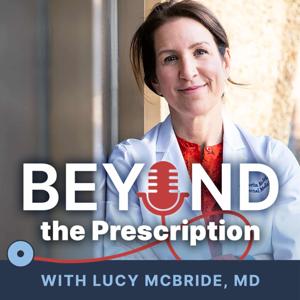


Leading political and intellectual historian and certified fitness instructor, Natalia Petrzela, firmly believes that exercise matters not only for your physical health, but mental health as well. Yet while we as a nation are obsessed with exercise, too many Americans are sedentary. Many of us equate exercise with losing weight – but health is about more than the number we see on a scale.
Natalia joins Dr. McBride to discuss America’s complicated relationship with exercise; why it’s so important for our overall health to prioritize movement; and how we can become healthier from the inside out.
Natalia is also the author of Fit Nation – The Gains and Pains of America’s Exercise Obsession, which shows how fitness in America is about more physical health— it’s a means for equity, inclusivity and community-building.
Join Dr. McBride every Monday for a new episode of Beyond the Prescription. You can subscribe on Apple Podcasts, Spotify, or at lucymcbride.com/podcast.
Get full access to her free weekly Are You Okay? newsletter at https://lucymcbride.substack.com/welcome
Please be sure to like, rate, review — and enjoy — the show!
You can also listen to this episode on Spotify!
Human suffering is impossible to fully measure. It includes our core values and beliefs. It encompasses our tolerance for pain. If medical decision-making is about avoiding risk, who gets to decide what’s even worth risking? If avoiding one risk means adding another, when are we doing “no harm”?
Doctors can measure blood pressure, blood sugar, liver enzymes, and white cells; we can even run genetic profiles to look for elevated risks for cancer (like the BRCA gene mutations). But there is no blood test for depression, no MRI for chronic pain, no line in the sand separating worry from debilitating fear.
In this episode, Dr. McBride discusses how modern medicine tends to discount things it cannot see — and how to better advocate for ourselves in the doctor’s office.
Join Dr. McBride every Monday for a new episode of Beyond the Prescription. You can subscribe on Apple Podcasts, Spotify, or at lucymcbride.com/podcast.
Get full access to her free weekly Are You Okay? newsletter at https://lucymcbride.substack.com/welcome
Please be sure to like, rate, review — and enjoy — the show!
The transcript of the show is here!
Dr. Lucy McBride: Hello, and welcome to my home office. I'm Dr. Lucy McBride, and this is "Beyond the Prescription". Today, it's just you and me. Every other week this season, I'll talk to you like I do my patients, pulling the curtain back on what it means to be healthy, peeling back the layers of everyday medical problems I see. In clinical practice for over 20 years, I've found that patients generally want the same things. A framework to evaluate their risks, [00:00:30] access to the truth and the courage to face it, and tools and actionable information to be healthy mentally and physically. So, whether it's managing weight, cholesterol, cancer, or mental health issues, we all want to feel more in control of our health. Here, I'll talk to you about how to be a little more okay tomorrow than you are today, and how to be healthy from the inside out. Let's go.
Today, dear listeners, I'd like to talk to you about how we do [00:01:00] such a bad job in the modern medical landscape at addressing the invisible suffering people experience. What do I mean by this? I read this article that you probably read in the New York Times, on February 1st, 2023. It was a fantastic article, written by Susan Dominus. The title, "Women Have Been Misled About Menopause." When I first read the article, I was honestly speechless. I was delighted but I was also kind of shocked that the mainstream media are finally recognizing [00:01:30] the invisible toll on women from the absence of hormones. I'm gonna get to the substance of that article in a minute. But the takeaway from that article, which I really encourage you to read, and I'll link it in the show notes, is not so much that women should be given nuanced information about hormone replacement therapy around menopause. They should. It's more that this article represents another example of modern medicine's inability to countenance things we cannot measure, [00:02:00] things we cannot see. In other words, as I talk about commonly, there are lots of things we can measure. We can measure cholesterol, we can measure blood pressure, we can measure genetics, you know, we can measure predispositions towards genetic phenomena. What is harder to quantify but no less important is the everyday suffering that people experience. And it's not just about menopause.
Let's think about other subjects in which we cannot quantify suffering. Let's talk about mental health. There's no blood test, there's no MRI [00:02:30] for depression. There is no line in the sand that separates anxiety that's unhealthy from anxiety that is "normal". Let's talk about COVID-19 and our response to it. We, for good reason, protected, at all costs, against COVID-19 in 2020, when we didn't know what was going on, we saw people dying, vulnerable people in nursing homes particularly vulnerable. But we also, [00:03:00] in my humble opinion, failed to acknowledge, over time, as more information and data was collected, and as we had extraordinary vaccines, we failed to zoom out and recognize that health is about more than the absence of COVID-19. In other words, not having COVID is great. But health is also about being in the classroom, seeing the faces of your teachers, participating in social activities. Particularly for young minds and for older people, [00:03:30] social interaction is crucial. But those are not measurable. There's no PCR test for despair. In other words, it's much easier to defend against the enemy that we can see than it is to protect against the things we can't see.
Here's another example of where we don't do well in this department. By the way, this is not gonna be a depressing podcast episode, although if you're depressed, you know, fine. I have lots of thoughts and ideas on how we can mitigate this problem, [00:04:00] from a societal level and on an individual level. But another area in which we see this problem where we don't countenance the invisible is in conversations about death and dying. I have the honor of being part of these conversations. My patients who have terminal illnesses, my patients who are elderly and infirm, they have accumulated medical conditions, none of which is going to necessarily take them, but we know that given their age and their comorbidities, that they have, you know, less than two years, less than five years to live. [00:04:30]
The way I approach these conversations with families and the patient is not by helping them decide on a menu which medicine, which medical procedure they want, at which time and which day, because guess what? We can't predict the future. We don't have a crystal ball on how everything is going to go in the last days, months, years of life. So, instead of asking people, "Do you wanna be on a ventilator? Do you want dialysis? Do you want aggressive measures, you know, at the end of your life?" I instead frame the question in a different way. What gives you meaning in your life? [00:05:00] In other words, let's center life in the question instead of death. Let's center your values as a way to pressure-test our decisions moving forward about interventions like feeding tubes or dialysis.
Let's take an example. And my friend Eleanor Tanno, who's a physician in the D.C. area, and a good friend of mine, has written me a guest post for my newsletter about this very issue. As she says, you know, when she's talking to patients and families about end-of-life decisions, how can
you decide on what you want for dinner [00:05:30] when you don't even know what's on the menu? In other words, when we're thinking about end-of-life decision-making, planning ahead, we wanna ask the patient, what is it you live for? And what are the things that you consider a bare minimum for a quality of life? And if your quality of life is contingent on being able to read the New York Times, listen to Beethoven, or know your grandchildren's names, any medical intervention that we're deciding on that's not gonna restore those faculties [00:06:00] is something we should spare you.
Because at the end of the day, we do harm by prolonging life that's not quality. Then this gets back to my original point that we don't do a good job of measuring things we cannot see. It is harder to measure the value someone places in the ability to identify music they hear on the
radio than it is to quantify their EKG, their heart rate, their blood pressure. Whether we're talking about menopause, and the absence of hormones, [00:06:30] and the unmeasurable suffering, like hot flashes and night sweats, sexual dysfunction, low sexual desire, loss of muscle tone in the pelvic floor, or whether we're talking about the despair that existed during the pandemic and that still does, or whether we're talking about people's core values or the way they value life, we have to do better as doctors, and as a …
You can also check out this episode on Spotify!
It turns out that caring for others carries occupational risk.
Anyone who has ever cared for aging parents, agitated teens, or sick friends has experienced symptoms of emotional and physical depletion. Caregiver burnout is not only common, it affects our health. Just as caregiving bleeds into everyday life, there’s no partition between our body and mind.
On this episode of Beyond the Prescription, Dr. Emily Silverman, physician and host of The Nocturnists podcast, shares her remarkable journey from burned-out physician to advocate for caregiver well-being.
Dr. Silverman approached her medical training with enthusiasm and eagerness, but everything changed when she worked two back-to-back 28-hour shifts and realized how burned out she was.
She began identifying more with her sick patients than her medical colleagues. The “work hard” culture of her residency program seemed to favor showing up at all costs and efficiency over the emotional and physical needs of residents.
Coping with her own health issues as she cared for patients, Dr. Silverman realized that if she was to treat others, she first needed to show herself the same level of care and respect. It was only when she acknowledged her suffering and asked for help that she knew she could authentically care for others.
Dr. Silverman went on to create a successful live show and podcast, The Nocturnists, for the medical community to speak openly about the struggles and triumphs of being a caregiver. There she has given space for others to tell their stories, learn from one another, and model compassion for others and for self.
It turns out that burnout applies not only to doctors but to anyone in a caregiving role.
Join Dr. McBride every Monday for a new episode of Beyond the Prescription. You can subscribe on Apple Podcasts, Spotify, or at lucymcbride.com/podcast.
Get full access to her free weekly Are You Okay? newsletter at https://lucymcbride.substack.com/welcome
Please be sure to like, rate, review — and enjoy — the show!
You can also check out this episode on Spotify!
Twice a month, Dr. McBride is trying something different. She will talk directly to you — sharing advice and top-line thoughts about the most important health issues she sees.
On this 13-minute episode, Dr. McBride explains the practical framework she created to help patients conceptualize their health, integrating medical evidence, the patient’s story, and real life.
Dr. McBride calls it the FOUR “I”s
* Information & data = the elements of our health that we can measure and see.
* Inputs = everything that we put into our health ecosystem.
* Infrastructure = the vehicle (i.e., the skeleton) that drives us through life.
* Insight = the process of laddering up from self-awareness to acceptance to agency over our health and well-being.
Helping people connect the dots between their own four “I”s lays the groundwork for improved physical and mental health.
Join Dr. McBride every Monday for a new episode of Beyond the Prescription.
You can subscribe on Apple Podcasts, Spotify, or on her Substack at https://lucymcbride.substack.com/podcast. You can sign up for her free weekly newsletter at lucymcbride.substack.com/welcome.
Please be sure to like, rate, review — and enjoy — the show!
Disclaimer: The views expressed here belong entirely to Dr. McBride. They do not reflect those of her employer, nor are they a substitute for advice from your personal physician.
The transcript of the show is here!
Dr. Lucy McBride: Hello, and welcome to my home office. I'm Dr. Lucy McBride, and this is, "Beyond the Prescription." Today, it's just you and me. Every other week this season, I'll talk to you like I do my patients. Pulling the curtain back on what it means to be healthy, peeling back the layers of everyday medical problems I see. In clinical practice for over 20 years, I've found that patients generally want the same things. A framework to evaluate their [00:00:30] risks, access to the truth, and the courage to face it, and tools, and actionable information to be healthy mentally and physically. So, whether it's managing weights, cholesterol, cancer, or mental health issues, we all want to feel more in control of our health. Here, I'll talk to you about how to be a little more okay tomorrow than you are today, and how to be healthy from the inside out. Let's go.
Welcome to our first one-on-one [00:01:00] meeting. I'm so excited to be here. I love talking to my guests. I've also been craving this kind of direct conversation where I can help strip some of the complex things I see in my office down to the studs, and then try to explain the way I frame various health issues, and then give people tools, and information to manage those issues in their everyday lives. As you know, I strongly believe that health is about more than just our lab tests, right? Our stories live in our bodies, [00:01:30] and the data that we can collect is only useful when we marry it with our lives, our stories, our pasts, and when people have access to nuanced information about how to take information, and apply it to their everyday existence. So, let's start with something really basic. I use a very simple graphic when I'm explaining to patients how I conceptualize health.
It's really, really simple. It's a two by two square. I'm not much of an [00:02:00] artist, but I can print out a box on my computer like a grid. If you're in your bed or sitting in a comfortable chair, maybe you want to close your eyes and imagine a two by two square. If you're driving, don't close your eyes, but maybe in your mind's eye, you can imagine this visual representation. So, what is it? I've called this graphic, "The Four I's." Why, "The Four I's?" Because I think of patients as the integrated sum of these different quadrants. The first I is information. [00:02:30] The second is inputs. The third is infrastructure. And the fourth is insight. So, imagine this, two by two square. In the top left corner, you have information, in the top right corner, you have inputs. In the bottom left corner, you have infrastructure, and the bottom right corner, you have insight.
If I've lost you, and you've fallen asleep, good for you. You probably needed a rest, but if you're still with me, I'd love to [00:03:00] keep going. Let's talk about the top right corner, information. Information is data, so things we can measure, from our cholesterol, our mammogram, our colonoscopy report, our genetic testing to look for our predisposition for breast cancer. Basically, information is the box where we put all the things that doctors love. Data, metrics, things we can quantify. Frankly, modern medicine does a really good job of helping people quantify all that data, right? [00:03:30] Patients love data so much that they're walking around with trackers to track their steps, their sleep, their moods, their energy, and then people have trackers to track their trackers, right? That's why all of these apps are so popular. The problem is that information, medical data in a vacuum isn't terribly useful.
We need context. So then, let's move over to the top right quadrant, inputs. Inputs are everything you put in your ecosystem, everything you put in your body, [00:04:00] whether it's kale and quinoa, or alcohol and marijuana. Every single thing that we ingest has impact on our bodies. Even things that are "natural," like supplements and vitamins, those things have direct effect on our everyday health. So, when I'm talking to a patient, I don't simply review their data, check their medical information, the data, and go through it like a checklist and tell them, "Great news, these look fine. See you next year." I contextualize it. In other words, I need to [00:04:30] know this top right corner. What are you putting into your ecosystem? What are you ingesting? Whether it's food, alcohol, vitamins, supplements, cigarette smoke, marijuana, cocaine, whatever it is, we needed to talk about it, and we needed to go over it.
The bottom left quadrant is infrastructure. This is, literally, your skeleton, the actual container that drives you through life. Remember, you only have one vehicle that takes you through life. You cannot trade your skeleton in like you can your Honda or your Prius. [00:05:00] Maintaining your skeletal health is essential for mobility, flexibility, pain control, general movement, and of course, exercise which is good for everything from diabetes to dementia. Okay, if you're still here with me, let's keep going. The bottom right quadrant is insight. Now, when I say insight, I mean self-awareness, awareness of the inseparability of your mental and physical health, and frankly, the whole ecosystem I've just gone [00:05:30] over. It's about understanding where you are on the continuum of anxiety. It's about locating yourself on the continuum of moods. It's about understanding your relationship with alcohol and food. It's about understanding the way you process stress, the way you handle relationships with work, with partners, and with yourself.
Insight is crucial, and insight informs how we think about the whole ecosystem. It informs how we [00:06:00] think about meaning, and purpose, and our lives in context. In sum, "The Four I's" is a visual representation of how I conceptualize health. It's very helpful. I have found for patients to look at each quadrant alone, and then in concert with the other quadrants. Because inevitably, they all talk to each other. Let's take, for example, someone who has high cholesterol. So, they have a data point that would go in the top left corner that they have high cholesterol. [00:06:30] I can say to that person all day long, "Eat less bacon, exercise more, your cholesterol's too high. I'll see you in a year." You know, that would be fine recommendation, but frankly, I don't believe in shaming people. I don't believe in telling people what to do. I believe in giving them the tools to help themselves.
More importantly, to appropriately …
You can also listen to this episode on Spotify!
Tashira Halyard is as fashionable as she is fearless. As an attorney, racial equity consultant, breast cancer survivor, and founder of the wildly popular blog and Instagram handle, Politics & Fashion, Tashira brings her audience inside her closet — and her world — nearly every day of the week.
Tashira brings her passion for equity and her fierce personal style everywhere she goes, but her path to success wasn’t paved in diamonds. In this episode, Tashira reveals how childhood trauma, her diagnosis of breast cancer, and a toxic relationship with work changed her, physically and emotionally, and how these painful experiences helped clarify her commitment to living boldly and unapologetically.
She is the author of Fight for Our Girls, a TV series that explores the intersection of race, gender, and trauma in the lives of Black girls. She also created the “The 21-Day Happiness Project,” a toolkit to foster self-awareness and self-care, and, most recently, a podcast called JustUs where she riffs with her BFF Margo about everything from racial justice to fashion runways.
Her goal? Empowering other women to leverage their self-worth for social progress.
Join Dr. McBride every Monday for a new episode of Beyond the Prescription. You can subscribe on Apple Podcasts, Spotify, or at lucymcbride.com/podcast or at https://lucymcbride.Substack.com/listen.
Get full access to her free weekly Are You Okay? newsletter at https://lucymcbride.substack.com/welcome
Please be sure to like, rate, review — and enjoy — the show!
You can also listen to this on Apple Podcasts or Spotify!
I’m excited to share my roster of amazing guests — and our conversations about health, wellness, and how to be a little more okay tomorrow than we are today.
A fun new feature! This season, every other week will be a sit-down with just you and me — where I go into more detail about the nuances of common medical issues. From the new weight loss drugs and hormone replacement therapy to the complexities of treating depression and anxiety, I can’t wait to share some practical advice and top-line thoughts about issues that affect our everyday lives.
Be sure to subscribe to the podcast on Apple podcasts, Spotify, or wherever you get your podcasts.
My weekly Are You Okay? newsletter is delivered free in your inbox every Monday. For lots of fun extras including early access to the podcast, consider a paid subscription!
Join Dr. McBride every Monday for a new episode of Beyond the Prescription. You can subscribe on Apple Podcasts, Spotify, or at lucymcbride.com/podcast or at https://lucymcbride.Substack.com/listen.
Get full access to her free weekly Are You Okay? newsletter at https://lucymcbride.substack.com/welcome
Please be sure to like, rate, review — and enjoy — the show!
Are You Okay? is a reader-supported publication. To receive new posts and support my work, consider becoming a free or paid subscriber.
You can also listen to this episode on Spotify!
Journalist and best-selling author Daniela Pierre-Bravo took an 18-hour overnight bus to New York City for her first interview in journalism. As the oldest daughter of a large family of Chilean immigrants — and having worked multiple odd jobs to put herself through college — this interview was her ticket to a new life. Yet as a DACA recipient, she struggled to feel like she truly belonged in the US.
Working tirelessly to be included in American life took a toll on Daniela’s mental health. She realized that she had tied her self-worth to productivity, sacrifice, and “fitting in” — instead of celebrating her individuality and unique talents.
Her new memoir, “The Other: How to Own Your Power at Work as a Woman of Color” chronicles her journey from self-sacrifice to self-empowerment. It is an honest account of the hopes, dreams, and barriers in the way of hard-working immigrants. It’s also a practical guide for women of color navigating the workplace.
On this episode of Beyond the Prescription, Daniela joins Dr. McBride to talk about the difference between inclusion and belonging, the emotional toll of not feeling seen, and the importance of showing up as our true selves for our mental and physical health.
Join Dr. McBride every Monday for a new episode of Beyond the Prescription. You can subscribe on Apple Podcasts, Spotify, or at lucymcbride.com/podcast or at https://lucymcbride.Substack.com/listen.
Get full access to her free weekly Are You Okay? newsletter at https://lucymcbride.substack.com/welcome
Please be sure to like, rate, review — and enjoy — the show!
You can also check out this episode on Spotify!
Principal dancer for the New York City Ballet, Tiler Peck, woke up one morning in 2019 in excruciating pain and unable to move. She was diagnosed with a herniated disc in her neck on an MRI, and multiple doctors recommended surgery. They also suggested she might never dance again. When Tiler asked if she could instead pursue physical therapy before — or instead of — surgery, one doctor asked if Tiler’s physical therapist wanted to be responsible if she ended up paralyzed.
Tiler went from abject despair to dogged determination to heal on her own terms.
And that’s what she did. Tiler listened to her body and sought a more nuanced approach to her neck. In the process, she learned more about herself than she ever imagined. From the physical manifestations of emotional distress to the power of saying “no,” Tiler’s seven months of immobility turned into a process of self-discovery.
As a result, she came back to ballet stronger and smarter.
In this episode of Beyond the Prescription, the dancer shares her insights about doctors, self-advocacy, and the power of knowing our own body and mind. She and Dr. McBride discuss treating the patient — and not just their test results — and the critical importance of more holistic approaches to health and well-being.
Join Dr. McBride every Monday for a new episode of Beyond the Prescription. You can subscribe on Apple Podcasts, Spotify, or at lucymcbride.com/podcast or at https://lucymcbride.Substack.com/listen.
Get full access to her free weekly Are You Okay? newsletter at https://lucymcbride.substack.com/welcome
Please be sure to like, rate, review — and enjoy — the show!
You can also check out this episode on Spotify!
Dr. Glynis Albright, fondly known as the Waffle Queen, has built an empire off of her pies, cookies and pound cakes. As CEO of the world renowned Glynis’ Kitchen, her treats have been tasted and loved by the likes of Bill Clinton and John Legend.
But cooking isn’t just Dr. Albright’s passion, it’s been her lifeline. When she was diagnosed with leukemia in her 30s, and with a PhD in nutrition, she used her superb culinary skills to whip up treats that tasted good and provided her with the nutrients she needed to heal. She then used those recipes to help others in her community struggling with their health.
On this episode of Beyond the Prescription Dr. Albright and Dr. McBride discuss our often complex relationship with food, how to abandon the shame inherent in diet culture, and to appropriately nourish our bodies and minds. They talk about the baker’s journey of self-discovery as she moved away from skipping meals toward preparing delicious ones for herself and others. As the inventor of the “Just Sweet Enough” line of treats for people undergoing cancer treatment, Dr. Albright herself is food for the soul.
Join Dr. McBride every Monday for a new episode of Beyond the Prescription. You can subscribe on Apple Podcasts, Spotify, or at lucymcbride.com/podcast or at https://lucymcbride.Substack.com/listen.
Get full access to her free weekly Are You Okay? newsletter at https://lucymcbride.substack.com/welcome
Please be sure to like, rate, review — and enjoy — the show!
You can also check out this episode on Spotify!
Award-winning NPR education reporter Anya Kamenetz saw firsthand the devastating effects of school closures during COVID on children’s learning, mental health and social-emotional well-being.
Her 2022 book “The Stolen Year: How Covid Changed Children’s Lives, And Where We Go Now” brings the stories of these children and their families to the forefront while providing historical context on the broken state of the U.S. education system.
Anya joins Dr. McBride to describe how the shift to remote learning exacerbated an already tenuous American public education system and discusses the lessons learned from a massive disruption of the U.S.’ last true social safety net. Anya offers advice to parents as they navigate the new “normal” while recognizing the diversity of pandemic experiences — even within the same household — and offers hope for the future of American families and children.
Join Dr. Lucy McBride every Tuesday for a new episode of Beyond the Prescription on Apple Podcasts, Spotify, or wherever you catch your podcasts. Find her at lucymcbride.com/podcast.
From the publisher's feed

8,325 Listeners
418 Listeners

9,140 Listeners

7,922 Listeners
226 Listeners
1,128 Listeners

28,984 Listeners

2,052 Listeners
355 Listeners

18,831 Listeners

1,218 Listeners
1,210 Listeners