Byte Sized Biographies…

Byte Sized Biographies…

Download on the App Store

Byte Sized Biographies… episodes

  • The Untold Story of Crime Boss and Sixteen-Year Federal Fugitive, James (Whitey) Bulger (Volume 5, Episode 10) Part Two
    For twenty years, Whitey Bulger terrorized Boston with the full collusion of the FBI.  On the run for sixteen years, he was eventually arrested on June 22, 2011. Litif got off with this stern warning but then made the mistake of telling Bulger that he was going to murder his bookmaker partner, a last straw.  On April, he was invited to the Triple O’s where Bulger stabbed him repeatedly with an ice pick and Steve … Continue reading The Untold Story of Crime Boss and Sixteen-Year Federal Fugitive, James (Whitey) Bulger (Volume 5, Episode 10) Part Two →
    1 hr 3 min
  • The Untold Story of Crime Boss and Sixteen-Year Federal Fugitive, James (Whitey) Bulger (Part Three)
    For twenty years, Whitey Bulger terrorized Boston with the full collusion of the FBI.  On the run for sixteen years, he was eventually arrested on June 22, 2011. The Massachusetts State Police Wanted poster for Whitey. Whitey did not limit himself geographically to South Boston.  No longer able to access Marshall Motors because a jailed, cash strapped Howie Winter’s family needed to rent it out, in early 1980, in a location owned by confederate George Kaufman, he set up another headquarters at a garage on Lancaster Street, only blocks away from Jerry Angiulo’s North End office in a restaurant on Prince Street.  Here Bulger routinely met with Ilario “Larry” Zannino, Angiulo’s number two man, among other bookies and criminals.  An initially strategic spot for such interactions, the Lancaster location set off a law enforcement reaction that was practically a keystone cop imitation.  When the Boston State Police received a tip that the garage was actually a chop shop, two investigators began surveillance from across the street.  Stunned when they observed the entrance and exit of some of Boston’s most notorious mobsters, they realized bugging the garage would probably provide a mother lode of indictments.  Jack O’Donovan, the head of the organized crime unit for the Massachusetts State Police had long suspected that the FBI was colluding with Bulger, and O’Donovan was intent on investigating and arresting Bulger himself. Final mug shot, after sixteen years on the run When Charley Gasko emerged from the elevator into the rear area of the apartment building he would not be meeting up with Josh Bond.  Instead, he would be confronted by a half dozen FBI agents and various other law enforcement officials, guns drawn.  They ordered him to get on the ground, but despite his age and relative frailty, his response underlined that this was not your typical 81 year old senior citizen, in fact it was not Charlie Gasko at all.  It was America’s Most Wanted criminal, James J. (Whitey) Bulger. Catherine Grieg, mugshot after Santa Monica arrest. Minutes later he called his longtime companion, the alleged Carol Gasko, who was in fact Bulger’s longtime girlfriend and fellow fugitive, Catherine Grieg, his accomplice during Whitey’s 16 year odyssey.  He told her that he had been arrested, that she should stay in the apartment and minutes later she was also brought down to the garage, both fugitives now in handcuffs. Josh Bond, property manager and Whitey's next door neighbor Bond, who also managed the Princess Eugenia, needed to reach Charles or Carol Gasko, the elderly, childless couple that occupied the northeast third floor corner apartment, #304.  The property manager actually knew the Gaskos’ quite well, his own apartment was next door to theirs and he interacted with Charlie Gasko quite frequently.  Bond heard the phone ringing in his earpiece but there was no answer.  He hung up, not sure what to do.  The reason for his call was that the Gasko’s storage unit at the rear of the building was broken into and he needed to know how the couple wanted to handle the situation.  Come down and meet him, Josh, in the back of the building or just have Josh notify the police. Foteas "Freddy" Geas, indicted for the prison murder of Whitey Bulger, now in Florence Supermax Prison On the evening of October 29, Bulger arrived at the US Penitentiary in Hazelton, West Virginia.  A high security prison where two inmates were murdered in the previous six weeks, unfortunately it also housed at least two individuals who made it completely unsuitable for Bulger.  One was Fotios (Freddy) Geas, serving a life sentence for the murder of two underworld criminals.  Although of Greek ethnicity, Geas was a hitman who operated in Springfield, Mass and was affiliated with the Mafia’s Genovese crime family.  In fact, he was arrested as part of the FBI’s investigation of organized crime in the Western Massachusetts area, an investigation that eventually involved the administration of Mayor Michael Albano.  Paul DeCologero was also a Northeastern Massachusetts organized crime figure, serving a lengthy sentence for murder.  On the morning of October 30, only minutes after Whitey Bulger’s prison cell door was unlocked at 6 AM, close circuit cameras showed Geas and DeCologero entering Bulger’s cell.  They left seven minutes later.  Whitey Bulger was discovered dead at approximately 8:20 AM, Whitey Bulger's grave, St. Joseph's Cemetery, West Roxbury, MA. He is buried with his parents, but has no individual marker. The Bulger family was not aware of his transfer to West Virginia and Jackie Bulger found out about his brother’s death from the media.  However, it seems that many inmates knew of Whitey’s impending transfer, Sean McKinnon, Geas’ cellmate, and the third man eventually indicted for his murder was recorded on a prison line telling his mother in advance that Whitey was on his way.
    1 hr 3 min
  • The Untold Story of Crime Boss and Sixteen-Year Federal Fugitive, James (Whitey) Bulger (Volume 5, Episode 10) Part Three
    For twenty years, Whitey Bulger terrorized Boston with the full collusion of the FBI.  On the run for sixteen years, he was eventually arrested on June 22, 2011. Whitey did not limit himself geographically to South Boston.  No longer able to access Marshall Motors because a jailed, cash strapped Howie Winter’s family needed to rent it out, in early 1980, in a location owned by confederate George Kaufman, he set up another headquarters at a … Continue reading The Untold Story of Crime Boss and Sixteen-Year Federal Fugitive, James (Whitey) Bulger (Volume 5, Episode 10) Part Three →
    1 hr 3 min
  • Harry Houdini, The World's First Entertainment Superstar (Part One)
    Few personalities have achieved the worldwide fame and popularity of Harry Houdini.  Successful in several different media ranging from vaudeville to motion pictures, this performer was also an astute businessman who incorporated both groundbreaking copyright implementation and sensational publicity to establish himself as the first 20th century entertainment superstar. Houdini, early publicity photo To garner publicity, Houdini now started to promote himself by slipping handcuffs in police stations after a meticulous search by detectives.  In San Francisco, he stripped down to a veritable loin cloth to illustrate that he could not possibly be concealing a key or lock pick.  Then police restrained him with at least ten of their own pairs off handcuffs, even going so far as fastening ankle shackles to the wrists with an additional set of cuffs.  Houdini was then lifted up and placed in a nearby closet, emerging minutes later with each set of handcuffs removed and now attached together, the magician still practically naked.  Publicity photos of Houdini’s scantily clad muscular frame, draped with all nature of restraints became commonplace.  Because he could not perform in such a risqué costume, Houdini instead added the wardrobe obstacle of a straitjacket strapped over and under the numerous locks, cuffs and metal restraints he typically employed.  This became another of the performer’s trademark routines. Houdini, with mother and wife. Although Houdini himself provided intense drama for his audience, he personally experienced one of the most dramatic moments of his own life when his mother, Cecelia, died on July 17, 1913.  Although all such mother-son relationships are typically close, Houdini had an especially strong maternal bond.  Having become a worldwide success, the rock that his family and especially his mother relied upon and an attentive son who lived up to his vow to his dying father, Harry Houdini’s interaction with his mother was a typically Old World relationship.  Unlike his behavior with non-family members, which was egotistical, controlling and financially ruthless, Houdini even described himself as a Mama’s Boy and it is has been speculated that his entire career and especially his death defying stunts were nothing more than an attempt to arouse approval, attention but most importantly Cecelia’s concern. Houdini with Bess Houdini, 1913 However, the nineteen year old was anything but an overnight success.  He first paired himself with an acquaintance factory co-worker and briefly with two of his brothers, most notably his younger brother, Theo, nicknamed Dash from his middle name of Dezo.  Eventually, Dash would strike out successfully on his own, performing as Hardeen, but Harry Houdini’s co-performer by then was Wilhemina Beatrice Rahner, nicknamed Bess, who also became Houdini’s wife in mid-1894.  Bess came from a German Catholic background, an unusual union within such a devoutly Jewish family.  All of the relatives eventually accepted the marriage and Bess became an integral part of Houdini’s act. Houdini, milk can publicity photo What resulted was one of his most famous tricks, the milk can escape.  Onstage, Houdini had audience members kick the four foot tall can to establish that it was in fact metallic and inflexible.  The can was then filled with water while offstage Houdini changed into a bathing suit.  When he returned, he was handcuffed and placed inside of the can after telling the audience to hold their breath for as long as they could.  Six hasps secured by locks, some even provided by spectators, were then secured and a screen was placed in front of the can, this process itself taking approximately a minute.  Houdini’s assistant, Franz Kukol, an Austrian hired while Houdini performed in Europe, stood by with an axe, the audience told that he was to break open the can if Houdini did not emerge in a set amount of time, the Austrian’s presence designed to add additional tension to the already potentially fatal undertaking. Houdini did employ a remarkable ability to hold his breath, as a young man he is said to have been able to do this for 3 minutes 45 seconds.  But on a regular basis he was able to not breath for about two and a half minutes, more than enough to take advantage of one aspect of his specially designed enclosure.  The so called milk can had rivets on it that were in fact fake.  Although anyone examining the top of the can who tried to pull it off would not be able to do so, anyone inside the can could quickly and easily push the top part of the can off with the locks still in place, put the top back on and in Houdini’s case easily slip out of his handcuffs.  He typically emerged in about three minutes, soaking wet, but free of his cuffs, having seemingly defied death in an inexplicable manner. Houdini, as he is lowered into Chinese Water Torture Cell Having received numerous challenges from various individuals incorporating Asian themed restraining devices, Houdini wished to adapt these exotic components within the ultimate escape challenge.  What resulted was the Chinese Water Torture Cell, an elaborate specially constructed glass, telephone booth sized container into which Houdini was lowered headfirst, his feet locked into wooden stocks.  But, before he even performed this trick in front of a live audience, Houdini attempted to anticipate any of the inevitable copycats who might attempt something similar.  Understanding that patents did nothing to stop any of his imitators who merely slightly varied any devices or performances to circumvent such restrictions, he instead performed what he eventually described as a one act play which he called Houdini Upside Down. This performance deliberately took place in front of an audience of one individual, Houdini then able to copyright it and its contents, asserting that only he had the legal right to perform such a trick.  Granted an official copyright by the Lord Chamberlain, entertainment managers were then formally notified of this legal perspective, warning them of consequences if this alleged intellectual property was infringed.

    53 min
  • Harry Houdini (Volume 5, Episode 9) Part One
    Few personalities have achieved the worldwide fame and popularity of Harry Houdini.  Successful in several different media ranging from vaudeville to motion pictures, this performer was also an astute businessman who incorporated both groundbreaking copyright implementation and sensational publicity to establish himself as the first 20th century entertainment superstar. To garner publicity, Houdini now started to promote himself by slipping handcuffs in police stations after a meticulous search by detectives.  In San Francisco, he stripped down … Continue reading Harry Houdini (Volume 5, Episode 9) Part One →
    53 min
  • Harry Houdini, The World's First Entertainment Superstar (Part Two)
    Few personalities have achieved the worldwide fame and popularity of Harry Houdini.  Successful in several different media ranging from vaudeville to motion pictures, this performer was also an astute businessman who incorporated both groundbreaking copyright implementation and sensational publicity to establish himself as the first 20th century entertainment superstar. Houdini, moments before jumping into the Charles River. To publicize commercial appearances, the escape artist also began the practice of jumping handcuffed from bridges spanning whatever river ran through the city where he was performing.  On May 6, 1907, when Houdini jumped from a bridge in Rochester, New York, he also incorporated the new phenomenon of motion pictures, a two minute clip of this exploit is still easily found on the internet today. Underwater for no more than fifteen seconds, Houdini quickly emerged, holding the now removed restraints in the air.  Not only was this particular jump witnessed by an estimated ten thousand spectators, Houdini cleverly was able to exhibit the film footage in subsequent performances in theaters and arenas, cutting edge stuff in 1907.  A subsequent jump in New Orleans, included not only handcuffs but chains wrapped around his limbs and padlocked at his throat.  This required only about thirty seconds, before Houdini emerged, holding all of the restraints triumphantly over his head, as a transfixed audience of thousands watched from a Mississippi levee.  Weather conditions also were circumvented, Houdini once jumping twenty five feet off of Detroit’s Belle Isle Bridge at the end of November, into the freezing Detroit River.  Similar successful jumps occurred into Pittsburgh’s Allegheny and Boston’s Charles Rivers but the danger involved in these attempts was evidenced when a head first dive into the ocean from an Atlantic City pier in front of 20,000 people resulted in Houdini slamming his head into the ocean floor. Houdini jumps off of Harvard Bridge into the Charles River. All of these escapades wound up routinely publicized on newspaper front pages all across America. Houdini, with President Teddy Roosevelt In Washington, DC, in January of 1906, he was placed in the former cell that confined Presidential assassin Charles J. Guiteau within the Murderer’s Row in the DC’s United States jail.  Stripped of his clothing and thoroughly searched, he was then placed in Guiteau’s former cell, jail personnel leaving him there and returning to an exterior office.  The cells were not only protected by sophisticated locks, they also featured a bar connected to the walls of the corridor, this bar also locked with a device that featured five tumblers and was unreachable from the inside of the cell.  He emerged in two minutes, but then added the extra twist of opening the cells of all of the confined criminals and persuading them to exchange positions within the row, extricating his clothing from another cell and presenting himself to the warden in his office in a total of twenty-one minutes. Houdini, with Charlie Chaplin After observing the huge contracts obtained by such performers as Charlie Chaplin, his path became clear, especially when two young producers offered him a deal to star in an adaptation of Twenty Thousand Leagues under the Sea.  Initially trumpeted as the highest amount of money to be paid for a performer in a motion picture up to that time, Houdini became the first of many artists to be disappointed by the promises of a film producer.  The film was never made and he eventually sued and recovered a modest amount of money but this foray only solidified Houdini’s desire to stop touring and get heavily involved in film production. Houdini family gravesite and memorial, Machpelah Cemetery, Glendale, Queens, NY Houdini’s distraction from performing was underlined by the undertaking of building a massive monument to his mother at her gravesite at the Jewish Machpelah cemetery in Queens.  This granite and marble memorial underlined his practical obsession with his mother and also was eventually meant as a final resting place for himself, another reason for the ornate 1000 ton addition to this maternal shrine.  A ceremony on October 1, 1916 attended by 250 guests in formal attire and Houdini in mourning garb evidenced the seriousness of the magician’s preoccupation with his mother’s passing.
    38 min
  • Harry Houdini (Volume 5, Episode 9) Part Two
    Few personalities have achieved the worldwide fame and popularity of Harry Houdini.  Successful in several different media ranging from vaudeville to motion pictures, this performer was also an astute businessman who incorporated both groundbreaking copyright implementation and sensational publicity to establish himself as the first 20th century entertainment superstar. To publicize commercial appearances, the escape artist also began the practice of jumping handcuffed from bridges spanning whatever river ran through the city where he was performing.  … Continue reading Harry Houdini (Volume 5, Episode 9) Part Two →
    38 min
  • Oscar Wilde, From Literary Genius to Social Outcast (Part One)
    In March of 1895, Oscar Wilde enjoyed fame and fortune as one of Britain’s foremost literary figures.  Only four months later he was inprisoned for the crime of “gross indecency,” convicted of violating Britain’s laws against same sex relationships.  Upon his release, he exiled himself to France, his career in ruins and never saw his family again. Oscar Wilde, college years At Oxford, Wilde continued his immersion in the classics.  The school was definitely a step up in class, his fellow students having matriculated at Eton, Harrow or similarly upper class English preparatory environments.  Many were also comparatively much wealthier than the modestly affluent Irish native. A later journalistic account described him as initially, naïve, embarrassed, with a convulsive laugh, a lisp and Irish accent. Wilde, in a typical outfit during his American tour. Wilde sailed for America, arriving in New York on January 2, 1882.  Oscar, who received a great deal of attention in London’s society columns, and whose tour was widely publicized in both Britain and the US, was swamped by journalists, even before he was able to clear customs and disembark, the press actually hiring boats to interview Wilde offshore.             Wishing to represent himself as an aesthete in appearance as well as philosophical perspective, Wilde greeted the press in a full length green topcoat, trimmed with fur on the cuffs and collars, a similarly colored and trimmed rounded green hat on his head, hair much longer then was typical.  A large collared shirt with light blue tie was visible underneath this outer layer.  He also wore a large seal ring with a classical Greek profile. Constance Wilde and son Cyril Oscar Wilde also remained focused on Constance Lloyd.  In Dublin, for a series of lectures, he was invited to the home of relative’s of Constance’s mother, Adelaide Atkinson Lloyd.  There, Oscar and Constance spent time together and socialized for the next few days, Constance attending both of Wilde’s Dublin lectures.  On November 25, the couple were left alone in the drawing room of the Atkinson home, the same room where Constance’s father proposed to her mother.  Here, also Oscar Wilde proposed to Constance Lloyd.  She accepted immediately and was described as, “insanely happy.” Wilde and Douglas in 1893 But just as Wilde reached the heights of public popularity, his private life resulted in his complete personal ruin and professional destruction.  Although his vow of celibacy applied to his relationship with his wife, it did not preclude Wilde from consorting sexually with men, on a frequent basis that included what were termed, “rent boys,” young, working class males typically in their late teens.  Wilde was also emotionally involved with Lord Alfred Douglas, nicknamed Bosie, a student at Oxford when Wilde was introduced to him.  The two began a tempestuous lengthy relationship that was also quite indiscrete. Calling card left at the Albemarle Club by the Marquess of Queensberry On February 28, 1895, Wilde entered a private club of which he was a member, the Albemarle Club.  He was hailed by the doorman, who handed him an envelope, stating that the enclosed card was dropped off ten days earlier.  Inside was a card embossed with the Marquess of Queensbury’s name and written in script, “For Oscar Wilde- posing Somdomite,” the last word misspelled but written with clear intent.  Only the card was delivered, it was judiciously placed in an envelope by the doorman and could have easily been seen by staff, as well as members, which included women.
    59 min
  • Oscar Wilde (Volume 5, Episode 8) Part One
    In March of 1895, Oscar Wilde enjoyed fame and fortune as one of Britain’s foremost literary figures.  Only four months later he was inprisoned for the crime of “gross indecency,” convicted of violating Britain’s laws against same sex relationships.  Upon his release, he exiled himself to France, his career in ruins and never saw his family again. At Oxford, Wilde continued his immersion in the classics.  The school was definitely a step up in class, … Continue reading Oscar Wilde (Volume 5, Episode 8) Part One →
    59 min
  • Oscar Wilde, From Literary Genius to Social Outcast (Part Two)
    In March of 1895, Oscar Wilde enjoyed fame and fortune as one of Britain's foremost literary figures.  Only four months later he was inprisoned for the crime of "gross indecency," convicted of violating Britain's laws against same sex relationships.  Upon his release, he exiled himself to France, his career in ruins and never saw his family again. Wilde and Douglas in Naples, 1897 Unfortunately, their reunion was so successful that both men began contemplating running off to Naples, the consequences be damned.  Robert Ross and various other associates and friends of Wilde soon heard about this development and were all uniformly dismayed.  Wilde was literally living off his wife’s allowance, funds that would be jeopardized if the news of his rekindled relationship with Bosie became known to her and especially her attorneys.  Even so, he needed to borrow money just to get to Naples by train, leaving this important fact out of any discussions he had about his reasons for heading to Italy. Robert Ross Robert Ross’ belief that Wilde’s literary reputation would eventually be reconstituted occurred faster than even he anticipated.  By the beginning of the 20th century, various critical analyses and biographies and accounts of Wilde’s life appeared to great interest.  His plays never really disappeared for any length of time, their popularity in British regional theater continued and all of Wilde’s theatrical works returned to popularity internationally as the century progressed.  By 1908, Ross had successfully repurchased all of Wilde’s copyrights that were sold off during Oscar’s bankruptcy proceedings.  These rights were then returned to Wilde’s sons. The Ninth Marquess of Queensbery, John Sholto Douglas John Sholto Douglas, the ninth Marquess of Queensberry.  Aggressively masculine and a sportsman, as opposed to his sons, the elder Douglas, is credited with creating what are known as boxing’s “Queensberry Rules,” the ten basic rules that govern boxing even today.  Despite great wealth, Douglas was extremely hostile, and possibly mentally ill. Constance Wilde Holland's grave. The Wilde connection was added much later by her relatives Although his wife also restored a modest allowance of ten pounds a month upon hearing of his break with Douglas, Wilde received the news that she died on April 7, 1898 after a botched operation to relieve her paralysis.  She was buried in Genoa, her gravestone using her newly assumed name of Holland with no mention of Oscar Wilde. Wilde deathbed photo. Note wallpaper. Finding Wilde borderline delirious and hearing that he had no more than days to live, Ross then went to the nearest Catholic church and brought back an Irish priest who quickly went through the official ceremony of converting Wilde to Catholicism.  Ross also sent cables to Frank Harris and Alfred Douglas, warning them of Wilde’s current state.  By the morning of November of November 30, Wilde had lost consciousness and was completely unresponsive.  He died that afternoon. Wilde's tomb, Pere Lachaise Ross also transferred Wilde’s remains from Bagneaux to the more prestigious Parisian cemetery at Pere Lachaise, already the resting place of Chopin, Balzac, Moliere and eventually Sarah Bernhardt, Edith Piaf and Jim Morrison. Ross also collected funds for a magnificent sculpted abstract sphinxlike creature, requesting that the artist Jacob Epstein include a compartment for the internment of Ross’ own ashes, a request that was not fulfilled until 1950, 32 years after Ross’ death at age 49 of a heart attack.  Epstein’s monument is perhaps too magnificent, it was repeatedly vandalized by lipstick kisses until cemetery authorities cleaned it and installed plexiglass to prevent such future vandalism.
    46 min

About Byte Sized Biographies…

From the publisher's feed

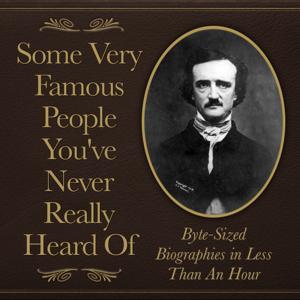
Some Very Famous People You've Never Really Heard Of, Byte Sized Biographies of the famous, the infamous and the quirky in less than hour. Think of that doorstop sized bio or history related book that…

More shows like Byte Sized Biographies…

HistoryExtra podcast by Immediate

HistoryExtra podcast

3,194 Listeners

1001 Heroes, Legends, Histories & Mysteries Podcast by Jon Hagadorn  Podcast Host

1001 Heroes, Legends, Histories & Mysteries Podcast

1,677 Listeners

Ben Franklin's World by Liz Covart

Ben Franklin's World

1,565 Listeners

Most Notorious! A True Crime History Podcast by Blue Ewe Media

Most Notorious! A True Crime History Podcast

2,773 Listeners

The Bowery Boys: New York City History by Tom Meyers, Greg Young

The Bowery Boys: New York City History

3,793 Listeners

Dan Snow's History Hit by History Hit

Dan Snow's History Hit

4,773 Listeners

History Unplugged Podcast by History Unplugged

History Unplugged Podcast

3,988 Listeners

Ridiculous History by iHeartPodcasts

Ridiculous History

4,525 Listeners

American History Tellers by Audible

American History Tellers

19,137 Listeners

The Wild West Extravaganza by The Wild West Extravaganza

The Wild West Extravaganza

777 Listeners

The Ancients by History Hit

The Ancients

3,368 Listeners

For the Ages: A History Podcast by The New York Historical

For the Ages: A History Podcast

385 Listeners

Short History Of... by NOISER

Short History Of...

2,826 Listeners

History Daily by History Daily

History Daily

2,160 Listeners

American History Hit by History Hit

American History Hit

1,596 Listeners