Byte Sized Biographies…

Byte Sized Biographies…

Download on the App Store

Byte Sized Biographies… episodes

  • John Wilkes Booth and the Lincoln Conspiracy (Part Two)
    A well known actor, John Wilkes Booth used his professional access to enter Ford's theater and assassinate President Lincoln Booth, in typical garb In April of 1865, John Wilkes Booth was a very depressed 27-year old.  His career in shambles, his fortune gone and involved in a volatile and passionate romantic relationship that was tenuous at best only added to his general agonizing over Confederate collapse.  To former colleagues and associates he seemed perpetually intoxicated, unstable, and possibly mentally unhinged.  Booth's proximity to Lincoln at the 1864 inauguration. Powell is believed to be standing below Lincoln in a wide brimmed hat. John Wilkes Booth subsequently spent several months attempting to coordinate a feasible plan to abduct the President.  He proposed kidnapping Lincoln during the President’s frequent trips to visit wounded troops at the Soldiers Home on the outskirts of the capital, on the President’s occasional, impromptu carriage rides which transpired with little security and even at Ford’s Theater itself which Lincoln frequently attended and Booth had both unlimited access to and specific knowledge of.  But none of these proposals ever amounted to any substantive efforts, the most glaring failure the absence of Booth to do anything at all despite his and other conspirators photographically documented presence only a few feet away from President Lincoln during the inauguration on March 10, 1865. Ford's Theater, Presidential Box, two days after Lincoln's assassination, photographed by Matthew Brady So familiar was Booth with the theater that he crossed under the stage during the performance via a trap door and subterranean passage.  He emerged on Tenth street, at the front of the building and headed to a saloon next door.  Casual observers would assume that Booth had come to the play as a pedestrian, only a few backstage employees knew he had a horse.  Booth entered the Star Saloon at approximately 10 PM.  He ordered whiskey and a bottle was placed in front of him and eventually water.  Quickly downing a shot, he remained alone and was not bothered by other patrons as he reflected on the task ahead.  Eventually, he paid for the drink and walked out of the bar and down the street to the theater.  He heard the dialogue as he entered, reassured that he still had plenty of time. Lucy Hale Booth’s access to the inauguration was the result of his ongoing and serious romance with Lucy Hale, the daughter of Senator John Hale of New Hampshire.  Booth and the Hales lived in the same hotel in Washington and the handsome actor and very attractive 24 year old first crossed paths in 1863.  Unlike some of Booth’s other, more sordid romantic entanglements, this relationship followed the traditional courtship mores of the period with attendance at formal dancing events and the exchange of flowery letters.  But it was also complicated by the Senator’s appointment as Minister to Spain, a posting that required the family’s relocation to Europe.  Lucy Hale would actually officially break up with Booth at least once, only to resume seeing him again.  What Lucy’s actual intention was in April of 1865 is still disputed but it was clear that, despite its unpublicized nature, this was a serious relationship. Garrett Farm, date unknown Richard Garrett petitioned the Federal government for reimbursement of the building and tobacco curing tools destroyed during Booth’s capture.  He was officially labeled an enemy sympathizer in a time of war and his claim was rejected.  The farm was eventually abandoned, the Garrett family shunned by their neighbors as complicit in Booth’s capture and death.  The notorious property was a popular landmark for tourists and although eventually sold, it remained unoccupied until the farmhouse, by now completely derelict, was bulldozed in the 1940’s by the land’s new owner, the federal government.  Today, the site of the Garrett farm is an empty clearing within the wooded median of a busy four lane Virginia state highway, a single historical marker on the side of the road the only acknowledgement of the historic location. Thomas "Boston" Corbett One individual who completely escaped official sanction was Booth’s executioner, Boston Corbett.  When angrily confronted by Everton Conger only minutes after Booth was shot, Corbett was completely forthcoming, claiming that it was the hand of God that directed the act.  For anyone who knew the sergeant, this was not an insignificant statement.  Corbett was so fanatically religious that he had previously castrated himself to avoid the temptation of the devil, which he believed omnipresent.
    1 hr
  • Charles Bukowski, Poet of the Damned (Part One)
    Charles Bukowski: Slacker, Drunkard, Misanthrope, Poet, Artist, Hero. The building where Bukowski was born in 1920, Andernach, Germany Heinrich Karl Bukowski was born in Andernach, Germany on August 16, 1920.  Andernach is a small German town located on the Rhine River, between Bonn and Koblenz.  Bukowski’s father, also named Heinrich Karl Bukowski was a sergeant in the US Army of occupation following World War One.  He met and impregnated Bukowski’s mother Katerina Fett in late 1919 and their marriage would not occur until July of 1920, one month before the birth of their son Bukowski on Santa Monica Beach The Bukowski’s settled briefly in Baltimore where they Anglicized their names before saving enough money to relocate to Los Angeles, where Bukowski’s father was born and raised.  Bukowski’s paternal grandparents were separated, his grandfather a successful carpenter plagued by alcoholism. The extended family was quite dysfunctional with siblings harboring deep resentment for each other.  Bukowski's father This dysfunction also plagued Bukowski’s relationship with his father, who beat him from a young age and was generally cold and hostile.  The family would come to reside in a typically modest home in a central Los Angeles neighborhood at 2122 Longwood Avenue.  Bukowski spent a great deal of time describing his painful and difficult childhood and he would refer to this address as the “the house of agony.”  Bukowski vacationing on Catalina Island, mid-Seventies Bukowski would publish his second novel, Factotum, in 1975.  This novel was an autobiographical account of Bukowski’s menial work career as a younger man.  It would be reviewed in the New York Times, the last sentence even comparing it favorably to Orwell’s “Down and Out In London and Paris.”  His column remained a longtime weekly feature of the Los Angeles Free Press after Open City folded and his works were featured across the literary spectrum from Black Sparrow to various pornographic magazines that to Bukowski were merely sexually graphic hackwork written for a buck.  Bukowski on Apostrophes While still an underground figure in the US, Bukowski’s stature in Europe was underlined by his October, 1978 appearance on such programs as the French intellectual television show Apostrophes, hosted by Bernard Pivot.  The central guest around a roundtable of celebrities, Bukowski was drinking wine out of the bottle and quickly got involved in a profane, drunken exchange with the host.  Mid-show, he decided that the interview was a waste of time and staggered out, propping himself up on the head of one of the other guests as the audience looked on with amused incredulity.  The DeLongpre house, in limbo Owners attempted to demolish the entire court where several older central Los Angeles dwellings, including Bukowski's, stood.  A lengthy process began to save the structure, ultimately successful, despite the potential developer's claims that Bukowski was among other things, a sexual degenerate, an abusive drunkard and an anti-Semite, Nazi sympathizer.
    30 min
  • Charles Bukowski, Poet of the Damned (Part Two)
    Charles Bukowski: slacker, drunkard, misanthrope, poet, artist, hero. Bukowski parking his Beamer at Santa Anita Although he was over sixty, Charles Bukowski was just hitting the stride of his professional life.  With money rolling in, he no longer gave public readings and his life settled into a daily, rigid, if undemanding  routine.  He got up late and then headed out in his newly purchased, expensive, 320i BMW sedan.  Opening the sunroof and tuning into a classical music station, Bukowski would head to whatever Southern California track was featuring live racing.  Santa Anita, Hollywood, Del Mar, it didn’t matter. Bukowski, relaxing with Linda He would bet a modest amount and then return home to have dinner with Linda Lee.  Then he would grab a bottle of wine and head to his writing study, working late into the night.  Linda King and her famous bust of Bukowski Linda King was an aspiring actress who ultimately turned to poetry and sculpting when her acting career went nowhere.  Through her LA poetry connections she met Bukowski and asked to sculpt his likeness.  After visiting him in 1970, at his DeLongpre apartment she was initially turned off by his flab, age and drunkenness but over time she became attracted to him enough to insist upon a makeover before they got involved.  An indication of Bukowski’s interest was his willingness to cut back on alcohol and to lose weight while pursuing this relationship.  Unfortunately, neither would remain monogamous during their subsequent five year involvement and this stormy relationship frequently deteriorated to one party tormenting or abusing the other.  Acquaintances  of Bukowski could immediately gauge the current situation by the presence of Linda’s remarkable sculpted likeness in the Delongpre residence.  If it was missing, Linda and Hank had broken it off, usually temporarily.  This break became permanent in 1975 after a raucous incident involving Linda smashing out the windows of Bukowski’s Carlton Way apartment with books she had stolen from the home’s interior.  She had reason to be angry after having suffered numerous taunts meant to inspire jealousy and even suffering blackened eyes as a result of Bukowski’s physical violence.  Ultimately, only the bust of Bukowski survived this relationship, Linda possesses it to this day. Bukowski, 1988 By 1989, Bukowski was in his late sixties.  His body began to wear out after years of abuse and he was actually diagnosed with tuberculosis, dormant since childhood but resurgent as a result of stress and debilitation.  A lengthy dose of antibiotics prompted Bukowski to give up alcohol and he would never resume his heavy consumption, his body no longer able to tolerate the effects of heavy drinking. Bukowski's grave, Rancho Palos Verdes, California Charles Bukowski was buried at Green Hills Memorial Cemetery after a funeral attended by friends, including Sean Penn and publisher John Martin, who both spoke at the service.  While the cemetery is located in the wealthy enclave of Rancho Palos Verdes, Bukowski’s grave is on a hillside overlooking the port of San Pedro.  His epitaph reads simply “Don’t Try” an allusion to the idea that if you are going to attempt an artistic or unconventional lifestyle don’t do it half-heartedly, go all the way.
    26 min
  • Benedict Arnold, American Traitor (Part One)
    The ultimate American traitor, Benedict Arnold's life was much more complicated  Death of Montgomery at Quebec Montgomery and Arnold spent December planning the inevitable storming of the city, a siege impossible against superior British artillery and December 31st the end of the enlistment period of many of Arnold’s militiamen.  They resolved to attack central Quebec City by scaling the walls on the first cloudy night towards the end of the month.  Perhaps not coincidentally an attack was ordered on the snowy night of December 30 to take place in the early morning hours of the 31st. Rockets signaled the 4AM attack by the divided American column but these rockets also alerted the British, who, tipped off by an American deserter, were expecting the attack.  Montgomery and several of his officers were killed after literally sawing through a log barricade and attempting to storm a heavily fortified blockhouse. Arnold, wounded at Saratoga As the sound of fighting reached Arnold in his tent in the vicinity of General Gates, again comfortably headquartered out of harm’s way, the demoted general could not stand staying out of battle and suddenly climbed on his horse and headed rapidly into the conflict.  Although Gates sent an aide to personally order Benedict Arnold off of the battlefield, this aide would never catch up with him.  Arnold spent the rest of the day leading several counterattacks, so visible at the head of several American assaults that it seemed miraculous that he was not killed.  Upon successfully seizing British fortifications after hand to hand combat, Arnold was inevitably wounded in the same leg injured previously in Quebec, his dead horse compounding wounds by falling on top of him.  With the British Army in full retreat, Arnold was carried behind the lines on a litter. General John Burgoyne, by Joshua Reynolds Washington became aware of a new British invasion in the Hudson Valley, this time commanded not by the plodding, deliberate Governor Carleton but by the flamboyant John Burgoyne.  Understanding that the current commanders of the colonial forces in the area, Philip Schuyler and Horatio Gates, having already surrendered Fort Ticonderoga without firing a shot, would be greatly aided by the addition of the aggressive and daring Arnold, Washington decided to involve him in the defense of the region. Burgoyne surrenders to Gates, October 17, 1777 Burgoyne’s 1,000 casualties underlined the overwhelming 3-1 manpower disadvantage he now faced.  Reluctantly, after meeting with whatever general staff that had not been killed, he came to the unavoidable decision to surrender, which occurred officially on October 17.  This stunning defeat of a battle tested, traditional British army at the hands of what was considered an undisciplined, under equipped rabble sent shock waves throughout Europe.  Site of Benedict Arnold's battle wound at Saratoga. His name is not inscribed on the monument
    32 min
  • Benedict Arnold, American Traitor (Part Two)
    Benedict Arnold is the ultimate American traitor, his life was actually much more complicated Peggy Shippen, sketched by John Andre During the British occupation, Peggy Shippen interacted closely with several British officers and enjoyed a flirtation with Major John Andre, a member of British commander Sir Henry Clinton’s staff.  Peggy continued to communicate with Andre after the British retreat from Philadelphia and when the British officer was appointed to head Clinton’s intelligence efforts, the Arnolds exploited this connection. John Andre On Arnold’s behalf, A Philadelphia loyalist named Joseph Stansbury covertly met personally with Andre in New York City  and established ground rules for communication by letter involving secret code and invisible ink.  Throughout 1779 Arnold provided Andre and Sir Henry Clinton information about troop movements.  When he began to request large sums of money for his defection, Andre made it clear that this must involve the surrender of a major army or military installation. John Andre, self portrait the day of his execution At noon on October 2, 1780, when he was conveyed to a peach orchard in Tappan, NY, nearby the stone house where he was confined, John Andre was greeted by a gathering of over two thousand people.  By then, his story had gripped the public imagination.  Accounts of the British officer toasting his captors and insisting that they remain in good cheer and sending a distraught servant from his presence “until you can show yourself more manly,” had only endeared him further as a tragic hero merely doing his duty.  Andre, a gifted artist, blithely sketched a self-portrait on the day before his execution and as he walked briskly to the gallows he is said to have only hesitated when he saw that he was to be hanged and not shot. Idealized version of Andre's capture Although the three men who detained John Andre, John Paulding, Isaac Van Wert and Daniel Williams have entered the history books as heroes of the Revolution, they were in fact thugs operating in the shadow of British lines, intent on robbing any loyalists who happened into their midst.  When Andre approached their hiding place near what is now the Tarrytown Sleepy Hollow border the three suddenly darted out onto the road and detained Andre at musket point.  Andre, confused by Paulding’s Hessian coat worn to facilitate an escape from a British jail in New York City only days earlier, believed that he had to be way beyond British lines.  He blurted out that he was a British officer and was glad to be among friends.  Informed roughly that he was among Americans, Andre tried to backtrack and protest that he was actually on official business from General Arnold and presented his pass.  Aggressively intent on money, his three captors ignored Andre’s threats of Arnold’s retribution and forced him into the woods.  Correctly understanding that he was a British officer, they insisted that he must have valuables, stripped him naked and found only his gold watch and a few continental dollars that Smith had given him. Leaving Andre wearing only his boots they even ripped apart his coat and his saddle in search of cash.  Convinced it had to be somewhere they finally forced him to take off his footwear, revealing the folded papers in one of his stockings.  Only Paulding was barely literate but he quickly deduced that Andre was a spy. Hanging of John Andre Although Washington conducted a brief negotiation with Henry Clinton, the price he demanded for Andre’s freedom was impossible to meet.  Arnold for Andre, a trade that would have contradicted British military regulations regarding deserters.  Clinton refused, also having personally guaranteed Arnold’s safety if the plot failed, but asked for a postponement to allow for an official meeting in which the case could be reviewed.  Clinton also enlisted Benedict Arnold to compose a letter threatening Washington with retribution against the numerous captives under British control.  By the time this letter was delivered, Andre’s fate had been sealed.  Although his hand is said by observers to have been shaking, George Washington personally signed the order for John Andre’s execution for ”treason against the United States.”  He refused Andre’s last request that he be shot by firing squad.  Washington reasoned that Andre was a spy and spies are to be hanged and he did not want to appear to be softening during one of the darkest periods of the Revolution. Peggy Shippen and daughter, painted after she fled to England But, probably realizing that he was going nowhere in Britain, Arnold purchased a ship and attempted to rebuild the trading business that he successfully conducted before the revolution.  He downsized his household, left his wife and family in London and moved to St. John, New Brunswick, Canada.  Spending much of his time at sea, Arnold had several business conflicts, was involved in a suspicious warehouse fire and even fathered an illegitimate son.  His unpopularity was such that he decided to sell all of his holdings in 1791 and return to London. Possibly ironic inscription on Arnold's last London address The last five years of Arnold’s life were a dreary existence in which his health failed, his eldest son died during military service in Jamaica and his only daughter suffered a stroke that left her an invalid.  His wife also was greatly affected by her social isolation and while she remained with her husband and handled his business affairs, her letters indicate a household permeated with economic uncertainty and despair. The London tombstone of Benedict Arnold Although a plaque in the basement of tiny St. Mary’s Church in Battersea, London memorializes Arnold, his wife and daughter, in fact Arnold’s remains lie unidentified in a common grave that resulted from a renovation of the church over a century later.  The stone tablet was actually donated in 2004 by an American who felt that Arnold’s initial achievements in the Revolution were not properly acknowledged.  Its basement location is currently occasionally used as a parish kindergarten so the memorial shares space with various children’s drawings and a fish tank.  So obscure is this monument that it can only be viewed by special appointment, a legacy in keeping with Benedict Arnold’s all consuming personal bitterness.

    35 min

About Byte Sized Biographies…

From the publisher's feed

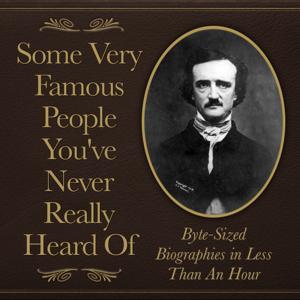
Some Very Famous People You've Never Really Heard Of, Byte Sized Biographies of the famous, the infamous and the quirky in less than hour. Think of that doorstop sized bio or history related book that…

More shows like Byte Sized Biographies…

HistoryExtra podcast by Immediate

HistoryExtra podcast

3,197 Listeners

1001 Heroes, Legends, Histories & Mysteries Podcast by Jon Hagadorn  Podcast Host

1001 Heroes, Legends, Histories & Mysteries Podcast

1,677 Listeners

Ben Franklin's World by Liz Covart

Ben Franklin's World

1,564 Listeners

Most Notorious! A True Crime History Podcast by Blue Ewe Media

Most Notorious! A True Crime History Podcast

2,772 Listeners

The Bowery Boys: New York City History by Tom Meyers, Greg Young

The Bowery Boys: New York City History

3,793 Listeners

Dan Snow's History Hit by History Hit

Dan Snow's History Hit

4,779 Listeners

History Unplugged Podcast by History Unplugged

History Unplugged Podcast

3,986 Listeners

Ridiculous History by iHeartPodcasts

Ridiculous History

4,526 Listeners

American History Tellers by Audible

American History Tellers

19,147 Listeners

The Wild West Extravaganza by The Wild West Extravaganza

The Wild West Extravaganza

777 Listeners

The Ancients by History Hit

The Ancients

3,372 Listeners

For the Ages: A History Podcast by The New York Historical

For the Ages: A History Podcast

384 Listeners

Short History Of... by NOISER

Short History Of...

2,826 Listeners

History Daily by History Daily

History Daily

2,161 Listeners

American History Hit by History Hit

American History Hit

1,592 Listeners