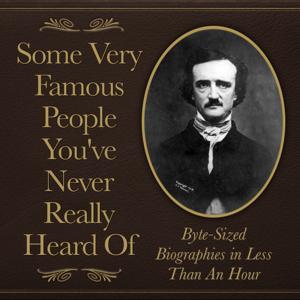
Byte Sized Biographies…

Byte Sized Biographies…

Download on the App Store

Byte Sized Biographies… episodes

  • Frida Kahlo (Volume 2, Episode 7) Part 2
    Frida Kahlo: Mexican Icon Since the death of Lenin in 1924, a power struggle over not only over the Soviet government but also the international Communist movement ensued with the winner Josef Stalin and the loser Leon Trotsky.  But Stalin was not content with merely expelling Trotsky from the party and the country.  His megalomaniac paranoia would subsequently require the physical extermination of his opponent, including Trotsky’s family.  Many of Trotsky’s relatives, including his first … Continue reading Frida Kahlo (Volume 2, Episode 7) Part 2 →
    25 min
  • Ian Fleming, Creator of James Bond (Part 1)
    Ian Fleming, who proved that a great deal of fiction is factual. Ian Fleming, Naval Intelligence Ian Fleming was born on May 28, 1908, the second son of Valentine and Evelyn Fleming. Both parents came from upper crust British backgrounds, Evelyn, known as Eve, was the descendant of a solicitor paternal grandfather and a maternal grandfather who was the personal physician to Queen Victoria, both of whom would be knighted for their efforts. Valentine, known as Val, was the son of the wildly successful Robert Fleming, a pioneering British financier who originated the investment bank Robert Fleming and Company. Muriel Wright, The real "Bond Girl" Although it would not become meaningful for many years, Ian Fleming initiated a relationship in August of 1935 that would have a profound effect on his future literary life.  In Kitzbuhel, on a summer holiday, he met twenty-six year old Muriel Wright.  Although she came from the type of elite British background that didn’t require that she work for a living, she was a professional model, especially of ski apparel and bathing suits with a figure to back it up.  She and Fleming hit it off immediately and they spent a great deal of time together.  Unfortunately, Muriel adored Ian Fleming, a situation that he took full advantage of, enjoying her company but not having the slightest intention of moving the relationship forward in any meaningful way. Ann Charteris, before her marriage to Fleming If Muriel was totally smitten and more than a little naive, Ann Charteris, another girlfriend, was more calculating and fully expected Fleming to propose when her husband was killed in the war.  He didn’t so she instead married Esmond Harmsworth, the Viscount of Rothermere. But, even after her marriage, Ann continued to see Ian on the side, a typically twisted Fleming emotional relationship.  When she miscarried with her first child, it was rumored to actually be Fleming’s and not her husband’s. Fleming's Home, Goldeneye, Jamaica By the end of the war, Fleming was interested in attempting to emulate his brother Peter Fleming, an accomplished travel writer and journalist for The Times.  But Fleming was not ready to forego a steady salary for the potentially financially unrewarding life of a writer so instead he took a job with the Kemsley Newspaper chain as a mid level manager.  Because his position allowed up to three months of annual vacation, Fleming spent all of his time off in Jamaica, which he first visited during the war.  He also began building a home near the northern coastline on Oracabessa Bay.  He would name this property Goldeneye and it would quickly become a destination for various British writers and celebrities who also spent time at the nearby Firefly, a home owned by Noel Coward.  Goldeneye overlooked a beach and a coral reef teeming with exotic fish and crustaceans and would play an important role in both Fleming’s romantic and professional life. Fleming with his first novel, Casino Royale Sometime in early 1952, Fleming began a process that he would continue while in Jamaica for the rest of his life.  After an early morning swim in the reef off of Goldeneye and breakfast in the garden with his wife, he would sit at a roll top desk in his living room and write continuously until noon.  After a nap and an afternoon outside, Fleming would return to whatever he had written earlier in the day and correct it.  The finished pages would then be deposited in his desk.  Although the exact date that Fleming began writing his first manuscript is still up for debate, it was finished in as little as four weeks on the eighteenth of March, 1952.  The novel was 62,000 words.  It was entitled Casino Royale.
    24 min
  • Ian Fleming, Creator of James Bond (Volume 2, Episode 6, Part 1)
    Ian Fleming, who proved that a great deal of fiction is factual. Ian Fleming was born on May 28, 1908, the second son of Valentine and Evelyn Fleming. Both parents came from upper crust British backgrounds, Evelyn, known as Eve, was the descendant of a solicitor paternal grandfather and a maternal grandfather who was the personal physician to Queen Victoria, both of whom would be knighted for their efforts. Valentine, known as Val, was the … Continue reading Ian Fleming, Creator of James Bond (Volume 2, Episode 6, Part 1) →
    24 min
  • Ian Fleming, Creator of James Bond (Part 2)
    Ian Fleming proved that a great deal of fiction is factual Ian Fleming, with his first novel Casino Royal Acquiring a name for his protagonist was simple enough.  When cosmopolitan visitors to Goldeneye found themselves a little bored by the repetitive, tropical languor, Fleming suggested some bird watching accompanied by the book Macmillan’s Field Guide to the West Indies by James Bond, a volume that sat prominently on a shelf near Ian’s desk.  Fleming deliberately wanted a simple name for a character that he described as “an anonymous blunt instrument wielded by a Government Department.” Blanche Blackwell Most likely, this aspect of the annual Jamaica sojourn did not go well, as Ann Fleming would return home in less than a month.  It was probably about this time that Fleming returned to his philandering ways, involving himself with an exotic, wealthy Jamaican neighbor, Blanche Blackwell, a formerly platonic friend who had at some indistinct moment became his lover.  Blanche’s family was among the most prominent of Jamaica’s colonial hierarchy and she was the carefree counterpart to Fleming’s wife’s combative tension.  Part of Ann’s discomfort, hostility and early return to Britain may have been her acknowledgement of this situation. Sean Connery, Amsterdam, during "Diamonds Are Forever" Ian Fleming stayed out of most of the major decisions revolving around the production of Dr. No.  He had no interest in composing the script and while he suggested first David Niven and then Roger Moore as the leading man, Broccoli had other ideas.  As Bond, he cast a relative unknown Scot, Sean Connery and plucked Ursula Andress out of total obscurity for the role of Honey Ryder. Ian and Anne Fleming, later in life On August 11, after dinner with his wife and a friend, Fleming suffered another massive heart attack.  Although he was coherent enough to joke with the ambulance driver who took him to the hospital, he would die in the early morning hours of August 12, aged 56.  It was also his son’s twelfth birthday. Caspar Fleming, far left Although Ian Fleming died on top of the publishing world, his wife and son would both experience great unhappiness following his death.  Although his son showed some academic promise as a teenager, he was expelled from Eton for, among other things, possessing loaded firearms in his dorm room.  He left Oxford after two years, accessed his trust fund at age twenty-one and quickly became an intravenous drug user.  He would commit suicide by a drug overdose of barbituates at his mother’s London apartment on October 2, 1975, aged 23. Grave of Ian, Anne and Caspar Fleming, Sevenhampton Never having come to terms with her relationship with her husband, Ann Fleming was plunged into deep depression and alcoholism after the death of her son.  She passed away from cancer at age 68, on July 12, 1981, at her home, Sevenhampton Place.  Today the mansion is owned by an auto racing magnate.
    25 min
  • Ian Fleming, Creator of James Bond (Volume 2, Episode 6, Part 2)
    Ian Fleming proved that a great deal of fiction is factual Acquiring a name for his protagonist was simple enough.  When cosmopolitan visitors to Goldeneye found themselves a little bored by the repetitive, tropical languor, Fleming suggested some bird watching accompanied by the book Macmillan’s Field Guide to the West Indies by James Bond, a volume that sat prominently on a shelf near Ian’s desk.  Fleming deliberately wanted a simple name for a character that … Continue reading Ian Fleming, Creator of James Bond (Volume 2, Episode 6, Part 2) →
    25 min
  • Grigori Rasputin, The Wrong Man in the Right Place (Part One)
    Rasputin, the wrong man in the right place. Rasputin, Early Years Grigori Rasputin was born on January 9, 1869, in the Siberian village of Pokrovskoe, one of nine children of Efim and Anna.  Even the number of surviving siblings of Rasputin is a matter of dispute. Possibly all of his nine brothers and sisters died only a few days after they were born and the only sister to perhaps survive was born in 1875 and named Feodosiya. That such biographical information is unclear is due to both the disorganization at this level of Russian society and the remote location of Rasputin’s birth and early life. Pokrovskoe was a small town located on the Tura river between the Siberian cities of Tyumen and Tobolsk. Tyumen is 1300 miles east of Moscow, even today an eighteen-hour automobile journey. In the late nineteenth century, this would have been a remote and isolated part of the world. Nicholas, Alexandra and Family Few individuals have generated as many legends and falsehoods as Grigori Efimovich Rasputin, the so-called “Mad Monk” of Russia. That Rasputin was neither mad or a monk is typical of much of the characterization of this Siberian peasant who would achieve a position of great influence over the government and court of Nicholas II of Russia, the last Tsar of the Romanov dynasty. Rasputin, Royal Family and Governess By the spring of 1907, Alexandra decided to introduce Rasputin to Anna Vyrubova, officially a lady-in-waiting at court but also the Tsarina’s closest friend.  Anna was another deeply religious woman from an aristocratic family, who married briefly and unhappily and became one of Rasputin’s most devout disciples.  Her opinion only strengthened his appeal to the Tsarina who trusted Vyrubova implicitly.  This connection further ingratiated Rasputin with other members of the aristocracy, although the staretz was starting to engender feelings of either great enthusiasm or profound disgust, a consistent thread throughout the rest of Rasputin’s life. Pyotr Stolypin By 1911, Stolypin had survived numerous assassination attempts, including a bombing that killed 28 people and almost killed his daughter.  As a result, Stolypin moved into the secure confines of the Winter Palace.  Pragmatic and politically astute, after a single interview with Rasputin, Stolypin came to the conclusion that the man’s influence over the ruling family was dangerous and should be eliminated.  However, historical accounts indicate that he repeatedly brought up the matter with the Tsar, who typically responded by deflecting any confrontation.  To his daughter, Stolypin said in the summer of 1911: “Nothing can be done about it. Every time I had an opportunity to warn the Tsar, I did.  And here is what he told me recently:  “I agree with you Pyotr Arkadievich, but better ten Rasputins than one of the Empress’s  hysterical fits.  That’s what the reason was.  The empress is ill, seriously ill, she believes that Rasputin is the only person in the whole world who can help the heir and it is beyond human capacity to dissuade her about it.”
    33 min
  • Grigori Rasputin (Volume 2, Episode 5, Part 1)
    Rasputin, the wrong man in the right place. Grigori Rasputin was born on January 9, 1869, in the Siberian village of Pokrovskoe, one of nine children of Efim and Anna.  Even the number of surviving siblings of Rasputin is a matter of dispute. Possibly all of his nine brothers and sisters died only a few days after they were born and the only sister to perhaps survive was born in 1875 and named Feodosiya. That … Continue reading Grigori Rasputin (Volume 2, Episode 5, Part 1) →
    33 min
  • Grigori Rasputin, The Wrong Man in the Right Place (Part Two)
    Rasputin, the wrong man in the right place. Rasputin, later years Rasputin routinely spent his summers in Pokrovskoe and June, 1914 found him back in his home town.  On June 29, Rasputin emerged from his house in order to hand a telegram to his postman.  He was greeted by a mysterious female stranger, dressed in black with a white kerchief over her features, only her eyes visible.  She silently bowed in front of him and Rasputin paused to reach for his wallet, thinking that she was a beggar in search of money.  The woman then produced a large dagger and rapidly stabbed Rasputin in the naval.  He fled with the stranger chasing him down the street, stopping only when Rasputin was able to knock her to the ground with a stick that was lying on the ground.  Both he and his wife screamed for help and a crowd quickly gathered, securing the attacker and taking her to jail.  Rasputin was taken into his home, losing consciousness and initially thought near death. Prince Felix Yusupov and the Grand Duchess Irina Yusopov continued to meet with Rasputin and then offered the ultimate bait, a visit to his home to meet Yusopov’s wife, Irina, an invitation that the lecherous Rasputin, having never met the glamorous and beautiful Irina, couldn’t conceivably turn down.  He didn’t.  Yusopov notified his conspirators that they would carry out their plan on December 16.  His wife would actually be at another family palace in the Crimea. Grand Duke Dmitri Several theories about the actual shooter have also evolved, the conspirators not wanting Grand Duke Dmitri, a royal, to have to take the blame for the murder.  Perhaps Yusopov or even Purishkevich might have initially wounded Rasputin, prompting the physically strong and probably intoxicated man to attempt to flee the palace. Whatever the sequence, a bullet into the forehead of Rasputin is what ultimately killed him.  Who actually shot him and exactly how will never be ascertained. Basement Room Where Rasputin Was Attacked The most familiar story of what ensued came from an account written by Yusopov in 1927.  Rasputin and the Prince entered the house from a side door and made their way to the cellar, sounds of music and voices supplying the background of the cover story.  Yusopov and Rasputin exchanged small talk, and the holy man ultimately ate the cakes and drank some Madeira, the prince becoming alarmed when the poisoned items seemed to have no effect. Rasputin began to grow impatient and made vague suggestions about knowing what Felix was up to.  Panicked, Yusopov went upstairs and retrieved the Grand Duke’s revolver.  He went back downstairs and after a few moments of hesitation told Rasputin to say a prayer and shot him in the midsection. Moika Palace Courtyard, Rasputin Fled Through Small Lower Right Door When the men returned, the group congratulated each other until Yusopov claimed he became concerned and wanted to make sure that Rasputin was actually dead.  The body was as they had left it, but suddenly Yusopov noticed that one eye was twitching.  As he moved closer, suddenly both eyes, “the green eyes of a viper” opened wide and Rasputin, foaming at the mouth, leapt to his feet and tried to grab Yusopov around the neck.  This from an individual who was shot in the midsection and allegedly poisoned with enough cyanide to kill a half a dozen men.  Yusopov managed to get away from Rasputin’s grasp and ran up the stairs, screaming for help.  The rest of the group quickly pursued Rasputin out into the side courtyard, the wounded staretz crawling on all fours, bellowing that he would tell the Tsarina everything. Rigor Mortis Photo of Rasputin Purishkevitch then drew his own revolver and put two more bullets into the lurching Rasputin, slowing him down until two more rounds finished the job.  The body was dragged back inside, quickly wrapped in a rug, driven to a bridge on the edge of the city and tossed into the freezing water. Autopsy Photo Of Rasputin, Note Bullet Hole In Forehead It would take divers to find the body, which had actually frozen to the bottom of the ice.  It was removed, photographed, placed in a wooden coffin and driven away in an ambulance.  Rasputin’s autopsy would ascribe the cause of death to gunshot, one in the chest, one in the back and one administered at close range directly into the forehead.  There was no poison in his system.  His face was horribly bruised, most of the damage probably administered by hitting the side of the bridge on the way into the river. Dmitri and His Wife, 1930's Grand Duke Dmitri’s banishment to the Caucasus meant that he avoided the clutches of the vengeful Bolsheviks who murdered most of his relatives.  Via Teheran and the help of the British embassy he made his way to Europe.  Living first in England and then in Paris.  His major claim to fame was his subsequent relationship with prominent women, among them Coco Chanel.  Broke, he ultimately married a Cincinnati heiress, they divorced a decade later and Dmitri died of tuberculosis, aged 50, in 1942, in Davos, Switzerland. Maria Rasputin, Circus Performer Needless to say, Rasputin’s immediate family had a rough go of it after the revolution.  Their large house in Pokrovskoe was seized by the Bolsheviks, only Rasputin’s daughter Maria was safely able to emigrate to the west.  His wife, other daughter and son, all harassed by the Bolsheviks, were dead by 1933.  Maria was able to capitalize on her famous name and performed in cabarets and even as a circus performer.  She eventually settled in the Silver Lake neighborhood of Los Angeles, teaching foreign language and writing her memoirs, which only added more contrived melodrama to the Rasputin legend.  She died in 1977 and is buried in of all places, a cemetery on Venice Boulevard in metropolitan LA.

    25 min
  • Grigori Rasputin (Volume 2, Episode 5, Part 2)
    Rasputin, the wrong man in the right place. Rasputin routinely spent his summers in Pokrovskoe and June, 1914 found him back in his home town.  On June 29, Rasputin emerged from his house in order to hand a telegram to his postman.  He was greeted by a mysterious female stranger, dressed in black with a white kerchief over her features, only her eyes visible.  She silently bowed in front of him and Rasputin paused to … Continue reading Grigori Rasputin (Volume 2, Episode 5, Part 2) →
    25 min
  • Georg Elser's 1939 Beer Hall Bomb Plot To Kill Hitler (Part One)
    Georg Elser's failure is one of the most remarkable stories in European history. Georg Elser, Circa 1939 The contrast between Adolf Hitler and Georg Elser could not have been more dramatic.  Hitler was a fanatically driven over achiever who had overcome his lower middle class background, lack of education and early personal failures to become one of the most charismatic and extroverted political figures of the twentieth century.  Elser was a simple woodworker, with an intermittent work history, an unmarried loner with little interest in politics or the world beyond the small towns of Southern Germany where he lived and grew up.  But, on November 8, 1939, the lives of these two individuals would intersect in a manner that today seems inconceivable. Burgerbraukellar, After the War. November 8 was an important date in the history of Nazi Germany and the life of Adolf Hitler.  It was on this date in 1923, that Hitler rushed into Munich’s Burgerbraukeller beer cellar with a group of followers and attempted to disrupt a speech of one of the political officials charged with ruling the German state of Bavaria.  Behaving theatrically, Hitler leapt onto a table, fired a pistol shot into the air and proclaimed “The national revolution has broken out! The hall is filled with six hundred men, nobody is allowed to leave!”  Hitler’s poorly conceived revolt would end the next day, after a march of Hitler and his followers was fired upon by soldiers and police in Central Munich. Hilter Addressing the "Alte Kampfers", Burgerbraukellar Less than ten years after his release from prison, Hitler would be named Chancellor of Germany on January 30, 1933.    To commemorate the success of the Nazi party and the sacrifice and struggle of what he called his Alte Kampfers, “Old Fighters” who had been with him from the beginning, Hitler began a tradition of addressing this group at the site of the start of the Nazi political struggle, the Burgerbraukeller, annually on November 8. Hitler, Burgerbraukeller, 1939, in Front Of Pillar Despite the outbreak of war on September 1, 1939 would be no different.  On November 8, Hitler flew with his entourage from Berlin, landed in Munich and in the early evening proceeded to the raucous hall jammed with Hitler’s most fanatical adherents.  Shortly after eight PM he proceeded to the dais in the reception hall, a giant Swastika flag draped on the massive pillar behind him framing Hitler dramatically.
    27 min

About Byte Sized Biographies…

From the publisher's feed

Some Very Famous People You've Never Really Heard Of, Byte Sized Biographies of the famous, the infamous and the quirky in less than hour. Think of that doorstop sized bio or history related book that…

More shows like Byte Sized Biographies…

HistoryExtra podcast by Immediate

HistoryExtra podcast

3,197 Listeners

1001 Heroes, Legends, Histories & Mysteries Podcast by Jon Hagadorn  Podcast Host

1001 Heroes, Legends, Histories & Mysteries Podcast

1,677 Listeners

Ben Franklin's World by Liz Covart

Ben Franklin's World

1,564 Listeners

Most Notorious! A True Crime History Podcast by Blue Ewe Media

Most Notorious! A True Crime History Podcast

2,772 Listeners

The Bowery Boys: New York City History by Tom Meyers, Greg Young

The Bowery Boys: New York City History

3,793 Listeners

Dan Snow's History Hit by History Hit

Dan Snow's History Hit

4,779 Listeners

History Unplugged Podcast by History Unplugged

History Unplugged Podcast

3,986 Listeners

Ridiculous History by iHeartPodcasts

Ridiculous History

4,526 Listeners

American History Tellers by Audible

American History Tellers

19,147 Listeners

The Wild West Extravaganza by The Wild West Extravaganza

The Wild West Extravaganza

777 Listeners

The Ancients by History Hit

The Ancients

3,372 Listeners

For the Ages: A History Podcast by The New York Historical

For the Ages: A History Podcast

384 Listeners

Short History Of... by NOISER

Short History Of...

2,826 Listeners

History Daily by History Daily

History Daily

2,161 Listeners

American History Hit by History Hit

American History Hit

1,592 Listeners