
Sign up to save your podcasts
Or

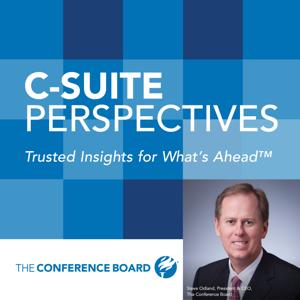


Setting the size and scope of the federal budget has long sparked fierce debate between the parties. But this year, the process is more fraught than usual: the President has proposed a $6 trillion budget, Democrats are hoping to pass a $3.5 trillion budget reconciliation bill encompassing a broad swath of legislative priorities, and Republicans adamantly oppose these proposed expenditures.
On top of that, the clock is ticking for legislators to raise the debt ceiling in a matter of days, explains Dr. Lori Esposito Murray, President of the Committee for Economic Development, the public policy center of The Conference Board—and the latest guest on CEO Perspectives. Failure to raise the ceiling would likely prove catastrophic for the US economy.
Hosted by President and CEO Steve Odland, tune into this podcast for a conversation that unpacks the state—and daunting trajectory—of America’s public debt and deficits, and how policymakers can course-correct to get the nation’s fiscal house in order.
Recent years have seen a surge in interest in environmental, social, and governance (ESG) issues. Topics such as climate change, workforce diversity and inclusion, and political spending are increasingly top of mind for stakeholders—investors, customers, employees, and more.
But the growing interest in ESG has also brought growing scrutiny, argues Matteo Tonello, Managing Director of The Conference Board ESG Center—and the latest guest on CEO Perspectives. As Tonello details, a broad swath of stakeholders expects heightened accountability from executives on how their companies address a variety of ESG-related issues.
Hosted by President and CEO Steve Odland, tune into this podcast for insights on:
As job growth surges in the United States, there are not enough workers to meet the demand. This stark imbalance has caused wages to grow in the US at the fastest pace in at least 20 years. In a new episode of CEO Perspectives, Gad Levanon, Head of The Conference Board Labor Markets Institute, joined President and CEO Steve Odland to discuss the US labor market: Why are workers hard to find and what can businesses do about it?
Tune into this podcast for insights on:
Where are the workers? What is contributing to historic labor shortages, and what will it take for the labor market to normalize?
Sticker shock: How is the low labor supply impacting inflation?
Recruiting challenges: Amid a limited pool of workers, what specific steps can companies take to attract and retain talent?
Automation: With workers hard to find and soaring labor costs, what’s the role of automation in filling the gaps?
What’s the business rationale for prioritizing climate change?
Having a solid grasp of an organization’s impact on the climate presents the opportunity to better optimize business. Firms can reap the benefits, but an understanding of their total footprint is required. Indeed, they must examine their impact beyond company walls, casting a broad net that covers the total value chain.
Understanding a company’s holistic impact is one of the many recommendations offered by Dr. Uwe Schulte, Leader of the Global Sustainability Centre at The Conference Board, in a new episode of CEO Perspectives. This week, Uwe joined President and CEO Steve Odland to discuss climate change: what are the causes and what can governments, businesses, and individuals do to combat it?
Tune into this podcast for insights on:
Sizing up the science: What is the science behind climate change?
A warming world: How much have global temperatures risen, and how significant is the increase?
Man vs. nature: How much of global warming is caused by humans and how much a result of natural occurrences?
Promising alternatives: What could a clean-energy future look like?
Solutions for sustainability: What is the role of governments, businesses, and individuals in addressing climate change?
“There is no contradiction between going more sustainable and having a thriving business.”
That’s according to Dr. Uwe Schulte, Leader of the Global Sustainability Centre at The Conference Board. This week, Uwe joined President and CEO Steve Odland on a new episode of CEO Perspectives to discuss sustainability: how the issue’s evolving, the challenges it presents to business, how companies can leverage the opportunities, and more.
As Uwe discusses, there’s growing consensus about the importance of sustainability efforts. A range of stakeholders are increasingly calling on businesses to evaluate and address their impact on the environment and society.
Tune in to this podcast for insights on:
The lay of the land: What is the current status of efforts to address sustainability?
Top concerns for businesses: What do consumers and other stakeholders want? And how can businesses meet those needs while staying competitive?
The business case: Why should businesses prioritize sustainability, and what steps can they take to improve their footprint?
The plastics problem: How much plastic do we produce, where is it going, and what should businesses be doing?
The climate crisis: How should businesses approach their role in addressing global warming?
Please note: The name of this podcast series has been changed from C-Suite Perspectives to CEO Perspectives. You’ll continue receiving timely, valuable insights for what’s ahead—but with a greater emphasis on what matters most to your company’s top decision-maker: the CEO.
What is the state of America’s infrastructure? What’s the road ahead? And would comprehensive reform really deliver a major economic punch?
Lori Esposito Murray, President of the Committee for Economic Development at The Conference Board, joins us on C-Suite Perspectives to answer this and more. In episode seven, Dr. Murray sat down with President and CEO Steve Odland, to discuss infrastructure reform.
As Dr. Murray details, any comprehensive deal will face numerous challenges, despite bipartisan agreement that the nation’s water, transportation, and energy systems are in immediate need of an upgrade.
Tune in to this podcast for insights on:
A clear definition: What, exactly, do policymakers mean when they talk about “infrastructure” in an advanced economy?
Understanding the players: What role does the federal, state, and local governments each play in infrastructure projects?
Footing the bill: At a time of record national debt, how can a broad-based infrastructure package be paid for in a way that is fiscally responsible?
The lightning rod tax increase: Why is there intense controversy surrounding a gas tax to finance infrastructure reform?
Where America stands globally: Among its competitors worldwide, how does America fare on the infrastructure front?
“At the end of the day, what’s really happening is a natural consequence of an incompatibility of systems.” This observation about US-China relations comes from David Hoffman, a Senior Vice President of The Conference Board and Managing Director of it's China Center for Economics & Business. David is the latest guest on the C-Suite Perspectives podcast, and in episode six he sits down with the show’s host, President and CEO Steve Odland, to discuss the relationship between America and its biggest competitor on the world stage—China. Where do things currently stand between the two countries and how might this dynamic change over time? As David makes clear, China will choose whether to change based on its own best interests. US pressure is not something to which they will acquiesce. Tune in to this podcast for insights on:
Heightened tensions: Where does the US-China relationship stand right now?
An incompatibility of systems: How did we get here, and what factors make the two systems fundamentally different?
Changes in US foreign policy: What is the current US Administration doing differently regarding its policy toward China?
Securing primacy of the party: What are China’s global aspirations?
Hostile foreign relations: What impact will the COVID-19 investigation have on the relationship between Western nations and China?
How can leaders bring out the best in their teams and organizations as we move beyond the pandemic?
Amy Lui Abel, PhD, Vice President of Human Capital at The Conference Board joins us on C-Suite Perspectives to answer this and more. In episode five, Amy sat down with The Conference Board President and CEO Steve Odland, to discuss remote work and successful leadership in a virtual world.
As Amy and Steve make clear, leaders must be deliberate in their communication and their efforts to build culture in a virtual or hybrid work environment. Tune in to this podcast for insights on:
Evolving responsibilities: How does leadership change in a virtual environment?
Replacing the watercooler: What are the leadership challenges of maintaining, driving, and inspiring culture in a virtual world?
Rethinking how we view virtual: Can leadership succeed in a 100% virtual environment?
Preventing problems: What breakdowns should leaders expect in this hybrid environment?
Customer Connection: What are the benefits and risks to the customer in a virtual or hybrid world?
Hosted by The Conference Board President & CEO, Steve Odland, C-Suite Perspectives takes an objective, data-driven look at a range of business topics aimed at senior executives. Listeners will come away with what The Conference Board does best: Insights for What’s Ahead™.
In episode four, Steve sits down with Lori Esposito Murray, President of the Committee for Economic Development, the public policy center of The Conference Board, to discuss the benefits of capitalism and the challenges it faces. Topics include:
Founding principles: How has capitalism proven to be the most enduring economic system over time?
Upward mobility: Why does capitalism enable people from all rungs of the economic ladder to rise out of poverty and into prosperity?
Fundamental shifts: Can capitalism continue to thrive in the face of looming environmental, wealth, health, and generational crises?
The American Dream: As the US grapples with the challenges facing capitalism, why is it a system worth saving?
The role of business and policy: What role can the business and policy communities play in evolving capitalism into a more prosperous, sustainable model?
Other related content from The Conference Board:
Committee for Economic Development: Sustaining Capitalism Solutions Briefs
Are Apprenticeships the Key to Alleviating Talent Shortages? (Podcast, May 2021)
Harvard Professor Claudia Goldin on Women’s Participation in the Workforce (Podcast, May 2021)
CED Report: First Hundred Days Plan (Report, December 2020)
Meeting the Upskilling Challenge: Training in the Time of COVID-19 (Report, July 2020)
Hosted by The Conference Board President & CEO, Steve Odland, C-Suite Perspectives takes an objective, data-driven look at a range of business topics aimed at senior executives. Listeners will come away with what The Conference Board does best: Insights for What’s Ahead™.
In episode three, Steve sits down with Paul Washington, Executive Director of The Conference Board ESG Center, to discuss multistakeholder governance. Topics include:
The paradigm shift: What factors are driving the shift from a stockholder-focused to stakeholder-focused model?
Speaking out or staying silent: As companies face pressure to take a stand on every issue under the sun, how can they choose wisely and avoid being soft targets?
The changing skillsets: How is the multistakeholder model changing the competencies—and even the composition—of a successful C-Suite?
The value of a balanced board: Why does a board with directors fluent on many issues—rather than one filled with specialists—typically lead to better multistakeholder governance?
Is this permanent or passing? What’s making the multistakeholder governance approach a durable, lasting blueprint for companies?
Other related content from The Conference Board:
Under a Microscope: A New Era of Scrutiny for Corporate Political Activity (Report, March 2021)
Sustainability Practices 2020 (Report, January 2021)
Even Higher Expectations in a Post-2020 World: How Organizations Engage with Social Change (Report, January 2021)
Insights for Investors and Companies in Addressing Today’s Social Issues (Report, October 2020)
Purpose-Driven Companies: Lessons Learned (Report, October 2020)
Maximizing the Benefits of Board Diversity (Report, June 2020)
From the publisher's feed

32,017 Listeners

30,705 Listeners

43,362 Listeners

8,741 Listeners
1,384 Listeners
1,713 Listeners
149 Listeners

5,442 Listeners

56,449 Listeners
3,977 Listeners
9,532 Listeners
9,071 Listeners
53 Listeners
334 Listeners
4,204 Listeners