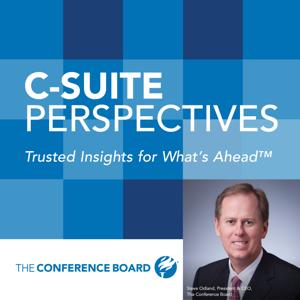
C-Suite Perspectives

C-Suite Perspectives

By The Conference BoardBusinessNewsBusiness NewsNon-Profit
Download on the App Store

C-Suite Perspectives episodes

  • What's Driving US Inflation?
    “[The Fed wants] to have a nice balance between not causing the US economy to slow down too quickly, or to create too much volatility in financial markets,” says Dana Peterson, Chief Economist at The Conference Board. In a new episode of CEO Perspectives, The Conference Board President and CEO Steve Odland sits down with Peterson to discuss US inflation: Why are prices climbing at the fastest pace in decades and what can be done to stop it?

    Tune in for insights on:

    Ukraine: What impact is the war in Ukraine having on the supply chain and inflation? What commodities are being affected? 

    Inflation trends: What effect did the pandemic have on the demand for and availability of goods? How do labor shortages and the Great Resignation factor into inflation?

    The Fed: Hindsight is 20/20, but what could the Fed have done differently? What can they do now to reduce inflation? What can’t they do?

    Infrastructure and energy: How can investing in infrastructure help resolve some of these issues? What can policymakers do? What can the US do to increase energy supply in the short term and how do we balance those short-term needs with long-term carbon goals?

    The timeline: When should we expect to get back to a normal inflation rate? Is there a new normal?

    29 min
  • Baby Boomers: The Most Important Consumer?

    “The 50-plus demographic is driving the ‘longevity economy,’ and they represent $8.3 trillion of economic activity on an annual basis—that's 56 cents of every dollar,” says Jo Ann Jenkins, CEO of AARP. In a new episode of CEO Perspectives, The Conference Board President and CEO Steve Odland sits down with Jenkins to discuss how the Baby Boomer generation is disrupting conventional thinking about aging. Tune in for insights on:

    • Boomers and their pull in the marketplace: Why marketers must look at this generation as an opportunity—and not just market to the newest generations.
    • “Ageless solutions”: What's good for the old is also good for the young. If you build something that is only suited for an older person, they won't buy it.
    • Marketing to the whole family: Why every business selling something for inside the home—tech, furniture design, retrofitting—needs a multigenerational approach.
    30 min
  • Leadership from the Military to the Private Sector
    “Accountability starts with me, if you’re leading the organization,” says Jim Huggins, former COO of the United States Army. In a new episode of CEO Perspectives, The Conference Board President and CEO Steve Odland sits down with Huggins to discuss the most effective ways to lead, based on both his military and private sector experience. Tune in for insights on:
    • The goal of leadership: Is it about simply telling people what to do, or something more?
    • Empowering your people: Does empowerment come at the cost of accountability for decisions and outcomes? What does accountability really mean?
    • Great leaders: What are the traits of great leaders today? Are people born leaders or can leadership be taught? Can introverts be leaders?
    • Developing tomorrow’s leaders: What is the most effective way to teach effective leadership skills?
    29 min
  • Is the Media Biased?

    As traditional journalistic institutions cede readers and viewers to social media, and political polarization increases among news purveyors, who can you trust? That’s the question posed in a new episode of CEO Perspectives. The Conference Board President and CEO Steve Odland sits down with Alan Murray, CEO of Fortune Media, to discuss bias, positioning, and truth in journalism. Tune in for insights on:

    • The effect of advertising versus subscriptions as a revenue source: Does this lead to institutional bias toward the views of a new outlet’s customers?
    • The difference between attitudes and facts: Whatever their world view, organizations such as The Washington Post and The New York Times have processes in place to ensure the facts they present are tested, vetted, and true.
    • The future of social media platforms: In an era when it takes only a computer to pass as a journalist, Facebook and Google have a big credibility problem. What does it mean for their futures?
    32 min
  • The Russia-Ukraine Crisis: What Does It Mean for Business?

    Watch the full webcast: 

    https://www.conference-board.org/webcast/ondemand/geopolitics

    Russia has launched a full-scale military invasion of Ukraine, attacking cities and key military hubs across the country. With each passing hour, the conflict becomes increasingly dire. The US and other countries have imposed severe sanctions on Russia, and international leaders are scrambling to respond to the constantly changing crisis. As the world wakes up to an upended geopolitical landscape, business leaders are left to navigate a new economic environment rife with uncertainty. On February 23—hours before the invasion began—The Conference Board held a webcast to break down the economic, policy, and business implications of this international crisis. The conversation featured Dr. Lori Esposito Murray, President of the Committee for Economic Development, the public policy center of The Conference Board (CED). Steve Odland, President and CEO of The Conference Board, moderated the conversation. We will be covering:

    • The business and economic fallout of an invasion.
    • NATO’s possible reaction to an invasion.
    • Implications of the Ukraine crisis for China’s policy towards Taiwan, a major supplier of computer chips and other essential electronics products.
    • The Russia-China Axis: the current state of the relationship, how it may evolve, and the economic and security implications of this alliance.
    • Steps businesses can take to fortify their supply chains and other steps to hedge against potential events.
    53 min
  • CEO Agenda 2022: Growth Jolts

    “This is a unique moment to be a CEO,” says Asutosh Padhi, managing partner for McKinsey in North America. Padhi is talking about what he calls the “jolt” of COVID-19: the way the pandemic has accelerated ecommerce, digitization, hybrid work, and government interventions, all “at a pace and scale we have never seen before.” In a new episode of CEO Perspectives, The Conference Board President and CEO Steve Odland sits down with Padhi to discuss why it took a pandemic to speed up business transformation, and what companies can do to maximize the effect of these transformations on productivity. Tune in for insights on:

    • New areas of CEO scrutiny: “Supply chain resilience [to take one example] was never a CEO topic, but now it is one,” says Padhi.
    • The pandemic’s three jolts: First came the pandemic itself, then came the pressures (on healthcare, government, and trade) that accelerated opportunities. Next: how businesses and industries will reshape in response.
    • The next CEO mindset: Normally cautious and iterative regarding major change, CEOs are now seeing the speed at which their companies are capable of moving—and changing their own mindsets accordingly.
    26 min
  • US-China Relations: An Olympic Challenge Part 2

    “Xi is a hard-core Communist and he is concerned with holding on to power,” says Ed Cox, who as President Richard Nixon’s son-in-law, had a front-row seat to history following Nixon’s historic 1972 visit to The People’s Republic of China. Cox, a former head of the New York Republican State Committee and a Trustee of CED, the public policy arm of The Conference Board, met or had dealings with Deng Xiaoping (“a fascinating man” and a chain smoker) and many of China’s most influential leaders. In a new episode of CEO Perspectives, The Conference Board President and CEO Steve Odland sits down with Cox for a second half-hour discussion of China: past, present, and future. Tune in for insights on:


    • The two Chinas: There remains a split between urban, developed and rural, agricultural China even today, despite the Belt and Roads initiative.
    • Dissolution of the Soviet Union: With Russia splintered, “who is then the main antagonist?” asks Cox. The answer: The United States.
    • What China’s slow economic growth may mean: Would Xi make military moves against Taiwan in order to shore up nationalist sentiment?
    30 min
  • US-China Relations: An Olympic Challenge

    “He told me, ‘Well, I’m going to go to Peking, then I’m going to go to Moscow, and that’s the way we will end the (Vietnam) War.’” Ed Cox is recalling a conversation with Richard Nixon in February 1968, when Nixon was running for President and Cox was dating his daughter Tricia. Cox is a former head of the New York Republican State Committee, a Trustee of CED, the public policy center of The Conference Board—and Tricia Nixon’s husband. In a new episode of CEO Perspectives, The Conference Board President and CEO Steve Odland sits down with Cox to discuss Nixon’s foreign policy and the history of US-China relations. Tune in for insights on:

    • Details of Nixon’s groundbreaking trip to China: When the President arrived at the Beijing airport, there was no schedule or certainty that he would even meet with Chinese leaders.
    • Détente with the Soviet Union: Nixon’s risky military maneuvers in Vietnam before his trip to Moscow.
    • The “Shanghai Communiqué”: A partial solution to the longtime tensions between Taiwan and mainland China.
    29 min
  • ESG: Is It the New Board Game?

    “What we’re really talking about is being responsive to the interests of an institutional investment community,” says Gaby Sulzberger, General Partner, Rustic Canyon/Fontis Partners, “and that’s true whether you’re a public company or a private company.” Sulzberger is talking about why ESG concerns are suddenly a focus for investors and an essential strategy for firms. About a third of global assets under management (AUM), Sulzberger says, factors sustainability into its investment decisions. In a new episode of CEO Perspectives, The Conference Board President and CEO Steve Odland sits down with Sulzberger to discuss all things ESG. Tune in for insights on:

    • The new focus on sustainability: Environmental, social, and governance issues used to be treated separately by companies, but the broad focus of portfolio managers on corporate social purpose has ended this “Balkanization.”
    • The importance of ESG to talent: Investors aren’t alone in demanding more corporate social responsibility. Employees want to work for companies that take ESG issues seriously.
    • The increasing importance of board diversity: Despite gains, the number of women and racial minorities on boards remains low. Sulzberger: “It’s not an intent to exclude, but it comes from a lack of interest to include.”
    32 min
  • Hybrid, High Demand, High Performance?

    “We’ve got to meet employees where they are,” says Jacqueline Williams-Roll, CHRO of General Mills. As the post-pandemic workforce transitions from remote to a more permanent hybrid model, The Conference Board C-Suite Outlook reveals that CEOs are concerned about the impact on company culture. What will this hybrid workforce look like? “The truth is, no one really knows,” says Williams-Roll. “But what we do know is simple: employees want flexibility.” In a new episode of CEO Perspectives, President and CEO Steve Odland sits down with Williams-Roll to discuss big changes in the way we work and the role of the CHRO in managing these changes. Tune in for insights on:

    • Going hybrid without sacrificing corporate culture: General Mills has launched a new initiative called “Work with Heart” that aims to keep its workforce connected and creative.
    • The role of teams in a hybrid workforce: Giving individual teams the opportunity to pivot in the direction that is best for them will ensure that flexibility doesn’t mean waste or isolation.
    • The role of the CHRO in corporate strategy: As the human resources function grows, CHROs need business acumen more than ever. “I don’t want to be able to pick out the HR person in the room,” says Williams-Roll. Courage and a gift for listening are also necessary assets.
    33 min

About C-Suite Perspectives

From the publisher's feed

Welcome to C-Suite Perspectives, a podcast series by The Conference Board. Hosted by our President & CEO, Steve Odland, this weekly conversation will take an objective, data-driven look at a range…

More shows like C-Suite Perspectives

Freakonomics Radio by Freakonomics Radio + Stitcher

Freakonomics Radio

32,017 Listeners

Planet Money by NPR

Planet Money

30,705 Listeners

Hidden Brain by Hidden Brain, Shankar Vedantam

Hidden Brain

43,362 Listeners

Marketplace by Marketplace

Marketplace

8,741 Listeners

Marketplace All-in-One by Marketplace

Marketplace All-in-One

1,384 Listeners

WSJ Your Money Briefing by The Wall Street Journal

WSJ Your Money Briefing

1,713 Listeners

HBR IdeaCast by Harvard Business Review

HBR IdeaCast

149 Listeners

Make Me Smart by Marketplace

Make Me Smart

5,442 Listeners

Up First from NPR by NPR

Up First from NPR

56,449 Listeners

Masters of Scale by WaitWhat

Masters of Scale

3,977 Listeners

The Indicator from Planet Money by NPR

The Indicator from Planet Money

9,532 Listeners

Worklife with Molly Graham by TED

Worklife with Molly Graham

9,071 Listeners

The Josh Bersin Company by Josh Bersin

The Josh Bersin Company

53 Listeners

Moody's Talks - Inside Economics by Moody's Analytics

Moody's Talks - Inside Economics

334 Listeners

What Now? with Trevor Noah by Trevor Noah

What Now? with Trevor Noah

4,204 Listeners