
Sign up to save your podcasts
Or

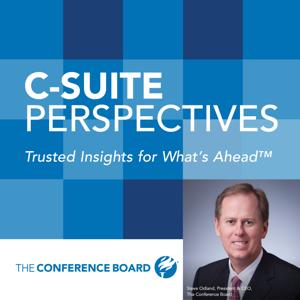


Consumer confidence has ticked up slightly but remains low in the face of tariffs, spiking prices and war.
The Conference Board Consumer Confidence Index® edged up in March to 91.8 (1985=100), from 91.0 in February. The Present Situation Index—based on consumers' assessment of current business and labor market conditions—increased by 4.6 points to 123.3. The Expectations Index—based on consumers' short-term outlook for income, business, and labor market conditions—declined by 1.7 points to 70.9.
While not obvious in the headline or its component indexes, the weight of rising costs due to tariff passthrough and spiking oil prices was evident among other measures in the survey like inflation expectations.
Join Yelena Shulyatyeva and guest Allen Li, Associate Economist, The Conference Board, to find out what's behind consumers' current and future expectations.
For more from The Conference Board:
US Consumer Confidence
Forecast for the US Economy
Global Economic Outlook
In this episode, Dana Peterson, leader of the Economy, Strategy & Finance (ESF) Center at The Conference Board, speaks with Malala Lin, economic research associate at the ESF Center, about new research on shifting consumer habits. They explore the widespread move toward value seeking, how strategies differ across income groups, and what these changes signal for businesses planning in an uncertain environment.
More from The Conference Board:
Cutting Back and Making Trade-offs: How Consumers Are Managing Food Costs
How Are Consumers Paying for Health Care?
Will E-Wallets and Deferred Payments Overtake Cash and Credit Cards?
Fur Babies: How Are US Consumers Financing Veterinary Care?
China remains one of the most essential -- and complex -- markets for global companies. In this episode of C-Suite Perspectives, host Steve Odland sits down with David Hoffman, Senior Advisor and China Center Leader at The Conference Board, to unpack what's really happening on the ground.
Fresh from a three-week visit to Beijing and Shanghai, David shares a nuanced view of a market in transition: slower growth, ongoing real estate challenges, and a policy environment that is becoming less market driven. Yet, despite these headwinds, China continues to offer unmatched scale, a deeply capable supply chain, and increasingly rapid innovation cycles that make it indispensable for companies competing globally.
The conversation also explores the rising strength of Chinese competitors, whose gains in design, quality, and cost are reshaping industries worldwide. Against a backdrop of geopolitical tension and trade frictions, companies are adapting through "China for China" strategies: localizing operations to build resilience while navigating a more fragmented global landscape.
For more from The Conference Board:
All China Center Research
China Economy Watch
China Consumption Quarterly Roundup
In this episode, Brian Campbell, leader of the Governance & Sustainability Center at The Conference Board, is joined by Blair Jones and Greg Arnold, managing directors at Semler Brossy, to examine the evolving role of the board in CEO selection and transition. Drawing on recent research, they discuss internal versus external hires, the signaling challenges boards face, and how disciplined succession planning can protect long-term value and organizational resilience.
More from The Conference Board:
CEO Succession Practices in the Russell 3000 and S&P 500: 2025 Edition
CEO Insight Minute: How Are CEO Succession Trends Shifting in 2025?
CEO Succession and Representation of Women in European Companies
CEO Succession Practices in the Russell 3000 and S&P 500: 2024 Edition
As climate extremes intensify, resilient infrastructure is no longer a future consideration; it is a present-day imperative.
Alex Heil, senior economist at The Conference Board, speaks with Greg Stonehouse, chief strategy officer at HDR, about how infrastructure design is evolving in response to rising climate risk. From transportation and water systems to health care and energy facilities, they explore how resilience is becoming a core design parameter rather than an add-on.
The conversation examines the economics of resilient investment, the growing role of nature-based solutions, advances in data and real-time system controls, and how cross-sector collaboration is reshaping the future of infrastructure.
For more from The Conference Board:
At the Climate Crossroads: US Corporate Commitments 10 Years After Paris Accord
Extreme Impacts: Severe Weather Events Create Growing Risks for US Businesses
Rising Stakes: Climate Impacts Worsen as World Set to Miss Paris Agreement Goals
Window On: The Business Impact of Intensifying Natural Disasters
Flooding Is Getting Worse. What Should Businesses Do?
New global data reveals strong employee support for diversity, equity & inclusion (DEI)—but also a widening gap between how leaders view progress and how workers experience it.
Allan Schweyer, principal researcher in the Human Capital Center, speaks with Marion Devine, principal researcher, Human Capital Europe, and Matthew Maloof, researcher, Human Capital Center, about findings from a survey of more than 1,300 employees across the US, Europe, and Asia.
They explore why managers are the make-or-break factor in DEI success, how regional attitudes differ, and what senior leaders can do to strengthen credibility in a climate of political and cultural pushback.
For more from The Conference Board:
Bridging International Perspectives: Exploring DEI
Evidence Over Optics: Proving the Impact of Diversity, Equity & Inclusion
Advancing Opportunity and Access: Linking DEI to Business Outcomes
A Tale of Two Continents: The Impact of US DEI Policy on European Businesses
The Conference Board Consumer Confidence Index® increased by 2.2 points in February to 91.2 (1985=100), from an upwardly revised 89.0 in January. The Present Situation Index—based on consumers' assessment of current business and labor market conditions—decreased by 1.8 points to 120.0 in February. The Expectations Index—based on consumers' short-term outlook for income, business, and labor market conditions—rose by 4.8 points to 72.0.
Join Dana M. Peterson and guest Malala Lin, Economic Research Associate, to find out what's behind consumers' expectations for the future, and where CEOs are focusing their growth efforts this year.
For more from The Conference Board:
US Consumer Confidence
C-Suite Outlook 2026
Forecast for the US Economy
Global Economic Outlook
Three years into the conflict, the Ukraine war has evolved into a brutal war of attrition—with implications far beyond the battlefield.
The Conference Board CEO Steve Odland and Dr. Lori Esposito Murray, a global affairs consultant most recently with the Council on Foreign Relations and the Committee for Economic Development, discuss the history underpinning the conflict, the realities on the ground, and the economic and political pressures facing both Kyiv and Moscow.
From sanctions and shifting alliances to the possibility of a frozen conflict or negotiated settlement, they explore how the war is reshaping geopolitics—and what may come next.
For more from The Conference Board:
The US Critical Minerals Ministerial and Industrial Policy
Three Years of War in Ukraine – And an Extraordinary Week
US–Ukraine Negotiations and Possible Ceasefire
Global Grey Swans Tool
Learn why companies need to understand AI's promise and potential drawbacks for environmental sustainability.
More than 60% of companies are using AI to support or advance environmental sustainability. What are the use cases they're exploring, and how can businesses also guard against the environmental risks of AI?
Join Steve Odland and guest Andrew Jones, PhD, principal researcher at the Governance & Sustainability Center of The Conference Board, to learn about the environmental impact of AI-focused data centers, how companies are capitalizing on AI for sustainability, and how sustainability leaders can demonstrate the ROI of AI applications.
For more from The Conference Board:
AI and Environmental Sustainability: Risks, Opportunities, and What Comes Next
Exiting International Climate Pacts Will Leave The US Isolated
AI Risk Disclosures in the S&P 500: Reputation, Cybersecurity, and Regulation
Find out what's new in CEO and executive compensation, including say-on-pay practices and SEC regulations.
CEO pay in the S&P 500 increased 7% year-over-year in 2025, with stock awards as the largest driver. What are the latest trends in CEO and executive compensation for governance teams and boards to consider?
Join Steve Odland and guest Dana Etra, managing director and head of the Boston office at FW Cook, to find out why some perquisites are being viewed through a risk and duty-of-care lens, how say-on-pay approaches have evolved, and why companies should watch for SEC changes to disclosure requirements.
For more from The Conference Board:
CEO and Executive Compensation Practices in the Russell 3000 and S&P 500: 2025
Pay Ratios: CEO and C-Suite Compensation in the Russell 3000 and S&P 500
Executive Compensation Benchmarking Tool
From the publisher's feed

32,046 Listeners

30,701 Listeners

43,359 Listeners

8,731 Listeners

1,384 Listeners
1,712 Listeners
150 Listeners

5,441 Listeners

56,447 Listeners
3,979 Listeners
9,537 Listeners
9,070 Listeners
53 Listeners
334 Listeners
4,208 Listeners