
Sign up to save your podcasts
Or

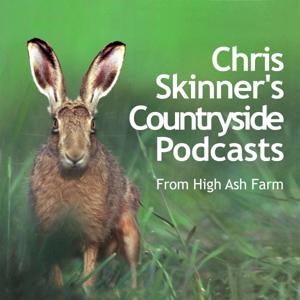
By High Ash Farm
Nature, Wildlife and Countryside Living with Chris Skinner from High Ash Farm
Chris Skinner, a Norfolk farmer, takes a unique approach to farming, prioritizing
... more
5
66 ratings


The podcast currently has 157 episodes available.
The most played episodes among Podcast App listeners.
Send us Fan Mail On a beautiful early-autumn morning at High Ash Farm, after another 13 millimetres of welcome rain has turned the fields verdant once more, Chris Skinner and Matthew Gudgin begin at the farmyard entrance. A robin is singing again after its midsummer silence, rooks and jackdaws corkscrew down from the sky in display flight while a peregrine circles high above, and late swallows are still feeding young in the barn. On the flowering ivy they discover a new arrival: ivy bees (Colletes hederae), first recorded in Britain in 2001. These late-season solitary bees, with their orange thoraxes and wasp-like stripes, are gathering the last major nectar flow of the year. A short drive to Greensides Loke reveals their nesting site — a west-facing sandy bank riddled with rabbit holes and thousands of tiny burrows. Females excavate straw-width tunnels half a metre into the soil, line them with saliva, and provision them with pollen and nectar before sealing them for the winter. Males hover at the entrances and pile onto females in frantic mating clusters. Though solitary, they nest in dense congregations wherever the habitat is right. In Fox’s Grove the pair turn to fungi and trees. Chicken of the woods (sulphur polypore) glows on a sweet chestnut, while a 250-year-old ash — one of the farm’s giants — stands in its last hours. Ash dieback has rotted its roots to pulp; a trail camera is trained on the trunk, ready to capture the moment it falls. Chris reflects on the 1,500 ash saplings that died young, the black staining of Chalara, and the Norse idea of ash as the tree of life. Once down, the timber will feed beetles, woodworm and more fungi, returning at last to the rich leaf-mould of the woodland floor. Listener letters bring a perfect comma butterfly displaying the white mark that gives it its name, recordings of a blackcap and a nightingale, and a precise reminder of the Game Act 1831.This episode is a poignant celebration of autumn’s dual nature — new life arriving with the ivy bees, and an ancient giant preparing to fall — ideal for savouring late pollinators, the first fungi of the season, and the quiet power of even the smallest organisms at High Ash Farm. https://www.buzzsprout.com/2432378/episodes/19791131-episode-2-89-ivy-bees-and-falling-ash.mp3?download=true Support the show Please email any questions for Chris to answer on the podcast to [email protected] This podcast is brought to you by High Ash Farm. To support our efforts in creating this content, please consider making a small monthly or one-off donation. Your contributions help us with production costs, and after expenses, every penny goes towards conservation and maintaining free public access at High Ash Farm. Support us here: https://donorbox.org/podcast-12 or from the Podcast page here: Podcast | High Ash Farm

Send us Fan Mail On a misty, humid late-August morning at High Ash Farm, with rain threatening after another dry month of just 17 millimetres, Chris Skinner and Matthew Gudgin stand on the farm’s poorest south-facing sandy field — the one exception still lush and green after the pollen-and-nectar crop was mown for fire safety. Chris digs into the concrete-hard ground to reveal the secret: lucerne (alfalfa) and sainfoin sending wooden tap roots two to two-and-a-half metres down to moisture, while nitrogen-fixing nodules on their fine roots feed the plants without any fertiliser. Deer and hares graze the protein-rich growth, and the stems are plastered with black bean aphids that reproduce like Russian dolls — wingless females giving birth to clones already carrying the next generation inside them. Ladybirds feast on the aphids, ants milk them, and the plants already show the first tiny germinating seedlings from last month’s mowing. The pair then walk an avenue of ancient oaks, where a colossal limb — perhaps three tonnes of timber and fifty feet long — has crashed down overnight with no wind at all. Chris explains the forestry term “self-pruning”: these giant trees shed huge branches unpredictably, creating both magnificent habitat (oaks support more than 350 insect species) and a serious safety challenge on a farm with daily public access. He reflects on their history as naval timber, the kestrel and barn owl boxes they still carry, and the careful ten-metre uncultivated margins left around each tree. Listener letters add further colour: changing farmyard smells and fertiliser use, hobbies nesting in Yorkshire and the surprising origin of the game Subbuteo, rats and the risks of secondary poisoning, and a heartfelt visit from a listener who travelled from New Zealand to walk the farm she had only imagined. This episode is a close-up celebration of hidden plant power and the raw drama of veteran trees — ideal for marvelling at drought-defying legumes, the astonishing lives of aphids, and the unpredictable grandeur of English oaks at High Ash Farm. https://www.buzzsprout.com/2432378/episodes/19715819 Support the show Please email any questions for Chris to answer on the podcast to [email protected] This podcast is brought to you by High Ash Farm. To support our efforts in creating this content, please consider making a small monthly or one-off donation. Your contributions help us with production costs, and after expenses, every penny goes towards conservation and maintaining free public access at High Ash Farm. Support us here: https://donorbox.org/podcast-12 or from the Podcast page here: Podcast | High Ash Farm
Send us Fan Mail On a fresher late-August morning at High Ash Farm, after just under ten millimetres of welcome rain has begun to tint the parched pastures with the faintest green, Chris Skinner and Matthew Gudgin begin at the duck pond. An extraordinary mallard mother who successfully raised nine ducklings earlier in the spring has now returned with a second brood of thirteen tiny balls of fluff. The youngsters form a tight “football” when geese approach, while the attentive mother keeps constant watch. Nearby, moorhens continue their own remarkable family life, with older chicks helping to feed the latest brood. The pair then walk into Cantley Hill Plantation to examine the beech trees, here close to the northern natural limit of the species. Chris gathers the hard, hairy cupules of beech mast, explains their value to squirrels, birds and once to pigs during pannage, and recounts how the dry, scrunchy leaves were once stuffed into mattresses known in France as a “talking bed.” A remarkable horizontal beech that keeled over in the 1987 storm but re-rooted and sent up new vertical trunks illustrates the tree’s resilience, while drought is already forcing some leaves into early autumn gold. In Barnwood they discover a deep clay pond — a vital woodland drinking hole. Trail-camera footage has already captured a female green woodpecker (the yaffle) and a great spotted woodpecker coming to drink, with hopes of adding the elusive lesser spotted. Dead trees and thick ivy stems provide further habitat, while Rat the terrier briefly becomes stuck in a bramble thicket. Listener letters bring a perfect mossy wren’s nest (and a discussion of polygamy), a discarded whisky bottle posing a fire risk, stressed cattle and early silage use in Northumberland, a kidney-spot ladybird, a mysterious wood-pigeon nest containing four eggs, and a long list of sightings from recent walkers including nuthatch, treecreeper, clouded yellows and roe deer. This episode is a gentle celebration of maternal devotion, woodland resilience and the quiet drama of late summer — ideal for savouring the determination of a mallard mother, the beauty of beech mast, and the vital role of a hidden woodland pond for Britain’s woodpeckers at High Ash Farm. Support the show Please email any questions for Chris to answer on the podcast to [email protected] This podcast is brought to you by High Ash Farm. To support our efforts in creating this content, please consider making a small monthly or one-off donation. Your contributions help us with production costs, and after expenses, every penny goes towards conservation and maintaining free public access at High Ash Farm. Support us here: https://donorbox.org/podcast-12 or from the Podcast page here: Podcast | High Ash Farm
Send us Fan Mail On a fine mizzling mid-September morning at High Ash Farm, Chris Skinner and Matthew Gudgin begin in the farmyard and notice that September has lived up to its name as the changeling month. The swallows have vanished almost overnight — more than a hundred young sent south after a successful season — while a handsome young cockerel struts among the nest boxes and a robin still sings. The pair then set out on a fungal foray. At the base of an oak they find beefsteak fungus, a rich red bracket that “bleeds” when scratched. Chris explains how cabinet-makers once rubbed its juice onto other oaks so the heartwood would stain a prized deep orange-brown. Nearby, a velvety Ganoderma bracket is already shedding spores. In the horse paddocks they test field mushrooms by peeling, smell and gill colour, then walk fairy rings — some perhaps three or four hundred years old — where a single spore has spread an inch a year, burning the grass in a circle and releasing nitrogen that darkens the turf. Inside another ring they gather horse mushrooms, identified by their aniseed scent, peeling cap and lack of yellow staining. On the Anglo-Saxon cemetery field in Caister Park a giant puffball has appeared in two or three days, still snow-white and the size of a small football. Last year’s dried specimens release clouds of spores that the wind can carry as far as the Continent. Along a damp lane, water mint has flowered again after the council mowed the verge, filling the ditch with its scent for a late buff-tailed bumblebee. Listener letters bring nightingales singing beside a Berlin beer garden, a visit from listeners who travelled from Western Australia, the first fieldfares of autumn, a polecat-ferret on camera in South Wales, and news of hirundine flocks and pink-footed geese passing Spurn Point. This episode is a rich harvest of autumn’s hidden harvest — ideal for savouring the strange beauty of fungi, the sudden switch from swallows to fieldfares, and the simple pleasure of gathering a safe supper from the fields of High Ash Farm. https://www.buzzsprout.com/2432378/episodes/19826686-episode-2-90-fairy-rings-and-giant-puffballs.mp3?download=true Support the show Please email any questions for Chris to answer on the podcast to [email protected] This podcast is brought to you by High Ash Farm. To support our efforts in creating this content, please consider making a small monthly or one-off donation. Your contributions help us with production costs, and after expenses, every penny goes towards conservation and maintaining free public access at High Ash Farm. Support us here: https://donorbox.org/podcast-12 or from the Podcast page here: Podcast | High Ash Farm
Send us Fan Mail On a bright late-September morning at High Ash Farm, Chris Skinner and Matthew Gudgin sit on a homemade oak bench with a panoramic view of Norwich and begin an unusual episode. 452 acres of the farm have been put on the market for around £2.5 million, yet the 1947 Agricultural Holdings Act means Chris — and in time his son Daniel — remain tenants for life. The pair set off to show what a buyer would actually acquire: not just land and cottages, but a working conservation landscape that Chris has spent decades shaping. They examine the soils first. Rabbit burrows on a sunken track reveal a buried beach of glacial sand and powdered chalk left by ice 200–300 metres thick. On Dirty Close the clay has cracked a metre deep after the drought; nearby, a pond once supplied clay for Saxon cremation urns now displayed in Norwich Castle Museum. The holding includes two scheduled ancient monuments — part of the Roman town of Venta Icenorum and an Anglo-Saxon cemetery planted with Scots pine — plus flint tools dating to 5000 BC that Chris once picked up while hoeing sugar beet. Wildlife is thriving. A spring count found more than 70 hares; house sparrows have returned to nest boxes; hedges are heavy with hawthorn and rowan berries; a jay works non-stop caching acorns. Five acres of teasels are ready for seed collecting. Chris contrasts his approach — no predator control, free public access — with other versions of “rewilding.” Listener letters bring thanks for last week’s horse mushrooms, concern about missing waterfowl on the Broads, another giant puffball mistaken for a football, mysterious woolly aphids on American beech, and the quiet after the autumn equinox once the swallows have gone. This episode is both a love letter to a farm and a clear-eyed look at its future — ideal for understanding how a 1947 Act still protects a tenant, why a “Norfolk gem” of wildlife and history is for sale, and how the landscape beneath High Ash Farm has been shaped by ice, Romans, Saxons and one determined farmer. https://www.buzzsprout.com/2432378/episodes/19863805-episode-2-91-tenancy-act-and-norfolk-gem.mp3?download=true Support the show Please email any questions for Chris to answer on the podcast to [email protected] This podcast is brought to you by High Ash Farm. To support our efforts in creating this content, please consider making a small monthly or one-off donation. Your contributions help us with production costs, and after expenses, every penny goes towards conservation and maintaining free public access at High Ash Farm. Support us here: https://donorbox.org/podcast-12 or from the Podcast page here: Podcast | High Ash Farm
The podcast currently has 157 episodes available.

281 Listeners

108 Listeners

245 Listeners

152 Listeners

108 Listeners

252 Listeners
99 Listeners
69 Listeners

84 Listeners

303 Listeners
242 Listeners

24 Listeners

55 Listeners

698 Listeners
17 Listeners