
Sign up to save your podcasts
Or

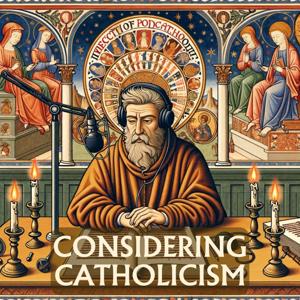


[DONATE WITH PAYPAL] In this episode, Greg explores the stark contrasts between the medieval Catholic guide "Ars Moriendi" and contemporary secular books on "The Art of Dying." He breaks down the historical steps for a faithful death—overcoming temptations, sacraments, and communal rituals—against modern focuses on autonomy, pain management, and legacy-building in hospices. Reflecting on why the Catholic approach offers eternal hope amid today's medicalized views, Greg invites listeners to consider how faith transforms our final moments. A thoughtful monologue for those curious about Catholicism's timeless wisdom on mortality.
Donate with PayPal!
Website: https://www.consideringcatholicism.com/
Email: [email protected]
Suggested Episodes:
A readable English version of the Ars Moriendi is the 15th-century adaptation known as "The Book of the Craft of Dying" (also called "The Craft for to Die"), which is based directly on the medieval Latin text and was printed by William Caxton in 1490 as one of the first English versions. This is available on Wikisource in a shorter, accessible form with modernized spelling for easier reading, covering the key elements like spiritual preparations, temptations (e.g., despair), faith affirmations, prayers, and devotions. It's fully in English, free to read online, and text-based without illustrations (though the original blockbook's woodcuts are not part of this adaptation). You can link to it at: https://en.wikisource.org/wiki/The_Book_of_the_Craft_of_Dying/shorter.
A more complete scholarly edition with the full Caxton text in Middle English (still readable but with archaic spelling), there's a free facsimile on Google Books at: https://books.google.com/books?id=8a5YAAAAcAAJ.
One of the best online versions of the medieval Ars Moriendi that includes woodcut illustrations is the digitized copy from the Library of Congress, specifically the blockbook edition from Germany, circa 1466. This version, part of the Lessing J. Rosenwald Collection, features the iconic eleven woodcut illustrations depicting the dying man (Moriens) facing temptations from demons and receiving inspirations from angels, culminating in a scene of salvation or damnation. The digital scans are high-quality, showcasing the detailed and dramatic artwork, and the resource is freely accessible under the Library of Congress's open access policy, making it ideal for your podcast audience of curious non-Catholics and cradle Catholics rediscovering the faith. You can link to it directly at: https://www.loc.gov/item/49038880/.
[DONATE WITH PAYPAL] Learn why set prayers and saint intercessions enrich heartfelt devotion, with Catechism quotes and saint insights, then explore essentials like Our Father and Hail Mary with origins and uses. Greg contrasts with evangelical spontaneous emphases, reflecting on unity. This episode equips your OCIA prayer life, bridging words to divine dialogue.
Donate with PayPal!
Website: https://www.consideringcatholicism.com/
Email: [email protected]
Recommended Episodes:
[DONATE WITH PAYPAL] Another installment of the series "OCIA: The Bridge to Rome." In this episode, Greg introduces the Catechism of the Catholic Church (CCC). Discover the CCC’s history as John Paul II’s "sure norm," its four-pillar structure (Creed, Sacraments, Morality, Prayer), unmatched value for authoritative answers, and versatile use in study or reference. Greg contrasts with Protestant fragmented sources, offering reflections on unified truth. This episode empowers your OCIA with the CCC as your ally against misinformation and myths about the Catholic faith.
Donate with PayPal!
Website: https://www.consideringcatholicism.com/
Email: [email protected]
[DONATE WITH PAYPAL] What if the Christianity you’ve known is like the shadows on the wall in Plato’s cave—flat, limited, and only a fraction of the real thing? In this episode, Greg explores how Protestantism, since Luther’s reforms, has often shrunk the faith’s vision of God, the Church, sacraments, saints, and salvation, leading to today’s minimalist pop Christianity. Through compelling examples and personal reflections on his own Road to Rome, he contrasts this with Catholicism’s expansive, colorful worldview that spans 20 centuries and the globe. Step out of the cave and discover why embracing a bigger faith might transform your spiritual journey.
Sup
Donate with PayPal!
Website: https://www.consideringcatholicism.com/
Email: [email protected]
[DONATE WITH PAYPAL] The Considering Catholicism Podcast launches "OCIA: The Bridge to Rome," a series designed to illuminate the path into the Catholic Church. In this inaugural episode, discover how OCIA serves as the bridge across the Tiber River for those on their Road to Rome, offering a holistic journey of faith formation rather than a simple class. Greg breaks down key terms, the ancient origins of the process, and the stages from inquiry to full initiation, making it accessible for curious seekers, current participants, alumni, and mentors alike. Whether you're previewing the experience or supplementing your own, this episode provides a clear map to guide your steps. Visit consideringcatholicism.com for more resources on exploring the Catholic faith.
Donate with PayPal!
Website: https://www.consideringcatholicism.com/
Email: [email protected]
[DONATE WITH PAYPAL] Greg shares a story from a golf outing where an awkward stranger handed him a Gospel pamphlet asking, "Am I Going to Heaven?" He praises the bold evangelism of Protestants but critiques the pamphlet's narrow "faith alone" view, offering a fresh Catholic perspective on how baptism and grace transform us to perform good works (for a deep dive into the Catholic position on this debate, see the "Faith or Works?" series, episodes #301-311. Contrasting Protestant urgency with Catholic strengths in charitable action, Greg calls for blending both to proclaim the fullness of salvation in the Church. This episode challenges listeners to evangelize boldly while embracing Catholic doctrine.
Donate with PayPal!
Website: https://www.consideringcatholicism.com/
Email: [email protected]
[DONATE WITH PAYPAL] In the final part of "The Church and Her Fathers," Greg introduces key Church Fathers—their lives, writings, teachings, and accomplishments—highlighting their unity on core Catholic doctrines despite minor disagreements. He explores how they represent the early, developing Church, maturing over centuries while preserving its identity, and stresses continuity to today. Greg shares why engaging the Fathers converts Protestants, including Newman's famous quote, and wraps the series with an encouraging call to discover the Church's roots.
Donate with PayPal!
Website: https://www.consideringcatholicism.com/
Email: [email protected]
[DONATE WITH PAYPAL] In Part 3 of "The Church and Her Fathers," Greg tackles an anti-Catholic X post dismissing the Church Fathers as mere “fragments” of history, connecting it to the series’ exploration of the Church’s visible nature and biblical roots. He exposes the flaws in claims about “lost voices” and late Christianity, highlighting the Fathers’ diverse origins and doctrinal unity as evidence of the Catholic Church’s continuity. Drawing from his Protestant past, Greg shows how the Fathers bridge the apostles to today, countering evangelical dodges. He sets the stage for a deeper dive into their lives and writings in Part 4.
Donate with PayPal!
Website: https://www.consideringcatholicism.com/
Email: [email protected]
[DONATE WITH PAYPAL] In part two of the series on the Church, Greg delves deeper into Catholic teachings from the Catechism, emphasizing the Church as both visible and invisible, human and divine. He explores the three-fold nature—the Church Militant on earth, Suffering in purgatory, and Triumphant in heaven—with direct quotes from CCC 954 and insights from Doctors like Aquinas and Augustine on their interconnected unity through the Communion of Saints. Addressing Protestant listeners, Greg explains the Catechism’s affirming view of other denominations as in imperfect communion through baptism, while calling for greater ecumenical unity. This episode invites seekers to reconsider the Church not as a mere institution but as Christ’s enduring, mystical body spanning time and eternity.
Donate with PayPal!
Website: https://www.consideringcatholicism.com/
Email: [email protected]
[DONATE WITH PAYPAL] In Part 1 of a four-part series called “The Church and Her Fathers,” Greg dives into a pet peeve: why evangelicals insist on calling early Christianity a “movement” instead of “the Church.” Tracing the term’s modern origins in missions and Reformation biases, he calls it infantile and passive-aggressive anti-Catholicism. With a strong biblical rebuttal, Greg shows how this language contradicts Scripture’s clear use of “church” and invites listeners to reconsider the visible, enduring body Christ founded.
Donate with PayPal!
Website: https://www.consideringcatholicism.com/
Email: [email protected]
From the publisher's feed

4,976 Listeners

5,716 Listeners

4,009 Listeners

809 Listeners

6,750 Listeners
7,679 Listeners

1,353 Listeners

2,615 Listeners
1,517 Listeners

2,640 Listeners
926 Listeners

1,276 Listeners

1,214 Listeners

779 Listeners

443 Listeners