
Sign up to save your podcasts
Or



Based on Podcast App listening data
This week, we get into whether the human genome can be patented. A lot of people, when they think about the Supreme Court, think about big constitutional issues, abortion, gay marriage, death penalty, guns, etc. All of that is of course super important, but the Court has an outsized influence on so many other areas of our lives.
The Myriad case is a perfect example. The case might actually influence your life more than just about any other. It concerns whether the human genome can be patentable. That is, can a company assure assert that is, can a company assert ownership over a gene sequence that exists in your body? And the stakes are huge. The case Myriad Genetics’s facts concerned patenting BRCA1 and BRCA2, which are two genes that, if you have them, mean you have a very high risk of getting an aggressive form of breast cancer. But the case reaches far beyond those two genes to reach all gene patents. The Reagan Administration onward issued gene patents, and roughly 20,000 had been issued until the US Supreme Court got involved.
We’ll break it down with Katie Couric, someone who is crazy talented at breaking down complex ideas. She’s also got her own personal connection to these issues, and we’ll get into that as well.
But before getting into all of that, I’m going to cover this week’s legal news, and focus in particular on two big Supreme Court cases that were recently decided, Moore v. Harper and the affirmative action cases. Moore v Harper was my big win, and I’m going to take you behind the scenes. The Court invalidating the Republican party’s “independent state legislature theory,” which posited that state legislatures could act unconstrained from their own constitutions and courts in setting rules for federal elections. The Supreme Court, in a 6-3 opinion by the Chief Justice, rejected this argument, a win that former appeals judge Michael Luttig said was the most important case for democracy in the nearly 250 years of the Court’s existence
But, as always, you come for the deep dive on a Supreme Court case, and Katie does not disappoint with a fascinating discussion about Myriad Genetics. We will learn all about the Court’s unanimous ruling, written by Justice Clarence Thomas. And you'll learn a ton about Katie Couric, and her interview secrets.
My substack on Courtside has all sorts of additional materials about the case, including a short 3 pager about it, a longer 20 page abridged version, and the full version of the judicial opinion, for paid subscribers.
Courtside has no ads and is a reader-supported publication. To receive new posts and support my work, consider becoming a free or paid subscriber, joining at nealkatyal.substack.com. There are no ads on Courtside, everything is listener supported and all profits go to charity.
Ten years ago this week, the Court issued one of its most important, and devastating, decisions. In a 5-4 decision, the Supreme Court struck down key aspects of the Voting Rights Act (VRA). This week’s episode gets into the case with the legendary John Legend. It’s a fitting time to do this, since I just found out I won Moore v. Harper in the U.S. Supreme Court in a 6-3 decision, a case that made clear that many election shenanigans are subject to serious court scrutiny. And the episode begins with a discussion of the Hunter Biden indictment and some reflections on the end of the Supreme Court Term and what to expect. There’s a ton of bonus material for paid subscribers too, including John Legend’s reflections on his childhood dreams and how he made the transition from a consultant at Boston Consulting Group to the mega star he is today. Please consider subscribing, and I'm giving all profits to charity.
Shelby County begins back in the 1960s, at the height of the Civil Rights Movement. During this time, the country was deeply divided, and Jim Crow laws were rampant throughout the South. In states such as Texas, Alabama, Georgia, Mississippi, and others, African Americans were systematically denied their right to vote. States and counties weaponized a whole arsenal of different voter suppression tactics. Some were overt, like poll taxes to literacy tests. And others were really subtle, like changing the polling hours for an election in a minority neighborhood the day before the election took place. Or moving the polling place across the street without telling anyone.
In response, President Lyndon B. Johnson pushed Congress to pass the Voting Rights Act, which was the single most important piece of voting rights legislation in American history. The Act contained many provisions, but perhaps the two most powerful were Sections 4b and 5. Taken together, these two provisions said that states and localities with a history of racial discrimination in voting practices must get federal court or federal DOJ approval before changing their voting laws. That meant any change – whether trying to have a literacy test or moving a poll across the street. Because Congress knew that there was no limit to the terrible ingenuity of racists who wanted to block people from voting.
Now this didn’t impact the whole country. Section 4b, it limited the preclearance requirements only to those states and counties which, prior to the 1964 presidential election, had a voting test in place and less than 50 percent voter registration. This is known as the “Coverage Formula.” In 1965, the formula covered nine states and a few dozen counties that tended to be the most racially discriminatory.
The Voting Rights Act (or VRA, as it’s called) was passed in 1965 and set to expire after five years. So, the Act was reauthorized in 1970. It was reauthorized yet again in 1975, 1982, and, in 2006. Each time the Act was reauthorized, it was challenged in Court. Time and again, however, the Supreme Court upheld the law; the Court pointed to the Fifteenth Amendment of the Constitution, which prohibits racial discrimination in voting and gives Congress “the power to enforce this article by appropriate legislation.”
But then President Obama won the Presidency. And I was tasked with representing the federal Government in defending the Voting Rights Act. It was my 4th Supreme Court argument ever. My boss Elena Kagan had a long confirmation process, and so instead of her as Solicitor General arguing it, the task fell to me. I worked my tail off. But it was hard to argue about the persistence of race discrimination 3 months after the nation elected its first black President. In any event, I threw myself in, and gave what I think was a pretty bang-up argument. I knew the Act had the blood of patriots on its pages – that Selma and the bridge were a deep part of its history. And I made much of the argument looking directly at Justice Clarence Thomas, because I really wanted his vote. Well, in any event, we did save the constitutionality of the VRA, in an 8-1 decision. The one dissenter: Clarence Thomas!
In that 2009 decision, called Northwest Austin v. Holder, the Court said that the VRA could stand. But it said that it was worried the government would have to justify the coverage formula – that it hadn’t been updated in 50 years. And so, over the next years, these largely Southern States argued that the coverage formula was unfair. And so that’s the issue in Shelby County.
The Court heard the case, and issued a sweeping 5-4 ruling. Writing for the Majority, Chief Justice John Roberts said that the coverage formula was outdated and violates the fundamental principle of equal sovereignty among the states. He pointed to the changes in voting registration numbers between 1965 and 2006 (when the VRA was reauthorized). For example, in Alabama in 1965, white voter registration was 50 percent higher than Black voter registration; in 2006, that difference was less than one percent. In Mississippi, there was a 63 percent difference between black and white voter registration in 1965, but in 2006, Black voter registration exceeded white voter registration by 3 percent. In short, the Chief Justice concluded that the Coverage Formula no longer addresses current voting disparities, and therefore must be unconstitutional. He writes the following: “In 1965, the States could be divided into two groups: those with a recent history of voting tests and low voter registration and turnout, and those without those characteristics. Congress based its coverage formula on that distinction. Today the Nation is no longer divided along those lines, yet the Voting Rights Act continues to treat it as if it were…”
Justice Ginsburg wrote a phenomenal dissent, one I go into some detail talking about with John Legend. There’s no better person to talk about and explain these concepts—John has spent years thinking about and supporting voting rights.
If you want a bunch of background material on the Shelby County case, including a short summary of the decision, a longer abridged one, and the full text of the decision, you can find it all at https://nealkatyal.substack.com/
Welcome to Courtside, Episode I. The podcast begins each week with a short, humorous discussion of the week’s legal news (because we all need humor to get through it). And then it turns to talking about a landmark case that’s been decided by the U.S. Supreme Court. I’ve argued 50 cases at the Supreme Court, and served as the federal government’s top lawyer. But I want the Court to come alive for you.
Each week, I’m going to discuss a single Supreme Court case with one guest, someone who’s not a lawyer and who can translate the case into plain English. So instead of talking about the law with some fusty lawyer named something like Oliver Wendell Holmes, we’re gonna do it with celebrities like John Mulaney and John Legend and Katie Couric. The Supreme Court is increasingly intruding into every aspect of our lives, and the goal here is to unpack that a bit this Summer, and we’ll run through the Summer. In September, the Court comes back and I’ve gotta go back to my day jobs, but if this podcast works out, we’ll do it again next summer.
Oh, by the way, in subsequent episodes, I’ll be releasing bonus material to subscribers from each interview. Given the fabulous guests we are going to have, I don’t want to squander the opportunity to talk to each of them about creativity, resilience, improvisation, and performance.
You’ll see I don’t have any ads on the podcast, that is because substack is pioneering a new model for podcasts, one that is entirely listener supported. For Episode I, I’m making everything available to non-subscribers, so what you see here is the kind of thing you’ll get if you pay for a subscription. I’m donating every dollar I receive from the podcast to charity.
Episode I begins with the Trump arraignment in Florida, and then quickly turns to the Supreme Court. We discuss NYT v. Sullivan, a groundbreaking 1964 case about freedom of the press and speech. This is the key decision that allows the media to operate without getting sued (well, unless you are Fox News). It’s about as major a decision about speech as any the Court has ever decided.
While Courtside is going to avoid lawyers as guests, I couldn’t resist the opportunity to break that rule for this specific episode and invite Ari Melber to the show. Ari has a unique perspective, he was a lawyer at a top law firm practicing First Amendment law, but now he’s on the other side of that, as one of the most brilliant anchors on MSNBC, where he’s had to think about freedom of the press and the threats posed by libel suits, akin to that with Fox and Dominion. Ari is also my partner in crime on MSNBC, where we work together each week on The Beat.
In fact, Ari came to the Supreme Court recently to watch me give my 50th Supreme Court argument. This is us after the argument (I am definitely not someone you want to see photographed before the argument.)
And, as some of you know, I do a series every Monday called Opening Arguments with Ari on his show The Beat.
Thank you for reading Courtside! I’d appreciate it if you would share this post with anyone in your life who is interested in the Supreme Court.
Anyway, for our discussion with Ari, I put together some materials to help guide you through the case. For Episode 1, all the materials are available to nonpaying subscribers. In later weeks, subscribers will be able to access all the case materials. Each week, I’ll provide a short 3 or 4 pager description of the case, along with a longer (roughly 20 pp) excerpted version of the Supreme Court case. I’ll also throw in the full case too, so interested readers can read that.
Stop by my Substack to find those those documents and images: nealkatyal.substack.com
June 13, 2021
On tonight's #Courtside, a discussion of the recent revelations that Trump's DOJ electronically spied on Dem members of Congress and their families.
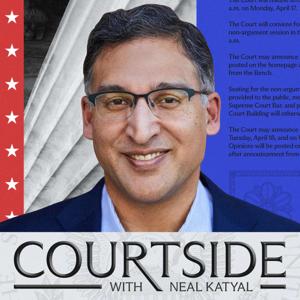
COURTSIDE with Neal Katyal is a fast, irreverent look at the legal issues of the day, hosted by the Obama Administration's top courtroom lawyer and Georgetown Professor Neal Katyal. Neal has argued 44 cases at the Supreme Court and explains the legal issues of the week in under 10 minutes.
Follow Neal:
#NealKatyal #Courtside
May 31, 2021
Today, on #Courtside, a description of the Tulsa Massacre of 1921 and how new laws in Oklahoma and other places that try to ban the teaching of such history are unconstitutional.
COURTSIDE with Neal Katyal is a fast, irreverent look at the legal issues of the day, hosted by the Obama Administration's top courtroom lawyer and Georgetown Professor Neal Katyal. Neal has argued 44 cases at the Supreme Court and explains the legal issues of the week in under 10 minutes.
Follow Neal:
#NealKatyal #Courtside
May 23, 2021
Discussing the Supreme Court's decision to hear the Mississippi abortion case, and what it means for the future of Roe v. Wade, and what you can do about it.
Follow Neal:
#NealKatyal #Courtside
May 16, 2021
Can Florida Governor DeSantis prevent Donald Trump from being extradited to face justice in New York if Trump is indicted? Answer: No.
Follow Neal:
#NealKatyal #Courtside
May 9, 2021
On #Courtside tonight, an analysis of the new voting restrictions in Florida and other states, what they mean for the future of our democracy, and what you can do about it.
Follow Neal:
#NealKatyal #Courtside
May 2, 2021
Examining the FBI raid of Rudy GIiuliani and what it means.
Follow Neal:
#NealKatyal #Courtside
April 25, 2021
Personal reflections on the Chauvin prosecution and a deep dive into the new tragic Supreme Court decision on juvenile life without parole.
Follow Neal:
#NealKatyal #Courtside
From the publisher's feed

36,272 Listeners

3,476 Listeners

9,308 Listeners

12,504 Listeners

4,599 Listeners
8,031 Listeners
2,896 Listeners
4,619 Listeners

10,418 Listeners

2,631 Listeners

3,440 Listeners
3,187 Listeners
31,724 Listeners

6,914 Listeners
4,303 Listeners