
Sign up to save your podcasts
Or

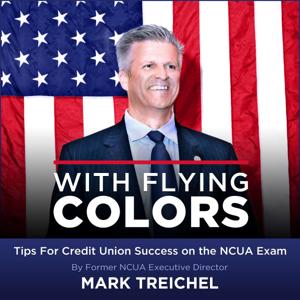
By Mark Treichel's Credit Union Exam Solutions

5
1414 ratings


The podcast currently has 382 episodes available.
The most played episodes among Podcast App listeners.
## Episode Summary Mark Treichel discusses the importance of on-site exams by NCUA (National Credit Union Administration) in detecting and preventing fraud in credit unions. He explores the concept of the Fraud Triangle and explains why a physical presence is crucial in maintaining the integrity of financial institutions. ## Key Points 1. NCUA Chairman Todd Harper emphasized the need for increased travel budget to accommodate on-site exams. 2. Recent credit union failures involved fraud as a contributing factor. 3. The Fraud Triangle consists of three elements: pressure, opportunity, and rationalization. 4. Physical presence of examiners can deter fraudulent activities by reducing opportunities. 5. While virtual examinations have their place, on-site visits remain essential for thorough oversight. ## Notable Quotes - "As examiners return on site, they have found an increase in record keeping deficiencies, problems with internal controls, and instances of fraud." - NCUA Chairman Todd Harper - "The opportunities available for committing the fraud motivate the fraudsters to commit the fraud." - Mark Treichel ## Conclusion Mark Treichel argues that while the pandemic has shown that many examination procedures can be done remotely, NCUA should maintain a balance between virtual and on-site examinations to effectively prevent and detect fraud in credit unions. ## Resources Mentioned - Credit Union Exam Solutions: marktreichel.com

www.marktreichel.com https://www.linkedin.com/in/mark-treichel/ Safety and soundness has been referred to in examinations from here to eternity, and until now nobody could tell you where it was defined. The FDIC and the OCC have finalized a rule that puts a definition on “unsafe or unsound practice” for the first time, for both enforcement actions under 12 USC 1818 and supervisory activities. NCUA did not join. Mark Treichel is joined by Steve Farrar and Todd Miller of Credit Union Exam Solutions to work through what the rule actually says, why it reads a great deal like a section buried in NCUA’s own National Supervision Policy Manual, and what credit unions should take from a rule that does not apply to them. Steve Farrar spent the first part of his NCUA career in the field, predominantly as a problem case officer working conservatorships, liquidations, and assisted mergers. He then spent fifteen years in the central office in the Division of Risk Management, training examiners in problem resolution and working on the enforcement manual and risk-based capital, and finished as a vice president of the Central Liquidity Facility. Todd Miller spent 34 years at NCUA — fourteen as a problem case officer and examiner in the Western Region, a decade as a regional capital markets specialist with a hand in writing much of the agency’s interest rate risk and liquidity policy, and another decade as a director of special actions supervising problem case officers and regional specialists. The conversation covers where unsafe and unsound actually lives in the Federal Credit Union Act and in Part 741, the two-part test in the final rule, the shift from “merely possible” to “likely,” the exclusion of reputation risk that is not tied to financial condition, the tailoring provision that forces a directive to get more specific as potential losses grow, the two changes between the proposal and the final rule, and the new supervisory observations category that lets examiners share expertise without creating a requirement that goes to the board. It closes with Todd reading NCUA’s DOR criteria straight out of the NSPM — which, as he points out, rhymes.
www.marktreichel.com https://www.linkedin.com/in/mark-treichel/ NCUA started sending a rewritten exam entry letter to credit union CEOs in late July and early August. It is not a formatting change. For the first time, the letter states what the exam is actually about. Mark Treichel is joined by Todd Miller and Steve Farrar of Credit Union Exam Solutions to go through the new template line by line and compare it against the one it replaced. The old template did not define or limit the substantive focus of the exam. Scope was whatever the exam team decided it was. The new template says the exam will focus on safety and soundness, significant compliance with applicable laws and regulations, and whether there is material financial risk. Steve traces that phrase across all three federal banking regulators and back to the Silicon Valley Bank failure. Todd points out that "material" is not defined by NCUA or anyone else, and that you can drive a truck through the barn door of what counts. Underneath all of it is staffing. Todd puts NCUA’s reduction at 27 percent and the FDIC’s at roughly a third. Examiners are playing triage, and the letter is the agency telling them what to stop looking at. The conversation covers what the letter now makes explicit that used to live as an unwritten rule in the national supervisory policy manual — including that examiners are supposed to work with management on corrective actions before the DOR is drafted, and that supplementary facts and informal discussion items are not actionable concerns. Todd’s read is that this took a tool away from examiners. Mark’s read is that the pressure does not disappear — it moves into supplementary facts, into the scope workbook, and into the close section the credit union never sees. Also covered: why compensation, vendor contracts, and pricing being off limits sits badly next to a decade of third-party due diligence pressure, and why it costs small credit unions the most; the mandatory exit meeting; the codified right to record joint conferences and exit meetings, and why recordings matter on appeal; VPN access and the two-week notice; CUSO records; direct examiner contact with external auditors; and the disappearance of unencrypted media and chain-of-custody transfers. Steve closes with a practical checklist for the day the letter lands: name the point person, resolve ambiguous requests before you upload anything, ask for extensions early and say why, and put someone on version control.
Guest: Vin Vieten, former NCUA Senior Credit Specialist Key Topics: - Financial analysis for commercial lending - Credit proposal best practices - Global cash flow analysis Key Takeaways: 1. Financial Analysis: - Should be well-organized, consistent, and comprehensive - Analyze 3+ years of financial performance to establish trends - Examine income statement, balance sheet, and cash flow - Provide value to borrowers through expert financial review 2. Credit Proposals: - Use a standard, logical format - Include key information like ownership structure, industry analysis, repayment ability - List all direct and related debt to show total relationship exposure - Assign and justify an appropriate risk rating - Highlight exceptions to policy on the cover page 3. Global Cash Flow: - Analyzes borrower, guarantor, and related entities to understand overall risk - Depth of analysis depends on transaction complexity and risk level - Should drive understanding of risk, not just regulatory compliance - Default expectation is to obtain guarantees; exceptions must be well-documented Resources Mentioned: - NCUA Examiner's Guide on financial analysis and credit approval documents - Preamble to the proposed MBL rule from July 2015
www.marktreichel.com https://www.linkedin.com/in/mark-treichel/ On September 2, five agencies signed a joint statement on suspicious activity report (SAR) confidentiality: the Federal Reserve, the FDIC, the OCC, the NCUA, and the Financial Crimes Enforcement Network (FinCEN). Every prudential regulator plus the Bank Secrecy Act (BSA) rule maker on the same page. That is not one agency freelancing. The subject is narrow and the headline is simple. SAR confidentiality rules do not prevent a credit union from communicating with a member about a potentially fraudulent transaction, or about an action taken on their account — a hold, a closure. What stays confidential is the existence of the SAR itself and its contents. Two different things, and for years a lot of compliance programs have treated them as one. Mark Treichel, former NCUA Executive Director, walks through the operative sentence in the statement — a SAR, or information that would reveal a SAR exists, does not include the underlying facts, transactions, and documents that the SAR is based on — and explains why that is a legal test rather than a question of institutional risk tolerance. He then takes it where it actually lands: on the CEO's desk. Internal guidance written more restrictively than the rule requires is not a safe harbor. It is a credit union's own policy manufacturing member service and complaint handling exposure, and it gets asked about under the consumer compliance side of the exam, separate and apart from the BSA/AML module. Examiners will ask how you communicate with members during a fraud hold. "We say nothing, ever" is a harder answer to defend than it was a week ago. The episode closes with a three-step gap analysis a BSA officer can finish this week, and a broader question worth sitting with: where else in the program did the safe answer quietly become the house rule?
The podcast currently has 382 episodes available.

32,081 Listeners

8,745 Listeners

15,970 Listeners

152,942 Listeners

9,635 Listeners

87,263 Listeners

9,541 Listeners

3,065 Listeners

2,438 Listeners

59,340 Listeners
39,381 Listeners

1,128 Listeners

21 Listeners
0 Listeners

155 Listeners