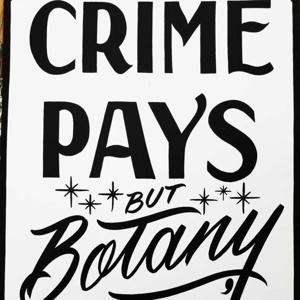
Crime Pays But Botany Doesn't

Crime Pays But Botany Doesn't

Download on the App Store

Crime Pays But Botany Doesn't episodes

  • Watering Before a Freeze, Goliad Gravels
    Rants about South Texas Geology, Geologic Timeline Apps for your D@mn phone, why its better to water before a freeze, being dragged by a freight train leaving Ft. Worth Texas, how much self-hate someone must have in order to lower themselves to the point of patronizing Subway Sandwich shops, and more.
    1 hr 14 min
  • Tucson Again, Agaves, Freezing in NM
    Rants about freezing while trying to sleep in the back of a truck in Lordsburg, New Mexico, why Agaves are monocarpic, the importance of having a "target list" should you ever get diagnosed with a terminal illness, fruit dispersal in Frankenia johnstonii, how rhyolite is just like Satan's play-doh, the biogeography of peyote gourds (Lagenaria sp.), microdosing LSD in the arboretum, and more

    Thumbnail pic is Pellaea truncata (Pteridaceae)
    1 hr 34 min
  • The Flower That Looks Like a Bird (especially if you're high) & other rants
    A roughly 77 minute rant about how an Australian plant in the legume Family named Crotalaria cunninghamii "looks a like a bird" but only to humans who have smoked copious amounts of weed and certainly not as a product of natural selection, how glyphosate works and why it's the lesser of two evils when used for restoration and invasive plant management, and how dwarf ponies dressed in Hawaiian shirts could be used for the eradication of invasive grasses in desert habitats.
    1 hr 22 min
  • How Do Chollas Bang
    Michelle Cloud-Hughes is a Cactus researcher, botanist and Desert Rat who specializes in one of my favorite cactus genera - Cylindropuntia: the genus of the dreaded Chollas. She has described a new species of Cholla, Cylindropuntia chuckwallensis, and spent 2 decades trudging up mountains and rockscapes of the Mojave, Sonoran and Baja Desert. In this podcast we talk about how Chollas bang, why deserts are some of the best places to study plant evolution, and why the sh*t they can't put solar panels on top of the parking lots of any of America's vast and expansive shopping and automobile culture slums.
    2 hr 5 min
  • Plant Anatomy with Jim Mauseth
    Jim Mauseth is a wizard with a microscope and a retired professor of plant anatomy at UT Austin, where he taught for 30+ years. Jim is an expert in Plant Anatomy with an emphasis on Cacti. In this podcast we talk about anatomical adaptations of cacti and why palms are not true trees.
    1 hr 35 min
  • Going to Jail for Botany
    Dr. Peter Breslin is a Botanist out of Tucson Arizona specializing in Cacti, and recently did time in Brewster County Jail for "trespassing" to photograph some rare endemics that only grow on Novaculite (ancient biogenic silica) soils in West Texas. He also helped elucidate some of the evolutionary relationships between species that were formerly classified in the genus Mammilaria but are actually more closely related to the Baja genus Cochemiea, which specializes in hummingbird pollination.

    This conversation was fun as hell, and we talk about why nomenclatural change-ups and classifications of this sort are important, and how they tell a story about how organisms (including humans) move and migrate across continents and landscapes, and how the environment (which consists of geology, climate, presence of certain animals, etc) SELECTS for various traits in plants.

    We also talk about DNA and transcriptome analysis, and how it clears up some of the evolutionary relationships between plants and how transcriptomes can actually change depending on what habitat conditions an individual plant is in.

    We talk about the remarkable genus Pediocactus, a genus of the frigidly-cold high desert in the American Southwest and the radiation that it has had there, as well its ability to pull itself into the ground during the dormant season, effectively "hiding".

    LAstly, we clear up some of the confusion around the extremely bizarre and endangered Mexican genus Pelecyphora and how it's related to plants in the genus Escobaria that grow all over North America, including in some very cold climates.

    2 hr
  • Dallas Plant Rescue & West Texas Dunes
    In this episode we rant about :

    Rescuing and digging thin-soiled limestone prairie plants from a soon-to-be-destroyed site in the Dallas/Ft. Worth area weeks before the bulldozers come by to erect a data center or some other obscenity.

    Moth pollination in deserts, the chemistry and familiar smell of moth-pollinated flowers.

    West Texas sand dunes

    Limestome endemic plants like Encelia scaposa and Echinocactus horizonthalonius

    Limestone cacti in Southern Arizona, which is a landscape composed almost entirely of volcanics or intrusive igneous rock
    1 hr 38 min
  • Nuevo León & Tamaulipas Cactus Blitz
    Jeremy Spath (owner of Hidden Agave nursery @hiddenagave) and Kevin Krucher (@crazy4cactus) talk about a recent trip through the states of Nuevo León, Tamaulipas and Coahuila to document and explore desert plants and their ecology, including tons of rare species like Lophophora williamsii, Stenocactus phyllacanthus, Astrophytum asterias, Obregonia denigrii, Ariocarpus scaphirostris, Agave Montana, Agave albopilosa and more.
    1 hr 10 min
  • Poison Ivy Doesn't Wanna Hurt You
    This entire podcast is about the Poison Ivy & Mango Family, Anacardiaceae. Susan Pell , Executive Director of the U.S. Botanic Garden & John Mitchell from the New York Botanic Garden both specialize in the systematics and phytochemistry of this incredible family of plants.

    In this episode we talk about the active compound in Poison Ivy, Urushiol, as well as some of the cool adaptations that dryland and desert-adapted members of the family have evolved to cope with their unique environments. We mention a ton of cool plants species you've never heard of before, some edible and some toxic, and spend 80 minutes discussing how cool this family of plants is.

    Plant in the thumbnail is Actinocheita potentillifolia from Puebla, Mexico.
    1 hr 29 min

About Crime Pays But Botany Doesn't

From the publisher's feed

Why do some plants grow where they do? How can geology cause new plant species to evolve? Why are some plants pollinated by flies, some by bats, some by birds, and others by bees? How does a plant…

More shows like Crime Pays But Botany Doesn't

Radiolab by WNYC Studios

Radiolab

43,819 Listeners

99% Invisible by Roman Mars

99% Invisible

26,173 Listeners

Outside/In by NHPR

Outside/In

1,474 Listeners

The Kitchen Sisters Present by The Kitchen Sisters & Radiotopia

The Kitchen Sisters Present

1,283 Listeners

BirdNote Daily by BirdNote

BirdNote Daily

1,256 Listeners

MARGARET ROACH A WAY TO GARDEN by Margaret Roach

MARGARET ROACH A WAY TO GARDEN

678 Listeners

In Defense of Plants Podcast by In Defense of Plants

In Defense of Plants Podcast

1,247 Listeners

Ologies with Alie Ward by Alie Ward

Ologies with Alie Ward

24,525 Listeners

Weird Studies by SpectreVision Radio

Weird Studies

597 Listeners

The Weirdest Thing I Learned This Week by Popular Science

The Weirdest Thing I Learned This Week

2,176 Listeners

The Wild with Chris Morgan by KUOW News and Information

The Wild with Chris Morgan

3,435 Listeners

Live Like the World is Dying by Margaret Killjoy

Live Like the World is Dying

442 Listeners

The Science of Birds by Ivan Phillipsen

The Science of Birds

875 Listeners

Completely Arbortrary by Completely Arbortrary

Completely Arbortrary

1,249 Listeners

The Atlas Obscura Podcast by SiriusXM and Atlas Obscura

The Atlas Obscura Podcast

1,736 Listeners