
Sign up to save your podcasts
Or



Based on Podcast App listening data
India is using more AI than ever. But most of that intelligence is not Indian. OpenAI, Google and others are expanding in India fast. They already shape how millions work, learn, and search.
Meanwhile, India’s own sovereign AI model is only expected in 2026. Other countries like South Korea and China have already built and deployed theirs.
What does sovereign AI actually mean, why does it matter for everyday users and why is India is still struggling to build the full stack. And most importantly, who will build the AI that runs India’s future?
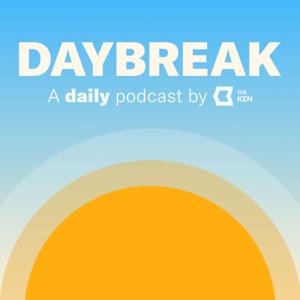
Daybreak is produced from the newsroom of The Ken, India’s first subscriber-only business news platform. Subscribe for more exclusive, deeply-reported, and analytical business stories.
A cardiologist in Nagpur performs two similar angioplasties. But the stents inside his patients tell two very different stories. One gets Indian-made devices under a government scheme. The other insists on an imported brand.
This contrast is now common across India. Price caps pushed foreign stent makers into a corner in 2017. But they never left.
And now, they’re back with new valves, pacemakers, and high-margin cardiac devices. Domestic players, meanwhile, grew fast but still struggle with data, technology, and trust.
Tune in.
Daybreak is produced from the newsroom of The Ken, India’s first subscriber-only business news platform. Subscribe for more exclusive, deeply-reported, and analytical business stories.
India’s largest cineplex chain, PVR INOX, has pulled off a major financial reversal, posting a ₹100 crore profit this quarter, a drastic recovery after bleeding nearly ₹12 crore last year. Over 40 million people showed up—but occupancy ratios are still struggling to cross 30%.
To fix this, PVR INOX is expanding into new, non-metro markets like Gangtok and Raipur. But there's a major twist: the company is no longer footing the bill for expansion.
Taking a page from hospitality giants like Marriott, PVR INOX is embracing an asset-light franchise model. Partners will now bankroll everything from projectors to seating, while PVR INOX manages the brand and operations. We explore this strategic shift—how it hedges risk, frees up capital, and whether betting on multiplexes in the age of OTT is a "Hail Mary" move.
Tune in.
Daybreak is produced from the newsroom of The Ken, India’s first subscriber-only business news platform. Subscribe for more exclusive, deeply-reported, and analytical business stories.
Tiruppur, Tamil Nadu, India’s knitwear capital, has long depended on massive U.S. orders that shaped its factories, products, and growth. But when the Trump administration imposed a 50% tariff on Indian garment imports, the town’s export engine received a long-pending shock.
Turns out, the crisis became a turning point. Manufacturers are now scrambling for discounts, shifting production to Sri Lanka and Kenya, reorienting toward Europe, and overhauling product lines from mass-market basics to intricate boutique styles.
Amid layoffs, automation, and global diversification, Tiruppur’s exporters are discovering something surprising.
This shock may be exactly the push the industry needed to evolve.
Tune in.
Daybreak is produced from the newsroom of The Ken, India’s first subscriber-only business news platform. Subscribe for more exclusive, deeply-reported, and analytical business stories.
India's largest school board, CBSE, has announced that students as young as Class 3 will begin learning Artificial Intelligence.
This isn't the first time. The board rolled out an AI elective for Class 9 in 2019, long before generative AI was a household name. Now, the goal is to make "AI thinking" as fundamental as grammar.
We dive into this massive national experiment, exploring what "learning AI" means for a third grader—it’s less about building chatbots and more about "computational thinking." And the real test ahead isn’t the syllabus; it’s whether India can train millions of teachers, many still unsure about using the tools they’re now expected to teach.
Tune in.
Daybreak is produced from the newsroom of The Ken, India’s first subscriber-only business news platform. Subscribe for more exclusive, deeply-reported, and analytical business stories.
What does it take to perform at your best — not once, but over and over again? Olympian Nisha Millet has spent her life answering that question.
In sport, as in business, success isn’t about one big win — it’s about showing up, even when it’s hard. From the pressures of competing at the Olympics to building a career as a coach and entrepreneur, Nisha shares what the pool taught her about focus, resilience, and managing performance under pressure.
In this episode, host Rachel Varghese explores how elite athletes think about consistency, how they recover from failure, and what leaders everywhere can learn from the mindset of those who compete for fractions of a second.
Tune in.
Daybreak is produced from the newsroom of The Ken, India’s first subscriber-only business news platform. Subscribe for more exclusive, deeply-reported, and analytical business stories.
SoftBank just sold about $5.8 billion worth of Nvidia shares earlier this week. The move frees up cash for new AI bets and comes as AI stocks power most of this year’s market rally. Nvidia’s rise has been spectacular but so have the warnings about overheating.
Some analysts see a rotation coming: money could move from pricey tech giants to steadier markets.
And that’s where India enters the picture. It’s grown slower, but on stronger fundamentals like broad demand, digital momentum, real earnings.
The question now is simple: when the AI fever cools, can India keep its calm?
Tune in.
Daybreak is produced from the newsroom of The Ken, India’s first subscriber-only business news platform. Subscribe for more exclusive, deeply-reported, and analytical business stories.
When Ozempic began changing how the world lost weight, most slimming companies panicked. But VLCC didn’t. Backed by Carlyle, it’s opening more clinics than ever before.
Because to Carlyle, Ozempic isn’t a threat—it’s just another doorway into India’s beauty economy.
In this episode, we look at how VLCC’s new owners are turning an existential challenge into expansion, why its products are taking a back seat to real estate, and what the future of India’s weight-loss industry looks like in the age of GLP-1 drugs.
Tune in.
In 2025, the University of Southampton became the first British university to open a campus in India. It was more than a milestone.
After a single policy change, foreign universities are rushing to claim their place in India’s higher-education market. States are competing to host them, and universities are chasing new revenue abroad. Everyone seems to be winning.
But beneath the glossy partnerships and big promises, what does this experiment really mean for students? And what happens when a “foreign degree” no longer means going abroad?
Tune in.
Daybreak is produced from the newsroom of The Ken, India’s first subscriber-only business news platform. Subscribe for more exclusive, deeply-reported, and analytical business stories.
Across India, lenders like HDFC and Kotak are repurposing the same algorithms that once judged credit risk to run hyper-personalised marketing campaigns.
These systems now predict who’s ready for a credit card, or insurance plan by studying every transaction, payment, and habit — turning customer data into personalised sales pitches.
The RBI has drawn clear lines for how AI can be used in lending. But when it comes to marketing, the rules are still fuzzy. That leaves space for India’s biggest banks to experiment—and for AI to quietly reshape how finance sells itself.
Tune in.
Daybreak is produced from the newsroom of The Ken, India’s first subscriber-only business news platform. Subscribe for more exclusive, deeply-reported, and analytical business stories.
From the publisher's feed

399 Listeners

285 Listeners
22 Listeners

155 Listeners

11 Listeners

56 Listeners

638 Listeners

222 Listeners

39 Listeners
288 Listeners

40 Listeners

2 Listeners

15 Listeners
93 Listeners

12 Listeners

11 Listeners

4 Listeners

0 Listeners

0 Listeners

0 Listeners