
Sign up to save your podcasts
Or



Based on Podcast App listening data
Titanium is the magic metal that made possible the mass production of plastics and paints, as well as buildings that clean both themselves and the air around them.
These powerful chemicals are essential to obtain the minerals that build our world, the fertilisers that feed the planet, and the fuels that propel our vehicles - as presenter Laurence Knight discovers on a trip to the Ineos Grangemouth oil refinery in Scotland. But while most traditional acids are based on the power of hydrogen ions, Prof Andrea Sella of University College London explains that many modern industrial "acids" do not, and come in startlingly unexpected forms such as powders. Many of the most corrosive acids are very tricky to contain, resulting in the occasional nasty accident, as chemical engineer Keith Plumb explains. Also, Justin Rowlatt has a report on acid attacks in southern Asia in which he speaks to campaigner Selina Ahmed of the Acid Survivors Foundation on how Bangladesh has tackled the problem. (Picture: A team working with toxic acids and chemicals secures chemical cargo train tanks crashed near Sofia, Bulgaria; Credit: Cylonphoto/Thinkstock)
Why is oxygen essential to steelmaking, how do you extract it from the air, and can you inhale too much of it? Answering these questions leaves presenter Justin Rowlatt almost breathless.
Stronger and more durable than steel, this glamorous metal crops up in sportscars, hip replacements and jewellery - but a new chemical process hopes one day to make it as common as steel. Prof Andrea Sella explains why this relatively widespread chemical element is so difficult to extract from its ore. Presenter Laurence Knight then heads to Yorkshire, where metallurgy pioneers Metalysis are trying to commercialise a novel way of doing just that - the so-called FFC Process. We also visit Epsom hospital, south of London, where orthopaedic surgery head Philip Mitchell explains why titanium makes such great bone implants, and Philip Dewhurst of mineral consultancy Roskill casts doubts on whether titanium will ever become cheap and ubiquitous, at least in his lifetime. (Picture: Hip implant; Credit: Photodisc/Thinkstock)
The “element of life” also makes the air that we breathe a perilous and costly atmosphere in which to operate.
Cobalt, the metal in magnets and phone batteries, is synonymous with the colour blue. But what exactly are magnets, how do they work and where are they used? And is some of the cobalt being mined by children? Presenter Laurence Knight hears from chemistry professor Andrea Sella of University College London why a permanent magnet is like a flock of birds, and he travels to Arnold Magnetics near Sheffield where manager Martin Satyr explains how magnets are used in everything from recovering the heat energy from sportscar engines to recycling your trash. Also in the programme, Mark Dummett of Amnesty International, back from Katanga in southern Congo - source of half the world's cobalt - tells of his concerns about the conditions in which artisanal miners work, including children. And David Weight of the Cobalt Development Institute explains what the industry is doing to ensure it knows where its cobalt is coming from. (Photo: Andrea Sella picking up lumps of cobalt with a magnet; Credit: Laurence Knight)
Copper has long been the metal of electricity generators and wiring. But presenter Justin Rowlatt asks whether new technologies herald the death of the old-fashioned electricity grid. Prof Andrea Sella of University College London explains the special properties of element 29 of the periodic table that mean that half of the world's mined copper is used to conduct electricity. Justin travels to the rapidly growing Indian city of Gurgaon to ask Jasmeet Khurana of solar consultancy Bridge to India what his government's plans to increase solar power a hundredfold mean for the best way to build the country's electricity grid. Electricity entrepreneur Simon Daniel of Moixa Technology argues that solar power and battery technology could transform the century-old debate between Tesla and Edison over AC vs DC power. And Zolaikha Strong of the Copper Development Association says the transition to renewable energy means the world will still need plenty more of the metal. (Photo: Copper cable, Credit: Yukosourov/Thinkstock)
Copper is the distinctive red metal in pots, pans and water pipes, and also plays a central role in whisky distillation. Presenter Laurence Knight and chemistry guru Professor Andrea Sella of University College London travel to the Abercrombie copperworks in Scotland to see the art of whisky still-making first-hand. Also in the programme, Gideon Long reports from Chile on why the source of one-third of the world's copper supply has not succumbed to the "resources curse". And Bill Keevil of Southampton University explains why copper's anti-microbial properties mean it could soon be leading the fight-back against hospital super-bugs such as MRSA. (Photo: A whisky still at the Abercrombie copperworks, Credit: Mike Wilkinson/Abercrombie Copperworks)
Boron is the mineral from the Wild West that stops glass from shattering and stops bullets in their tracks. Presenter Laurence Knight visits the Dixon Glass works to see why borosilicate glass is perfect for making chemistry equipment and much of the glassware we use in our day-to-day lives. Professor Andrea Sella demonstrates how this element puts the flub into flubber. Colin Roberson, founder of body armour firm Advanced Defence Materials, explains why being shot is like standing at the bottom of a volcano. And the BBC's Kim Gittleson travels to the deserts of California where the modern-day story of boron first began. (Photo: Boron, California, Credit: Kim Gittleson/BBC)
LED lighting, solar power and lasers are just some of the electronics revolutionised by two obscure chemical elements - gallium and indium. Laurence Knight hears from Mike Simpson of Philips why we will only need to replace our lightbulbs once every two decades, and travels to Sheffield University where research centre head Jon Heffernan explains what on earth III-V materials are and why making an LED is like baking a pizza. Meanwhile chemistry stalwart Prof Andrea Sella of UCL demonstrates these two metals' surprisingly buttery melt-in-the-mouth properties. (Photo: Times Square New Year's Eve ball, Credit: Jeff Zelevansky/Getty Images)
From the publisher's feed
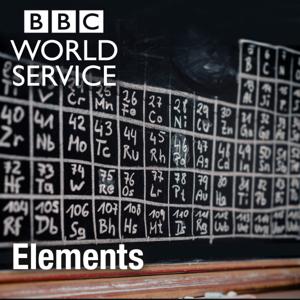
A close look at chemical elements, the basic building blocks of the universe. Where do we get them, what do we use them for and how do they fit into our economy?
Ranked by our users in the last 21 days

91,022 Listeners

43,852 Listeners

26,831 Listeners
26,151 Listeners

7,625 Listeners
873 Listeners

1,048 Listeners

5,481 Listeners

1,797 Listeners

3,201 Listeners

1,811 Listeners

1,907 Listeners

4,839 Listeners
964 Listeners

770 Listeners
359 Listeners

4,209 Listeners

3,225 Listeners

1,004 Listeners

723 Listeners

1,004 Listeners

779 Listeners