
Sign up to save your podcasts
Or

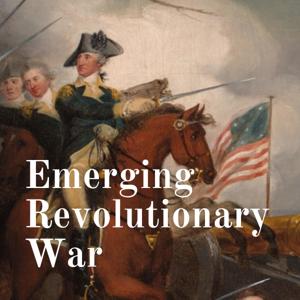


Join Emerging Revolutionary War as we discuss the latest book and this amazing historical tale with historian and author Tom McMillan. "Our Flag Was Still There" details the improbable two-hundred-year journey of the original Star-Spangled Banner—from Fort McHenry in 1814, when Francis Scott Key first saw it, to the Smithsonian in 2023—and the enduring family who defended, kept, hid, and ultimately donated the most famous flag in American history.
Join ERW as we sit down with historian Jim Piecuch to discuss the Battle of Waxhaws which occurred on May 29, 1780.
To celebrate Mother's Day, join us as we talk with the staff of the Washington Heritage Museums (who manage the Mary Washington House Museum in Fredericksburg) about the complex relationship between Mary Washington and her son. Also learn about how WHM will be managing the newly acquired grave site of Mary Washington in Fredericksburg.
Emerging Revolutionary War returns to the War of 1812 with a discussion of the first part of the campaign that eventually led to the climatic Battle of Baltimore. This discussion will center around the action at Bladensburg and the movement to Baltimore. Joining Emerging Revolutionary War historian Phillip S. Greenwalt will be Daniel Davis, Senior Education Manager for the American Battlefield Trust.
We are celebrating our three year anniversary of holding our Rev War Revelries! We discuss some random topics on the Revolutionary War and share some of our research and work we are each involved in. So grab a drink and prepare for a fun hour of chat with ERW.
In May 1782, Colonel William Crawford led over 450 volunteers across Ohio to attack British-allied Native Americans who had been raiding the frontiers of Pennsylvania and Virginia for years. An experienced yet reluctant commander, Crawford and his men clashed with a similarly sized force of British Rangers and Wyandot, Delaware, and Shawnee Indians on the Sandusky River in early June. After three days, the Americans were routed in one of the worst defeats American arms suffered on the frontier during the American Revolution. During the retreat, Native American warriors captured dozens of men, including Colonel Crawford. Many were horrifically tortured to death in revenge for the Gnadenhutten massacre earlier that spring, when American volunteers bludgeoned nearly one hundred unarmed and unresisting Delaware Indians to death.
This Rev War Revelry focuses on British General Benedict Arnold's operations in Virginia in 1781, including the capture and burning of Richmond. We will be joined by Virginia historians John Pagano and Mark Wilcox, who will help bring to life the story of when Arnold turned his sword against the people he once called his comrades and countrymen.
Emerging Revolutionary War welcomes historian and author Mike Cecere to discuss his latest book: "Williamsburg at War: Virginia's Capital in the Revolutionary War." Williamsburg witnessed many crucial events during the Revolution and war. From the Stamp Tax Resolves of 1765, meetings at the Raleigh Tavern in 1769 and 1774, the gunpowder incident and formation of troops in 1775, the unanimous decision of the 5th Virginia Convention to support American independence in May 1776, the steady support of the continental army throughout the war, two brief enemy occupations in 1781, and finally, as a staging area for the Siege of Yorktown in 1781, Williamsburg played a significant role in the Revolution and Revolutionary War.
The Battle of Eutaw Springs took place on September 8, 1781, and was among the last in the War of Independence. It was brutal in its combat and reprisals, with Continental and Whig militia fighting British regulars and Loyalist regiments. Although its outcome was seemingly inconclusive, the battle, fought near present-day Eutawville, South Carolina, contained all the elements that defined the war in the South. Shrouded in myth and misconception, the battle has also been overshadowed by the surrender of Yorktown. Eutaw Springs represented lost opportunities for both armies. The American forces were desperate for a victory in 1781, and Gen. Nathanael Greene finally had the ground of his own choosing. British forces under Col. Alexander Stewart were equally determined to keep a solid grip on the territory they still held in the South Carolina lowcountry. In one of the bloodiest battles of the war, both armies sustained heavy casualties with each side losing nearly 20 percent of its soldiers. Neither side won the hard-fought battle, and controversies plagued both sides in the aftermath. Join us as we talk about the Battle Eutaw Springs with ERW"s own Bert Dunkerly, co-author of the book Eutaw Springs: The Final Battle of the American Revolution's Southern Campaign.
Join us as we welcome author Gene Procknow to discuss his new book: "William Hunter - Finding Free Speech: A British Soldier’s Son Who Became an Early American." During the American Revolution, Hunter accompanied his father on a campaign to fight the American Rebels. Witnessing first-hand the terrors of combat and twice experiencing capture, Hunter wrote the only surviving account written by a child of a British soldier during the American Revolution. Previously unknown, the journal is one of the most important document discoveries in recent years. He later became a prominent newspaper editor and representative. Join us as we learn more about this fascinating story from early American history.
From the publisher's feed
4,706 Listeners
1,561 Listeners

744 Listeners
787 Listeners
3,992 Listeners
6,231 Listeners
6,157 Listeners
1,035 Listeners
4,209 Listeners

3,338 Listeners
923 Listeners

208 Listeners

387 Listeners
2,132 Listeners
1,593 Listeners