Epic of Gilgamesh

Epic of Gilgamesh

By John HarrisArts
Download on the App Store

Epic of Gilgamesh episodes

  • Introduction to the Text
    A brief introduction to the Epic: its origin and significance to our lives.
    ***
    Image is of the famed eleventh tablet
    of the Epic of Gilgamesh,
    in which the tale of the Flood is related.
    Now housed in the British Museum,
    it was found in the pillaged remains
    of the royal library of the Assyrian King Ashurbanipal (reigned 669-631 BC)
    in his palace at Nineveh.
    20 min
  • Prologue
    Preamble to the adventures, introducing Gilgamesh, king of Uruk, and alluding to the goddess Ishtar whose presence is preeminent among all divinity in this tale, and in whose temple are kept the tablets which are to be read to tell this tale.
    ***
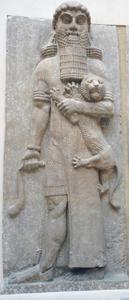
    Image is an Akkadian representation of Gilgamesh in his prime.
    Music excerpt is “Ur” from the album
    The Forest by David Byrne
    7 min
  • Adventure of Enkidu
    The Adventure of Enkidu continues tablet I of the Epic and finishes on tablet II. It is supplemented by Bablyonian material where the Akkadian text is damaged.
    Gilgamesh is a young king of Uruk, arrogant, and overbearing. He so abuses his authority by the mistreatment of his people, even his own warriors and peers, even taking their brides in sexual intercourse, that he is feared and despised, even while admired.
    The people pray for a champion to deliver them, another strong man who can best him. The creator Aruru places Enkidu (the "wild man") on earth for this purpose. He is eventually tamed and comes to Uruk to challenge Gilgamesh.
    This is the tale of that encounter.
    ***
    The image is an Akkadian frieze
    representing Enkidu drinking at a waterhole
    in the wilderness like a beast.
    Music excerpt is “Ur” from the album
    The Forest by David Byrne
    23 min
  • Adventure of Forests of Cedar (Part 1)
    The text of this episode is much damaged in both the Akkadian and the Babylonian series; rather than indicating the frequent gaps and ambiguities, the text is reconstructed from the best sources, including the more ancient Sumerian.
    Much is conjectural, and is given some poetic license. The Sumerian, rather than the Akkadian, contains more details, and so the temper of the story reflects its more “archaic” tone.
    ***
    Image is a classic Sumerian representation of Gilgamesh wrestling a lion to his death.

    Music excerpt is 
“Fantasia On A Theme By Thomas Tallis”
    from the album, Vaughan Williams: Symphonic Works
    20 min
  • Adventure of Forests of Cedar (Part 2)
    The conclusion of the adventure, the confron-tation with Humbaba.
    ***
    The image is a Sumerian
    clay model of the face of Humbaba,
    said to be the image of coiled intestines.

    Music excerpt is 
“Fantasia On A Theme By Thomas Tallis”
    from the album, Vaughan Williams: Symphonic Works
    32 min
  • Adventure of the Halub Tree
    This is the heavily damaged twelfth tablet in the Gilgamesh Epic found in the royal library of Ninevah. It’s content is disconcerting to scholars as the final chapter to the Epic, because so ranked it would seemingly resurrect Enkidu from the dead for a gratuitous and incoherent conclusion; an end to the Epic with Tablet 11, where Gilgamesh returns to Uruk after his wanderings, seems much more fitting and so nicely closes with an epilogic passage that poetically parallels the prologue in Tablet 1.
    But this adventure is a traditional Sumerian tale of Gilgamesh and was appended by the Ninevah compiler for some importance, perhaps as further elucidation of the central theme of death, or rather, the meaning of life in the midst of death. I find its color and its archaic lore mysterious and so include it where other renditions omit it. I have rendered it perhaps more poetically and liberally than my other renditions here, so as to evoke its strangeness. We should remember that in traditional oral story telling, tales concatenate “spiritually” related matter, even if they are otherwise illogical. Relation, rather than logic, rules the story. Still, in deference to modern narrative sensibilities, I have opted to place the tale among the series of adventures that precede the death of Enkidu and the final wanderings of Gilgamesh.
    ***
    Music excerpt is 
“Fra Angelico”
    by 20th century composer, Alan Hovnhaness;
    the album is Hovhaness: Symphony Etchmiadzin
    18 min
  • Adventure of Lugalbanda and the Anzud Bird
    Lugalbanda, the ostensible father of Gilgamesh, whose statue stood in his bedroom, which he reverentially anointed with butter, and to which he addressed his private thoughts, appeared in important Sumerian legends that told how he had become King of Uruk and other exploits. These are tales in one sense historical, as he is named in the ancient Sumerian List of Kings. On the other hand, magical portions of narrative and the setting of them should make him a figure of myth, of primordial time, of time even at the creation of the world. Lugalbanda is said to have lived and reigned for 1200 years, and so defies mere mortal aspect.
    ***
    Music excerpt is “Tamarack Pines” by George Winston from his album, Forest.
    39 min
  • 5,000 Year Old Proverbs
    This is my favorite Sumerian artifact.
    A so-called “devotional statue,” it dates to 2600 B.C., representing what scholars believe is a married couple. This statue was found buried beneath the floor of a shrine at Nippur in Iraq and measures at little more than 4 inches high. The couple originally had feet, and the figures have eyes made of shell and lapis lazuli set in bitumen, a natural cement-like substance.
    ***
    Music excerpt
    is the song “Glad”
    by David Byrne from his
    album, Grown Backwards.
    19 min
  • Adventure of the Bull of Heaven (Part 1)
    The image is the “Queen of the Night,” a relief of Old Babylonian Empire (1800-1750 BC); it is now housed in the British Museum.
    This large plaque is made of baked straw-tempered clay, modeled in high relief. The figure of the curvaceous naked woman was originally painted red. She wears the horned headdress characteristic of a Mesopotamian deity and holds a rod and ring of justice, symbols of her divinity. Her long multicolored wings hang downwards, indicating that she is a goddess of the Underworld. Her legs end in the talons of a bird of prey, similar to those of the two owls that flank her. The background was originally painted black, suggesting that she was associated with the night. She stands on the backs of two lions, and a scale pattern indicates mountains.
    The figure could be an aspect of the goddess Ishtar, Mesopotamian goddess of sexual love and war, or Ishtar's sister and rival, the goddess Ereshkigal who ruled over the Underworld, or the demoness Lilitu, known in the Bible as Lilith. The plaque probably stood in a shrine.
    ***
    Music excerpt is “Ninevah”
    from the album
    The Forest by David Byrne
    33 min
  • Adventure of the Bull of Heaven (Part 2)
    A modern clay impression of a Neo-Assyrian cylinder seal, circa 7th century BCE. One of only five with this motif that have survived. Height: 3.9 cm. Diameter: 1.6 cm. Enkidu, on the left, wears a short kilt decorated with rosettes, hair and beard in curls, an axe in one hand, holding the tail of the Bull of Heaven in the other. The winged human-headed bull crouches down on its foreleg, in front Gilgamesh, wearing long fringed robe with rosettes, a double horned headdress, long curled hair and beard, holding one of the bull's horns while plunging his sword into its neck.
    The cylinder is in the Schøyen Collection of London and Oslo. The Schøyen Collection was started around 1920 by Engineer M.O. Schøyen (1896-1962), father of Martin Schøyen, who collected some 1000 volumes of early and later editions of Norwegian and international literature, history, travel, science, as well as antiquities.
    ***
    Music excerpt is Vocalise, Op. 34/14 by Rachmaninov
    from the album The Swan (Le Cygne) 
Han-Na Chang (Cello) & Leonard Slatkin with the Philharmonia Orchestra

    16 min

About Epic of Gilgamesh

From the publisher's feed

An Annotated Prose Rendition
Based upon the Original
Sumerian, Akkadian, Babylonian,
and Hittite Tablets

With Supplementary Sumerian
Texts and Selected Sumerian…

More shows like Epic of Gilgamesh

The Joe Rogan Experience by Joe Rogan

The Joe Rogan Experience

227,392 Listeners

Lore by Aaron Mahnke

Lore

44,981 Listeners

StarTalk with Neil deGrasse Tyson by Neil deGrasse Tyson

StarTalk with Neil deGrasse Tyson

14,356 Listeners

In Our Time by BBC Radio 4

In Our Time

5,502 Listeners

The Run-Up by The New York Times

The Run-Up

2,070 Listeners

The History of Literature by Jacke Wilson / The Podglomerate

The History of Literature

1,112 Listeners

The Daily by The New York Times

The Daily

111,831 Listeners

Interesting Times by New York Times Opinion

Interesting Times

7,125 Listeners

Mythology by Spotify Studios

Mythology

5,201 Listeners

Post Reports by The Washington Post

Post Reports

5,208 Listeners

Fall of Civilizations Podcast by Fall of Civilizations Podcast

Fall of Civilizations Podcast

5,223 Listeners

Throughline by NPR

Throughline

16,313 Listeners

The Ancients by History Hit

The Ancients

3,364 Listeners

Unexplainable by Vox

Unexplainable

2,314 Listeners

The Weekly Show with Jon Stewart by Comedy Central

The Weekly Show with Jon Stewart

10,671 Listeners