
Sign up to save your podcasts
Or

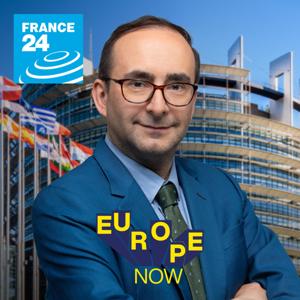


FRANCE 24 heads north to the kingdom of Denmark. The Scandinavian country has been in the spotlight this year, holding the rotating presidency of the European Council from July to December and pushing forward its priorities such as migration and the energy transition – topics that we dive into in this show. In this first part of the programme, our focus is on defence and migration.
Denmark used to be a Eurosceptic country, voting against the Maastricht Treaty and opting out of the single currency. Denmark was also traditionally thought of as a "frugal" member of the EU when it came to common expenditure. But all this has changed with the war in Ukraine and the long shadow that Russia casts over the Baltic and Nordic regions.
We take a closer look at one of the key priorities of Denmark's EU presidency: Europe's defence policy, in an era marked by the US retreat from Europe and Russia's increasingly aggressive posture. Indeed, Denmark has been dealing with a series of drone incursions over its territory. To discuss these issues, our team meets with one of the vice-presidents of the European Parliament, Danish MEP Christel Schaldemose from the Socialists and Democrats, as well as with the head of the Danish Defence Intelligence Service, Thomas Ahrenkiel.
Read moreDenmark drone incursions: All signs point to Russia?
We also illuminate a specifically Danish phenomenon: a left-leaning, Social Democratic-led government that pursues a very hard line on migration and asylum. It's a strategy that seems to be gaining ground in the EU. This December, EU member states gave the green light to tightening immigration policy, including the setting up of controversial "return hubs" outside the bloc.
At home, Denmark's move to crack down on what the government calls "parallel societies" has faced accusations that it discriminates against people of migrant heritage. To discuss these questions, we meet with former Renew MEP Karen Melchior from the European think tank CEPS (Centre for European Policy Studies), and we visit Nørrebro, a multicultural district of Copenhagen, where we watch local football team Nørrebro United.
Our reporter Charlotte Prudhomme investigates the impact of fake news in Denmark, and the efforts being made to counter them.
And our reporter Luke Brown meets the people most affected by Denmark’s hard line on immigration: two young women who fled Syria a decade ago. We discuss how they cope with the uncertainty of not knowing if they'll be able to stay in Denmark.
Show presented by Armen Georgian, produced by Charlotte Prudhomme, filmed on location by Charlotte Prudhomme and Stéphane Bodenne, with Luke Brown. Editor-in-chief: Caroline de Camaret.
Europe Rendezvous brings you a special programme from the Azores, a beautiful and remote archipelago in the Atlantic. The dramatic volcanic islands constitute an Autonomous Region of Portugal, and also an Outermost Region of the EU. That means their relatively small population of around 240,000 inhabitants receives outsized help from the EU – about €160 million in cohesion funds every year. Despite that investment, the Azores' GDP in 2023 was lower than it was in the 2000s. So how much have EU funds actually helped to level up this distant territory?
Admittedly, tourism has boosted the local economy in the post-Covid period, and a major pull for tourists is Gorreana, the only functioning tea plantation in Europe. We meet the owners and speak to João Teixeira, an economist at the University of the Azores, about the role of tourism and EU funds on the islands.
We also interview the president of the autonomous government of the Azores, José Manuel Bolieiro, who opposes the EU Commission's plans to centralise the management of cohesion funds. Our reporters Renaud Lefort and Charlotte Prudhomme take a look at the battle for the EU budget in Brussels and how that could impact Outermost Regions.
And our chief reporter Luke Brown looks at something particularly important for life on an island over 1,400 kilometres from mainland Europe: just what to do with all the waste. He zooms in on the clean-up of the beaches where so much marine litter washes up, because of the Azores' position in the middle of so many Atlantic currents.
Watch moreEU solidarity in the Azores: Miracle or mirage? (part 2)
Show presented by Armen Georgian, produced by Renaud Lefort, filmed on location by Renaud Lefort and Stéphane Bodenne, with Luke Brown.
Video editing: Aude Richelet, Joël Procope, Gilles Terrier, Aurélien Porcher, Lucille Latour. Editor-in-chief: Caroline de Camaret.
Special thanks to Terra Azul, Anne-Marie Brossard, Visit Azores, Regional Secretariat for the Sea and Fisheries, Rui Martins, The Ocean Azores Media House, Azores Regional Government, João Inocêncio Gomes
Co-funded by the European Union. Views and opinions expressed are however those of the author(s) only and do not necessarily reflect those of the European Union or the DG Regional and Urban Policy. Neither the European Union nor the DG Regional and Urban Policy can be held responsible for them.
Europe Rendezvous brings you a special programme from the Azores, a beautiful and remote archipelago in the Atlantic. The dramatic volcanic islands constitute an Autonomous Region of Portugal, and also an Outermost Region of the EU. That means their relatively small population of around 240,000 inhabitants receives outsized help from the EU – about €160 million in cohesion funds every year. In this second part of the show, we focus on what is all around the Azores: the Atlantic Ocean.
In 2024, the Azores implemented the Marine Protected Area, which protects almost 300,000 square kilometres, or 30 percent of the water that surrounds the islands. It means that fishing is banned in certain zones. We speak with MEP Paulo do Nascimento Cabral, one of the legislators for the European Ocean Pact.
We are lucky enough to get a glimpse of an animal that is at the meeting point between sustainable tourism and the Blue Economy of the Azores – the local whales – as we join a tour company that has used EU funds to finance its new fleet of electric vessels, thus reducing the carbon footprint of whale-watching.
Our senior reporter Luke Brown visits the most distant of the Azorean islands, Flores, where just this year, work began to repair the harbour destroyed by Hurricane Lorenzo in 2019. EU funds are set to finance 85 percent of the total rebuilding cost of €197 million.
Luke Brown also investigates regional efforts to reduce brain drain and provide incentives for young people to stay on the islands. He visits the School of the Sea, which trains young Azoreans in all types of maritime careers, thanks to EU funds. We discuss brain drain and updating the "rent-seeking" economy of the past with MEP Ana Vasconcelos, at the emblematic Nonagon Science and Technology Park.
Finally, the Azores have the perfect climate to raise dairy cows, and they account for over 35 percent of Portugal's entire dairy production. We meet with a local farmer, who shows us her "happy cows", which are free to roam outside every day of the year!
Watch moreEU solidarity in the Azores: Miracle or mirage? (part 1)
Show presented by Armen Georgian, produced by Renaud Lefort, filmed on location by Renaud Lefort and Stéphane Bodenne, with Luke Brown.
Video editing: Aude Richelet, Joël Procope, Gilles Terrier, Aurélien Porcher, Lucille Latour. Editor-in-chief: Caroline de Camaret.
Special thanks to Terra Azul, Anne-Marie Brossard, Visit Azores, Regional Secretariat for the Sea and Fisheries, Rui Martins, The Ocean Azores Media House, Azores Regional Government, João Inocêncio Gomes
Co-funded by the European Union. Views and opinions expressed are however those of the author(s) only and do not necessarily reflect those of the European Union or the DG Regional and Urban Policy. Neither the European Union nor the DG Regional and Urban Policy can be held responsible for them.
Europe Now brings you a special programme from Kyiv to mark the second anniversary of full-scale war in Ukraine. The fighting has killed and injured hundreds of thousands of people and left around a fifth of Ukrainian territory under Russian control, but this has not deterred Kyiv from seeking full membership of the European Union. In this first part of the show, we focus on Ukraine's reforms and its cultural heritage.
In December, Ukraine received a crucial signal from the EU, when the 27 member states agreed to start accession talks with Kyiv. And in February, a compromise was reached with Hungary to unblock a €50 billion financial support package for Ukraine. Throughout the war, and even before, the EU has been a crucial partner, providing at least €85 billion in aid to Ukraine.
In part one of this special programme, we visit Ukraine's premier innovation park, Unit City, where we meet Olha Stefanishyna, the country's deputy prime minister for European and Euro-Atlantic integration. She outlines the current state of play on Ukraine's EU reforms and tells us what she now expects from the European Commission in order to take things further.
We also tour the war-damaged Khanenko museum in Kyiv and discuss the impact of the war on Ukrainian culture with the country's most celebrated novelist, Andrey Kurkov. He describes how, despite the destruction of cultural heritage and all the horrors associated with that, the international visibility of Ukraine's culture has grown significantly.
In our motion design segment, Sophie Samaille recaps the various EU funding programmes that have been deployed in Ukraine.
Our reporter Luke Brown looks at EU-funded projects for Ukraine: from long-standing efforts to help "level up" Ukraine with EU Cohesion funds, to the more recent – and all the more urgent – efforts to help Ukraine rebuild homes and schools damaged by the Russian invasion, even as the war rages on.
Watch moreUkraine: A nation at war, yet firmly on the path to EU membership (part 2)
Show presented by Armen Georgian, produced by Johan Bodin, filmed on location by Johan Bodin and Stéphane Bodenne, with Luke Brown. Video editing: Gilles Terrie, Joël Procope, Aude Richelet. Editor-in-chief: Caroline de Camaret.
Co-funded by the European Union. Views and opinions expressed are however those of the author(s) only and do not necessarily reflect those of the European Union or the DG Regional and Urban Policy. Neither the European Union nor the DG Regional and Urban Policy can be held responsible for them.
Europe Now brings you a special programme from Kyiv to mark the second anniversary of full-scale war in Ukraine. The fighting has killed and injured hundreds of thousands of people and left around a fifth of Ukrainian territory under Russian control, but this has not deterred Kyiv from seeking full membership of the European Union. In this second part of the show, we focus on the reconstruction of the country.
In December, Ukraine received a crucial signal from the EU, when the 27 member states agreed to start accession talks with Kyiv. And in February, a compromise was reached with Hungary to unblock a €50 billion financial support package for Ukraine. Throughout the war, and even before, the EU has been a crucial partner, providing at least €85 billion in aid to Ukraine.
In part two of this special programme, we travel to the northern suburbs of Kyiv that were hit especially hard in the first weeks of Russia's onslaught – Bucha, Hostomel and Irpin. We look at concrete examples of reconstruction and EU aid to small and medium-sized businesses, such as the Dim bakery in Bucha, which recently won a grant from the EU and is managed by refugees from eastern Ukraine. We discuss the importance of such projects with senior representatives from the EU delegation in Ukraine, Iryna Hubarets and Alberto Fernandez-Diez.
We also visit the town of Borodyanka, which was devastated in February-March 2022, with around 1,500 buildings damaged. In the new administrative services centre, financed by the UN and the EU, we meet Liudmyla Buimister, an independent MP in the Ukrainian parliament. We discuss rebuilding plans, EU-aligned reforms of local government and her hopes for Ukraine's anti-corruption efforts.
In our motion design segment, Sophie Samaille looks at the ripples of the Ukraine war in the EU, particularly the cost-of-living crisis, and how EU funds – including cohesion – are being used to counter inflation.
Our reporter Luke Brown examines how EU cohesion funding is supporting Ukrainians in Poland, and takes a look at how fears of "social dumping" – or cheaper Ukrainian labour costs – are being felt in the vital road haulage sector; fears which led to a months-long blockade of the two countries' road border.
Read moreUkraine: A nation at war, yet firmly on the path to EU membership (part 1)
Show presented by Armen Georgian, produced by Johan Bodin, filmed on location by Johan Bodin and Stéphane Bodenne, with Luke Brown. Editor-in-chief: Caroline de Camaret.
Co-funded by the European Union. Views and opinions expressed are however those of the author(s) only and do not necessarily reflect those of the European Union or the DG Regional and Urban Policy. Neither the European Union nor the DG Regional and Urban Policy can be held responsible for them.
It's not often that an EU member state decides to hold a national election just as it takes over the rotating presidency of the European Union. But that's exactly what the Spanish government did on July 23, just three weeks after starting its six-month stint at the helm of the EU. In this second part of the show, we focus on Spain's scientific research and the importance of EU funds to the country.
We take you to Spain's national scientific research council, which is very much aligned with the EU's goals on cutting-edge research and strategic autonomy in key industries.
We also take a closer look at EU cohesion funding and Next Generation EU funds (the post-Covid recovery plan) in Spain, with two of the country’s leading economists.
In our motion design segment, Sophie Samaille reports on how cohesion funds help communities across EU borders.
And FRANCE 24's Luke Brown reports on the Franco-Spanish Treaty of Barcelona and cross-border projects.
Read moreWatch part one of the show
Show presented by Armen Georgian, produced by Johan Bodin, filmed on location by Johan Bodin and Stéphane Bodenne, with Luke Brown. Editor-in-chief: Caroline de Camaret.
Co-funded by the European Union. Views and opinions expressed are however those of the author(s) only and do not necessarily reflect those of the European Union or the DG Regional and Urban Policy. Neither the European Union nor the DG Regional and Urban Policy can be held responsible for them.
It's not often that an EU member state decides to hold a national election just as it takes over the rotating presidency of the European Union. But that's exactly what the Spanish government did on July 23, just three weeks after starting its six-month stint at the helm of the EU. In this first part of the programme, we meet movers and shakers in Madrid to take the political temperature following the inconclusive result of Spain's July 23 parliamentary vote.
Acting Foreign Minister José Manuel Albares, from the ruling Socialist Party (PSOE), insists that Spain's EU presidency is firmly on track and making important decisions, despite a few initial delays.
We also speak to Antonio Lopez-Isturiz White, whose conservative Partido Popular (People's Party) won the election but did not succeed in building a governing coalition.
The far right Vox party's Hermann Tertsch expresses his concerns about a possible government of "extremists and ex-terrorists" as he puts it, going forward.
And Ernest Urtasun, representing the left-wing bloc Sumar, shares his optimism about four more years of progressive politics if a deal is found with the incumbent Socialist Prime Minister Pedro Sanchez.
In our motion design segment, Sophie Samaille reports on how Spain benefits from EU cohesion funding.
Plus, we report on how Spain and the EU are trying to bridge the digital divide and improve connectivity for all.
Read moreWatch part two of the show
Show presented by Armen Georgian, produced by Johan Bodin, filmed on location by Johan Bodin and Stéphane Bodenne, with Luke Brown. Editor-in-chief: Caroline de Camaret.
Co-funded by the European Union. Views and opinions expressed are however those of the author(s) only and do not necessarily reflect those of the European Union or the DG Regional and Urban Policy. Neither the European Union nor the DG Regional and Urban Policy can be held responsible for them.
Bulgaria is one of the most recent members of the European Union, and also the poorest. EU funds contribute a vital role to the economy: €12 billion for the period of 2021-2027, and €6.6 billion already thanks to the post-Covid recovery fund.
But Bulgaria faces multiple obstacles in its attempts to reduce poverty. Political instability has resulted in five elections in the past two years, and that instability has undermined long-term financial planning. Meanwhile, reforms to reduce corruption and strengthen the independence of the judiciary are still incomplete.
Our guests in part one of the show explain Bulgaria’s current political deadlock, as well as how the EU aid is helping the country.
Bulgarian Vice-President (close to the Socialist Party), Iliana Iotova is interviewed in the Bulgarian archeology museum in Sofia.
Mayor of Gabrovo, Tanya Hristova (GERB - centre-right party which got the most seats in the recent elections) - interview in the city of Gabrovo, which is still dealing with the legacy of its industrial past.
Our reports also cast light on how the EU functions in Bulgaria:
The EU helping young Bulgarians to help their country, by David Gilberg. How EU funds help improve education opportunities for young people in Bulgaria and aim to reverse the brain drain - Bulgaria’s population has fallen 10 percent in the past decade.
Fact or Fake by Sophie Samaille: Does the EU really help young people?
>>Watch part two of the show
Show presented by Armen Georgian, produced by Johan Bodin, filmed on location by Johan Bodin and Stéphane Bodenne, with Luke Brown. Editor in chief, Caroline de Camaret.
Co-funded by the European Union. Views and opinions expressed are however those of the author(s) only and do not necessarily reflect those of the European Union or the DG Regional and Urban Policy. Neither the European Union nor the DG Regional and Urban Policy can be held responsible for them.
How does the European Union use cohesion funds to reduce poverty and inequality across the bloc? Our first stops are in two of the EU’s poorest countries, Bulgaria and Romania, to look at the role that EU aid plays in the areas of education and public transport. We also visit one of Europe’s richest countries - France - to see how the European Union can help to level up parts of the EU that display some surprising inequalities.
Our guests are experts on just how valuable EU funds are for Bulgaria. Bulgaria’s Minister in charge of EU funds, Atanas Pekanov, University Professor of European Affairs, Ingrid Shikova and Representative of the European Commission in Sofia, Cvetan Kyulanov.
In Romania, Luke Brown looks at efforts to reduce exclusion for the Roma community. Education has been a key vector since Romania joined the EU in 2007 - but many within the community remain frustrated by the lack of progress.
In France, Sophie Samaille and Luke Brown visit one of the regions most affected by de-industrialisation in the north of the country. Faced with a growing cost of living crisis due to inflation, food banks are a first port of call for many - and they rely on EU contributions. We also meet a dynamic mayor of the small town of Anor - badly hit by factory closures - who has battled for his community to receive EU funds to renovate the old industrial area.
>>Watch part one of the show
Show presented by Armen Georgian, produced by Johan Bodin, filmed on location by Johan Bodin and Stéphane Bodenne, with Luke Brown. Editor in chief, Caroline de Camaret.
Co-funded by the European Union. Views and opinions expressed are however those of the author(s) only and do not necessarily reflect those of the European Union or the DG Regional and Urban Policy. Neither the European Union nor the DG Regional and Urban Policy can be held responsible for them.
Whether they're islands, mountains or territories far from the mainland, such areas are considered by the EU to be regions with a strong natural geographical handicap. The EU's cohesion policy, with its powerful budget, gives these regions substantial resources to help them try to catch up with metropolitan areas. The Europe Now team travels to the French overseas department of Guadeloupe to take a closer look.
With the goal of "levelling up" in mind, nine Ultra-Peripheral Regions, or UPRs, have received €13 billion over the last seven years. Six of these UPRs are French. In the case of France, around 18 percent of the total EU Structural Funds goes to 3 percent of the population. On the face of it, that's a major boost for UPRs. But is that money being used optimally?
We went to see for ourselves in Guadeloupe, an archipelago nearly 7,000 kilometres from the French mainland. It is set to receive a billion euros from the EU in 2021-2027. Unemployment is around twice the national rate; a third of the population lives below the poverty line and water shortages are frequent. So why does more EU investment not necessarily translate into better living standards?
In part two of the programme, we meet the president of Guadeloupe’s chamber of commerce and industry, Patrick Vial-Collet, who also owns the island's only five-star hotel. He gives us a taste of the hospitality sector's post-Covid recovery, and touches on efforts to create jobs in that industry.
MEP Maxette Pirbakas meets us in the famous Parc de la Source to show us Guadeloupe's biodiversity and to highlight her efforts to promote that at the EU level.
Socialist senator and former regional president Victorin Lurel takes us on a tour of MACTe, Guadeloupe's spectacular memorial and culture centre dedicated to the memory of the slave trade, which was co-financed by the European Union.
FRANCE 24's Europe reporters Luke Brown and Isabelle Romero visit ski resorts that are adapting to climate change, as well as seeing how smaller ski resorts cope with being so far from the beaten path.
And Sophie Samaille zooms in on the Just Transition Fund which puts the green transition at the heart of EU investment policy.
>> Watch part one of the show
Show presented by Armen Georgian, produced by Johan Bodin, filmed on location by Johan Bodin and Stéphane Bodenne, with Luke Brown. Editor in chief, Caroline de Camaret.
Co-funded by the European Union. Views and opinions expressed are however those of the author(s) only and do not necessarily reflect those of the European Union or the DG Regional and Urban Policy. Neither the European Union nor the DG Regional and Urban Policy can be held responsible for them.
From the publisher's feed
We take you to the 27 EU member states for a series of exclusive reports and interviews with national and local players, including MEPs. Produced in partnership with the European Union.…

7,626 Listeners
4 Listeners

11 Listeners
0 Listeners
0 Listeners
2 Listeners
1 Listeners

21 Listeners
4 Listeners
0 Listeners
4 Listeners
21 Listeners

6 Listeners
39 Listeners

111,779 Listeners
4 Listeners
4 Listeners
1 Listeners

0 Listeners
0 Listeners

0 Listeners
8 Listeners
9 Listeners
138 Listeners