
Sign up to save your podcasts
Or

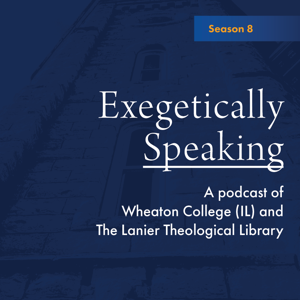


The Christ hymn of Phil. 2:6-11 is one of the most studied NT passages on Christology. When considering Paul's own study we should note 3:20-21 of the same letter, which reprises several Greek words from the hymn. Dr. Chris Kugler is Lecturer in Theology for George W. Truett Theological Seminary, Baylor University, at the Houston Campus, Lanier Theological Library. His publications include Paul and the Image of God and Heaven, Hell, and Hope: A Biblical and Theological Exploration of Universal Salvation.
Check out related programs at Wheaton College: B.A. in Classical Languages (Greek, Latin, Hebrew): https://bit.ly/4s5Br54 M.A. in Biblical Exegesis: https://bit.ly/4qSuOlE
Describing the Holy Spirit's work on behalf of believers in Christ, Paul employs two verbs with double prefixes. The effect is to give special stress to the Spirit's work of support and intercession. Dr. Jones, who has been on this podcast before, is the Director of Global Theological Education for Hamoreh Ministries, a theological training ministry working in northern Kenya.
Check out related programs at Wheaton College: B.A. in Classical Languages (Greek, Latin, Hebrew): https://bit.ly/4kLm8MC M.A. in Biblical Exegesis: https://bit.ly/4rp3xs4
This is a repeat of our very first episode: Veteran interpreter Dr. John Walton describes the process of exegesis — from choosing a text, analyzing the genre and background, and grappling with the "linguistic core" — in this step-by-step explanation of how exegesis is done. Dr. John Walton, Old Testament Professor Emeritus at Wheaton Graduate School, has since become a frequent contributor to this podcast. He has many volumes in his "Lost World" series along with many other publications, including (with Andrew Hill), A Survey of the Old Testament (4th ed.). He is currently collaborating with Dr. Aubrey Buster in preparing a major commentary on Daniel (NICOT), of which the first volume (Daniel 1-6) is out. Check out related programs at Wheaton College: B.A. in Classical Languages (Greek, Latin, Hebrew): https://bit.ly/4kwp8MT M.A. in Biblical Exegesis: https://bit.ly/4arsNa2
John 3:16 is routinely translated, "For God so loved the world." The NLT translates it, "For this is how God loved the world." The difference roots in a Greek adverb, the sentence as a whole, and the theological logic employed by John. Dr. George Kalantzis, who has been on this podcast before, is Professor of Theology and Director of The Wheaton Center for Early Christian Studies at Wheaton College. Among his publications are Theodore of Mopsuestia: Gospel of John and Caesar and the Lamb: Early Christian Attitudes on War and Military Service. He has been editor or co-editor of several volumes, including, Come, Let Us Eat Together: Sacraments and Christian Unity. Check out related programs at Wheaton College: B.A. in Classical Languages (Greek, Latin, Hebrew): https://bit.ly/4c5vikE M.A. in Biblical Exegesis: https://bit.ly/3NQWucV
Rev. 5:1-14 depicts a dramatic heavenly scene in which the Lamb alone is worthy and able to take and open what is referred to as a βιβλίον (biblion) with seven seals and inscribed in a particular way. The attempt to gain a more precise mental picture of this literary object and its nature as a text includes matters of word meaning and textual criticism. Dr. Christian Askeland, a past contributor to this podcast, is Advisor for The Green Collection (Oklahoma City) and works with Inspire.org. He is interested in the origins and diversity of early Christianity, endeavoring to reconstruct historically the movements from which the relevant texts and manuscripts arose. He has authored John's Gospel: The Coptic Translations of its Greek Text and has co-authored The Bible in the U.S. Capital: Inviting All People to Engage with the Transformative Power of the Bible.
Check out related programs at Wheaton College:
B.A. in Classical Languages (Greek, Latin, Hebrew): https://bit.ly/3LLFswf M.A. in Biblical Exegesis: https://bit.ly/4jYUwTL
Many translations render Rom. 8:28 as, "all things work together for good." The NLT renders the same words as, "God causes everything to work together," a construal that is represented in some ancient Greek manuscripts. Yet another possibility would be, "the Spirit works all things together." What explains these differences? A past contributor to this podcast, Joseph Dodson is the Dr. Craig L. Blomberg Chair of New Testament at Denver Seminary. In addition to other publications, he has written Paul the Rabbi Philosopher: Stoic and Jewish Philosophy in the Apostle's Thought, and (with Mattie Mae Motl) Conquerors Not Captives: Reframing Romans 7 for the Christian Life. He is working on commentaries on Romans (Brill) and Colossians-Philemon (Holman).
Check out related programs at Wheaton College:
B.A. in Classical Languages (Greek, Latin, Hebrew): https://bit.ly/4k1MKJ0 M.A. in Biblical Exegesis: https://bit.ly/45tWh5s
Following his resurrection in Luke 24 Jesus startles his disciples by appearing among them when they are talking about him. By v. 41, properly understood, they are still not believing. Luke's implicit argument about what finally brings them to faith requires close attention to the Greek wording and clues as to discourse structure. Dr. J. D. Atkins is Associate Professor of New Testament Language and Literature, and Chair of the Department of Biblical and Exegetical Studies at Tyndale Theological Seminary. Among other things he has authored, The Doubt of the Apostles and the Resurrection Faith of the Early Church. He is working (coauthor) on Forty Questions on the Gospels (Kregel). In this episode, Dr. J. D. Atkins concludes his discussion of Luke 24:41-45. Check out related programs at Wheaton College:
B.A. in Classical Languages (Greek, Latin, Hebrew): https://bit.ly/3Z9V1kg M.A. in Biblical Exegesis: https://bit.ly/4jzKnwy
Following his resurrection in Luke 24 Jesus startles his disciples by appearing among them when they are talking about him. By v. 41, properly understood, they are still not believing. Luke's implicit argument about what finally brings them to faith requires close attention to the Greek wording and clues as to discourse structure. Dr. J. D. Atkins is Associate Professor of New Testament Language and Literature, and Chair of the Department of Biblical and Exegetical Studies at Tyndale Theological Seminary. Among other things he has authored, The Doubt of the Apostles and the Resurrection Faith of the Early Church. He is working (coauthor) on Forty Questions on the Gospels (Kregel).
Check out related programs at Wheaton College:
B.A. in Classical Languages (Greek, Latin, Hebrew): https://bit.ly/4qfstlu
M.A. in Biblical Exegesis: https://bit.ly/4jv2tQk
In Matthew 6, is Jesus talking about "healthy" and "unhealthy" eyes, as translations sometimes have it (e.g., NIV, ESV, NLT), or is the Greek expression an idiom that Jewish listeners would have readily understood in another way? Dr. Brad H. Young is Emeritus Professor in Judaic Christian Studies with an emphasis in Biblical Literature at Oral Roberts University Graduate School of Theology and Ministry, and Professor at Jerusalem Seminary. Among other things, he has published Jesus the Jewish Theologian and The Parables: Jewish Tradition and Christian Interpretation.
Check out related programs at Wheaton College: B.A. in Classical Languages (Greek, Latin, Hebrew): https://bit.ly/4rOK6ZN M.A. in Biblical Exegesis: https://bit.ly/4qAkbUH
What sort of work do the Scriptures forbid on the Sabbath? What sort of work is allowed? Attention to the Hebrew words used in connection with the Sabbath and in other contexts sheds some light on these questions. Dr. Baruch Kvasnika is President of Jerusalem Seminary, which equips believers to understand their faith in and through the land of the Bible. His dissertation at The Hebrew University of Jerusalem was, "The Language of Practice: Hebraic Walking and Way Metaphors in First Century Greek Related to Conduct."
Check out related programs at Wheaton College: B.A. in Classical Languages (Greek, Latin, Hebrew): https://bit.ly/4resSVR M.A. in Biblical Exegesis: https://bit.ly/4atV2VG
From the publisher's feed

15,995 Listeners

2,018 Listeners

19,471 Listeners

1,125 Listeners
4,427 Listeners
1,476 Listeners

1,282 Listeners

2,056 Listeners

641 Listeners
247 Listeners

340 Listeners

643 Listeners

219 Listeners

560 Listeners

382 Listeners