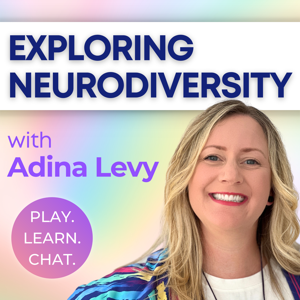
Exploring Neurodiversity with Adina Levy from Play. Learn. Chat

Exploring Neurodiversity with Adina Levy from Play. Learn. Chat

By Adina LevyEducationKids & Family
Download on the App Store

Exploring Neurodiversity with Adina Levy from Play. Learn. Chat episodes

  • Neurodivergent Acceptance & Finding Personal Joy - Chat with Stephanie Roberston - Neurodivergent OT
    In this fabulous chat with Stephanie Robertson, Neurodivergent OT, we chat about all kinds of topics including:
    • her journey of self-discovery and self-acceptance
    • the impact of masking on mental health and well-being
    • the need for systemic change and neurodiversity affirming practices to create an inclusive and supportive environment for neurodivergent people
    • moving away from behaviourism
    • understanding the intergenerational nature of parenting and education
    • promoting empathy, acceptance, and a broader version of social norms
    • holistic ways to support neurodivergent children
    • the need for self-care and finding personal joy in life.
    Connect with Steph - SGR Occupational Therapy: www.sgroccupationaltherapy.com Instagram: @sgroccupationaltherapy Facebook: SGR Holistic and Family Focused Occupational Therapy - https://www.facebook.com/SGROccupationalTherapy Facebook group: The Neurodiversity Empowerment Movement - https://www.facebook.com/groups/1258437025035170 YouTube: The Spiritual OT - https://www.youtube.com/@TheSpiritualOT Learn more with Adina from Play. Learn. Chat. Allied Health Professionals and Education Professionals! You're invited to my FREE Webinar! Neurodiversity Affirming Practice Kickstart: 3 Actionable Tips to do Today https://playlearnchat.com/free-webinar/ Podcast Link: https://pod.link/1625478932 Website: www.playlearnchat.com Instagram: https://www.instagram.com/play.learn.chat Facebook: https://www.facebook.com/play.learn.chat
    58 min
  • Collaboration & Advocacy: When others aren't aligned with your Neurodiversity Affirming approach to supporting Neurodivergent Kids
    In this episode for parents and professionals who support autistic and neurodivergent children, I share my response to a very common question - What should I do when other people don't agree with my neurodiversity affirming approach to supporting autistic or neurodivergent kids? I've got 7 ideas to share about how to collaborate and advocate when you're not aligned with the other person's approach. Here's the short list:
    1. Build relationships - connection over compliance
    2. Regulate yourself
    3. Find their ways of learning
    4. Educate in their way
    5. Understand their barriers - get curious
    6. Go slooooow
    7. Know when to walk away
    I share a lot more about these topics with parents and professionals in my webinars and workshops. Keen to learn more with me? For Parents: Free download for you: My checklist How Neurodiversity Affirming is your Child's Team -playlearnchat.com/freebies Learn more about supporting neurodivergent children in Neurodiversity Affirming ways, with my webinar series 'Turn Theory into Practice' - https://playlearnchat.com/neurodiversity-affirming-practice-webinar-series/ Podcast Link: https://pod.link/1625478932 Website: www.playlearnchat.com Instagram: https://www.instagram.com/play.learn.chat Facebook: https://www.facebook.com/play.learn.chat
    12 min
  • Don't Teach Kids through Trauma - Teach through Connection
    Picture this. You take your child to swimming class and it's a pretty unfamiliar environment. They haven't met the teacher before. It's noisy. It's all new and pretty overwhelming. It might also be quite enticing and interesting, but there's also a huge dose of new and unknown in there. The time comes around for your child's lesson to start. And you take your child over to the edge of the pool. The teacher's standing in the pool, looking up. Checking the clock and saying, "just pass it to me. She'll be okay." Your child does not agree. Your child is clinging to you. Crying screaming and quite simply not feeling ready to do what the teacher is asking. We all learn best through connection, relationship building when we're in a calm headspace. When we're intrigued, when we're feeling supported. Put simply, nobody learns well when they're in a state of trauma. Today we discuss why teaching kids through trauma isn't the way, and ideas for how teaching through connection can look. Learn more with me about this topic and many others! Links: Learn more about supporting neurodivergent children in Neurodiversity Affirming ways, with my webinar series 'Turn Theory into Practice' - https://playlearnchat.com/neurodiversity-affirming-practice-webinar-series/ And find your own pathway for Neurodiversity Affirming Practice professional learning here: https://playlearnchat.com/professionals/
    14 min
  • All Communication is Valid: Why it Might be Hard for an Autistic Child to Speak
    We're tucking in to this idea that All Communication is Valid. Busting the ableist bias that speech is the best way of communicating. In this episode I share some of the reasons why it might be hard for an autistic child (or anyone!) to speak. More non-speech might be needed when…
    • Speech skills are hard for someone (physical/motor skills or motor planning)
    • Language skills are hard
    • The content of language in that situation is complex
    • Emotions are heightened
    • They're experiencing sensory dysregulation
    • The situation is new
    • The situation is less preferred
    • Other people around aren't familiar, connected or trusted
    • Whenever someone wants!
    Speech isn't the end goal... Communication & relationship is! Learn more with me about this topic and many others! Professionals: My next Neurodiversity Affirming Practice 2-hour online Intro Workshop: https://playlearnchat.com/neurodiversity-affirming-practice-intro-workshop/

    Podcast Link: https://pod.link/1625478932

    Website: www.playlearnchat.com

    Instagram: https://www.instagram.com/play.learn.chat

    Facebook: https://www.facebook.com/play.learn.chat

    18 min
  • How to be an Excellent Ally this Autism Acceptance Month
    Autism Acceptance Month is here! This April, how can YOU be a fantastic, genuine and helpful ally to the autistic community? Here's how you can be an excellent ally this Autism Acceptance Month:⁠ 1️⃣ Listen to diverse autistic people⁠ 2️⃣ Share the work of autistic creators⁠⁠ 3️⃣ Get comfortable with feeling uncomfortable. Challenge your existing beliefs & biases 4️⃣ Call out ableist, negative, incorrect views of autism⁠ 5️⃣ Celebrate autistic joy!⁠ 6️⃣ If you mess up, own it. Help others learn.⁠ 7️⃣ Don't leave your advocacy in April. Make it a life-time thing.⁠ Links 👩‍💻 Therapists & Allied Health Professionals: Check out my Neurodiversity Affirming Practice Introductory 2-hour workshop here: https://playlearnchat.com/neurodiversity-affirming-practice-intro-workshop/ Learn more about the all supports I offer for professionals: www.playlearnchat.com/professionals My resource & links list - always being updated! https://www.playlearnchat.com/resources Podcast Link: https://pod.link/1625478932 Website: www.playlearnchat.com Instagram: https://www.instagram.com/play.learn.chat Facebook: https://www.facebook.com/play.learn.chat
    13 min
  • An Alternative, Affirming Approach to Behaviour Support - Understand the Deep Why
    Show Notes: In this episode, I discuss the issue with looking at children's behaviour through a lens of 'what triggered that behaviour?'. We talk about the need to understand the Deep Why behind a child's behaviour, before you can work out how best to support them. I share a very relatable example for any parent - a child 'refusing' to leave the house when you need to get out the door, and how two very different approaches to understanding WHY the behaviour is happening leads to two very different outcomes! Here's a summary of some of the possible 'Deep Whys' behind behaviours:
    • needing connection (this is fine!)
    • sensory need or dysregulation
    • difficulty sensing internal feelings (interoception)
    • uncertainty about what's happening or expected
    • task is too hard
    • difficulty expressing needs, wants or emotions
    • a combination of the above (most often!)
    Learn more about supporting neurodivergent children in Neurodiversity Affirming ways, with my webinar series 'Turn Theory into Practice' - https://playlearnchat.com/neurodiversity-affirming-practice-webinar-series/ Instagram accounts sharing experiences and thoughts as autistic women of colour:
    • ​Follow Tiffany on Instagram @fidgets.and.fries
    • Follow Sandyha @onwardsandupwardspsych
    • ​Follow TJ on Instagram @nigh.functioning.autism
    Dr. Ross Greene: Book - The Explosive Child Website: Lives in the Balance – Dr Ross Greene's Collaborative And Proactive Solutions Approach

    Podcast Link: https://pod.link/1625478932

    Website: www.playlearnchat.com

    Instagram: https://www.instagram.com/play.learn.chat

    Facebook: https://www.facebook.com/play.learn.chat

    19 min
  • What do Neurodiversity Affirming Goals look like for Autistic children?
    In this episode we discuss a range of key considerations to ensure that goals for autistic children's support are Neurodiversity Affirming, useful and relevant to each child. We'll discuss the need for goals that support an autistic child's regulation, connection, and overall well-being. Goals should not only seek to change the skills of a child, but we should instead have goals that aim to change the world around the child. This includes supporting other people's knowledge, perspectives, and skills in supporting and accepting each child, as well as their physical environment. We talk about the importance of meeting an autistic child's sensory and emotional regulation needs before asking for any other goals to be met. Communication goals should not just focus on speech or mouth words, but rather include all forms of communication, whatever is preferred by the child in each moment. Social interaction goals should not be based on changing an autistic child to appear more neurotypical or forcing eye contact. Affirming social goals can exist, if they are aligned with what a child wants. I also share a paragraph that I add to the start of goal summaries or plans, which is an example of how you can introduce Neurodiversity Affirming goals. You're welcome to use and edit it to use for your clients or child: These goals are to be supported when Amelia's sensory and emotional support needs are being met and she is well-regulated. Learning and development will happen better when she is regulated. Amelia's interests and personal preferences are important. We will support her to explore these more in and out of therapy sessions. Interests and fun will be incorporated at all stages of working on the below goals. Amelia's interests will not be used as rewards for doing other, less-interesting things. All communication methods are OK and valid: The goals are to be supported honouring Amelia's preferred communication method/s in any moment. For Amelia this generally includes a mix of using body movements, sounds, some mouthwords, and she is beginning to use her Augmentative and Alternative Communication (AAC) Speech Generating Device. Our priority is connection. We do not push or pressure Amelia to communicate using only speech, if that is not within her abilities. If you found this episode helpful, please share it with a friend, family member or a colleague! Links 📝 Free download for parents - Goal Setting Guide & Workbook: https://playlearnchat.ck.page/c73185e86e Learn more about supporting neurodivergent children in Neurodiversity Affirming ways, with my webinar series 'Turn Theory into Practice' - https://playlearnchat.com/neurodiversity-affirming-practice-webinar-series/ Podcast Link: https://pod.link/1625478932 Website: www.playlearnchat.com Instagram: https://www.instagram.com/play.learn.chat Facebook: https://www.facebook.com/play.learn.chat
    20 min
  • Neurodiversity Affirming 'Social Skills' Support for Autistic Children - Part 2: What Is and What Isn't Affirming

    In this episode, we dive into the specifics of what a Neurodiversity Affirming approach looks like when supporting social interactions for autistic children. The key point is that we do not want to teach neurodivergent children that they need to act more neurotypical. This means all our goals, therapy approaches and resources need to teach that autistic children might be different, and socialise in different (but not wrong) ways to neurotypical kids. We need to stop sending the message that kids are missing social skills... because they DO have social skills, just different perhaps from neurotypical social skills.

    We discuss that boundaries can still apply to autistic kids' communication & interactions (it's not OK to hurt others, physically or emotionally!), but we need to pause and think carefully about why we are asking a child to change.

    The traditional approach of teaching autistic children that they are wrong, different, and weird in a bad way is not acceptable any more. We talk about the issue with asking children to 'fit in'.

    So what should we do? We should focus on truly seeing neurodivergent children for who they are, what they enjoy, and help them be surrounded by people who appreciate them. We should teach self-awareness. We should teach self-advocacy.

    Tune in for these ideas and more!

    If you found this episode helpful, please share it with a friend, family member or a colleague!

    Links

    📝 Free download for parents of autistic and neurodivergent children - ✅ Checklist: How Neurodiversity Affirming is your Child's Team?: https://playlearnchat.ck.page/8c5072e2e7

    📝 Free download for therapists and parents of autistic and neurodivergent children - ✅ Checklist: Neurodiversity Affirming Social Support Approaches for Autistic Children: https://playlearnchat.ck.page/1fcf4c5759

    Learn more about supporting neurodivergent children in Neurodiversity Affirming ways, with my webinar series 'Turn Theory into Practice' - https://playlearnchat.com/neurodiversity-affirming-practice-webinar-series/

    ---

    Yellow Ladybugs - Org I mention - https://www.yellowladybugs.com.au/

    I CAN Network - Org I mention - https://icannetwork.online/

    ---

    Podcast Link: https://pod.link/1625478932

    Website: www.playlearnchat.com

    Instagram: https://www.instagram.com/play.learn.chat

    Facebook: https://www.facebook.com/play.learn.chat

    15 min
  • Neurodiversity Affirming 'Social Skills' Support for Autistic Children - Part 1: The Big Ideas
    'Social skills' is a massively important area of support that we all need to pause and examine what we've been teaching neurodivergent kids. We need to check if the programs, resources and goals we've worked on previously still apply under a Neurodiversity Affirming approach. There's a lot that we need to change. In short, we do not want to be teaching neurodivergent kids that they should act 'more neurotypical' to be accepted and socially connected. Today we discuss some of the bigger ideas that underpin what affirming social supports look like, and in the next episode we'll cover specific aspects of support that form a neurodiversity affirming approach to supporting social skills and social interactions for autistic kids. In this episode you'll learn about:
    • The importance of unlearning old practices and adopting Neurodiversity Affirming approaches to support for autistic children
    • Understanding neurodivergent communication styles can be different to neurotypical communication styles, but not wrong - we discuss the 'Double Empathy Problem'
    • Why we should focus should on respecting the unique strengths, challenges, quirks, and preferences of each child, instead of trying to make neurodivergent kids conform to neurotypical 'norms'
    • The impact of sensory differences on socialising, for neurodivergent people
    If you found this episode helpful, please share it with a friend, family member or a colleague! Links 📝 Free download for parents of autistic and neurodivergent children: https://playlearnchat.ck.page/8c5072e2e7

    Learn more about supporting neurodivergent children in Neurodiversity Affirming ways, with my webinar series 'Turn Theory into Practice' - https://playlearnchat.com/neurodiversity-affirming-practice-webinar-series/

    🖼 Fellow AuDHDer Speech Therapist Em @Neurowild_'s cartoon about the Double Empathy Problem is on Instagram (https://www.instagram.com/p/CoGbw44PziC/) and Teachers Pay Teachers (https://www.teacherspayteachers.com/Product/Differences-in-Autistic-and-NT-communication-styles-9-page-infographic-9079365?st=a31d3c6801571aefbb50f2ff8414a384) Podcast Link: https://pod.link/1625478932 Website: www.playlearnchat.com Instagram: https://www.instagram.com/play.learn.chat Facebook: https://www.facebook.com/play.learn.chat
    15 min
  • Words Matter: Exploring Neurodiversity Affirming Language

    So… you're ready to be part of the Neurodiversity Affirming movement to support an autistic and neurodivergent child in your world. Awesome, welcome in! The language you use matters. I'm kicking off this podcast series by sharing the language that you need to put in the bin, and the language to use instead.

    In today's episode, we delve into neurodiversity versus neurodivergent, why identity first language is preferred by most autistic people. We discuss getting comfortable with the term 'autistic' rather than 'on the spectrum' and why 'high-functioning' & 'low-functioning' terms should be left in the past.

    Tune in for these ideas and more!

    In this episode, you'll learn:

    • One person with a different type of brain from others is neurodivergent, while a group of people can be neurodiverse
    • Being autistic doesn't have to be limiting or a problem. The problems arise when an autistic person lives in a world that does not support and accommodate their needs
    • Why we should drop the D (Disorder) in ASD
    • It's not a compliment to refer to an autistic person as high-functioning - this negates someone's internal experience and only describes your opinion of how 'normal' they appear to you
    • Referring to an autistic person as low-functioning indicates low expectations of them, and it's an awful term.

    Get the free Cheatsheet PDF highlighting the terms that you should and shouldn't use when talking about autism and neurodiversity - https://playlearnchat.ck.page/48f9b202e1

    Transcript available on my website: https://playlearnchat.com/podcast-1

    If you found this episode helpful, please share it with a friend, family member or a colleague!

    Links

    Podcast Link: https://pod.link/1625478932

    Website: www.playlearnchat.com

    Instagram: https://www.instagram.com/play.learn.chat/

    Facebook: https://www.facebook.com/play.learn.chat

    16 min

About Exploring Neurodiversity with Adina Levy from Play. Learn. Chat

From the publisher's feed

Welcome to the Exploring Neurodiversity Podcast for adults who support Neurodivergent children. Whether you're an allied health professional, medical professional, education professional or a parent of a Neurodivergent child, you are welcome here.

More shows like Exploring Neurodiversity with Adina Levy from Play. Learn. Chat

Hamish & Andy by LiSTNR

Hamish & Andy

1,052 Listeners

All In The Mind by ABC Australia

All In The Mind

758 Listeners

Health Report by ABC Australia

Health Report

126 Listeners

Mamamia Out Loud by Mamamia Podcasts

Mamamia Out Loud

562 Listeners

Up First from NPR by NPR

Up First from NPR

56,384 Listeners

Feel Better, Live More with Dr Rangan Chatterjee by Dr Rangan Chatterjee: GP & Author

Feel Better, Live More with Dr Rangan Chatterjee

3,609 Listeners

Shameless by Shameless Media

Shameless

874 Listeners

Unravel by ABC Australia

Unravel

881 Listeners

Off Menu with Ed Gamble and James Acaster by Plosive

Off Menu with Ed Gamble and James Acaster

2,675 Listeners

The Quicky by Mamamia Podcasts

The Quicky

92 Listeners

True Crime Conversations by Mamamia Podcasts

True Crime Conversations

497 Listeners

Speak Up by Speak Up: A Speech Pathology Australia Podcast

Speak Up

5 Listeners

The Mel Robbins Podcast by Mel Robbins

The Mel Robbins Podcast

18,833 Listeners

Just The Gist by Just The Network

Just The Gist

66 Listeners