
Sign up to save your podcasts
Or



In March of this year, teachers all over the world were thrown a curveball when schools were closed until further notice due to the COVID-19 outbreak. Suddenly, we found ourselves signing up for Zoom accounts, setting up home studios, purchasing webcams and external microphones, and trying to figure out how to do what we do in this new virtual space.
Instead of looking at this as a temporary substitute for in-person teaching and learning, I started settling into a new teaching rhythm and uncovering some surprising benefits that I wouldn’t have recognized were it not for this unusual and unexpected experience.
It’s been 12 weeks now of teaching solely online. Twelve weeks of innovating and adapting and learning new technologies. Twelve weeks of meeting my students in their homes, navigating this new virtual world together, and finding ways to keep making music through it all.
Today, I want to share a few of my observations and reflections on this season, this new paradigm in music education, and the benefits to music teaching and learning that I’ve discovered.
For show notes + full transcript, click here.
Resources mentioned:
*Disclosure: I get commissions for purchases made through some of these links.
My best external microphone recommendations
Episode 009 - Six Things I’ve Learned About Teaching Online (So Far)
The New School for Music Study
Four Reasons Why Playing Your Instrument for Fun is Vital to Your Music Career
Afternoon Ti podcast (Episode 100)
If you enjoyed this episode, please leave a review in Apple Podcasts >>
Find me on Instagram: @ashleydanyew
Do you find yourself drawn to being a learner again in the summer months? Do you read more or study a topic that’s interesting to you, learn a new skill, take a class, or try something creative?
This summer already looks a little different than normal: events have been canceled, trips have been postponed, and most of us find ourselves (still) staying home. But there’s a gift in that if we’re willing to receive it.
How have the events of the past few months changed us as teachers, as musicians? What will we do differently going forward?
One of the things I love about summer is the slower pace: the invitation to create a new routine, a new rhythm, the opportunity to learn and work and rest at my own pace. And that hasn’t changed.
Looking for a few ideas for how to spend your time this summer? Here are a few things to explore:
For show notes + full transcript, click here.
Resources mentioned:
*Disclosure: I get commissions for purchases made through some of these links.
Creative Confidence by Tom Kelley and David Kelley
Zig-Zag: The Surprising Path to Greater Creativity by Keith Sawyer
Episode 011 - Zig Zag: The Surprising Path to Greater Creativity
Questions and Answers by Frances Clark
A Piano Teacher’s Legacy by Richard Chronister
The Success Factor in Piano Teaching by Elvina Pearce
American Orff-Schulwerk Association (AOSA) virtual professional development opportunities
The Kodály Music Institute online summer courses
Summer@Eastman Session online courses and workshops
The Frances Clark Center for Keyboard Pedagogy virtual Summer Intensive Seminars
Choristers Guild webinars and virtual forums for choir directors
The Presbyterian Association of Musicians online summer conference
NAfME Academy professional development webinars
Evernote: an app for note-taking, planning, organizing, and archiving
Milanote: a web-based tool for organizing creative projects into beautiful visual boards
Google Drive: home to all my online lesson recordings, recordings from students, and virtual studio class games
Episode 010 - Hosting a Virtual Studio Class: 7 Tips for Success
If you enjoyed this episode, please leave a review in Apple Podcasts >>
Find me on Instagram: @ashleydanyew
Today, we’re talking about curriculum. And more specifically, how to write your own.
A curriculum can be defined in a few different ways. My favorite definition comes from A.V. Kelly’s (2009) book, The Curriculum: Theory and Practice: “[Curriculum is] the totality of student experiences that occur in the educational process.”
Think of a curriculum like a guide: a plan to help you do your best teaching and help promote meaningful learning experiences.
Today, I’m going to show you how to create your very own curriculum, something tailor-made to fit your students.
For show notes + a full transcript, click here.
Resources mentioned:
*Disclosure: I get commissions for purchases made through some of these links.
The Curriculum: Theory and Practice by A. V. Kelly (2009)
Directing a Church Children's Choir 101 - a 4-week online course for children’s choir directors
The Art of Music Teaching & Learning - a comprehensive 8-week online course for music educators in all types of settings
National Coalition for Core Arts Standards - a guiding framework for arts education
Around the World: Music & Prayers for Children’s Choir
"Around the World" Piano Theme
J.W. Pepper and Sheet Music Plus
Episode 012 - How to Develop Musicianship Skills in Those You Teach
What to Teach When in Children’s Choir: Preschool, Younger Elementary, Older Elementary (+ a free eBook!)
12 Practical Transition Songs to Teach to Your Children’s Choir
The Ultimate Guide to Children’s Choir Warm-Ups (+ a free eBook!)
15 More Singing Games for Children’s Choir (+ a free eBook!)
How to Create a Children’s Choir Rehearsal Plan (+ a free template!)
Adult Choir Rehearsal Template - a free printable planning tool for a 60-90 minute rehearsal
If you enjoyed this episode, please leave a review in Apple Podcasts >>
Find me on Instagram: @ashleydanyew
Let’s talk about musicianship.
Musicianship is the skills you have as a musician: things like listening, singing, playing, creating, performing. It’s also the ability to “think in sound,” or audiate (source). This means hearing music in your head without any sound being present. Think of this as the ability to read a book silently — hearing the words in your head as you read them but not actually saying them out loud.
There are two things that help us develop this skill: exposure and experience.
Today, we’re going to talk about some practical, intentional ways to develop musicianship in those you teach. Here are a few examples:
Listening (including pitch recognition, intervals, phrasing, dynamics, listening to each other, and form)
Singing (including breathing, vowels, and tone production)
Improvising and Composing (making music spontaneously in the moment and the ability to write those ideas down)
Expression (including phrasing, dynamics, and movement)
Tonality (including singing with solfege and understanding the difference between a melody, bass line, and harmony part)
Rhythm and Steady Beat (including counting, chanting, and moving)
Reading (including music notation, symbols, and intervals)
Are you starting to get a sense of how big this topic is?
In today’s episode, you’ll find 10 practical things you can do to develop musicianship in those you teach, week by week, all throughout the year.
For show notes + full transcript, click here.
Resources mentioned:
*Disclosure: I get commissions for purchases made through some of these links.
The Ultimate Guide to Children’s Choir Warm-Ups (+ a free eBook!)
The Value of Teaching Vowels to Your Children’s Choir
Tonal & Rhythm Pattern Cards (Younger Elementary) - a printable set of 152 cards (88 tonal patterns + 64 rhythm patterns) designed for younger elementary (K-2nd grade) students
Tonal & Rhythm Pattern Cards (Older Elementary) - a printable set of 216 cards (88 tonal patterns + 128 rhythm patterns) designed for older elementary (3rd-5th grade) students
10 Movement Activities for Children’s Choir
16 Clapping Games for Children’s Choir
How to Use Color to Teach Music Literacy
How We Learn: The Surprising Truth About When, Where, and How It Happens - a fascinating look at the learning process by Benedict Carey
7 Fun Games for Children’s Choir (+ a free eBook!)
Fun, Easy Gathering Activities for Children’s Choir
If you enjoyed this episode, please leave a review in Apple Podcasts >>
Find me on Instagram: @ashleydanyew
Last summer, I discovered a book one day that piqued my curiosity while browsing in the OverDrive app: Zig Zag: The Surprising Path to Greater Creativity by Keith Sawyer.
I’m always interested in learning more about the creative process and gleaning insight into our creative processes as musicians, thinkers, educators, and creators, and when I found out that Keith Sawyer was not only a scientific expert on creativity but also a jazz pianist, I couldn’t wait to start reading.
In the book, Sawyer outlines 8 stages of the creative process but explains that there are multiple ways of entering and engaging in creativity. Rather than following a clear and direct path forward, starting here and ending there, the path to greater creativity has more zigs and zags; it’s unpredictable, erratic, and yes, surprising.
As Sawyer summarized, “The wonderful beauty of the creative life is that no authentic, thoughtful experience, no new glimmer of knowledge, is ever wasted.”
There’s so much I could say about Keith Sawyer’s book, but today, I want to give you a big picture of what this book is about by sharing three of my three biggest takeaways.
For show notes + full transcript, click here.
Resources mentioned:
*Disclosure: I get commissions for purchases made through some of these links.
OverDrive app for checking out free eBooks and audiobooks from your local library
Zig Zag: The Surprising Path to Greater Creativity by Keith Sawyer
The Art of Short Story - a writing masterclass by Joyce Carol Oates
If you enjoyed this episode, please leave a review in Apple Podcasts >>
Find me on Instagram: @ashleydanyew
A few years ago, I started teaching monthly group classes in my studio.
The idea was to include more opportunities for informal performance, observation, musical discussion, and developing musicianship skills in a supportive group environment. All students are invited and encouraged to play something each time, even just part of a piece.
But what to do when the world shuts down and everything moves online?
Host a Zoom studio class, of course.
Earlier this month, I taught two studio classes (3rd-6th grade and 7th-12th grade) and two buddy lessons (K-2nd grade). Here’s a behind-the-scenes look at how I set these up, how I structured our time together, and what activities I created to play virtually.
For show notes + full transcript, click here.
Resources mentioned:
*Disclosure: I get commissions for purchases made through some of these links.
Zoom - free video-chat software (40-minute limit for groups of three or more on the Basic plan, waived right now for K-12 educators)
Google Meet - free video-chat software (the business version of Google Hangouts)
DecideNow - a free spinner app that’s great for games, reviewing scales, performances challenges, improv activities, and more
Blue Yeti Microphone - my all-time favorite microphone for recording directly into my MacBook. I use it for recording spoken directions as well as playing demonstrations.
Frances Clark Center - hosting free webinars multiple times a week for piano teachers who are navigating teaching online
Google Slides - a free, cloud-based tool for creating presentations, slide decks, and other visuals
Victoria Boler - an elementary music educator who shares lesson plans, planning resources, game ideas, virtual teaching tutorials, and folk song materials
flat.io - an easy-to-use, free browser-based music notation software with a Google Chrome extension
If you enjoyed this episode, please leave a review in Apple Podcasts >>
Find me on Instagram: @ashleydanyew
What a crazy few weeks in the world, right?
Who would have thought that we’d be facing widespread school closures and the sudden need to move everything online in the wake of the COVID-19 pandemic?
If you’re technologically savvy and have been using technology in your teaching already, it may not feel like that big a jump, but for those who are new to all this, there’s quite a lot to learn and figure out to ensure a smooth, effective learning experience for your students. What platform is best? What kind of activities lend themselves to online learning? What equipment do you need? How do you make it interactive?
This is my third week of teaching solely online and I feel like I’m starting to get the hang of it, so I thought I’d share the top six things I’ve learned so far.
For show notes + full transcript, click here.
Resources mentioned:
*Disclosure: I get commissions for purchases made through some of these links.
Zoom - free video-chat software (40-minute limit for groups of three or more on the Basic plan, waived right now for K-12 educators)
Blue Yeti Microphone - my all-time favorite microphone for recording directly into my MacBook. I use it for recording spoken directions as well as playing demonstrations.
Google Drive - free digital file-storage system (documents, spreadsheets, video files, images, audio files, forms, slides) for anyone with a Google account
Google Slides - a free, cloud-based tool for creating presentations, slide decks, and other visuals
Brit & Co. - free art, lettering, photography, business, and design courses with code “selfcare” (through 3/31)
Marco Polo app - a free video-messaging mobile app
If you enjoyed this episode, please leave a review in Apple Podcasts >>
Find me on Instagram: @ashleydanyew
Rhythm pattern cards are a great way to teach new rhythmic concepts, reinforce familiar patterns, and build that all-important musical vocabulary (the ability to understand and create your own musical patterns and sequences).
I’ve found that having a few sets of rhythm pattern cards on hand can be so helpful in teaching to capture the attention of young learners and help them grasp new concepts (and have fun while doing it!).
Today, I’m sharing 10 fun ways you can use rhythm pattern cards in your teaching. I hope you find a few new ideas on this list!
For show notes + full transcript, click here.
Resources mentioned:
Free Rhythm Pattern Card Set - a printable set of 16 rhythm patterns cards in 4/4 time
Rhythm Pattern Card Set - a printable set of six rhythm pattern card sets in duple and triple meters (192 patterns total)
Decide Now! app + how I use it in my teaching
Rhythm Train Cards by Color in My Piano
Rhythm Clock game demonstration by Fun Music Company
Rollin’ Rhythms game board by Teach Piano Today
Rhythm Go Fish on Teachers Pay Teachers
Body Percussion Rhythm by Let’s Play Music
If you enjoyed this episode, please leave a review in Apple Podcasts >>
Find me on Instagram: @ashleydanyew
Last week, in Episode 6, I talked about four things I’m doing differently in my piano studio this year.
Today, I want to take a step back and tell you a story about one of my teachers. She wasn’t my first teacher—in fact, she was one of my last teachers—but she was the woman who taught me how to overcome my fears, play with power and control, develop my own interpretation, and understand music and artistry at the piano in a whole new way.
And in some ways, that meant starting at the very beginning…
For show notes + a full transcript, click here.
Resources mentioned:
*Disclosure: I get commissions for purchases made through some of these links.
Episode 006 - Four Things I’m Doing Differently in My Studio This Year
Italian Concerto by J.S. Bach
If you enjoyed this episode, please leave a review in Apple Podcasts >>
Find me on Instagram: @ashleydanyew
No matter how many years I teach, I always feel the same excitement around a fresh start and trying new things. There are certain parts of my routine that I like coming back to—things I like to keep the same—but there are always a few things I’m ready to change in my teaching when the new year rolls around.
I've learned a few things over the past few years and asking the questions, “What’s working?” and “What’s not working?” always provides a sense of clarity on what I can change and how I can improve things in the year ahead. I’m trying a few new things in my studio this year and today, I want to share them with you.
For show notes + a full transcript, click here.
Resources mentioned:
Wave Invoicing - a free online tool for sending invoices, receiving payments, and keeping up with basic bookkeeping
12 Supplemental Piano Books for Elementary Students
The Piano Syllabus (2015 Edition) by Royal Conservatory of Music / Music Development Program
If you enjoyed this episode, please leave a review in Apple Podcasts >>
Find me on Instagram: @ashleydanyew
From the publisher's feed
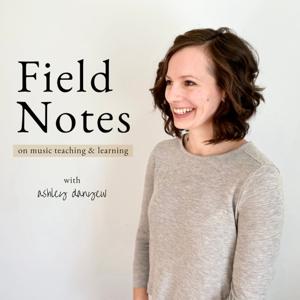
This podcast is a collection of creative ideas, practical strategies, and thoughtful observations from the field of music teaching and learning. Music educator Ashley Danyew will dive into topics…
3,945 Listeners
524 Listeners

130 Listeners

111,799 Listeners

56,447 Listeners
39 Listeners
64 Listeners
47 Listeners
24 Listeners
1,620 Listeners
9 Listeners

41 Listeners
15 Listeners
18 Listeners
5 Listeners