
Sign up to save your podcasts
Or



I have to be honest: I have a love-hate relationship with goals. I’ve had years of setting detailed goals in categories like Business, Teaching, Professional, and Personal. I’ve set monthly goals and sometimes weekly goals to stay on track.
Other years, I’ve been happy with a few new habits and a book list. And that's where I'm finding myself this year.
How do we plan and set goals for the year ahead when everything feels misty and grey? How do we change and grow when things around us are staying the same?
Today, I'm sharing a few helpful strategies and a glimpse at what my pseudo-goal-setting process looks like this year.
For show notes + full transcript, click here.
Related resources:
*Disclosure: I get commissions for purchases made through some of these links.
The Joy of Painting with Bob Ross
How to Set Goals for Your Business (Musician & Co.)
Goal Setting Workbook (Emily Jeffords)
The Talent Code (Daniel Coyle)
My 2021 Book List
Kartotek Simple Danish Monthly Planner Pad (The Foundry Home Goods)
Kartotek Simple Danish Weekly Planner Pad (The Foundry Home Goods)
If you enjoyed this episode, please leave a review in Apple Podcasts >>
Find me on Instagram: @ashleydanyew
Are you an introvert or an extrovert?
Society often makes us feel like we are one or the other, but in reality, these personality traits are two opposite ends of a spectrum, and most of us fall somewhere in the middle (source).
I’ll admit it took me a while to figure this out for myself. When I realized what I was feeling was a natural part of being an introvert, I planned my days and weeks differently. I became aware of how and when I used my social energy and I was much more intentional about rest and alone time.
The secret is to use your natural strengths. And that’s what we’re going to talk about today.
For show notes + full transcript, click here.
Related resources:
*Disclosure: I get commissions for purchases made through some of these links.
How You Can Tell That You’re an Introvert (Kendra Cherry, MS)
Quiet: The Power of Introverts in a World That Can’t Stop Talking (Susan Cain)
The Power of Introverts: A Manifesto for Quiet Brilliance (Scientific American)
The Introvert’s Guide to Leadership Presence (Quiet Revolution)
5 Ways Introverts Can Become Wired for Leadership Presence (Quiet Revolution)
The Ins and Outs of Using Evernote
If you enjoyed this episode, please leave a review in Apple Podcasts >>
Find me on Instagram: @ashleydanyew
We know that practicing is important to our work as professional musicians, even if we aren’t performers. Staying connected to your instrument helps keep your musicianship skills sharp—your aural awareness and reading abilities, technique, and commitment to a beautiful tone.
Playing your instrument makes you a better teacher, too, because you’re in it—you know how to pick and choose the strategies that will help you be most efficient.
In this episode, you’ll learn a handful of quick tips for practicing efficiently in 30 minutes or less.
For show notes + a full transcript, click here.
Related resources:
*Disclosure: I get commissions for purchases made through some of these links.
Songs Without Words by Felix Mendelssohn
Sight-Reading and Rhythm Every Day series by Helen Marlais
Ep. 007 - Let’s Start at the Very Beginning
4 Reasons Why Playing Your Instrument for Fun is Vital to Your Music Career
Pulse app - a metronome for your phone
3 Tips for Playing Open Score (for Choral Accompanists Everywhere)
The Church Musician Primer - a 4-week online keyboard skills class
If you enjoyed this episode, please leave a review in Apple Podcasts >>
Find me on Instagram: @ashleydanyew
As lifelong learners, we get to discover new things, new people, and new ideas. We explore things that are new and unfamiliar, whether that’s reading a short biography about a composer or sight-reading a new piece; outlining a new learning sequence or figuring out how to use a new app.
But what does this look like as a music professional? Here’s a personal and practical look at what lifelong learning looks like for me in this season.
For show notes + a full transcript, click here.
Related resources:
*Disclosure: I get commissions for purchases made through some of these links.
A Piano Teacher’s Legacy(Richard Chronister)
Sight-Reading and Rhythm Every Day series (Helen Marlais)
The Music Tree series (Frances Clark & Louise Goss)
Royal Conservatory of Music Syllabi
Milanote - the tool for organizing creative projects
forScore App for iPhone/iPad
Notability App for iPhone/iPad
Victure USB Webcam
How to Teach Music Lessons Online (+ Inside My Home Teaching Studio)
Four Reasons Why Playing Your Instrument for Fun is Vital to Your Music Career
If you enjoyed this episode, please leave a review in Apple Podcasts >>
Find me on Instagram: @ashleydanyew
In the last few years, I’ve spent some time reflecting on how best to encourage and motivate my students to continue learning on their own. I started thinking about how I give praise and offer words of encouragement.
Praise is a powerful tool and one that we as educators can use to equip and empower those we teach. We can use praise to inspire creativity, cultivate the pursuit of excellence, and celebrate milestones. And we can use it to motivate learners to keep moving forward and keep exploring.
Learning is a lifelong process, after all.
I did a little research on this topic and today, I want to share a few simple ways we can offer praise with intention — those meaningful words that inspire, encourage, and motivate others — and 12 practical phrases you can use in your teaching and tailor to your students.
For show notes + full transcript, click here.
Related resources:
*Disclosure: I get commissions for purchases made through some of these links.
"Praise and the Instructional Process” in The Journal of Classroom Instruction by Edmund T. Emmer
“Elementary Students’ Preference for Teacher Praise” in The Journal of Classroom Instruction by Paul C. Burnett
“Student Interpretations of Teacher Verbal Praise in Selected Seventh- and Eighth-Grade Choral Classes” in Journal of Research in Music Education by Ouida Taylor
Mindset: The New Psychology of Success by Carol S. Dweck
“Stop Saying, ‘You’re So Smart!’ 3 Better Ways to Praise Kids” in HuffPost by Renee Jain
If you enjoyed this episode, please leave a review in Apple Podcasts >>
Find me on Instagram: @ashleydanyew
As teachers, we ask a lot of questions.
What’s the first note?
What’s your hand position?
Which finger plays the black key?
What kind of note do we sing in m. 8?
Are these notes stepping or skipping?
But, did you know there are different kinds of questions (or ways of asking questions) that can actually promote learning?
A good question does more than assess student learning or mastery of a concept; it can actually foster a deeper level of understanding, open a space for productive dialogue, and promote self-reflection.
Today, I want to spend some time talking about how to ask the right kinds of questions in teaching: the ones that cultivate rich learning experiences, develop deeper understanding of a skill or concept, and lead students to begin asking questions of their own.
For show notes + full transcript, click here.
Related resources:
*Disclosure: I get commissions for purchases made through some of these links.
5 Powerful Questions Teachers Can Ask Students by Rebecca Alber
Asking Questions: Six Types from the Centre for Teaching Excellence at the University of Waterloo
Using Effective Questions from the Center for Teaching Innovation at Cornell University
The Power of Questioning: Opening Up the World of Student Inquiry by Starr Sackstein
Learning to Question, Questioning to Learn: A Guide to Developing Effective Teacher Questioning Practices by Marylou Dantonio and Paul C. Beisenherz
If you enjoyed this episode, please leave a review in Apple Podcasts >>
Find me on Instagram: @ashleydanyew
Rote learning is a method of instruction based on imitation and repetition. This is useful for things like multiplication tables and the ABCs, but it’s also beneficial for learning a new language and yes, learning music. And in a day and age when we’re doing more online teaching, this is especially important.
When we learn something by rote, we start by listening, then experiencing it ourselves—imitating what we see or hear, listening and watching again, and repeating it until we can do it on our own.
Today, I want to talk about three of the primary benefits of rote learning in music education and offer some practical, step-by-step techniques for incorporating rote learning into your teaching approach.
For show notes + a full transcript, click here.
Resources mentioned:
*Disclosure: I get commissions for purchases made through some of these links.
The Benefits of Rote-Teaching (Dr. Julie Knerr & Katherine Fisher)
Classroom Activities for Teaching a Rote Song (Gordon Institute for Music Learning)
Methodology: Sequence, Whole/Part/Whole Curriculum, and Other Central Principles (Gordon Institute for Music Learning)
Piano Safari - a beginning piano method
Fun, Easy Gathering Activities for Children’s Choir
How to Teach Solfege in Children’s Choir
If you enjoyed this episode, please leave a review in Apple Podcasts >>
Find me on Instagram: @ashleydanyew
At the beginning of this year, I had a buddy lesson with a 2nd grader and a 1st grader.
Samantha and Colby have back-to-back lessons in my schedule this year, so once a month, I overlap their 30-minute lessons so they each have 15 minutes of solo lesson time and 30 minutes in the middle for shared buddy lesson time.
Today, I’m giving you a behind-the-scenes peek into one of our buddy lessons this spring—these are notes straight from my teaching journal.
For show notes + a full transcript, click here.
Resources mentioned:
*Disclosure: I get commissions for purchases made through some of these links.
Ep. 023 - How to Channel Your Inner Child and See the World Differently
Piano Adventures Lesson Book Primer (Faber & Faber)
Wunderkeys Primer 2 (Andrea Dow)
Ep. 008 - 10 Creative Ways to Use Rhythm Pattern Cards in Your Teaching
Free Rhythm Pattern Card Set - a printable set of 16 rhythm pattern cards in 4/4 time
Rhythm Pattern Card Set - a printable set of six rhythm pattern card sets in duple and triple meters (192 patterns total)
Rollin’ Rhythms game board (Teach Piano Today)
Mini Erasers: fish, dinosaurs, hearts, penguins, zoo animals, fruit, pets
Fearless Fortissimo Major Battle game board (Teach Piano Today)
An Inside Look at My Superhero-Themed Studio Incentive Program
If you enjoyed this episode, please leave a review in Apple Podcasts >>
Find me on Instagram: @ashleydanyew
Some suggest that embracing your inner child (and, in some cases) thinking like a five-year-old is actually beneficial for creativity, lifelong learning, and the development of core leadership skills (source).
After all, five-year-olds are about as creative as they come (try asking one how many patterns they can create with notes C, D, and E).
Of course, we were all five once. But it’s all too easy to forget what that sense of wonder feels like, to be curious and inquisitive, to ask questions and seek out the answers, to try something you’ve never tried before. All of these things help us see the world in new ways, expand our horizons, step outside our comfort zones and open ourselves up to possibility and discovery.
So, next time you need a fresh spark of creativity or you want to see the world from a new perspective, try channeling your inner five-year-old. Today, I’m sharing eight ways to do that.
For show notes + full transcript, click here.
Resources mentioned:
*Disclosure: I get commissions for purchases made through some of these links.
Do We Really Teach How We Were Taught?
8 Simple Ways to Tap Into Your Inner Child (HuffPost)
How to Read Lead Sheets & Chord Charts
Wunderkeys Primer Piano, Book 2 (Andrea Dow)
Free Rhythm Pattern Card Set - a printable set of 16 rhythm patterns cards in 4/4 time
Rhythm Pattern Card Set - a printable set of six rhythm pattern card sets in duple and triple meters (192 patterns total)
Go-To Warm-Up Resources for Busy Choir Directors
Decide Now! app + how I use it in my teaching
If you enjoyed this episode, please leave a review in Apple Podcasts >>
Find me on Instagram: @ashleydanyew
Most years, the beginning of the new school year feels fresh and exciting. Everything is new and bright and full of possibility.
This year, in the midst of a global pandemic, things feel a little different.
Some of you are starting new jobs or preparing for your first year of teaching. Others of you are trying to decide if you want to return for another year or take this opportunity to do something else.
Some are preparing to return to the classroom after four months of being home (and trying to get a handle on all the new rules and precautions that go with that). Others are navigating the ever-evolving world of online teaching.
That’s why today, I’m not here to talk about how to set the right goals or plan out your entire year in one sitting (because who knows what the year may hold!). Instead, I want to share with you a few unconventional ways to prepare for the new school year ahead.
For show notes + full transcript, click here.
Related resources:
*Disclosure: I get commissions for purchases made through some of these links.
The Choir Year in Review: Free Workbook
Chasing Slow by Erin Loechner
Present Over Perfect by Shauna Niequist
Work-Life Balance — Is There Such a Thing?
How to Build and Run a Successful Piano Studio
The French Chef in America: Julia Child’s Second Act by Alex Prud’homme
If you enjoyed this episode, please leave a review in Apple Podcasts >>
Find me on Instagram: @ashleydanyew
Digital Minimalism by Cal Newport
From the publisher's feed
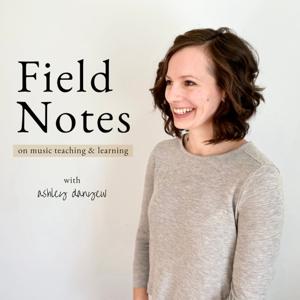
This podcast is a collection of creative ideas, practical strategies, and thoughtful observations from the field of music teaching and learning. Music educator Ashley Danyew will dive into topics…

3,945 Listeners

524 Listeners

130 Listeners

111,799 Listeners

56,447 Listeners

39 Listeners
64 Listeners
47 Listeners
24 Listeners
1,620 Listeners

9 Listeners

41 Listeners
15 Listeners
18 Listeners
5 Listeners