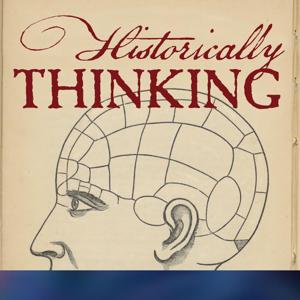
Historically Thinking

Historically Thinking

Download on the App Store

Historically Thinking episodes

  • Episode 12: Brian Leech on Environmental History
    In her palace, Clio the patron Goddess of History has many rooms. This is the first of a recurring series of conversations in which we investigate one of the sub-disciplines of historical study. For those with a casual interest in history, it will be a way of learning something new. For graduate students, it should be a […]
    42 min
  • Episode 12: Brian Leech on Environmental History
    In her palace, Clio the patron Goddess of History has many rooms. This is the first of a recurring series of conversations in which we investigate one of the sub-disciplines of historical study. For those with a casual interest in history, it will be a way of learning something new. For graduate students, it should be a great introduction to studying for comprehensive exams.

    As a way of beginning the series, and simultaneously celebrate Earth Day, Al Zambone has a conversation with his colleague Brian Leech on the discipline of environmental history. Ironically enough, while this is the first of the series, environmental history is one of the newest of historical disciplines.

    And below you'll find the Biggest List of Books ever on this podcast. At least until the next one. Happy listening.


    Three Areas of Original Environmental History
    Material History: Donald Worster, Dust Bowl, (1979); Rivers of Empire (1986). Capitalism transforms nature.

    Political History & the History of Environmental Politics: Samuel P. Hays, Conservation and the Gospel of Efficiency: The Progressive Conservation Movement, 1890–1920 (1959)

    Cultural History: Leo Marx, The Machine in the Garden (1964); Jennifer Price, Flight Maps (1999)

    Then Everything Became Interconnected and Complicated

    Hybrid Landscapes
    Mark Fiege, Irrigated Eden (1999)

    The Environmental Management State
    Louis S. Warren, The Hunter’s Game: Poachers and Conservationists in Twentieth-Century America (1997)

    Karl Jacoby, Crimes against Nature: Squatters, Poachers, Thieves, and the Hidden History of American Conservation (2001)

    Mark David Spence, Dispossessing the Wilderness: Indian Removal and the Making of the National Parks (1999)

    Agroenvironmental History
    Judith A. Carney, Black Rice: The African Origins of Rice Cultivation in the Americas (2001)

    John Soluri, Banana Cultures: Agriculture, Consumption, and Environmental Change in Honduras and the United States (2005)

    Environmental Histories of Disease and Health
    Linda Nash, Inescapable Ecologies: A History of Environment, Disease, and Knowledge (2006).

    Gregg Mitman, Breathing Space: How Allergies Shape Our Lives and Landscapes (2007)

    Nancy Langston, Toxic Bodies: Endochrine Disrupters and the Legacy of DES, 2010

    The Human-Built World (Urban, Industrial, Mining)
    Andrew Hurley, Environmental Inequalities (1995)

    Tim LeCain, Mass Destruction: The Men and Giant Mines that Wired America and Scarred the Planet (2009)

    Thomas G. Andrews, Killing for Coal (2008)

    Gunther Peck, “The Nature of Labor: Fault Lines and Common Ground in Environmental and Labor History,” Environmental History 11 (April 2006), 212-38.

    Water/Ocean History
    Marc Reisner, Cadillac Desert (1993)

    Craig Colten, Perilous Place, Powerful Storms

    W. Jeffrey Bolster, The Mortal Sea: Fishing the Atlantic in the Age of Sail

    Native American/Deep History
    Andrew C. Isenberg, The Destruction of the Bison: An Environmental History, 1750–1920 (2000)

    Shepard Krech III, The Ecological Indian: Myth and History (1999)

    Elliott West, The Contested Plains: Indians, Goldseekers, and the Rush to Colorado (1998)

    Studying Politics in Relation to Nature from All Sides
    Karl Jacoby, Crimes against Nature: Squatters, Poachers, Thieves, and the Hidden History of American Conservation (2001)

    Jay Turner, The Promise of Wilderness (2013)

    Brian Drake, Loving Nature, Fearing the State: Environmentalism and Antigovernment Politics Before Reagan (2013)

    Global/Transnational/Comparative
    Kate Brown,

    42 min
  • Episode 011: Barry Strauss on “The Death of Caesar”
    "The past is a foreign country; they do things differently there." So said L.P. Hartley, a novelist now only remembered for a line that's increasingly a cliché. Often it's an aphorism taken by its speaker to mean that the past is unknowable, unattainable, unreachable.

    Yet people travel to foreign countries all the time. When they do, they have essentially two options. One is to see the sites, but to do so from within their own comfortable cultural bubble. Alternatively, they could learn the language; study some maps; learn a little bit about the culture; maybe even have a guide help us take a look around. The two experiences of that foreign country will be remarkably different.

    The Roman Republic in its last years is a remarkably faraway and foreign country. We might think that we know it; isn't the United States a republic; isn't our bank a neoclassical building; didn't we read Shakespeare's Julius Caesar when we were freshmen in high school? Those things that we think we know are the bubble from which we try to understand the Roman Republic. But to appreciate it in all its foreignness, to fully appreciate it as other, we need a guide like Barry Strauss.


    More Books by Barry Strauss

    Barry Strauss, The Death of Caesar

    –, The Battle of Salamis

    –, The Spartacus War

    –, Rowing Against the Current: On Learning to Scull at Forty

    For Further Reading

    A translation of Nicholas of Damascus' Life of Augustus

    A helpful review of Édith Parmentier, Francesca Prometea Barone (ed.), Nicolas de Damas. Histoires; Recueil de coutumes; Vie d'Auguste; Autobiographie. Fragments.
    44 min
  • Episode 010: Gareth Glover on the Battle of Waterloo
    Were you at Waterloo?
    I have been at Waterloo.
    'Tis no matter what you do,
    If you were at Waterloo.
    Thus a little ditty that appeared in the United Service Gazette, thirty years after the Battle of Waterloo was fought on June 18, 1815. It was the third day of a series of battles fought between the Emperor Napoleon of France, newly returned from exile, and an Allied Coalition led by Britain's Arthur Wellesley, the Duke of Wellington, and Prussia's Gebhard von Blücher, Prince von Wahlstatt.

    Today on Historically Thinking, Al Zambone re-fights the Battle of Waterloo with Gareth Glover, a retired naval officer dedicated to the study of the land campaigns of the British Army in the Napoleonic Wars.


    Glover is the author of Waterloo: Myth and Reality, a meticulous reappraisal of the momentous battle that discovers that many of the things that historians, writers, and even veterans of the battle thought they knew about Waterloo just aren't so.

    For Further Reading
    Gareth Glover, Waterloo: Myth and Reality
    The Gareth Glover Collection: Original Source Material from the Napoleonic Wars, 1793-1815

    Addenda
    Some listeners have complained that they couldn't follow along with the rapid-fire description of the Waterloo campaign, and the eponymous battle that concluded it. Therefore we've added some links to maps

    The strategic situation facing Napoleon (at Wikipedia)

    The Waterloo Campaign (at Wikipedia)

    52 min
  • Episode 009: John Shelton Reed on Dixie Bohemia
    John Shelton Reed, William Rand Kenan Jr. Professor of sociology (emeritus) at the University of North Carolina, has been observing the South for decades. This week he and Al Zambone talk about New Orleans in the 1920s, the subject of his book Dixie Bohemia. For Further Reading William Faulkner, Mosquitoes Phyllis M. Goddard, Spratling Silver: A Field […]
    47 min
  • Episode 009: John Shelton Reed on Dixie Bohemia
    John Shelton Reed, William Rand Kenan Jr. Professor of sociology (emeritus) at the University of North Carolina, has been observing the South for decades. This week he and Al Zambone talk about New Orleans in the 1920s, the subject of his book Dixie Bohemia.

    For Further Reading
    William Faulkner, Mosquitoes
    Phyllis M. Goddard, Spratling Silver: A Field Guide
    Taylor D. Littleton, William Spratling: His Life and Art
    John Shelton Reed, Dixie Bohemia, The Enduring South
    47 min
  • Episode 008: Why the Liberal Arts is Not A Career Killer
    Today Dr. Mike Edmondson is the guest on the show. He's the Associate Vice President of Career Development at Augustana College, and the author of Marketing Your Value: Nine Steps to Navigate Your Career. In the course of the interview, Mike and Al Zambone discuss the current and coming job market; explore why someone who has a doctorate in history cares about career services; and talk about why a liberal arts degree can contribute to getting good jobs, and keeping them. Also, the two of them get their Philadelphia on. Stick' em, Bullies.

    This might not seem to have a lot to do with historical thinking...or does it? Listen and find out.


     For Further Reading

    Michael Edmondson, Marketing Your Value: 9 Steps to Navigate Your Career
    Scott Jaschik, "The Liberal Arts and Careers"
    Katharine S. Brooks, "Close the Gap Between the Liberal Arts and Career Services"
    Plato, Charmides
    Tyler Cowen, Average is Over
    43 min
  • Episode 007: John Kolp, Virginia, and State History
    This week, Al Zambone speaks with John Kolp, Emeritus Professor of History at the United States Naval Academy. He’s the author of Gentlemen and Freeholders: Electoral Practices in Colonial Virginia, and one of the four co-authors of Old Dominion, New Commonwealth: A New History of Virginia. There are few better people to talk about Virginia […]
    53 min
  • Episode 007: John Kolp, Virginia, and State History
    This week, Al Zambone speaks with John Kolp, Emeritus Professor of History at the United States Naval Academy. He's the author of Gentlemen and Freeholders: Electoral Practices in Colonial Virginia, and one of the four co-authors of Old Dominion, New Commonwealth: A New History of Virginia. There are few better people to talk about Virginia with, or why we should bother to write the history of the individual states of the United States. After all, isn't state history just for fourth graders?
    53 min
  • Episode 006: Brian Leech on the “City That Ate Itself”
    In this week's podcast, Brian Leech discusses his award-winning work on Butte, Montana, "the city that ate itself." Leech and host Al Zambone discuss mining and its history, the rich cultural and social world of an isolated city in Montana, and how the transition from underground to open pit mining changed everything about all of the above.
    34 min

About Historically Thinking

From the publisher's feed

We believe that when people think historically, they are engaging in a disciplined way of thinking about the world and its past. We believe it gives thinkers a knack for recognizing nonsense; and that…

More shows like Historically Thinking

The LRB Podcast by The London Review of Books

The LRB Podcast

303 Listeners

More or Less by BBC Radio 4

More or Less

875 Listeners

In Our Time by BBC Radio 4

In Our Time

5,478 Listeners

HistoryExtra podcast by Immediate

HistoryExtra podcast

3,198 Listeners

The Infinite Monkey Cage by BBC Radio 4

The Infinite Monkey Cage

1,906 Listeners

EconTalk by Russ Roberts

EconTalk

4,275 Listeners

Conversations with Tyler by Mercatus Center at George Mason University

Conversations with Tyler

2,450 Listeners

Tides of History by Audible /  Patrick Wyman

Tides of History

6,225 Listeners

Cautionary Tales with Tim Harford by Pushkin Industries

Cautionary Tales with Tim Harford

5,079 Listeners

The Bunker – Your daily news Deep Dive by Podmasters

The Bunker – Your daily news Deep Dive

101 Listeners

The Old Front Line by Paul Reed

The Old Front Line

181 Listeners

The Rest Is History by Goalhanger

The Rest Is History

15,653 Listeners

Empire: World History by Goalhanger

Empire: World History

2,463 Listeners

Disorder by Jason Pack

Disorder

105 Listeners

Strong Message Here by BBC Radio 4

Strong Message Here

57 Listeners