
Sign up to save your podcasts
Or



Based on Podcast App listening data
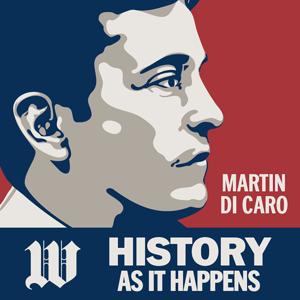
The fall of Bashar al-Assad marked the historic end of more than 50 years of cruel tyranny that began with his father Hafez, who took power in 1970. The world watched moving scenes of Syrians being freed from the regime's dungeons after a 13-year-long civil war killed hundreds of thousands of people. But who are Syria's new leaders? Who are the rebels that toppled Assad? In this episode, Sefa Secen, an expert on Syria and Middle East security, delves into the country's murky future and dark past.
Go to historyasithappens.com to learn more.
Hosted by Simplecast, an AdsWizz company. See pcm.adswizz.com for information about our collection and use of personal data for advertising.
Midway through his eighth year in office, President Bill Clinton kicked off a White House conference on the "new economy." The internet age was underway, unemployment was low, inflation was dormant, the stock market boomed, major industries had been deregulated, and Congress was preparing to pass a big trade deal with China. The future seemed so bright as Americans enjoyed the longest economic expansion in the country's history. The "new economy" cheerleaders did not foresee the working-class discontent that now defines American capitalism in the Age of Trump. In this episode, historian Nelson Lichtenstein delves into the illusions and missteps that hollowed out the working class.
Further reading:
A Fabulous Failure: The Clinton Presidency and the Transformation of American Capitalism by Nelson Lichtenstein
Why Bidenomics Did Not Deliver at the Polls by Dani Rodrik (Project Syndicate)
The Decline of Union Hall Politics by Michael Kazin (Dissent)
Go to historyasithappens.com to learn more.
Hosted by Simplecast, an AdsWizz company. See pcm.adswizz.com for information about our collection and use of personal data for advertising.
Thirty years ago, in early December 1994, at a security summit in Budapest, the United States, United Kingdom, Russia, and Ukraine signed a memorandum in which Kyiv agreed to eliminate all nuclear weapons left on its territory after the collapse of the USSR. In exchange, the other signatories offered assurances to refrain from the threat or use of force against Ukraine's territorial integrity or political independence. Events would prove the Budapest Memorandum to be worth less than the paper it was printed on. Thirty years later, Russia has invaded Ukraine and occupies much of its eastern regions. The war has been devastating, killing tens of thousands of soldiers on both sides. In this episode, historian Michael Kimmage looks back at the empty assurances of the Budapest conference, which were made at a time of great optimism and even cooperation among former foes. Kimmage also contends that today's war is a world war insofar as it has expanding global repercussions and is attracting the involvement of non-European countries.
Further reading:
How Ukraine Became a World War by Michael Kimmage and Hanna Notte in Foreign Affairs, the official publication of the Council on Foreign Relations
Go to historyasithappens.com to learn more.
Hosted by Simplecast, an AdsWizz company. See pcm.adswizz.com for information about our collection and use of personal data for advertising.
The International Criminal Court issued arrest warrants for individual Israeli and Hamas leaders, charging them with crimes against humanity. The accusations against Israeli Prime Minister Benjamin Netanyahu and his former defense chief Yoav Gallant involve the intentional murder of Palestinian civilians and starvation as a method of war. Since invading Gaza in the aftermath of the Hamas atrocities of Oct. 7, 2023, Israel has killed tens of thousands of Palestinian women and children while utterly destroying most of Gaza's civilian infrastructure. Jewish settlers are said to be waiting to move into the northern Gaza Strip now that it has been emptied of Palestinians. Is it genocide? In this episode, historian Omer Bartov explains why he believes Israel's actions amount to the "intent to destroy, in whole or in part, a national, ethnical, racial or religious group, as such."
Further reading:
Essay on the Israeli-Palestinian conflict by Omer Bartov (The Guardian)
Go to historyasithappens.com to learn more.
Hosted by Simplecast, an AdsWizz company. See pcm.adswizz.com for information about our collection and use of personal data for advertising.
After the election, there was a hurricane of postmortems attempting to explain why Kamala Harris lost to Donald Trump. Eschewing small-bore analysis, historian Daniel Bessner posted on X, "I feel like people are missing the fundamental lesson of the election: it is not the Democratic Party that is in crisis; liberalism itself is in crisis." Liberalism—the dominant political philosophy of the American Century—appears to be a spent force amid a wave of illiberal populism and anti-establishment politics. In this episode, Bessner, who co-hosts American Prestige podcast, delves into the origins of liberalism's rise and apparent decline in this post-post-Cold War period.
Further reading:
Empire Burlesque: What Comes After the American Century? by Daniel Bessner (Harper's)
Go to historyasithappens.com to learn more.
Hosted by Simplecast, an AdsWizz company. See pcm.adswizz.com for information about our collection and use of personal data for advertising.
Over the centuries, Thanksgiving traditions have changed with political, cultural, and religious winds. The holiday's mythic origins were propagated in the mid-nineteenth century, and soon Americans were all celebrating Thanksgiving on the fourth Thursday of November. Parades and football games are important pieces of Americana now synonymous with Thanksgiving -- as is the start of the Christmas shopping season. In this episode, historian David Silverman delves into the history of a quintessential American holiday whose development has as much to do with magazine editor Sara Josepha Hale as the Pilgrim Edward Winslow.
Go to historyasithappens.com to learn more.
Hosted by Simplecast, an AdsWizz company. See pcm.adswizz.com for information about our collection and use of personal data for advertising.
Ronald Reagan was the most consequential U.S. president of the second half of the twentieth century. Conservatives once lionized him before the rise of Donald Trump. Yet how Reagan is remembered does not entirely square with his actual record. Although an anti-government, anti-Communist ideologue, Reagan governed like a pragmatist. Moreover, the fortieth president was a terrible manager with a flimsy grasp of policy. His administration was rife with scandal. When he left office, the federal deficit had nearly tripled. Despite it all, Reagan was an effective national leader who inspired Americans to feel proud of their country again. In this episode, historian and biographer Max Boot delves into the life and times of "The Great Communicator" whose Hollywood and television careers prepared him for political success.
Further reading/listening:
Reagan: His Life and Legend by Max Boot
When Reagan Pressured Israel (podcast) with Salim Yaqub
Election of 1980 (podcast) with Jeremi Suri and Jeffrey Engel
Star Wars (podcast) with Joe Cirincione
Go to historyasithappens.com to learn more.
Hosted by Simplecast, an AdsWizz company. See pcm.adswizz.com for information about our collection and use of personal data for advertising.
Does the historical concept of oblivion offer a way out of our ruptured political life? "For centuries, legislative acts of oblivion were declared in times when betrayal, war, and tyranny had usurped and undermined the very foundations of law; when a household or nation had been torn apart, its citizens pitted against one another; when identifying, investigating, trying, and sentencing every single guilty party threatened to redouble the harm, to further fracture already divided societies," writes the scholar Linda Kinstler. In this episode, Kinstler delves into the history of oblivion as well as its limitations, as Donald Trump prepares to return to the presidency having gotten away with his attempt to subvert democracy on Jan. 6, 2021.
Further reading:
Jan. 6, America's Rupture, and the Strange, Forgotten Power of Oblivion by Linda Kinstler (New York Times)
Come to This Court and Cry: How the Holocaust Ends by Linda Kinstler (2022)
Go to historyasithappens.com to learn more.
Hosted by Simplecast, an AdsWizz company. See pcm.adswizz.com for information about our collection and use of personal data for advertising.
The United States' most-wanted jihadist in Afghanistan is trying to portray himself as a pragmatic diplomat. Washington doesn't seem to be interested. Sirajuddin Haqqani has the blood of many U.S. soldiers and Afghan civilians on his hands. While the U.S. views him as an enemy, the CIA once handsomely supported his father Jalaluddin Haqqani in the war against the Soviets in the 1980s. The elder Haqqani was close to bin Laden in the years before the Haqqani network would violently resist U.S. invaders -- after the al-Qaeda strikes on 9/11/2001. Ah, Afghanistan, where the past is not even past. In this episode, Adam Weinstein of the Quincy Institute for Responsible Statecraft untangles the complexities of a land where the U.S. has been involved for most of the past forty years.
Further reading:
Is Afghanistan's Most-Wanted Militant Now Its Best Hope For Change? by Christina Goldbaum (New York Times)
Ghost Wars by Steve Coll
Taliban by Ahmed Rashid
Go to historyasithappens.com to learn more.
Hosted by Simplecast, an AdsWizz company. See pcm.adswizz.com for information about our collection and use of personal data for advertising.
Donald Trump's election victory probably means Hitler comparisons won't go away, even if they make little sense. Still, there are lessons to learn from the collapse of the Weimar Republic in 1933, the year Adolf Hitler was levered into power by conservative elites who wrongly assumed that they could control the "Bohemian corporal." The question is which lessons are the right lessons? In this episode, historian Christian Goeschel of the University of Manchester explains how Hitler achieved power in Germany to avoid facile comparisons to the America of 2024. Our problems today bear little resemblance to the crisis of Weimar democracy.
Go to historyasithappens.com to learn more.
Hosted by Simplecast, an AdsWizz company. See pcm.adswizz.com for information about our collection and use of personal data for advertising.
From the publisher's feed
Ranked by our users in the last 21 days
8,442 Listeners

1,103 Listeners
740 Listeners
6,280 Listeners
717 Listeners

902 Listeners
20 Listeners

2,040 Listeners

7,122 Listeners
2,398 Listeners

15,904 Listeners

209 Listeners

383 Listeners
493 Listeners

470 Listeners