
Sign up to save your podcasts
Or



Based on Podcast App listening data
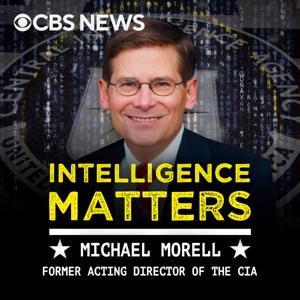
In this episode of Intelligence Matters, host Michael Morell speaks with top infectious disease epidemiologist Dr. Michael Osterholm, who is also director of the Center for Infectious Disease at the University of Minnesota, about the world's past, present and future handling of the coronavirus pandemic. Osterholm and Morell discuss the essential, still unanswered, questions surrounding vaccine and antiviral production and their manufacturing and distribution to the cities and countries that need them most. Osterholm explains why this virus is unlike any predecessor, and why so many mysteries about its transmission remain. He also explains how China's early handling of the outbreak may or may not have affected the effectiveness of other countries' responses. Intelligence Matters has dedicated a series of episodes to understanding the fundamentals and national security implications of COVID-19.
In this bonus episode of Intelligence Matters, host Michael Morell offers an in-depth analysis of seven potential national security consequences of the COVID-19 pandemic. He describes, among other factors, the possible effects of a prolonged financial crisis, of growing political instability, of escalating conflict in global hotspots, of the threat of a reconstitution of ISIS, and of the consequences of sustained tension in the US-China relationship. He also discusses the role of the United States in navigating an expected period of global turbulence.
In this episode of Intelligence Matters, host Michael Morell speaks with Chris Johnson, Senior Fellow at the Center for Strategic & International Studies and former senior China analyst at the Central Intelligence Agency, about China's internal handling of COVID-19, its subsequent messaging efforts, and the current state of U.S.-China relations. Johnson explains how Xi Jinping's leadership has affected both the domestic and diplomatic responses by Beijing to the outbreak. He also explains some of the likely near-term economic consequences of the pandemic. Johnson and Morell evaluate the state of the relationship between China and the U.S., as well as its likely trajectory. Intelligence Matters will dedicate several forthcoming episodes to understanding the fundamentals and national security implications of COVID-19.
In this episode of Intelligence Matters, host Michael Morell speaks with Olivier Blanchard, former chief economist for the International Monetary Fund and Senior Fellow at the Peterson Institute for International Economics. Blanchard and Morell discuss the near- and long-term global economic effects of the COVID-19 pandemic, the policy response from governments, and the prospects for an eventual recovery. Blanchard also explains recent turbulence in global oil markets and the vulnerabilities specific to lower-income economies. Intelligence Matters will dedicate several forthcoming episodes to understanding the fundamentals and national security implications of COVID-19.
In this episode of Intelligence Matters, host Michael Morell speaks with former CIA deputy director John McLaughlin about the immediate and long-term effects the COVID-19 pandemic may have on global national security. McLaughlin and Morell focus on tensions within the U.S.-China relationship that the outbreak has exacerbated, as well as efforts by adversaries like Russia, Iran and North Korea to further destabilize the world order. McLaughlin shares views on the value of leadership to coordinate a response, and voices concerns about a potential void left by an America-First policy. Intelligence Matters will dedicate several forthcoming episodes to understanding the fundamentals and national security implications of COVID-19.
In this episode of Intelligence Matters, host Michael Morell speaks with former White House Homeland Security and Counterterrorism Advisor Lisa Monaco about pandemic preparedness and response by the federal government. Monaco, who helped oversee the Obama Administration's response efforts during the Ebola and Zika outbreaks, explains which government agencies play key roles in managing public health crises and preparing for future outbreaks. She shares lessons learned by the teams she led and details of their transition to the Trump administration. She also discusses the current government response to the COVID-19 pandemic. Intelligence Matters will dedicate several forthcoming episodes to understanding the fundamentals and national security implications of COVID-19.
In this episode of Intelligence Matters, host Michael Morell interviews Dr. David Agus, Professor of Medicine and Engineering and Founding Director and CEO of the Lawrence J. Ellison Institute for Transformative Medicine at the University of Southern California. Dr. Agus, who is also a CBS News contributor, explains what scientists have learned about the origins, spread, transmissibility and lethality of COVID-19 -- as well as what remains a mystery. He discusses the policies and practices that have led to successful mitigation efforts and explains how data may be used to better control future global health crises. Intelligence Matters will dedicate several forthcoming episodes to understanding the fundamentals and national security implications of COVID-19.
In this revamped episode of Intelligence Matters — re-released while the world contends with the COVID-19 pandemic and the podcast has temporarily suspended new production — host Michael Michael reflects on a July 2018 conversation with CIA's Chief of Talent Acquisition, Sheronda Dorsey, who explains how the agency finds, trains and retains its global network of employees. Morell offers new perspective on the importance of the work of intelligence agencies during a global health crisis.
In this revamped episode of Intelligence Matters — re-released while the world contends with the COVID-19 pandemic and the podcast has temporarily suspended new production — host Michael Michael reflects on a 2018 conversation with Dr. Anthony Fauci, director of the National Institute of Allergy and Infectious Diseases and, in 2020, leading member of the White House Coronavirus Task Force. Morell and Fauci discuss how pandemics and epidemics arise and how their spread can affect national and international security.
In this episode of Intelligence Matters, retired Admiral Sandy Winnefeld speaks with retired General Philip Breedlove, former NATO Supreme Allied Commander, Europe and Commander of U.S. European Command, about the trajectories of the United States' relationships with North Korea, China, Russia, Europe, and other adversaries and partners. Breedlove addresses the leadership characteristics and regional objectives of each nation and assesses U.S. engagement to date. He and Winnefeld also discuss the U.S. military's capabilities and readiness for potential confrontation with key adversaries. Breedlove reflects on his career at all levels of the U.S. Air Force.
From the publisher's feed
Ranked by our users in the last 21 days
2,732 Listeners
1,138 Listeners

189 Listeners
1,529 Listeners

10,743 Listeners
657 Listeners

6,283 Listeners

87,116 Listeners
586 Listeners

111,799 Listeners

2,387 Listeners
20 Listeners
466 Listeners

62 Listeners

1,330 Listeners

256 Listeners
1,675 Listeners

1,856 Listeners
1,940 Listeners

15,702 Listeners

15,882 Listeners

350 Listeners
10,759 Listeners
401 Listeners
266 Listeners