
Sign up to save your podcasts
Or



Based on Podcast App listening data
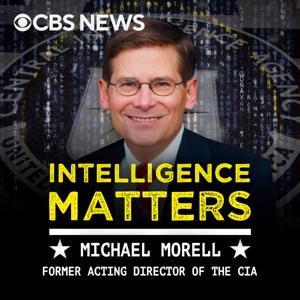
In this episode of Intelligence Matters, host Michael Morell speaks with Brett Holmgren, Assistant Secretary of State for Intelligence and Research (INR) at the U.S. Department of State, about the unique history of his agency, its future, and how its analysts work to equip diplomats with key intelligence today. Holmgren and Morell discuss the Biden administration's unprecedented strategy of publicly releasing declassified intelligence about Russia's military plans in Ukraine, the risks it entails, and how it may have solidified Western support for rigorous sanctions. They also discuss China's support for Russia and other key global challenges, including the elusive nuclear deal with Iran and democratic backsliding in Latin America.
In this episode of Intelligence Matters, host Michael Morell speaks with Mark Finley, fellow in energy and global oil at Rice University's Baker Institute, former senior economist for British Petroleum, and former analyst and manager at CIA. Finley explains the effects of Russia's invasion of Ukraine on global oil and gas markets and why current Western sanctions may not immediately meaningfully curtail Moscow's energy revenues. Morell and Finley also discuss how the rest of the world may experience price shocks stemming from growing commodities prices, including the risk of a recession.
In this episode of Intelligence Matters, host Michael Morell speaks with former senior CIA operations officer and senior fellow at the Harvard Kennedy School's Belfer Center Rolf Mowatt-Larssen about Vladimir Putin's invasion of Ukraine, the prospect of Russia using weapons of mass destruction, and the likelihood of a near-term political solution to the crisis. Mowatt-Larssen, who spent a significant part of his career in Moscow and dealt with WMD terror threats after 9/11, outlines some of Putin's most significant miscalculations, his efforts to control domestic narratives within Russia, and the internal fissures that the Ukraine conflict has laid bare. Mowatt-Larssen also offers insights into how the war - and potential political solutions - may proceed from here.
In this episode of Intelligence Matters, host Michael Morell speaks with Brian Morra, former Air Force intelligence officer and author of "The Able Archers," a novel based on the true story of a narrowly avoided nuclear confrontation between the U.S. and the Soviet Union in 1983. Morra details the key players and events that brought the two global superpowers to the brink of conflict - and what high-risk interventions were required to avert cataclysm. Morra explains how his book - and experience in 1983 - might have meaning for the Russia-led war in Ukraine today.
In this episode of Intelligence Matters, host Michael Morell speaks with Chris Johnson, Senior Fellow at CSIS, about the Chinese perspective on the Russia-Ukraine War. Morell and Johnson discuss how the crisis in Ukraine affects China's view on Taiwan and how China would like the conflict to end. Johnson discusses how chemical weapons "would probably be a dividing line for the Chinese, although it wasn't in Syria."
In this episode of Intelligence Matters, host Michael Morell speaks with Kenneth Dekleva, a psychiatrist, former U.S. Department of State Regional Medical Officer, and Senior Fellow at the George H.W. Bush Foundation for US-China Relations, about how experts compile psychological profiles of world leaders. Morell and Dekleva discuss the formative experiences and core characteristics of Russian president Vladimir Putin, Chinese President Xi Jinping, North Korean leader Kim Jong Un, and Supreme Leader of Iran Ayatollah Khamanei. They also discuss the character of Ukrainian President Volodymyr Zelensky, as well as how other countries might approach similar profiles of U.S. leaders
In this episode of Intelligence Matters, host Michael Morell speaks with Mike Vickers, former Undersecretary of Defense for Intelligence, Special Forces officer and CIA operations officer. Vickers and Morell discuss whether and how Russian President Vladimir Putin's invasion of Ukraine may have been a gross strategic miscalculation, how and when the West might have deterred his moves, and what future scenarios for the conflict exist. They discuss Putin's options and decision-making and how his pariah status will affect developments domestically and globally.
In this episode of Intelligence Matters, host Michael Morell speaks with Bonnie Glaser, director of the Asia Program at the German Marshall Fund of the United States, about the history of Taiwan, current political perceptions of it within China and the Communist Party, and whether Chinese president Xi Jinping has a timeline for achieving reunification. Morell and Glaser also discuss Xi’s likely perceptions of the Russia-Ukraine crisis and of the effect of the United States’ longstanding policy of strategic ambiguity.
In this episode of Intelligence Matters, host Michael Morell moderates a conversation among a panel of experts including former Deputy Secretary General of NATO Rose Gottemoeller, former Deputy National Intelligence Officer for Russia and Eurasia Andrea Kendall-Taylor, and former senior CIA operations officer John Sipher about the state of the Russia-Ukraine crisis and whether diplomatic options remain viable. The panel evaluates Russian President Vladimir Putin's immediate and long-term objectives and discusses how deterrent measures might be enhanced. They also discuss possible post-conflict scenarios in the European security landscape. This episode was produced in partnership with the Michael V. Hayden Center for Intelligence, Policy, and International Security at George Mason University's Schar School of Policy and Government.
In this episode of Intelligence Matters, host Michael Morell speaks with Sue Mi Terry, former senior CIA analyst and current Director of the Hyundai Motor-Korea Foundation Center for Korean History and Public Policy at the Wilson Center, about North Korea's record-breaking spate of missile tests in 2022 and its overall approach to the Biden administration. Terry and Morell discuss the stances struck by Russia and China to Pyongyang's newly aggressive behavior, as well as the prospects for changes in the Kim regime's behavior. Terry also identifies some burgeoning fissures in North Korean society and discusses growing concerns about leader Kim Jong Un's health.
From the publisher's feed
Ranked by our users in the last 21 days
2,732 Listeners
1,138 Listeners

189 Listeners
1,529 Listeners
10,743 Listeners
657 Listeners

6,283 Listeners

87,116 Listeners
586 Listeners

111,799 Listeners

2,387 Listeners
20 Listeners
466 Listeners

62 Listeners
1,330 Listeners

256 Listeners
1,675 Listeners

1,856 Listeners
1,940 Listeners
15,702 Listeners

15,882 Listeners
350 Listeners
10,759 Listeners
401 Listeners
266 Listeners