
Sign up to save your podcasts
Or



Based on Podcast App listening data
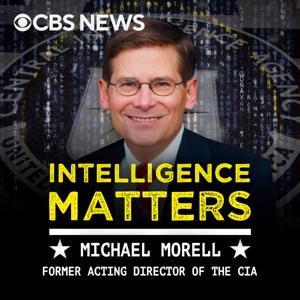
In this episode of Intelligence Matters, host Michael Morell speaks with Global Energy Expert Daniel Yergin about energy security in the context of deep power rivalries as he provides his analysis of Putin's energy miscalculations. Yergin details the Biden administration's efforts to promote more oil production while committing to its long-term climate agenda. He warns against the large impact that any global disturbance can have to tight energy markets.
In this episode of Intelligence Matters, host Michael Morell speaks with Terrorism Analyst and Long War Journal Editor Bill Roggio on the state of the counterterrorism fight in Afghanistan a year after the full U.S. withdrawal and the Taliban regaining control of the country. Roggio says that al Qaida has a stronger global position today than it had prior to 9/11. He notes that while the Islamic State is a more immediate threat, al Qaida is the greater threat long-term. Roggio details the lead up to the U.S. withdraw from Afghanistan and how the Biden administration's lack of a phased withdraw did not give a chance for Afghans to transition to "an Afghan way."
In this episode of Intelligence Matters, host Michael Morell speaks with Former Senior CIA analysts Chris Johnson, President and CEO of China Strategies Group, and John Culver, former national intelligence officer for East Asia, about Chinese and Taiwan relations after Speaker Pelosi's trip to Taipei. Culver describes China's military response as both "unprecedented" and showing "constraints", never escalating to a point where Taiwan had to make a use of force decision. Culver discusses how a real Chinese invasion of Taiwan would involve a national mobilization of not only the People's Liberation Army but of the entire Chinese economy and society. Chris Johnson details the Chinese mindset to Speaker Pelosi's visit and the concerns China has over bills in Congress it believes would erode the one-China policy.
In this episode of Intelligence Matters, host Michael Morell speaks with Hal Brands, Henry A. Kissinger Distinguished Professor of Global Affairs at the Johns Hopkins University School of Advanced International Studies and author of the new book, Danger Zone: The Coming Conflict with China, about China's economic, political and demographic trajectory and the percolating risk of conflict with Beijing in the coming years. Brands explains why he believes China, rather than being on the rise, is peaking as a global power and as a result may engage in more destabilizing behavior. Brands and Morell explore how certain external tailwinds - which once propelled China's rise - have become headwinds, and may be driving President Xi Jinping's tightening grip on political power. They also discuss the effect of Speaker Pelosi's visit to Taipei, different scenarios and timelines for a possible Chinese invasion of Taiwan, as well as how the conflict in Ukraine may - or may not - affect Xi's calculus.
In this episode of Intelligence Matters, host Michael Morell speaks with Eric Edelman, former U.S. Ambassador to Turkey and Finland and Under Secretary of Defense for Policy, about the ongoing conflict in Ukraine and likely lessons being drawn about the West's response and the nature of the battle by the People's Republic of China. Edelman and Morell discuss a range of possible future scenarios for the war in Ukraine, exploring its military, economic and diplomatic dimensions for both Kyiv and Moscow. Edelman also offers insights into how the conflict may inform China's approach to coercive or forceful reunification with Taiwan.
In this "Best Of" episode of Intelligence Matters, host Michael Morell speaks with Amy Zegart, the Morris Arnold and Nona Jean Cox Senior Fellow at the Hoover Institution and Professor of Political Science at Stanford University about her new book, "Spies, Lies and Algorithms: The History and Future of American Intelligence." Morell and Zegart discuss the impact of emerging technologies on intelligence collection and analysis, both of which, Zegart says, have been fundamentally changed by developments like artificial intelligence, quantum computing, and commercial satellite imagery. Zegart also outlines the five "mores" - more threats, more speed, more data, more customers and more competitors - that she says have made the work of intelligence newly challenging. This episode was originally released in February 2022.
In this "Best Of" episode of Intelligence Matters, host Michael Morell speaks with Kenneth Dekleva, a psychiatrist, former U.S. Department of State Regional Medical Officer, and Senior Fellow at the George H.W. Bush Foundation for US-China Relations, about how experts compile psychological profiles of world leaders. Morell and Dekleva discuss the formative experiences and core characteristics of Russian president Vladimir Putin, Chinese President Xi Jinping, North Korean leader Kim Jong Un, and Supreme Leader of Iran Ayatollah Khamanei. They also discuss the character of Ukrainian President Volodymyr Zelensky, as well as how other countries might approach similar profiles of U.S. leaders. This episode was previously released in March 2022.
In this episode of Intelligence Matters, host Michael Morell speaks with Alex Finley, a former CIA officer in the Directorate of Operations and an author of three satirical books depicting life and work at the agency. Finley describes how CIA officers often use humor in unique ways to cope with high-stress assignments, and she and Morell discuss the ways in which satire can illuminate little-known realities about serious subjects. Finley also describes her newfound role as an amateur 'yacht-watcher,' tracking Russian oligarchs' yachts through the port of Barcelona.
In this episode of Intelligence Matters, host Michael Morell speaks with Heather Conley, president of the German Marshall Fund of the United States, about Russia's use of "strategic conservatism" to exploit divisions with and within the West. Conley explains how Russian President Vladimir Putin has leveraged the support of the leadership of the Russian Orthodox Church to portray himself as a global defender of conservative values. Conley and Morell also discuss how the Russian Orthodox Church has undermined its own objective of ecumenism by alienating those who oppose Russia's invasion of Ukraine.
In this episode of Intelligence Matters, host Michael Morell speaks with Peter Wittig, Germany's former ambassador to the United States, United Kingdom, Lebanon, Cyprus and the United Nations, about foreign perceptions of the United States at pivotal historical moments. Wittig and Morell trace the evolution of America's standing in the eyes of the world from the end of the World Wars to the end of the Cold War, through the period following 9/11, the wars in Iraq and Afghanistan, to today. Wittig offers insights on the effect of the Trump administration's "America First" policy on global alliances and shares his view on the Biden administration's effort to rally global support for Ukraine before and during Russia's invasion. Wittig and Morell also discuss how its domestic instability may undermine America's credibility and ability to lead.
From the publisher's feed
Ranked by our users in the last 21 days

2,732 Listeners

1,138 Listeners

189 Listeners
1,529 Listeners

10,743 Listeners

657 Listeners

6,283 Listeners

87,116 Listeners
586 Listeners

111,799 Listeners

2,387 Listeners
20 Listeners
466 Listeners

62 Listeners
1,330 Listeners

256 Listeners

1,675 Listeners

1,856 Listeners

1,940 Listeners

15,702 Listeners

15,882 Listeners

350 Listeners
10,759 Listeners
401 Listeners
266 Listeners