
Sign up to save your podcasts
Or



Based on Podcast App listening data
The 2026 midterm elections are just 29 days away—and Ryan Girdusky is looking beyond the polls to the numbers that could actually determine who wins.
On this episode of It’s a Numbers Game, Ryan breaks down two critical indicators heading into Election Day: campaign spending and voter registration. Republicans are pouring money into key Senate, House, and gubernatorial races, while Democrats are showing surprising momentum among newly registered voters in several important states.
Ryan examines the numbers in Texas, Ohio, Kansas, Michigan, Maine, Iowa, Georgia, Florida, Pennsylvania, North Carolina, Nevada and other battlegrounds—and explains where Republicans and Democrats may have reasons to worry.
Then, Ryan dives into the explosive Cornell University sexual assault case that has become a national political controversy. He examines the allegations, competing accounts, Cornell’s response, the reopened investigation, and why politicians including Alexandria Ocasio-Cortez, Kathy Hochul and Letitia James are now weighing in.
Plus, Ryan answers listener questions about why affluent suburban voters have shifted toward Democrats, Bill Maher’s political evolution, and whether party registration matters in American elections
EMAIL RYAN
See omnystudio.com/listener for privacy information.
Ryan Girdusky breaks down the political warning signs facing Republicans with just 32 days until the midterm elections.
Ryan examines polling and voter sentiment surrounding President Donald Trump, traditional Republican voters, the economy, inflation, healthcare costs, immigration, artificial intelligence, taxes, Social Security, and the growing appeal of economic populism. He argues that Republicans in traditionally safe red states and districts can no longer assume victory—and need to campaign aggressively and address the economic concerns affecting voters.
Ryan also makes the case for what he views as the major accomplishments of the Trump administration and Republican Congress, including actions on the southern border, immigration, crime, DEI, prescription drug costs, manufacturing, energy, taxes, and the child tax credit.
Plus, Ryan answers listener questions about the Texas Senate race, James Talarico, Ken Paxton, black voter turnout in Texas, John Cornyn voters, and whether Republicans could face a repeat of past Senate election upsets.
Subscribe to It’s a Numbers Game with Ryan Girdusky for polling analysis, election data, political trends, and the numbers shaping the 2026 midterm elections.
See omnystudio.com/listener for privacy information.
Ryan Girdusky sits down with Nothing Left author Evan Barker for a wide-ranging conversation about the 2026 midterm elections, the battle for the U.S. Senate and the Democrats already positioning themselves for the 2028 presidential race.
Barker discusses Democratic confidence heading into the midterms and examines competitive Senate races in states including Kansas, Nebraska, Michigan and Georgia. The conversation also explores the appeal of economic populism, working-class voters and what could determine whether Democrats can make gains in traditionally Republican territory.
Then Ryan and Evan turn toward 2028: Is Kamala Harris preparing another presidential campaign? Could Jon Ossoff emerge as a national contender? Where do JB Pritzker, Rahm Emanuel, AOC and other potential candidates fit into a Democratic Party divided between progressive activists, traditional Democrats and working-class voters?
Barker also explains why he believes Harris could run again, while discussing the challenges she could face during a prolonged Democratic primary campaign.
Plus, Evan discusses his New York Times bestselling book Nothing Left and what his firsthand experience inside Democratic politics taught him about the direction of the party.
See omnystudio.com/listener for privacy information.
Is a massive Democratic blue wave really coming in the 2026 midterm elections—or are the headlines getting ahead of the data?
Ryan Girdusky breaks down the latest 2026 midterm polling, the congressional map, Senate races, and the first early-voting numbers as Election Day approaches.
Ryan examines predictions of huge Democratic gains and explains why political polarization makes nationwide electoral waves different from those of previous generations. He looks at Virginia, Florida, North Carolina, Wisconsin and other key states, including what early turnout may—and may not—tell us about Republican and Democratic enthusiasm.
Plus, Ryan digs into the battle for the Senate, including Texas, Ohio, Alaska and Iowa; discusses Nate Silver’s analysis of Democratic gains in red states; and explains why turnout among lower-propensity voters could matter enormously this November.
Later, Ryan answers listener questions about Nikole Hannah-Jones and education, affordability and housing, the Trump tax cuts, immigration and former Border Patrol official Greg Bovino.
See omnystudio.com/listener for privacy information.
Ryan Girdusky is joined by Jack Posobiec for a deep dive into one of the most disturbing and controversial true-crime cases of 1970s San Francisco: the Zebra murders.
Ryan and Jack retrace the killing spree that terrorized San Francisco, the victims and survivors, the formation of the Zebra Task Force, the controversial police response known as Operation Zebra, and the informant who ultimately helped investigators identify suspects. They also examine the racial and political tensions surrounding San Francisco during the era and discuss why the Zebra murders never became as culturally famous as the Zodiac Killer case.
Plus, Posobiec discusses his book Unhumans: Socialist Revolution, historical political violence, media portrayals of crime, and what he believes Americans can learn from the unrest of the 1960s and 1970s.
See omnystudio.com/listener for privacy information.
Are Republicans beginning to distance themselves from President Donald Trump as the 2026 midterm elections approach?
On this episode of It’s a Numbers Game with Ryan Girdusky, Ryan examines what he sees as a late Republican pivot away from Trump as GOP candidates confront voter concerns over the Iran war, rising costs, data centers and the president’s political standing. He looks at Republican Senate and House candidates who have broken with Trump on key issues and explains what the polling could mean for competitive races across the country.
Ryan also digs into the enormous amounts of campaign money pouring into Texas and competitive House races, including the Senate contest involving Ken Paxton and James Talarico, and explains why Republicans are spending heavily to defend territory that previously leaned strongly Republican.
Plus, Ryan takes aim at Nikole Hannah-Jones’ reflections on her daughter’s education, examining her decision to enroll her daughter in a struggling New York City public school and what Ryan believes the story reveals about education policy, school performance and parental responsibility.
Finally, Ryan answers listener questions about Tulsi Gabbard and 2028, possible live midterm election-night coverage, the ideal podcast length, and his disagreements with Clay Travis and Buck Sexton.
See omnystudio.com/listener for privacy information.
Are Democrats really headed for a massive 2026 midterm election wave, or are the polls overstating the political environment?
Ryan Girdusky sits down with Quantus Insights founder and lead pollster Jason Corley for a deep dive into the latest 2026 election polling, the generic congressional ballot, and some of the biggest Senate and governor races across the country.
Corley discusses polling showing a sizable Democratic advantage nationally while explaining why response bias, turnout models and the composition of the electorate could change what the political landscape ultimately looks like in November.
They break down Susan Collins and the Maine Senate race, Minnesota, Katie Hobbs and the Arizona governor's race, and the Georgia Senate contest, along with what current polling is showing about Black, Hispanic and young voters. Corley says his polling shows Hispanic voters moving back toward Democrats compared with 2024, while voters ages 18–29 are showing a substantial shift to the left.
Plus, Jason explains how professional political polling actually works, why high-quality polls can cost thousands of dollars, how voter files and online panels are used, and why polling response rates make accurate election surveys increasingly difficult.
See omnystudio.com/listener for privacy information.
The 2026 midterm elections are approaching, and Ryan Girdusky breaks down the latest polling to examine where Republicans are showing potential bright spots despite Democrats holding a sizable advantage in national generic-ballot polling.
Ryan digs into Senate, gubernatorial and congressional polling in Minnesota, Maine, New Hampshire, Oregon, New York, Alaska, Michigan, Pennsylvania and Texas, examining why individual races can diverge sharply from the national political environment. He also looks at what current polling says is motivating Democratic and Republican voters heading into November.
Plus, Ryan examines the latest economic warning signs after the Federal Reserve raised interest rates by 25 basis points to a 3.75%–4.00% target range, its first increase since 2023, as inflation remains elevated. He discusses how dramatically the cost of food, vehicles, rent, insurance and other everyday expenses has changed—and why affordability could remain a major concern for voters.
Ryan also discusses demographic tensions in Los Angeles and closes the show with Ask Me Anything, answering listener questions about rural voters, Texas campaign spending and Utah politics.
EMAIL RYAN
See omnystudio.com/listener for privacy information.
The 2026 midterms are just weeks away—and Ryan Girdusky says the latest polling contains major warning signs for Republicans.
On this episode of It’s a Numbers Game, Ryan breaks down new polling on the generic congressional ballot, President Donald Trump’s approval rating, the economy, immigration, and the issues shaping the battle for control of Congress. He also examines the impact of soaring oil and gas prices and why the cost of living could become one of the defining issues of the midterm elections.
Plus, Ryan discusses Gavin Newsom’s surprising comments about Kamala Harris and the 2028 presidential race, the legal fight over the Trump administration’s public-charge immigration policy, and why India’s growing relationships with Iran, Russia, and the BRICS nations deserve more attention in Washington.
Ryan also weighs in on the controversy surrounding Texas Republican Bo French before answering listener questions about political betting markets, Alberta’s separatist movement, and the political differences between Pennsylvania Gov. Josh Shapiro and Sen. John Fetterman.
EMAIL RYAN
See omnystudio.com/listener for privacy information.
In this episode of It’s a Numbers Game with Ryan Girdusky, Ryan breaks down the massive wave of Republican money pouring into the 2026 midterm elections and what the spending reveals about the races the GOP believes it must win.
The battle for Texas takes center stage as Republican groups and Elon Musk's America PAC reportedly prepare major investments while Ken Paxton faces James Talarico in a crucial U.S. Senate contest. Ryan examines new polling in Texas, the enormous spending battle taking shape, and why Republicans appear determined to prevent the Lone Star State from becoming a major Democratic breakthrough.
Ryan then follows the money across the country, looking at Republican offensive and defensive investments in Michigan, Ohio, New Hampshire, Maine, Iowa, Florida and key House districts. He explains what these spending decisions may reveal about internal polling and which Senate and House races could ultimately determine control of Congress.
Plus, Ryan digs into the latest polling from Minnesota, Maine, North Carolina, Michigan and Iowa, along with troubling national generic-ballot numbers for Republicans. He explains where the GOP may still have opportunities, where Democrats currently hold the advantage, and whether an enormous influx of campaign cash can change the political environment before Election Day.
Finally, Ryan answers listener questions about the shift from “Merry Christmas” to “Happy Holidays,” voter-registration trends, the Texas Senate runoff, and whether political books like Regime Change can be trusted.
EMAIL RYAN
See omnystudio.com/listener for privacy information.
From the publisher's feed
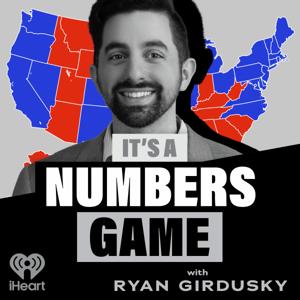
Dive into the world of data with Ryan Girdusky, an acclaimed American political commentator and writer, on "It’s a Numbers Game with Ryan Girdusky." In each episode, Ryan breaks down the most crucial data on politics, economics, and culture, providing you with the insights you need to stay informed and ahead of the curve. Whether you're a data enthusiast or just looking to understand the numbers behind the headlines, Ryan is your go-to source for in-depth analysis and engaging discussions. Listen to new episodes released every Monday and get the facts that matter - subscribe now and never miss an episode!
Join the conversation and follow Ryan for exclusive insights on X.com/RyanGirdusky and Instagram.com/Ryan.James.Girdusky. Listeners of the podcast also receive a free 30-day trial to Ryan’s National Populist Newsletter at natpopnewsletter.com.
Ranked by our users in the last 21 days
3,291 Listeners

464 Listeners
2,247 Listeners

22,667 Listeners

4,839 Listeners
2,817 Listeners
11,796 Listeners
3,082 Listeners
6,203 Listeners
557 Listeners

217 Listeners
1,299 Listeners

1,153 Listeners
1,179 Listeners

503 Listeners