
Sign up to save your podcasts
Or

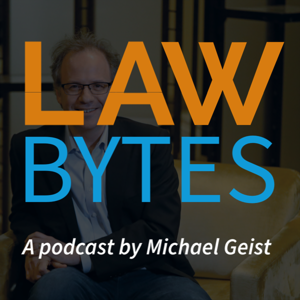


Last week was Fair Dealing Week, a chance for a wide range of Canadians - educators, students, librarians, archivists, and creators - to celebrate the important role that fair dealing plays in facilitating both fair access and fair compensation to copyrighted works. I ran a series of posts on Canadian education, fair dealing and copyright that will continue into the coming week. This podcast episode is part of that series featuring Stephen Spong, the director of the John and Dotsa Bitove law library and copyright officer at Western University. Spong used fair dealing week to write a piece that appeared in multiple press venues to lament what he termed “goblin mode gaslighting on copyright” and he joins the Law Bytes podcast to talk about fair dealing in practice and the ongoing policy debate.
Bill C-11 is in the hands of the government as Canadians await a decision on which Senate amendments it will accept, which might be rejected, and then how the Senate responds. A key question involves a fix to the regulation of user content provision, which provides that sound recordings are in, but user content is out. Senator Paula Simons, an independent Senator from Alberta nominated by Prime Minister Justin Trudeau to the Senate in 2018, co-crafted the compromise amendment and has been one of the most engaged and informed Senators throughout the Bill C-11 legislative process. She joins the Law Bytes podcast to discuss the hearings, her amendment, and what may lie ahead for both Bill C-11 and the upcoming Senate review of Bill C-18.
Many Canadians started the new year with an unwelcome surprise as they learned that Canada had extended the term of copyright by additional 20 years with no mitigation measures or efforts to limit the harmful effects of the policy. That the extension did not get much attention was seemingly by design as the government buried it in a budget implementation bill and posted no news releases on it. Mark Swartz is a Scholarly Publishing Librarian at Queen’s University and has been an active participant in copyright reform issues for many years. He joins the Law Bytes podcast to talk about Canada’s approach to copyright term extension, the impact on the public domain, and what could come next.
The battle over the Rogers – Shaw merger has continued to escalate in recent days with TekSavvy filing a complaint with the CRTC on the wholesale access implications of the deal, a campaign to urge ISED Minister François-Philippe Champagne to reject the transaction, and a forthcoming Industry committee hearing on the situation. The merger heads for what may be its final legal showdown this week as the Federal Court of Appeal conducts its hearing on the Competition Bureau’s appeal of a recent decision from the Competition Tribunal that rejected its opposition to the proposed merger. Jennifer Quaid is an Associate Professor and Vice-Dean Research in the Civil Law Section at the University of Ottawa, Faculty of Law. She joins me on the podcast to unpack the legal arguments in the case, provides her prognostication on a potential outcome at the Court of Appeal, and offers insights into potential future competition law reforms in Canada in light of a national consultation on the issue.
The start of a new year often means a fresh start and for the CRTC, it meant welcoming a new chair, as Vicky Eatrides officially took over as chair a few days into 2023. Eatrides comes to the Commission at a particularly busy time with wireless competition concerns top of mind for many Canadians and the government set to ask the Commission to play a pivotal role in implementing Bills C-11 and C-18. Konrad von Finckenstein is someone who knows quite a bit about the challenges faced by new CRTC chairs, having served in the role from 2007 to 2012. He was recently appointed to the Order of Canada for his many contributions to public life and he joins me on the podcast to reflect on those experiences in the context of the CRTC. Our conversation reflects on what is involved in launching entirely new programs, ensuring public engagement, and developing policies that enjoy both public support and can withstand potential legal challenges.
Canadian digital law and policy in 2022 was marked by legislative battles over Bills C-11 and C-18, the Rogers outage, stalled privacy and AI reform, copyright term extension, and a growing trade battle with the U.S. over Canadian policies. For this final Law Bytes podcast of 2022, I go solo without a guest to talk about the most significant trends and developments in Canadian digital policy from the past year and to think a bit about what may lie ahead in 2023.
The government’s two big Internet bills - Bill C-11 and Bill C-18, both made significant advances late last week. The Senate Transport and Communications committee concluded months of hearings on Bill C-11 by agreeing to about 25 amendments, notably including a change to the scope of user content regulation that is designed to limit the application to sound recordings as well as the removal of a provision that critics feared would limit CRTC independence. Meanwhile in the House, Bill C-18 cleared the Canadian Heritage committee with changes that invite legal challenges and make a showdown over blocking news content increasingly likely. Just prior to these closing committee meetings, I appeared on TVO’s the Agenda with Steve Paikin to discuss the bills and why they matter. The interview elicited very positive feedback and with the kind permission of TVO and the Agenda, I’m pleased to provide the audio version of that interview as this week’s Law Bytes podcast.
The stunning collapse of FTX, one of the world’s leading crypto exchanges, has not only shaken the crypto world but called into question the future of blockchain and digital assets. In a year of repeated failures and crashes, the calls for increased regulation are getting louder. Ryan Clements is a law professor at the University of Calgary, where he holds the chair in Business Law and Regulation and specializes in the regulation of fintech, blockchain and crypto-assets. He’s written extensively on crypto regulatory issues, including an expert report on Canadian cryptocurrency governance for the Public Order Emergency Commission. He joins the Law Bytes podcast to provide some background into the growth of crypto, the collapses of Luna and FTX, and where Canada sits on the regulatory spectrum.
From the publisher's feed

26,165 Listeners

26,260 Listeners
210 Listeners
76 Listeners

106 Listeners

8 Listeners

50 Listeners
5,082 Listeners

36 Listeners

575 Listeners

5,554 Listeners

15,918 Listeners
39 Listeners

4 Listeners

34 Listeners