
Sign up to save your podcasts
Or

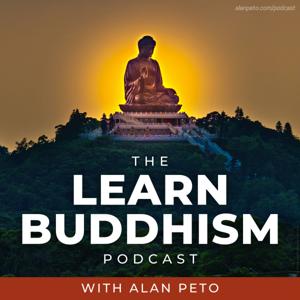
By Alan Peto


4.6
221221 ratings


The podcast currently has 116 episodes available.
The most played episodes among Podcast App listeners.
This episode is the full audiobook reading of my book Buddhism in 10 Steps. Many of you have already listened to the shorter podcast/video version, which offered a quick overview of the ten foundational steps. This episode is different — it’s the complete, long‑form narration of the actual book. If you prefer listening over reading, or you enjoy deeper, uninterrupted explanations, this audiobook version is for you. It walks through each step (topic) with more detail, context, and guidance than the condensed episode, making it a great companion for new Buddhists, curious listeners, or anyone wanting a clearer path into Buddhist practice. You can also find the book and eBook here: alanpeto.com/books/buddhism-10-steps/ or BuddhismStarterPack.com Settle in, relax, and enjoy the full journey through the ten steps! Contact Alan: alanpeto.com/contact Podcast Homepage: alanpeto.com/podcast Podcast Disclaimer: alanpeto.com/legal/podcast-disclaimer

Daily Buddhist Practice: Right View "Those who view the unreal as real and the real as unreal reach not up to the real, mislead as they are." ~ The Buddha (Dhammapada 11) Mara is the embodiment of fear, confusion, and delusion in our lives. While portrayed as an actual entity that the Buddha challenged before his enlightenment, Mara is also referred to as the actions of our own mind. Our mind constantly deceives us and leads us to paths of wrong action. You may think of the unskillful actions created by yourself, and others, during this time as Mara. Mara is feeding off the anxiety, fear, and suffering like fuel to the flame. Understanding this is occurring is the first step in dousing the three fires of delusion/confusion/ignorance, greed/sensual attachment, and aversion/anger. The first step of the Buddha’s Eightfold Path is a good place to start with the current COVID-19 pandemic. We must understand the nature of things is impermanent, that we are a temporary grouping (non-self/the five aggregates), and that fear is an illusion. Today's Focus: * Realize fear as being an illusion. It is a manufactured response to uncertainty, love of the concept of ‘self’, and attachment to the idea ‘self’. * Impermanence affects everything in life, and this is not always bad. While we may see impermanence as “we will die one day”, it also means “things will end”. While many things about COVID-19 are not yet known, it is likely to ‘end’ (even if that means there may be recurrences, like the seasonal flu). Focus on not only are we impermanent, but our suffering, fear, and uncertainty is also impermanent. * Realizing the truths of Buddhism are “Right View” and can lead you away from the causes and effects that create the three fires (poisons). Today's Practice: * Begin each day reciting the Five Remembrances (see page 22) to help with humbling ourselves, and understanding that our ego is fabricated. This will be part of your daily “exercises” to fortify your mind against Mara. Through knowledge and realization, you can build your defense. * Meditate at least once a day, starting with being mindful of the breath (refer to page 8). If you are an advanced practitioner, you can add insight meditation to your daily practice by focusing on the suffering, fear, and confusion people are facing, and it is causes as it relates to Buddhist understanding. * Realize the collective suffering. The pandemic is the latest in a series of suffering that sentient beings face. Your view of it in this way will let you understand we are all in this together, and that we need to support one another through loving kindness/compassion. Learn more about the Eightfold Path: https://alanpeto.com/buddhism/understanding-eightfold-path/ Video daily practice: https://youtu.be/AveK4mAP5NQ View the entire 14-day playlist: https://www.youtube.com/watch?v=BxlqwF6P6GE... Free 14 Day Buddhist Planner for Buddhists: https://gum.co/BuddhistPlannerCOVID Join us for a daily Buddhist practice via Zoom. Details here: https://www.facebook.com/events/126631375746490 Your hosts: *** More on Alan Peto: https://alanpeto.com/about *** More on Bhikkhu Sanathavihari Los-Angeles: https://www.casadebhavana.com/ Teaching in graphic comes from Venerable Master Hsing Yun --- Send in a voice message: https://anchor.fm/alanpeto/message
This episode will give you an overview of what the next 14 episodes (days) will cover for our Buddhist practice, and what you will learn. Be sure to get the FREE planner that compliments the practice: https://gum.co/BuddhistPlannerCOVID More on Alan Peto: https://alanpeto.com/about More on Sanathavihari Bhikkhu: https://www.casadebhavana.com/ --- Send in a voice message: https://anchor.fm/alanpeto/message
Why do we suffer? Why does life feel painful, stressful, or disappointing even when things seem to be going well? In this episode, we explore suffering from a practical Buddhist perspective not as a concept, but as a lived human experience. Sometimes referred to as 'suffering' in the West, 'Dukkha' has a much deeper range and significance. Drawing from the Buddha’s core insights into impermanence, dependent origination, the Three Poisons/Fires, karma, and rebirth, we look at how suffering arises, why we add extra layers of pain through craving and clinging, and what the Buddhist path offers as a way to understand and transform it. This episode is not a repeat of our discussion on dukkha. Instead, it’s a grounded, compassionate look at the reality of suffering and the hope the Buddha offered: suffering has causes, and those causes can be understood and released. Read the Article: https://alanpeto.com/buddhism/understanding-dukkha/ Contact Alan: alanpeto.com/contact Podcast Homepage: alanpeto.com/podcast Podcast Disclaimer: alanpeto.com/legal/podcast-disclaimer
"Engaged Buddhism" is Buddhism lived in the world through compassion in action, wisdom applied to real life, and mindfulness extended beyond the meditation cushion! In this episode, we explore how Engaged Buddhism developed from the Buddha’s own teachings and practices 2,600 years ago, and then through the reform movement of Venerable Taixu and Humanistic Buddhism, to Thich Nhat Hanh’s modern mindfulness‑in‑action approach and the 14 Mindfulness Trainings of the Order of Interbeing that were created during the Vietnam war. We also look at Master Hsing Yun’s global humanitarian work with Fo Guang Shan, showing how Engaged Buddhism can be both deeply personal and profoundly communal. This is a great episode if you have heard of 'Engaged Buddhism' before and are wondering how your Buddhist practice can help respond to suffering, support our communities, and live the Bodhisattva ideal in everyday life. 📖 Read the article: https://alanpeto.com/buddhism/engaged-buddhism-buddhist/More about Ven. Thich Nhat Hanh: https://plumvillage.org/about/thich-nhat-hanh/biographyMore about Ven. Master Hsing Yun: https://hsingyun.org/bio/index.phpContact Alan: alanpeto.com/contactPodcast Homepage: alanpeto.com/podcastPodcast Disclaimer: alanpeto.com/legal/podcast-disclaimer
The podcast currently has 116 episodes available.

2,584 Listeners
10,524 Listeners
491 Listeners
2,630 Listeners
363 Listeners
11,827 Listeners
1,478 Listeners

942 Listeners
12,733 Listeners

3,587 Listeners

27,697 Listeners

29,143 Listeners
797 Listeners
1,375 Listeners

2,044 Listeners