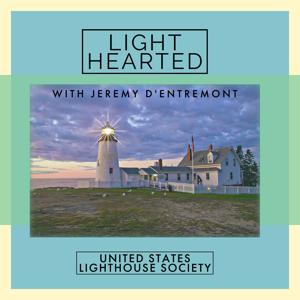
Light Hearted

Light Hearted

By Jeremy D'Entremont, U.S. Lighthouse SocietySociety & CulturePlaces & Travel
Download on the App Store

Light Hearted episodes

  • Light Hearted ep 165 – Terry & Jeri Cole, Fort Point, Maine, pt 2; Laurie Perkins, Tawas Point, MI

    Fort Point Lighthouse is in Stockton Springs, Maine, near the mouth of the Penobscot River. The light station was established in 1836 and the square brick lighthouse tower and attached keeper’s house that stand there today were built in 1857. Terry Cole was a keeper at Fort Point when he was in the Coast Guard for three years in the 1970s. The lighthouse is within Fort Point State Park, and Terry became involved as a park manager while he was in the Coast Guard.

    Fort Point Light Station, Maine. Photo by Jeremy D’Entremont.

    In 1989, long after he had left the Coast Guard, Terry and his wife Jeri moved back into the light station and Terry became the resident park manager. Jeri Cole also played an important role, helping to host visitors at the lighthouse and planning events. Terry retired last August after after 44 years working for Maine Parks and Lands. In part two of this two-part interview, Terry and Jeri reminisce about living at Fort Point in all kinds of weather, about the concerts and other events they held there, and about what they’re doing in retirement, among other things.

    Terry and Jeri Cole, photo by Jeremy D’Entremont.

    Laurie Perkins is the Southern Lower Peninsula Historian for the Michigan History Center. Under that umbrella is Tawas Point Lighthouse, which is located in Tawas Point State Park on the west side of Lake Huron in Northern Michigan. In a “Be a Lighthouse” segment, Laurie talks with host Jeremy D’Entremont about some ways the Michigan History Center and Tawas Point Lighthouse are enriching the lives of young people.

    Tawas Point Lighthouse, Michigan. USLHS photo.

    Listen to the podcast with this player:

    56 min
  • Light Hearted ep 164 – Terry and Jeri Cole, Fort Point, ME 1 of 2; Valeriy Kostyuk of Lighthouse Immersive

    Listen to the podcast with this player:

    Fort Point Lighthouse is in Stockton Springs, Maine, near the mouth of the Penobscot River. The light station is part of Fort Point State Park and is adjacent to the remains of Fort Pownall, which was built in 1759 to guard against the French. Fort Point Light Station was established in 1836, and the 31-foot square brick lighthouse that stands today was built in 1857.

    Fort Point Light Station, Maine. Photo by Jeremy D’Entremont.
    Terry and Jeri Cole with Molly the lighthouse dog, at Fort Point in the 1990s. Photo by Jeremy D’Entremont.

    In 1973, 22-year-old Coast Guardsman Terry Cole became the light keeper at Fort Point. While he was stationed at Fort Point with the Coast Guard, Terry served as park manager for a while before he and his family moved on to another assignment on Cape Cod. In 1988, Fort Point Light was automated and the Coast Guard removed its keepers. The keeper’s house became housing for a park ranger and his family. The first person to fill the live-in position was Terry Cole, beginning in 1989. Terry’s wife Jeri also played a large role, helping to organize events and answering visitors’ questions. Terry retired this past summer after 44 years working for Maine Parks and Lands and more than 30 years of living at the Fort Point Lighthouse.

    The historic fog bell tower at Fort Point, sunrise view by Terry Cole.
    Fort Point Light Station in winter, courtesy of Terry Cole.

    An organization called Lighthouse Immersive is sponsoring a fundraising initiative built around a show called Immersive Shevchenko: Soul of Ukraine. The subject of the show is Taras Shevchenko (1814-1861), a Ukrainian poet, writer, artist, political figure, and folklorist. In the new show, the audience can see pieces by Shevchenko projected across the gallery walls, and the show is set to a soundtrack to further immerse you in his world. The exhibit first opened in Odesa to celebrate the 30th anniversary of Ukrainian independence last year. Immersive Shevchenko will be shown in five cities on March 15 – Boston, Chicago, Denver, Los Angeles, Toronto, and San Francisco. There will also be a virtual showing on March 15. Details are available at lighthouseimmersive.com. One of the show’s producers, Valeriy Kostyuk, discusses the exhibit in a “Be a Lighthouse” segment.

    Listen to the podcast with this player:

    57 min
  • Light Hearted ep 163 – Larry and Marolyn Becker, Pointe aux Barques, Michigan
    Circa late 1800s photo of Pointe aux Barques Light Station, Michigan. U.S. Coast Guard Historian’s Office.

    Pointe aux Barques, on Lake Huron at the northeastern tip of the part of Michigan known as “The Thumb,” takes its name from a French phrase meaning “point of little boats.” A dangerous reef extending almost two miles from the point was a hazard to shipping traffic heading north along the Lake Huron shore.

    The first lighthouse on the point was constructed of stone in 1848, on a three-acre site carved out of dense wilderness. In addition to warning mariners of the reef at Point aux Barques, the light served to guide shipping into Saginaw Bay and the Saginaw River.

    Marolyn and Larry Becker

    The original keeper’s house was destroyed by fire in 1849. The first tower was poorly built and had to be replaced in 1857. The new keeper’s house and attached 89-foot tower were built of the finest brick available. The light remains an active aid to navigation, making Pointe aux Barques one of the oldest continuously operating lights on the Great Lakes. The light was automated in 1934 and the last keeper left five years later. The light station property was transferred to Huron County in 2003. A nonprofit group, the Point aux Barques Lighthouse Society, was formed.

    Larry Becker is the past president of the Pointe aux Barques Lighthouse Society. His wife Marolyn is a longtime volunteer and membership chair for the Society.

    Pointe aux Barques Light Station, Michigan. USLHS photo by Chad Kaiser.

    Listen to the podcast with this player:

    51 min
  • Light Hearted Special Edition – Tetiana Manziuk, Kyiv, Ukraine

    In this special episode, Light Hearted host Jeremy D’Entremont interviews Tetiana Manziuk of Kyiv, the capital city of Ukraine. Tetiana — or Tanya, as she’s known — is the Alumni Officer at House of Europe, a non-governmental organization fostering professional and creative exchange between Ukrainians and their colleagues in European Union countries.

    Tetiana Manziuk at the Lower Berdiansk Lighthouse in Ukraine

    In this conversation, Tanya and Jeremy discuss what life in Kyiv is like currently during the Russian invasion of Ukraine. They discuss the beauty and history of the city of Kyiv. And they also touch on the cultural and symbolic importance of lighthouses in Ukraine and the world.

    Article about the keeper of the Lower Berdiansk Lighthouse in Ukraine

    Thank you to Yana Gultiayeva for making this interview possible.

    Tetiana Manziuk

    Here is what Tanya posted yesterday on her Facebook page:

    Dear friends from abroad, I am in Kyiv, my home. My big wide windows which I always considered as an advantage now are taped and covered. Due to our municipal services doing their job despite everything, I have electricity, water, WiFi. Our metro works as transport and as a shelter from shelling. Our army fights like hell defending our cities from Russian occupants – that’s why I am still able to write this post.

    We need support.We need strict sanctions against Russia, especially banning from SWIFT and No-Fly Zone over Ukraine. Here are some offers from Ukraine Сrisis Media Center

    No-Fly Zones and Other Ways the International Community Can Help Ukraine

    Here is a link to support charity foundation Повернись живим (Come Back Alive) helping army and veterans https://savelife.in.ua/en/donate/

    Hospitallers – medical battalion working directly on the frontline in Ukraine.

    This is an account from The National Bank of Ukraine to assist the Ukrainian Armed Forces https://bank.gov.ua/…/natsionalniy-bank-vidkriv-spetsrah

    Open Petition: People around the world ask NATO to close the airspace over Ukraine.

    Change.org: No-Fly Zone for Ukraine Now!

    Thank you so much for being in touch with me. It is very important to know that we are not alone. Many greetings from Kyiv!

    Listen to the podcast with this player:

    32 min
  • Light Hearted ep 162 – Sarah Wassberg Johnson, Hudson River Maritime Museum/Rondout Lighthouse, NY

    Located on the historic waterfront of Rondout, New York, the Hudson River Maritime Museum was established in 1979 and is dedicated to the preservation and interpretation of the maritime history of the Hudson River, its tributaries, and related industries. The museum’s collections include historic vessels, objects, archival material, and art related to Hudson River transportation, industries, and recreation, with paintings, prints, photographs, artifacts, ship models, boats, and more.

    The Hudson River Maritime Museum, New York. (Courtesy of HRMM)

    Of the dozens of lighthouses and smaller lights that once dotted the Hudson River, only seven remain. Rondout Lighthouse, located at the confluence of the Hudson River and Rondout Creek, was established in 1838. The present lighthouse building, still fully operational as a navigational light, was completed in 1915.

    Rondout Lighthouse, New York. Photo by Jeremy D’Entremont.
    Sarah Wassberg Johnson

    Rondout Lighthouse is owned by the City of Kingston and operated by the Hudson River Maritime Museum, and guided tours of the lighthouse are available seasonally.

    Sarah Wassberg Johnson is the director of exhibits and outreach at the Hudson River Maritime Museum. She was also the co-author of the book Hudson River Lighthouses, published in 2019.

    Together with filmmaker Jeff Mertz of Moonbow Imaging, the Hudson River Maritime Museum is creating a feature-length documentary film, Seven Sentinels: Lighthouses of the Hudson River. Here is the trailer for the film:

    Listen to the podcast with this player:

    55 min
  • Light Hearted ep 161 – Amy Maxwell Chase and Mark Boyt, Bolivar Point, TX, “Be a Lighthouse” #3

    Listen to the podcast with this player:

    The Port of Galveston, Texas, which was established in 1825, eventually became the busiest port on the Gulf Coast and the second busiest in the country after New York City. Bolivar Point is at the southwestern end of the Bolivar Peninsula, marking the east side of the entrance to Galveston Bay. The first lighthouse on the point began service in late 1852. In 1870 Congress appropriated funds for a new 117-foot-tall cast-iron lighthouse.

    Mark Boyt and Amy Maxwell Chase

    The third-order Fresnel lens was first illuminated in the rebuilt Bolivar Point Lighthouse on November 19, 1872. The light station weathered devastating hurricanes in 1900 and 1915. With an increase in the intensity of Galveston Jetty Lighthouse in 1930, Bolivar Lighthouse was considered expendable and the light was extinguished. In 1947, the War Assets Administration sold the property for $5,500 to rancher E. V. Boyt. In 2015, descendants of the first private owners of the light station property created the nonprofit Bolivar Point Lighthouse Foundation to address the restoration and preservation of the lighthouse. Amy Maxwell Chase is the executive director of the Bolivar Point Lighthouse Foundation, and Mark Boyt is a founder and board member of the organization.

    Bolivar Point Light Station (Courtesy of Bolivar Point Lighthouse Foundation)

    Click here for a virtual tour of Bolivar Point Lighthouse

    Lighthouses save lives and serve as symbols of hope, and first responders do the same in our communities every day. On Tuesday, February 1, first responders rescued three fishermen after their fishing boat sank off Scituate, Massachusetts. Shortly after 2:30 that afternoon, a local woman called 911 and reported seeing a fishing boat overturn and sink, with black smoke filling the air. She saw that the three fishermen were clinging to debris to stay afloat. The water was 42 degrees and the men were in the water for 45 minutes. Scituate Fire Chief John Murphy discusses the rescue in a “Be a Lighthouse” segment.

    Drone footage of the February 1 rescue captured by Scituate Fire Department Lieutenant Erik Norlin:

    https://youtu.be/jl4Lq42-plc

    Listen to the podcast with this player:

    51 min
  • Light Hearted ep 160 – Megan Beck, Noble Maritime Collection and Robbins Reef, NY; “Be a Lighthouse” #2

    The mission of the Noble Maritime Collection, an art and history museum on Staten Island, New York, is to present exhibitions and programs that celebrate the working waterfront of New York Harbor in the tradition of the distinguished artist John A. Noble. The museum is located on the former grounds of the retirement home known as Sailors’ Snug Harbor, on Staten Island’s North Shore.

    Robbins Reef Lighthouse, New York Harbor. Photo by Peter Yuschak, courtesy of Noble Maritime Collection.

    The museum also works to preserve Robbins Reef Lighthouse, a spark-plug-style tower located between the Statue of Liberty and Staten Island’s North Shore. Robbins Reef is best known as the home of the famous Kate Walker, who was its keeper from 1895 to 1919.

    Megan Beck (Courtesy of Noble Maritime Collection)

    Curator Megan Beck began working at the Noble Maritime Collection in 2013. She researched and helped develop exhibits on Sailors Snug Harbor and Robbins Reef Lighthouse, and she oversees all curatorial and archival projects for the museum.

    Below: Kate Walker, the celebrated keeper of Robbins Reef Lighthouse. (U.S. Lighthouse Society archives)

    • Today’s “Be a Lighthouse” subject is from Oak Ridge, Tennessee. Scarves tied around poles were recently spotted in that city, along with notes that said, “If you need this scarf, please take it and be warm and safe.” The person behind this act of kindness is Aunika Sharrock, an 18-year-old Oak Ridge high school senior who enjoys helping others. And this isn’t the first time Aunika has performed selfless acts of caring. Co-host Michelle Jewell Shaw interviewed Aunika for the podcast.

      54 min
    • Light Hearted ep 159 – Rear Admiral Dan May, U.S. Coast Guard ocean engineer, pt 2 of 2
      Retired Rear Admiral Daniel R. May
      U.S. Coast Guard photo

      Retired Rear Admiral Daniel R. May graduated with a degree in ocean engineering from the U.S. Coast Guard Academy in 1979. He spent more than three decades working on many lighthouse-related projects from the Carolinas to Maine.

      In part two of this two-part interview, Dan talks about more lighthouses he worked on, including Plum Island in New York, Watch Hill in Rhode Island, Mount Desert Rock in Maine, Isles of Shoals in New Hampshire, and Lynde Point in Connecticut. Also discussed is his work on buoy-related projects, and his involvement with Friends of Plum Island Light in his home city of Newburyport, Massachusetts.

      Plum Island (Newburyport Harbor) Lighthouse was transferred to the City of Newburyport, Massachusetts, on May 10, 2003. Left to right: Captain Daniel R. May, commander of Coast Guard Group Boston, Newburyport Mayor Alan Lavender, Friends of Plum Island Light President Jim Frey, Congressman John F. Tierney, and Coast Guard Rear Admiral Vivien S. Crea, who at the time was commander of the First Coast Guard District. Photo by Jeremy D’Entremont.
      Lynde Point Light Station in Old Saybrook, Connecticut. Dan May was involved with a project to modernize the automated light and fog signal, as well as the repointing and repainting the of the stone tower. The actress Katharine Hepburn was a neighbor. Photo by Dan May.
      47 min
    • Light Hearted ep 158 – Rear Admiral Dan May, U.S. Coast Guard ocean engineer, pt 1 of 2

      Daniel R. May graduated with a degree in ocean engineering from the U.S. Coast Guard Academy in New London, Connecticut, in the Class of 1979. After time aboard the Coast Guard cutter Ingram, based in Portsmouth, Virginia, Dan became the ocean engineer for the Fifth Coast Guard District. He earned a master’s degree in ocean engineering from the University of Rhode Island in 1982.

      Retired Rear Admiral Dan May with his wife, Leslie, at Boston Light. Courtesy of Dan May.
      Block Island Southeast Lighthouse, Rhode Island, before its 1993 move back from the edge of the eroding bluff. Photo by Dan May.

      During his time as the ocean engineer for the Fifth District, Dan worked on lighthouse projects from Delaware Bay to the Carolinas, along with other engineering projects involving buoys and other structures on the water. After time as the commanding officer of Coast Guard Station St. Louis, Dan moved to Civil Engineering Unit Providence, Rhode Island, where he served as the project engineer for several major lighthouse projects including the relocation of Block Island Southeast Light, the first move of a major lighthouse structure in the United States.

      Dan May with Gordon Russell of the Truro (MA) Historical Society just prior to the 1996 move of Highland Lighthouse on Cape Cod. Courtesy of Dan May

      Dan retired as a rear admiral in 2013. This is part one of a two-part interview.

      In part one, Dan talks with host Jeremy D’Entremont about projects involving erosion control at Montauk Light Station, New York, the moves of Block Island Southeast Lighthouse in Rhode Island and Highland Light in Massachusetts, and several projects involving Boston Light.

      58 min
    • Light Hearted 157 – Neil Hargreaves, English light keeper; “Be a Lighthouse” #1
      Neil Hargreaves

      Listen to the podcast with this player:

      Neil Hargreaves was a light keeper for Trinity House in England from 1974-1988, and he is the founder and chairman of the Association of Lighthouse Keepers. Neil, who was originally from Lancashire, spent the first two years of his light keeping career on light vessels, mostly the Newarp lightship off the Norfolk coast in southwest England. Neil’s first appointment as an assistant lighthouse keeper was at the Smalls Lighthouse, a wave-swept granite tower on a rock about 20 miles off the coast of Pembrokeshire. After two years at the Smalls station, he spent seven years on the Inner Dowsing tower – a converted coal rig – in the North Sea off England’s east coast.

      Neil Hargreaves in the radio room at Longships Lighthouse, 1987. (Courtesy of Neil Hargreaves)
      The Smalls Lighthouse, Wales. U.S. Lighthouse Society photo.

      Neil’s final three years working for Trinity House were spent traveling around to various light stations in England, Wales, and the Channel Islands. He spent time at Longships, Souter, Wolf Rock, and several other stations. His last station as a keeper was Portland Bill on the Dorset coast. Neil founded the Association of Lighthouse Keepers, or ALK, in 1988, and he serves as its chairman. The ALK manages a lighthouse museum on the south coast of England. The group also runs lighthouse tours and produces a quarterly journal called Lamp.

      * * * *

      Lighthouses are seen around the world as a symbol of hope, guidance, and strength along with lots of other positive qualities. The playwright George Bernard Shaw once wrote, “I can think of no other edifice constructed by man as altruistic as a lighthouse. They are built only to serve.” In recognition of that, Light Hearted will be doing occasional segments called “Be a Lighthouse,” discussing people and organizations who are being lighthouses, or beacons of hope, in our communities.

      The first “Be a Lighthouse” segment focuses on a nonprofit organization on the New Hampshire Seacoast. Gather serves those in the community experiencing hunger by providing nutritious food through innovative distribution programs. The organization also collaborates with community partners to address the root causes of hunger throughout the Seacoast in New Hampshire and Maine. Seneca Adam Bernard is the associate executive director of Gather.

      * * * *

      Following is the transcript of the interview with Neil Hargreaves.

      JEREMY

      I’m speaking today with Neil Hargreaves, who is a former

      lighthouse keeper in England and also the founder of the Association of Lighthouse
      Keepers. You know, I was reading some interviews with you lately. And in one of
      the interviews, you talked about how you worked on fishing trawlers before you
      became a lighthouse keeper. I’m sure that was an interesting job that could
      probably be pretty scary at times.

      NEIL HARGREAVES

      Yeah. It was a dangerous job. I sailed out of Fleetwood

      and then I ended up on deep sea in the Faroes in Iceland. That was a beautiful sight
      to see when I first saw Iceland, and these white mountains rising sheer out of
      the sea with pink tints on the top. Absolutely magical. But, unfortunately, we
      weren’t allowed to land at the time, because it was during the time of the Cod
      Wars with Iceland. We had the Icelandic gunboats trying to cut our nets away.

      JEREMY

      But there must have been some heavy seas you encountered

      at times.

      NEIL HARGREAVES

      Oh, for sure. Yeah. I mean there was one trip, we ended up

      sailing right around Iceland. The skipper kept sailing north and right to the
      top to escape the weather. The weather was that bad. There was one sea, the
      vessel actually keeled over and half the boat deck was underwater. But it was
      pretty close, I think, that one. I only did it two years before I transferred
      over to lighthouses.

      JEREMY

      You worked on the lightships at first, but what, what

      exactly led you to work for Trinity House? Was being a lighthouse keeper or being
      a lightship sailor — were those things you aspired to before that?

      NEIL HARGREAVES

      I can’t say it was, to be honest, Jeremy. Some guys I knew,

      I was having a drink with them in the bar and they worked for Trinity House. And
      they got talking and they told me they were looking for guys on the lightships.
      That’s how it came about.

      JEREMY

      After being on the trawlers like that, I imagine being on

      the lightships was a fairly calm way of life, but it must have had its
      interesting moments. What, what was life like on the lightships?

      NEIL HARGREAVES

      It was less dangerous, a bit. But having said that, the

      lightships in the U.K, they can’t move under their own steam. The ship’s out
      there for three years, for a month on and a month off, but they take them in
      every three years for drydock and repair. The North Sea’s only a shallow sea. So
      when the wind’s whipped up, it could be quite choppy. If you got wind and tide
      in a certain way, the lightship could behave like in a corkscrew motion. So luckily
      I was never seasick either on the trawlers or on the lightships. But it was a
      different experience to lighthouses because on a lightship, during fog, you
      watch out on deck because you had to listen out for the fog signal when it
      blasted. If a vessel was close by, on the rebound, it would come back to you. And
      you could sort of find out show far away that vessel was. And if it was too
      close, you’d have to call everybody out in case it was going to hit you. Small
      coasters used to come along. The vessels I was on, the Newarp, it did end up
      getting hit twice. Luckily that was after I’d left.

      JEREMY

      So after a couple of years on the lightships, and then

      after your training course, you became a supernumerary keeper. That’s not a
      term we use here. From what I gather, it was kind of like being an apprentice
      keeper. So can you explain a little bit about that? What did you do as a supernumerary
      keeper?

      NEIL HARGREAVES

      Yeah, that that’s correct. It was going around various

      lighthouses, to begin with, before you got specific a posting — still learning
      different engines, because they had different engines at different stations,
      different lights at different stations. I even got to, to go on an old IOV
      light at St. Mary’s, the old incandescent oil burner. That was something in
      itself. You know, it was like being back in time. The very first lighthouse I
      was sent to was Souter Point on the northeast coast and the second one was St.
      Mary’s Island. That was a great little island. It was connected by a causeway that
      was covered at high water. One of the keepers on there had canoes so we used to
      go out sea canoeing. That was great. After there I went to St. Ann’s
      Lighthouse, and then Cromer. But it wasn’t long that I actually got forced into
      Smalls because of the time spent on the lightships previous.

      JEREMY

      After your time as a supernumerary keeper, you were an

      assistant at the Smalls Lighthouse, which is extremely remote. It’s the most
      remote station operated by Trinity House, I believe.

      NEIL HARGREAVES

      That’s correct.

      JEREMY

      It’s about twenty miles off the coast of Wales. Life there

      must have been really interesting.

      NEIL HARGREAVES

      You were certainly felt like you were at one with nature,

      that sort of thing, being out there, you know. You just had the sound of the
      sea and the seagulls. It’s quite something.

      JEREMY

      Did you enjoy it?

      NEIL HARGREAVES

      I did. I did to begin with, I did.

      JEREMY

      Mm-hmm —  to begin with?                                    

      NEIL HARGREAVES

      Yeah, yeah, yeah. For the most part, the guys were a great

      set of blokes. Great camaraderie on the job, you know. But there was just one
      particular chap on this station. He wasn’t there when I first went there, he
      came later. And he was just a complete racist, a bigot, homophobic. You name it,
      he was it, you know? Yeah. Couldn’t even watch TV without some derogatory
      comment coming in. So I just had enough and I wrote to Trinity House saying you
      need to get me off there. They did. They gave me a transfer to the Inner
      Dowsing. But there’s an end story to this, Jeremy. After seven years on the
      Inner Dowsing, the last three years they put me on the pool, which meant I got
      sent around relieving people were off sick or on holiday. A month here, a month
      there. So I got to see a lot more lighthouses than I would have done normally.
      And one of the superintendents said, would you like to go to Souter again? He
      said that there’s just one thing. He said the principal keeper that’s there now
      was this particular chap. He said you don’t have to go, but would you be okay
      with going? I said, yeah. And sure enough, we ended up going for a drink
      together. You know?

      JEREMY

      Wow.

      NEIL HARGREAVES

      That was the end to that one.

      JEREMY

      Yeah, that’s good story. I guess people can change for the

      better. That’s good to hear. Yeah. But it’s a shame you had to transfer there
      because, as you said, most of the guys were great at the Smalls. Going back to
      that, how many keepers were typically assigned to the Smalls? What kind of
      rotation did you have there?

      NEIL HARGREAVES

      It was only three in the crew. We had the principal keeper

      and two assistant keepers. The reason they made it three on the crew, it was
      actually on the Smalls Lighthouse way back in the 1800s when there were only
      two keepers, one of the keepers died. The other one fearing that he’d be blamed
      for killing him, kept his body there. First inside then he had to put it
      outside. The weather was bad. They didn’t have radio communication back then
      either. So he had to wait until the relief boat came to get him off. By the
      time the relief boat came, it been delayed due to bad weather. This guy had
      gone insane. After that, they decided to put three keepers on the station.
      There’s been several plays about this particular story. I remember watching one
      on TV. It was quite good.

      JEREMY

      It inspired a couple of movies as well. Including the

      recent movie, The Lighthouse — the plot was very different. But I read
      that the writer/director was inspired by that incident. And I was going to ask
      you about that. When you were there at the Smalls, was that something you and
      the other keepers knew about? Did that enter your thinking at all when you were
      there?

      NEIL HARGREAVES

      No, it didn’t really enter our thoughts. As I say, we had

      such a good rapport with each other. There was no worries. As I say, it was
      great camaraderie amongst the majority, you know. You had oddball as you do
      anywhere, you know?

      JEREMY

      Sure. Yeah. So it’s obviously a very isolated place. Do

      you recall any specific times in storms or especially high seas at the Smalls?

      NEIL HARGREAVES

      Yes. Yeah. For sure. Yeah. I’ve experienced a wave

      actually coming right over the top of the tower.

      JEREMY

      Which is how tall?

      NEIL HARGREAVES

      It’s 120 feet. The tower would actually shake when that would

      hit. But it had to have that give, that’s how it was designed. Because if it
      didn’t, it would snap. It was built into it. Amazing feats of engineering,
      absolutely. The water would wash down on the light and would come back through
      the windows. It was quite an experience. And that happened at the Longships as
      well, off Land’s End.

      JEREMY

      What were the living quarters like in those towers?

      NEIL HARGREAVES

      Quite cramped. You only had one bedroom for all three of

      you. Of course, there was always one on watch, you know? So there was only was only
      two that turned it at maximum. The middle watch was midnight to four in the
      morning. So that’s when you did your ablutions. You didn’t have a shower or
      anything. It was just a wash at the sink in the kitchen. You didn’t realize at
      the time when you were there, but it wasn’t until you got ashore that you could
      smell it on your clothes. It was a great job, Jeremy. It was the best job I
      ever had, to be honest.

      JEREMY

      Your water supply at those places was a cistern in the bottom

      of the tower, right? And was that delivered to you? Or how did that work?

      NEIL HARGREAVES

      Yeah, that, that was delivered by the tenders, one of our

      ships. We had tanks down on the rock, oil tanks. They supplied water as well.
      That was once a month.

      JEREMY

      Those oil tanks must have been pretty heavy duty to

      withstand those seas there.

      NEIL HARGREAVES

      Well, the helicopter used to land on top of the oil tank because

      it was the only the only flat bit. At the Smalls you always had to keep an eye
      open for a rogue wave coming and the ones. Once when he had to take off in the
      hurry, he said I’ll have to go. He took off. A wave came over. It washed one of
      the guys’ suitcases into the — in between our rock and the next rock, sort of
      thing. He jumped in and got after it. So then I had to fish him out along with
      his suitcase.

      JEREMY

      I was going to say, it’s a good thing that the suitcase

      was all that swept away. And it sounds like he was pretty lucky to survive
      that.

      NEIL HARGREAVES

      Yeah, for sure. Yeah.

      JEREMY

      I know a, a lot of keepers, other people I’ve interviewed

      like Richard Cummins, who was a lighthouse keeper in Ireland for quite a while,
      talked about the wildlife. Ian Duff in Scotland, also. What kind of wildlife
      did you have? Was there anything of significance around someplace like the Smalls?

      NEIL HARGREAVES

      Well, we had a colony of seals there and they used to come

      swimming into the gut and pop their heads up and be taking the lot on what was
      going on, what we were doing, you know. So they were quite comical and it was
      always interesting to watch those. Yeah. And the different seabirds as well,
      seeing the gannets dive and that sort of thing. A lot of keepers actually
      became birdwatchers. Just to hear the sound of the gulls and the waves washing
      on the rock out there, it was just —

      JEREMY

      Probably go to sleep with those sounds, right? I remember

      spending a night at Boston Light in Boston Harbor. I got to sleep on the couch in
      the keeper’s house. And I was so aware of the gulls all night. They were so
      loud just outside the house, but I guess you get used to that, probably fairly
      fast.

      NEIL HARGREAVES

      Well, yeah. When you consider, you have to get used to the

      louder — much louder — fog signal going.

      JEREMY

      Right. Well, let’s talk a little bit about the fog signal

      at the Smalls. What type of signal was that?

      NEIL HARGREAVES

      It was diaphone, same as on the lightships. Really loud,

      with a grunt at the end, sort of thing. You just got used to it. You got to
      sleep. No problem. You know, it’s funny because sometimes it suddenly stops and
      it was just silent. You might wake up with the silence.

      JEREMY

      I’ve heard that before. It’s the silence that, that woke

      you up. I heard a diaphone horn at Souter that they still operate on occasion. And
      it’s pretty impressive. And I can’t imagine living inside a tower where you had
      one of those. Was it difficult to operate? Of course it was compressed air.
      Right? And probably not all that hard to start up. Is that right?

      NEIL HARGREAVES

      You had a much bigger engine you had to start up and then let

      it build up to a certain pressure, then wind it in and away you’d go. Some of
      them were crank start – you had to turn the handle. They ended up putting push
      button start on.

      JEREMY

      So after the Smalls, as you mentioned before, you moved to

      the Inner Dowsing Light, for reasons you mentioned before. And you actually
      spent seven years there. It’s an unusual place. I don’t know if you could
      exactly call it a lighthouse, certainly a light station. Certainly not anybody’s
      idea of a traditional lighthouse. But, first of all, for people who don’t know,
      can you explain where the Inner Dowsing is? Geographically?

      NEIL HARGREAVES

      Yeah, geographically it’s just off The Wash off the east

      coast of England. It’s off the Lincolnshire coast. And it was actually an ex-coal
      rig. They actually used a light vessel lantern on the top of it. The helipad was
      on top as well on the other corner. Being an ex-rig, of course, it was a much
      bigger than the granite tower that I’d just been on the previous two years. We
      actually had flushing toilets. We had showers. There was a TV room, as well as a
      kitchen. It was a dining area as well, a separate radio room, and other rooms.
      The engine room was in the center. You also had a crane on there to operate
      when the boat came along, the tenders. Although all the reliefs were done by
      helicopter. On their annual inspection we’d have to winch them from the little
      motor launch that they’d come across in onto the deck, which was about 120 foot
      up.

      JEREMY

      In this country. We had a bunch of towers that were

      sometimes referred to as Texas towers, kind of like oil rigs. And they seemed
      very similar. As you said, it was a former coal rig and I guess they would
      explore for undersea coal.

      NEIL HARGREAVES

      That is correct. That was up off the northeast coast where

      this rig was being used. There used to be some miners’ cottages next to the
      lighthouse at one time.

      JEREMY

      I’ve certainly heard about a lot of keepers who had

      hobbies of one kind or another to pass the off hours when there wasn’t work
      they had to do. Or when they’re keeping watch certainly — hobbies probably
      helped you stay awake when you were keeping watch. But did you have any hobbies
      you used to pass the time?

      NEIL HARGREAVES

      I did. Yeah. One of the old masters of a light vessel

      taught me how to put ships in bottles. So I got quite adept at doing those. I
      only did them on the light vessels, for some reason. I didn’t carry it on when
      I transferred onto lighthouses. I used to do a lot of reading. I did bit of
      photography as well, of course.I quite a lot out there, to be honest.

      JEREMY

      I bet! Those are good places to read, I would say. I don’t

      know if you know Richard Cummins, the former Irish keeper who makes amazing
      ships in bottles and other models and posts a lot of the pictures on his
      Facebook page. I don’t know if that’s something you’re aware of.

      NEIL HARGREAVES

      I saw the interview you did with him. Most keepers had

      hobbies. Some were artists, who were quite good some of them. And some had
      various hobbies like rug making, some even knitted.

      JEREMY

      I’ve heard that. Yeah. Your last three years after the Inner

      Dowsing and the Smalls and your lightship time, you spent three years with
      Trinity house — I think you alluded to this earlier — but you traveled around
      to a bunch of different lighthouses. And I believe you mentioned a couple
      earlier, but during that period, were there kind of favorite places you had?

      NEIL HARGREAVES

      I think Alderney was my favorite, in the Channel Islands,

      I did a couple of the other Channel Islands lights as well — Casquets and Hanois.
      But Alderney was on the island itself of Alderney, of course. So you to meet
      all the local people, which was great. You were immediately, being a lighthouse
      keeper, wherever you went to in the country, you were immediately made welcome
      by the local community as one of them. Because you were there to protect their
      fishermen, their yachtsman. You know, was another great part of the job. And at
      Alderney, the lighthouse was also the 999 call center for the island. We were
      the only place manned 24/7. So we used to turn out the fire, police, or
      ambulance. The local bobby – copper – used to call in on his rounds – call in for
      a chat at the lighthouse, have a cup of tea. So it was great.

      JEREMY

      What exactly led you the end of your career with Trinity

      House?

      NEIL HARGREAVES   

      The automation program, sadly. We could see the writing on

      the wall as soon as the computer chip came along, you know.

      JEREMY

      How do you feel about lighthouse automation?

      NEIL HARGREAVES

      Well, being a keeper, I’d have to say, you know —  I mean, we can see progress, you know, we

      know why it’s going to GPS and all that, but it’s like one skipper said to us,
      he said, “GPS is all really well.” He said, “But it tells me where I think I am.”
      He said, “When I see a lighthouse, I know where I am.” things are changing all
      the time, aren’t they? You know.

      JEREMY

      Sure are. I guess it’s progress, but you often lose things

      along the way with so-called progress.

      NEIL HARGREAVES

      The thing was, I mean, the other service keepers give, of

      course, is you were on hand in real emergencies. You know, whether it be yacht
      in distress, or in couple cases where climbers were stuck on the rocks where there
      was a lighthouse. One of our keepers actually ended up getting a medal for
      bravery. He ended up doing two rescues on the cliffs at South Stack Lighthouse.
      He actually went down and kept the bloke’s head up out of the water while help
      came.

      JEREMY

      Well, that’s why in Canada they still have more than 50

      staffed lighthouses. Even though the lights are automated, they like having the
      people there to keep an eye on things. Although the government keeps
      threatening to take the keepers off, but there’s enough outcry to keep them
      there, at least so far.

      NEIL HARGREAVES

      Yeah. That’s good to hear. Another thing that’s been done

      over here, of course, is they’ve got rid of all the Coast Guards. Most of our
      Coast Guard stations are gone. So there’s no eyes there either.

      JEREMY

      So you have volunteer lifesavers.

      NEIL HARGREAVES

      The Coast Watch. A volunteer group sprang up. It’s not as

      heavy on the ground as what the old Coast Guards were, you know. They’re fewer
      and far between. So, I mean, at least it’s something, you know, but they’re
      just volunteers.

      JEREMY

      Yeah. So I wanna talk a bit about the Association of Lighthouse

      Keepers, but I’m also wondering since you left Trinity house in 1988 and
      started the ALK around that time, what else have you been doing in the years since
      then?

      NEIL HARGREAVES

      I ended up moving down to London. I was living in Suffolk

      at the time. Shortly after I did leave, before I moved down to London, [?]
      contacted me and asked me if I’d consider being attendant for Southwold (?)
      Lighthouse. So that’s just a part-time job. You just have to go along every so
      often, keep it tidy and clean, and show anybody around when it was requested.
      So I did that for two years after I came out of the service. But then I had to
      move down to London for full time work and actually went into security at the press
      association on Fleet Street in London. From there I was transferred to
      Powergen’s registered office in the city of London, where I did security. And
      while I was there, I ended up getting a job in facilities at PowerGen at that
      registered office. So I ended up looking after all the staff there and kept them
      all supplied with their office requirements. But it was a really good little
      friendly crowd there. I was there nine years in total, but then redundancy came
      along again. They said we’ll retrain you to do whatever job you fancy doing. I
      took them up on it. So I retrained as a housing officer. I did the course got
      the certificate and I ended up getting the job as a housing officer. So that
      was quite interesting. It was only for two years, because redundancy came along
      again. And after that I ended up running a dry cleaners. And then from that ended
      up being manager of a coffee shop and gift shop. And then the big recession
      came along and for the last six years of my working life I was actually a
      carer.

      JEREMY

      Say that again? You were –

      NEIL HARGREAVES

      A carer — looking after old people.

      JEREMY

      Oh, right. Okay. I thought that’s what you said at first.

      Yeah.

      NEIL HARGREAVES

      But it was a quite interesting, challenging job, you know?

      JEREMY

      Sure.

      NEIL HARGREAVES

      It was worthwhile doing.

      JEREMY

      I bet. Yeah. So what led you to start the Association of Lighthouse

      Keepers in 1988?

      NEIL HARGREAVES

      Like I said, the, the camaraderie in the job had been

      great. It wasn’t a job I wanted to just walk away from and forget about. I
      mean, right from the start we collected our own archives as well. Schools come
      to us, colleges for information, we had one girl doing a dissertation on fog
      signals. At first, of course, it was just from people within the service. But
      when I left, there were only 174 keepers left at the time when I left. But there
      were also people in the Trinity House depots that joined — we had our own
      mechanics and electricians back then as well. Some of them joined. Even people
      at headquarters joined. But then we had such an interest from general members
      of the public that we decided to open membership up to anyone interested in
      lighthouses. And to be honest, Jeremy, I think it’s just as well we did because
      there’s not many of us keepers left now at all. The bulk of the trustees now on
      the board is made up of enthusiasts. They do a great job, sterling job. And the
      good thing about it is, over the years, when we’ve grown our lighthouse tours,
      you get the regular tour goers going on these tours and to see the smiles on
      their faces when they meet up with their friends again — that’s been a huge
      bonus of it as well, you know?

      JEREMY

      Yeah. Well, you mentioned the tours and the archives. I know

      that the ALK also does a magazine, Lamp, which is fantastic. A lot of history
      in there. How often does that magazine come out?

      NEIL HARGREAVES

      Quarterly.

      JEREMU

      Quarterly. Yeah. So if you get a membership in the ALK,

      you, you get the magazine, right?

      NEIL HARGREAVES

      You get the magazine, and a lapel badge, and a patch.

      JEREMY

      Back to the archives you mentioned, is that just for UK

      lighthouses or is it kind of worldwide?

      NEIL HARGREAVES

      It’s mostly UK ones, as you can imagine, because a lot of

      stuff has been sent in by UK members, but we do have odd bits from other places,
      yeah, around the world. Books as well from around the world.

      JEREMY

      The ALK also runs a museum right. In Hampshire. Is that

      correct?

      NEIL HARGREAVES

      That’s correct. Yeah. It’s inside Hurst Castle. Hurst

      Castle itself is run by English Heritage.

      JEREMY

      That’s H U R S T as opposed to — we have a property known

      as the Hearst Castle in California. William Randolph Hearst, H E A R S T.

      NEIL HARGREAVES

      Yeah, it’s H U.

      JEREMY

      And what is there again at the museum there?

      NEIL HARGREAVES

      We’ve got various lamps on display, various lighting

      equipment. We’ve got a mockup of The Needle’s kitchen in the museum as well.
      And we also show maps of all the lights around the UK. And it also shows people
      the refraction, the lens we’ve got there, from the prisms. The small team we
      have there now, they’re really dedicated. And they like to refresh things, you
      know, every so often. And they also look after to the Trinity House room that’s
      down there as well.

      JEREMY

      So I’ve got a couple of final questions for you, and these

      are for bonus points. Okay. What was the best thing about being a lighthouse
      keeper?

      NEIL HARGREAVES

      The fact that you knew, the job you was there to do, you

      knew that you was there to save lives, irrespective of where those sailors come
      from, whether they came from America, India, China, wherever. You were there to
      save people’s lives. And that was, you know, the real benefit of doing that
      job. And like I mentioned earlier, when you got sent to anywhere in the country,
      you might have been new when you got there, you were soon welcomed into the
      local community as one of them. It was great experience. It really was.

      JEREMY

      Well, I think I know the answer to this last question. But

      looking back, would you do it again?

      NEIL HARGREAVES

      Yes.

      JEREMY

      Didn’t hesitate there.

      NEIL HARGREAVES

      For sure.

      JEREMY

      Well, Neil, Hargreaves, it’s really fun talking to you.

      And I know we just have scratched the surface today and maybe we need to do a
      part two, part three, or whatever in the future, but I’m sure there’s a lot
      more stories we haven’t covered today. And I’d like to talk more about the ALK
      at some point, too. But I do really appreciate you spending this time with me
      today. It’s really, really great talking with you. Thank you, Neil.

      NEIL HARGREAVES

      You’re welcome. And thank you for inviting me along,

      Jeremy.

      58 min

    About Light Hearted

    From the publisher's feed

    The official podcast of the U.S. Lighthouse Society

    More shows like Light Hearted

    Stuff You Missed in History Class by iHeartPodcasts

    Stuff You Missed in History Class

    23,733 Listeners

    99% Invisible by Roman Mars

    99% Invisible

    26,160 Listeners

    Ben Franklin's World by Liz Covart

    Ben Franklin's World

    1,565 Listeners

    The Paranormal Podcast by Jim Harold

    The Paranormal Podcast

    4,760 Listeners

    The Daily by The New York Times

    The Daily

    111,865 Listeners

    RV Miles Podcast by RV Miles Network

    RV Miles Podcast

    1,344 Listeners

    Parkography by RV Miles Network

    Parkography

    896 Listeners

    Points North | Great Lakes. Great Stories. by A Great Lakes Podcast

    Points North | Great Lakes. Great Stories.

    295 Listeners

    The Wild with Chris Morgan by KUOW News and Information

    The Wild with Chris Morgan

    3,418 Listeners

    Park Predators by Audiochuck

    Park Predators

    18,046 Listeners

    Anatomy of Murder by Audiochuck

    Anatomy of Murder

    18,952 Listeners

    The Deck by Audiochuck

    The Deck

    10,823 Listeners

    The Wirecutter Show by The New York Times

    The Wirecutter Show

    1,171 Listeners