
Sign up to save your podcasts
Or

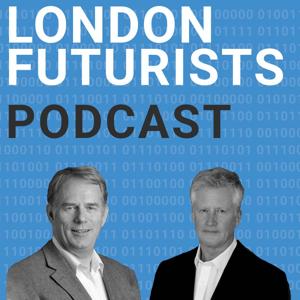


When we started this Podcast back in August 2022, we, Calum and David, announced the theme to be “Anticipating and managing exponential impact”. We talked about three sub-themes: Developing the skills of exponential foresight; Distinguishing between scenarios, whether they were plausible or implausible, and whether they were desirable or undesirable; and thirdly, Supporting the community of collaborative exponential foresight. 126 episodes later, as we reach the transition between 2025 and 2026, it’s a good time for the two of us to take stock.
Accordingly, in this episode, we each pick out a number of events from the last 12 months which we see as potential signals of larger exponential impact ahead.
Selected follow-ups:
Music: Spike Protein, by Koi Discovery, available under CC0 1.0 Public Domain Declaration
Almost every serious discussion about options to constrain the development of advanced AI results in someone raising the question: “But what about China?” The worry behind this question is that slowing down AI research and development in the US and Europe will allow China to race ahead.
It's true: the relationship between China and the rest of the world has many complications. That’s why we’re delighted that our guest in this episode is Kayla Blomquist, the Co-founder and Director of the Oxford China Policy Lab, or OCPL for short. OCPL describes itself as a global community of China and emerging technology researchers at Oxford, who produce policy-relevant research to navigate risks in the US-China relationship and beyond.
In parallel with her role at OCPL, Kayla is pursuing a DPhil at the Oxford Internet Institute. She is a recent fellow at the Centre for Governance of AI, and the lead researcher and contributing author to the Oxford China Briefing Book. She holds an MSc from the Oxford Internet Institute and a BA with Honours in International Relations, Public Policy, and Mandarin Chinese from the University of Denver. She also studied at Peking University and is professionally fluent in Mandarin.
Kayla previously worked as a diplomat in the U.S. Mission to China, where she specialized in the governance of emerging technologies, human rights, and improving the use of new technology within government services.
Selected follow-ups:
Music: Spike Protein, by Koi Discovery, available under CC0 1.0 Public Domain Declaration
Our guest in this episode is Stephen Witt, an American journalist and author who writes about the people driving the technological revolutions. He is a regular contributor to The New Yorker, and is famous for deep-dive investigations.
Stephen's new book is "The Thinking Machine: Jensen Huang, Nvidia, and the World's Most Coveted Microchip", which has just won the 2025 Financial Times and Schroders Business Book of the Year Award. It is a definitive account of the rise of Nvidia, from its foundation in a Denny's restaurant in 1993 as a video game component manufacturer, to becoming the world's most valuable company, and the hardware provider for the current AI boom.
Stephen's previous book, “How Music Got Free”, is a history of music piracy and the MP3, and was also a finalist for the FT Business Book of the Year.
Selected follow-ups:
Music: Spike Protein, by Koi Discovery, available under CC0 1.0 Public Domain Declaration
Our guest in this episode is Holly Elmore, who is the Founder and Executive Director of PauseAI US. The website pauseai-us.org starts with this headline: “Our proposal is simple: Don’t build powerful AI systems until we know how to keep them safe. Pause AI.”
But PauseAI isn’t just a talking shop. They’re probably best known for organising public protests. The UK group has demonstrated in Parliament Square in London, with Big Ben in the background, and also outside the offices of Google DeepMind. A group of 30 PauseAI protesters gathered outside the OpenAI headquarters in San Francisco. Other protests have taken place in New York, Portland, Ottawa, Sao Paulo, Berlin, Paris, Rome, Oslo, Stockholm, and Sydney, among other cities.
Previously, Holly was a researcher at the think tank Rethink Priorities in the area of Wild Animal Welfare. And before that, she studied evolutionary biology in Harvard’s Organismic and Evolutionary Biology department.
Selected follow-ups:
Music: Spike Protein, by Koi Discovery, available under CC0 1.0 Public Domain Declaration
Popular movies sometimes feature leagues of superheroes who are ready to defend the Earth against catastrophe. In this episode, we’re going to be discussing some real-life superheroes, as chronicled in the new book by our guest, Tom Ough. The book is entitled “The Anti-Catastrophe League: The Pioneers And Visionaries On A Quest To Save The World”. Some of these heroes are already reasonably well known, but others were new to David, and, he suspects, to many of the book’s readers.
Tom is a London-based journalist. Earlier in his career he worked in newspapers, mostly for the Telegraph, where he was a staff feature-writer and commissioning editor. He is currently a senior editor at UnHerd, where he commissions essays and occasionally writes them. Perhaps one reason why he writes so well is that he has a BA in English Language and Literature from Oxford University, where he was a Casberd scholar.
Selected follow-ups:
Music: Spike Protein, by Koi Discovery, available under CC0 1.0 Public Domain Declaration
Craig Kaplan has been thinking about superintelligence longer than most. He bought the URL superintelligence.com back in 2006, and many years before that, in the late 1980s, he co-authored a series of papers with one of the founding fathers of AI, Herbert Simon.
Craig started his career as a scientist with IBM, and later founded and ran a venture-backed company called PredictWallStreet that brought the wisdom of the crowd to Wall Street, and improved the performance of leading hedge funds. He sold that company in 2020, and now spends his time working out how to make the first superintelligence safe. As he puts it, he wants to reduce P(Doom) and increase P(Zoom).
Selected follow-ups:
Music: Spike Protein, by Koi Discovery, available under CC0 1.0 Public Domain Declaration
Many people expect improvements in technology over the next few years, but fewer people are optimistic about improvements in the economy. Especially in Europe, there’s a narrative that productivity has stalled, that the welfare state is over-stretched, and that the regions of the world where innovation will be rewarded are the US and China – although there are lots of disagreements about which of these two countries will gain the upper hand.
To discuss these topics, our guest in this episode is Carl Benedikt Frey, the Dieter Schwarz Associate Professor of AI & Work at the Oxford Internet Institute. Carl is also a Fellow at Mansfield College, University of Oxford, and is Director of the Future of Work Programme and Oxford Martin Citi Fellow at the Oxford Martin School.
Carl’s new book has the ominous title, “How Progress Ends”. The subtitle is “Technology, Innovation, and the Fate of Nations”. A central premise of the book is that our ability to think clearly about the possibilities for progress and stagnation today is enhanced by looking backward at the rise and fall of nations around the globe over the past thousand years. The book contains fascinating analyses of how countries at various times made significant progress, and at other times stagnated. The book also considers what we might deduce about the possible futures of different economies worldwide.
Selected follow-ups:
Music: Spike Protein, by Koi Discovery, available under CC0 1.0 Public Domain Declaration
Our guest in this episode is Noel Hurley. Noel is a highly experienced technology strategist with a long career at the cutting edge of computing. He spent two decade-long stints at Arm, the semiconductor company whose processor designs power hundreds of billions of devices worldwide.
Today, he’s a co-founder of Literal Labs, where he’s developing Tsetlin Machines. Named after Michael Tsetlin, a Soviet mathematician, these are a kind of machine learning model that are energy-efficient, flexible, and surprisingly effective at solving complex problems - without the opacity or computational overhead of large neural networks.
AI has long had two main camps, or tribes. One camp works with neural networks, including Large Language Models. Neural networks are brilliant at pattern matching, and can be compared to human instinct, or fast thinking, to use Daniel Kahneman´s terminology. Neural nets have been dominant since the first Big Bang in AI in 2012, when Geoff Hinton and others demonstrated the foundations for deep learning.
For decades before the 2012 Big Bang, the predominant form of AI was symbolic AI, also known as Good Old Fashioned AI. This can be compared to logical reasoning, or slow learning in Kahneman´s terminology.
Tsetlin Machines have characteristics of both neural networks and symbolic AI. They are rule-based learning systems built from simple automata, not from neurons or weights. But their learning mechanism is statistical and adaptive, more like machine learning than traditional symbolic AI.
Selected follow-ups:
Music: Spike Protein, by Koi Discovery, available under CC0 1.0 Public Domain Declaration
Could the future see the emergence and adoption of a new field of engineering called nucleonics, in which the energy of nuclear fusion is accessed at relatively low temperatures, producing abundant clean safe energy? This kind of idea has been discussed since 1989, when the claims of cold fusion first received media attention. It is often assumed that the field quickly reached a dead-end, and that the only scientists who continue to study it are cranks. However, as we’ll hear in this episode, there may be good reasons to keep an open mind about a number of anomalous but promising results.
Our guest is Jonah Messinger, who is a Winton Scholar and Ph.D. student at the Cavendish Laboratory of Physics at the University of Cambridge. Jonah is also a Research Affiliate at MIT, a Senior Energy Analyst at the Breakthrough Institute, and previously he was a Visiting Scientist and ThinkSwiss Scholar at ETH Zürich. His work has appeared in research journals, on the John Oliver show, and in publications of Columbia University. He earned his Master’s in Energy and Bachelor’s in Physics from the University of Illinois at Urbana-Champaign, where he was named to its Senior 100 Honorary.
Selected follow-ups:
Music: Spike Protein, by Koi Discovery, available under CC0 1.0 Public Domain Declaration
This episode of London Futurists Podcast is a special joint production with the AI and You podcast which is hosted by Peter Scott. It features a three-way discussion, between Peter, Calum, and David, on the future of AI, with particular focus on AI agents, AI safety, and AI boycotts.
Peter Scott is a futurist, speaker, and technology expert helping people master technological disruption. After receiving a Master’s degree in Computer Science from Cambridge University, he went to California to work for NASA’s Jet Propulsion Laboratory. His weekly podcast, “Artificial Intelligence and You” tackles three questions: What is AI? Why will it affect you? How do you and your business survive and thrive through the AI Revolution?
Peter’s second book, also called “Artificial Intelligence and You,” was released in 2022. Peter works with schools to help them pivot their governance frameworks, curricula, and teaching methods to adapt to and leverage AI.
Selected follow-ups:
Music: Spike Protein, by Koi Discovery, available under CC0 1.0 Public Domain Declaration
From the publisher's feed
Anticipating and managing exponential impact - hosts David Wood and Calum Chace
Calum Chace is a sought-after keynote speaker and best-selling writer on artificial intelligence. He…

878 Listeners

1,795 Listeners

2,448 Listeners
3,056 Listeners

152 Listeners
606 Listeners

8,307 Listeners

4,166 Listeners

10,141 Listeners

3,031 Listeners

1,139 Listeners

882 Listeners

397 Listeners

384 Listeners

2,282 Listeners