
Sign up to save your podcasts
Or



Earlier this month, I gathered with colleagues to review updates to a brand guide. We were deep in the language preferences section of the guide when the team came upon a point of tension. All agreed to capitalize racial, ethnic, and cultural identities such as Black, Asian, Latino, and Navajo. Still, there was disagreement among those who wished to capitalize White and those who wanted to lowercase white.
This week’s essay comes from the Finding The Words column, a series published every Wednesday that delivers a dose of communication insights direct to your inbox. If you like what you read, we hope you’ll subscribe to ensure you receive this each week.
November 17-19, 2022, thousands of people gathered for Facing Race: A National Conference, produced by Race Forward, to explore new and powerful ways to advance racial justice. It is, in a word, extraordinary in the way this conference offers advocates of all stripes to connect, to learn, and to love the work we all do, in our own ways, furthering the conversations of racial justice together.
In the lead-up to the conference, we hosted our own forum with two very special people in our lives — and in the conference itself. What you're about to hear is a conversation with Glenn Harris, President of Race Forward and host of the Facing Race Conference, and Ashton Lattimore, editor-in-chief of Prism, a valued partner in this year's conference.
This is a timely conversation, not just for its proximity to the conference itself, but for its resonance to the public discourse. We're in the run-up to another election in a contentious political environment. How do we find hope and possibility in the face of what we have lost through division and partisanship? How do we remember the value of speaking truth to power with love in the face of eroding rights in this country? How do we confront the disenfranchisement of public education and the inequality of our efforts in climate legislation with strength, compassion, and faith that people of good will, will do good things?
We don't offer answers in this episode. But we hope that our efforts to showcase these voices and perspectives, voices of two people we believe offer good faith and goodwill in a marketplace of communication challenged by both, can give you a glimpse of how you might mount your own efforts for advocacy, and find a little hope in a brighter future, too.
Our deepest thanks to Glenn Harris and Ashton Lattimore for joining us this week.
Last November, Apple released a short film titled "The Greatest," which follows seven people throughout what is considered an average day, with an all-disabled cast, representing the authentic experiences of each cast member as they engage in various daily tasks, showcasing how Apple's suite of accessibility tools enables them to, as Forbes writes, navigate a world that wasn't designed with their needs in mind. It gives us a lot to thinking about.
This week’s essay comes from the Finding The Words column, a series published every Wednesday that delivers a dose of communication insights direct to your inbox. If you like what you read, we hope you’ll subscribe to ensure you receive this each week.
In 2020, Mission Partners was exploring the launch of an apprenticeship program to advance leaders in the communications and PR field with a specific and public race equity action plan to invest $2.5 million in Black and women-led organizations over five years.
As we started on that journey, we discovered some troubling data: 8% of agency leadership identified as Black, while 89.8% identified as White. During the period of February to April 2020, there was also a 41% drop in the number of active Black business owners, compared to a 22% drop in business owners overall and a 14% drop in White business owners.
That inspired us to create the Mission Partners Social Entrepreneur-in-Residence Program. This nine-month executive program is open to any Black communications agency leader with five years of business leadership. It provides executive coaching and a five-figure stipend to support their business giving back to the communities most important to them through their leadership and expertise.
Now, as we’re nearing the end of the first year of the program, we’ve invited Ryan to share his experience and guidance as we share our collected insights to those considering a similar program. Our great thanks to Ryan for his contributions and incredible insights as we have learned together on this journey.
You probably know the name Craig Newmark. You probably know his name as the founder of Craigslist, a web pioneer, a philanthropist, and—depending on your line of work—a staunch advocate on behalf of trustworthy journalism. (Learn more about that in our conversation on the Mission Forward podcast.) But there’s one equally important part of his bio you may not know: Customer Service Representative.
This week’s essay comes from the Finding The Words column, a series published every Wednesday that delivers a dose of communication insights direct to your inbox. If you like what you read, we hope you’ll subscribe to ensure you receive this each week.
A couple of years ago, a well-known and well-loved nonprofit organization contacted our team with a bit of a problem. The organization had been sustained by a loyal following of recurring donors, but their leadership had noticed a concerning trail off in contributions. They had lost some of their most important donors and they needed to figure out why.
This week’s essay comes from the Finding The Words column, a series published every Wednesday that delivers a dose of communication insights direct to your inbox. If you like what you read, we hope you’ll subscribe to ensure you receive this each week.
The role of Army Pathfinders originated with the U.S. military during World War II. These specialized soldiers were parachuted into Europe ahead of the D-Day invasion. Their mission: establish and operate drop zones, pickup zones, and landing sites for airborne troops and air supply operations in support of ground unit commanders. They were the first soldiers deployed into enemy territory and the last to leave.
Our guest today is one of the first female Army Pathfinders.
Master Sergeant (Ret.) Erinn Watkins served in the U.S. Army for 29 years. She's an accomplished pilot, having flown and tested some of the most advanced Army helicopters in operation. She's also an esteemed administrator, having helped to build, develop, and implement the Human Resources Management System used to track Soldier and civilian data for the National Guard Bureau.
Working across such a diverse functional spectrum requires an incredible set of skills. She joins Carrie Fox to lay out just a bit of the history that has led her to writing her new book, "PathfYnder: How I Use Emotional Control to Build Success and Get What I Want.”
Learn more about the book and pre-order today, and connect with Erinn on LinkedIn right here. Our great thanks to Erinn for joining us this week on the show!
John Trybus is a professor at Georgetown University and Director of the Georgetown Center for Social Impact Communication. He sat down with Carrie Fox for a conversation on the role and power of social impact communications on the cusp of the release of her book, More Than Words: Communications Practices for Courageous Leaders.
John is a generous interviewer and host and opens the conversation on a point we think of often around the halls of Mission Partners: "Think about how the social impact sector is evolving. How can it evolve if we think about doing our work a little bit differently?" It's a powerful question and one that drives so much of our work. What if, when we evaluate how we navigate our work in strategic communications, we were able to shake ourselves free of the increasingly artificial structures of all the communications work that has come before us?
We don't claim to have the definitive answer to that question. But we're proud to be on the journey toward it and honored to be in the conversation with John this week. Our great thanks to the University for offering the event to us to share with you.
This week, we offer a preview of Carrie’s new book, an excerpt from chapter one, and an invitation to explore what it means to use communication to drive change in the world.
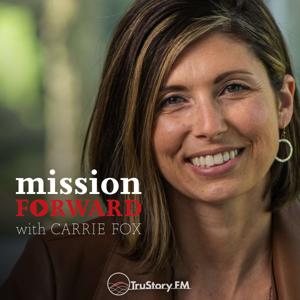
With over twenty years as a social impact communications consultant and a leader in the B Corporation movement, Carrie Fox takes to heart the role—and the responsibility—that leading communicators hold in shaping how stories are told, how narratives are shaped, and how decisions are made.
More than Words: Communications Practices of Courageous Leaders is an invitation to join an emerging community of practice and become your own positive and powerful agent of change. With lessons and insights from some of the brightest minds in social impact communications and tools to help you practically apply these lessons to your work, More Than Words will meet you where you are in your quest to become a more authentic, inclusive, and connected communicator.
Nicole Lynn Lewis is the founder and CEO of Generation Hope and an incredible leader in the fight against poverty and the stigma surrounding it. Her specific area of focus? Teen mothers.
You see, Nicole is a former teen mother herself, rocked by this sudden life change that upended her life at a young age. But she was able to rebound, to put herself through college with a three-month-old daughter along for the ride.
"... across higher education, about one in five undergraduate students across the country are parenting. It's almost five million students," she says. "It is an invisible population ... a population more likely to be women and women of color, particularly black women.”
Nicole decided to do something. She wrote a book, Pregnant Girl: A Story of Teen Motherhood, College, and Creating a Better Future for Young Families, and Generation Hope was born. It's a nonprofit dedicated to supporting teen parents and their children through mentorship, emotional support and guidance, and financial resources they need to thrive through college and kindergarten, a two-generation solution to poverty.
Nicole's story is amazing, inspiring, and challenging all at once. Join us and hear how her story truly shaped the future of this movement. Our deep thanks to Nicole for joining us on Mission Forward.
From the publisher's feed

441 Listeners
8 Listeners

21 Listeners

37 Listeners

38 Listeners

12 Listeners

100 Listeners

4 Listeners
2 Listeners

8 Listeners

0 Listeners

69 Listeners

6 Listeners

0 Listeners

5 Listeners

8 Listeners

0 Listeners

0 Listeners
2 Listeners