
Sign up to save your podcasts
Or

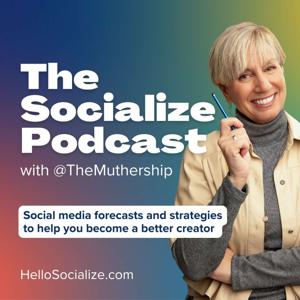


If posting makes your stomach drop, or one weird comment can wreck your whole day, this episode is for you. I sat down with Dr. Bonnie Zucker, a Los Angeles psychologist who specializes in anxiety, social anxiety, panic, and perfectionism (my personal favorite).
Bonnie never planned to be on camera. She started posting on TikTok because a literary agent told her she needed a platform, and her very first videos were a trench coat, sunglasses, and a big hat, removed one piece at a time as her own exposure therapy experiment.
We talk about finding your "why" so your motivation outweighs your fear, figuring out what your real barrier is (looks, perfectionism, criticism, or something deeper), practical workarounds like the teleprompter, the back camera, and even "safety objects," how to get out of "200 view jail" without obsessing over metrics, and how to handle negative comments in a way that actually helps you grow.
Find Bonnie on TikTok and Instagram @bonniezuckerphd, at bonniezuckerphd.com, on her podcast Anxiety Matters with Dr. Bonnie Zucker and Dr. Bonnie Zucker, and in her new book on panic, Freedom from Panic.
Summary
Mary Anne Bautista, cofounder of Turbo Rank, joins to break down why YouTube is a matching platform, not just a place to post videos. She and Helen dig into how AI search (AEO) is changing what content gets found, why YouTube is the top source for AI citations, how Shorts and long-form work together as a funnel, and what actually separates brands and creators who see real results from those who don't.
Key Points
YouTube's algorithm doesn't reward posting alone. Without proper optimization (keywords, descriptions, titles, tags, clean thumbnails, chapters), it doesn't know who to show your content to.
Content strategy should start with research: create around the questions and demand that already exist, not what feels good to post. Consistency matters too — at least one long-form video a week, plus multiple Shorts.
Chapters help Google index and surface specific sections of a video as search results, and help viewers skip to the part they want.
SEO vs. AEO: AI answer engines don't weight on-page website content as highly as deep, contextual content. YouTube is the top average source for AI citations because of its transcripts. Reddit, Quora, Facebook, and Substack also rank well; TikTok doesn't, since it's not as machine-learnable.
"Authority footprint": Turbo Rank builds credibility for clients through gentle, organic, manual engagement on high-authority third-party sites (sometimes standing up a client subreddit), never posting from the brand's own voice.
AI-driven search traffic is still small (~6% of searches) but growing fast, and converts at notably higher quality/intent, per recent Adobe and Amazon reporting.
Shorts can get indexed and cited, but carry less authority than long-form. The funnel that works: Shorts for broad reach, connected to long-form for depth — this drives watch time and subscribes.
YouTube Partner Program threshold is rising Feb 1: from 1,000 subs + 4,000 watch hours to 1,000 subs + 8,000 watch hours (even higher for Shorts-only).
Case study: a heavily restricted-category ecommerce client built 60+ non-branded YouTube channels organically over ~20 years and still generates orders today. Other clients with complex products (example: a GPS dog collar) use YouTube to answer pre-purchase questions rather than chase direct sales.
Other people talking about your brand carries more weight than your own voice, but those voices need to be credible. Attribution remains a real challenge without affiliate links or QR codes.
Biggest mistake brands make: skipping the upfront research and creating based on internal opinions instead of audience demand.
Helen's addition: reframing content from "I" to "you" language, same offer, different framing, tends to land better.
Advice for creators/brands starting from zero: talk to current customers about why they chose you, then just start. Early videos won't be perfect, and that's fine.
Links:
TurboRank: https://turborank.co
TurboRank on YouTube: https://www.youtube.com/ @TurboRanKVIdeoMarketing
This episode is about efficiency: getting visibility on every platform without multiplying your workload. Helen walks through her own recent experiments, especially on LinkedIn, a platform where she barely posts and has low engagement, but where the right people are quietly watching and it's led to real client and business opportunities. She also breaks down how she's turned viral trend tutorials into email list lead magnets, and closes with a personal story about instruction quality that ties back into why her teaching style works.
Key Points
JOIN the Muthership Creator Studio HERE!
AEO (Answer Engine Optimization) is showing up everywhere in client conversations right now, and it's changing how brands and creators approach YouTube.
Where SEO gets you found in a search, AEO gets you quoted as the answer when AI tools cite sources. This episode breaks down the shift toward longer-form YouTube content built for AEO, walks through the Muthership Studio's move into its own branded app, and shares a hard lesson learned about Apple's in-app purchase cut.
Key Points
AEO vs. SEO: SEO helps you show up in a search. AEO helps you show up as the answer itself, the kind of source AI tools cite when they do research and pull in outside information.
Why YouTube is shifting: clients used to post YouTube content and push it with ad spend. Now more of them want longer-format videos specifically because length and depth help content surface in AI-generated answers.
YouTube back-end basics still matter: tags, transcription accuracy, chapters, and thumbnails all feed into this. Advice for anyone overwhelmed: pick one or two things to focus on first (titling, transcript, captions) before adding more (chapters, tags).
The Muthership Studio app launched this week: previously hosted inside the Mighty Networks app, now its own standalone branded app in iOS and Android. Notifications now read as Muthership instead of Mighty.
Existing members see no real change inside; new members join without the extra step of downloading a separate host app.
What's still inside the Studio: community chat, weekly live meetings every Monday (Q&As and lessons), studio tutorials, weekly trends, daily news feed.
JOIN HERE
And then download the MUTHERSHIP APP from the App Store and Google Play Store!
The Content That's Winning Isn't the Content That Sells
Branded and creator content wins right now when it entertains first and lets the brand show up almost as an afterthought. Ad spend can inflate views without making content actually work.
Examples: Duolingo's early public-stunt era, Sensodyne's leaf-blower dentist spot, and Liquid Death's full commitment to chaos over any hook-line-CTA formula. On the creator side, a cautionary example: someone whose only content is "I'm posting to grow my following" isn't telling a story, and it shows in the numbers. The fix is sharing what's authentically yours instead of comparing yourself to other creators.
September's Studio theme is storytelling!
This week's live demo covered overlapping on-camera audio (starting the next line under the tail of the last one) to tighten pacing for slower, more deliberate speakers without rushing their delivery - taught via the one of our own member’s content and the technique has already tried successfully by another member.
I also covered how to use trends for stories, with examples of non-talking formats like the Pepé the King Prawn carousel-text trend, transition edits with text overlay, and a voiceover-free product demo that outperformed the voiced version.
If you need help with content, give the studio a try for a month:
https://www.muthershipstudio.com/spaces/18811426/feed
This week's episode came straight out of a studio hours session that hit me hard.
A seasoned creator asked a simple question about overlays, and suddenly I realized: the advice that works for a confident, camera-natural storyteller can completely miss the mark for someone who's newer, a little nervous, and reading off a teleprompter.
In this episode, I breaks down:
• Why "just add overlays" (or any blanket editing advice) isn't one-size-fits-all, and how to figure out what YOUR speaking videos actually need
• The real-time before-and-after from studio hours that showed just how different the same advice can land on two different creators
• What actually makes a speaking video watchable (hint: it's not about following a formula)
• A gorgeous studio member testimonial about stepping out from behind the camera and why "being seen" is such a big deal
• How to build your own honest feedback loop so you're not just guessing whether your videos are working
If you've ever wondered whether you're over-editing, under-editing, or just editing wrong for who you are on camera, this one's for you.
Got a video you want eyes on? Drop it in the studio community chat - that's what it's there for – and if you want in on it...
JOIN ME HERE:
https://www.muthershipstudio.com/spaces/20736151/content
In this episode of Muthership Creator Strategy, I dive into quick-cut editing and why editing pace is one of the biggest levers for keeping viewers from scrolling past your content. I share the story behind this episode: in my Monday studio meeting, I demonstrated fast-paced product editing (no talking head, just quick cuts) and got such glowing feedback that I knew I'd struck a chord. I even play a voice note from one of my studio members who cut her editing time from hours down to fifteen to thirty minutes using what I taught.
Cuts aren't decoration, they're attention (or retention) management. I explain how editing pace should match your content and your platform - social media viewers are scrolling, not committed the way a TV audience is, so your pacing needs to reflect that. Even slower, calmer content (like meditation or breathing videos) still needs intentional pacing, just not fast cuts.
I break down five editing techniques and when I use each one: jump cuts for tight, breath-free talking-head videos; text overlays and interrupts to keep my audience engaged when they might tire of watching my face; speed changes (used sparingly, in short bursts rather than throughout) to move through less important moments; looping, which I've found works best on short-form content rather than longer videos; and progress indicators or numbered lists (showing all the numbers up front with blanks to fill in), which I explain psychologically encourage viewers to stick around for the full list.
The truth is that AI editing tools aren't there yet for this kind of creative, story-driven editing - it's a skill I believe creators need to learn themselves. I wrap up with an update on our studio's upcoming app launch, as we move from Mighty Networks to our own branded app.
If you are struggling with storage on your phone, accumulating too many drafts, or are just now sure how many drafts to keep in your social media app, this episode will help you think about how to create a system for exactly that!
And if you'd 'like to join the Muthership Creator Retreat Oct 2-4 in NYC - here's the link:
https://www.muthership.com/muthership-creator-retreat
Welcome to the 200th’ episode! To celebrate, I’ve created a gift code for listeners only – 30 days free in the Studio!
Take a listen to hear about the five chapters from zero to 1.2M+ followers: pandemic beginnings, discovering a teachable skill, going through cancer, the comeback, and finally monetizing.
And the 5 top takeaways from the experience: exposure therapy, relentlessness over talent, ignoring the gurus, getting a little strategic, and playing the long game.
Listen to learn the one thing I'd start on day one if I could go back!
JOIN HERE and get 30 days free!
Use code: TRYITFOR30
You've seen the video: vision board, candle, or ‘repeat this mantra every morning’ and then a statement or caption about the universe delivering. What you didn't see is everything that led up to the actual result!
On this week’s episode of the Muthership Creator Strategy, I'm sharing a different take on manifestation and why the version that goes viral is only ever half the story.
Getting a little personal, there is something I said out loud 4 years ago (and only recently remembered saying it) which perfectly describes upcoming Muthership Creator Retreat. Did I actually manifest it?
My take: Manifestation is real, but it's not just spoken words or focused thoughts. If you skip the part most people leave out of the caption - you're just talking to yourself.
Check out the Muthership Creator Retreat details HERE!
Join the Muthership Studio HERE!
From the publisher's feed

91,018 Listeners
1,448 Listeners

87,108 Listeners

111,865 Listeners

8,527 Listeners
50,421 Listeners
57,618 Listeners

19,273 Listeners

93 Listeners
28 Listeners