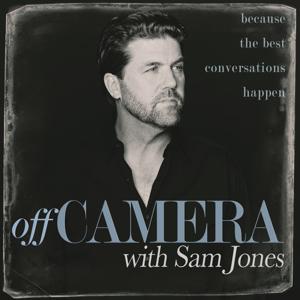
Off Camera with Sam Jones

Off Camera with Sam Jones

Download on the App Store

Off Camera with Sam Jones episodes

  • 174. Ron Livingston
    When Ron Livingston was a kid growing up in Iowa, he watched movies with the belief that being an actor meant you were transported to and fully immersed in the environment of the film. “I watched Star Wars and thought the actors were actually going into space and flying the Millennium Falcon.” Ron eventually discovered this thing called a “green screen,” but his desire to act and be fully immersed in the experience didn’t go away.
    A combination of talent and hard work, fueled by a (mostly) healthy dose of self-criticism, forged Ron’s career in projects like Office Space, Swingers, and Sex and the City. But it wasn’t until he was on set of Steven Spielberg’s Band of Brothers, surrounded by military tanks, explosions, and everything else a solider in a war zone might encounter, that Ron could look around and say, “When I was a kid, this is what I thought being an actor would be like.”
    Removing the artifice is a theme with Ron, because the less he has to act and pretend, the more he can focus on being in the moment. “All I try to worry about is showing up and being a real person. Ideally, yourself.” He’s taken that mindset to his most recent role in the dark comedy series Loudermilk as a former music critic and grumpy recovering alcoholic. His technique for getting into character? Going to some real-life AA meetings and going dry while he’s working on the show. “It makes that extra little bit miserable for those three months.” Perfect for a character like Sam Loudermilk.
    Ron joins Off Camera to talk about learning to listen to his instincts, why his self-critical voice is a blessing as well as a curse, and why his sleeping reel is so strong.
    1 hr 8 min
  • 173. Steve Coogan
    British actor, writer, and comedian Steve Coogan was first drawn to the magic and wonder of performing when he was a kid, sitting around the television with his family and watching comedies like Fawlty Towers and Monty Python. It was before the era of VCRs, so the only way to record something you loved was to memorize it in your head and talk about it afterwards. The whole experience left young Steve in awe: “Wow, how great would it be to do a comedy character who people had such affection for and made everyone laugh at the same time? That would be it for me—if I achieved that, I would be happy.”
    After spending years doing standup and impressions, Steve got a chance to achieve his dream. He created the massively popular character Alan Partridge, a lovable broadcaster who says all the things that most people think but don’t dare say. Unfortunately, Steve’s anticipated happiness only lasted until he discovered the drawback to success—typecasting. Under the heavy scrutiny of the British media, Steve, who wanted to branch out and try different things, was constantly criticized in the press when he did so. “Alan Partridge became an albatross. I had to find a way to escape from it.”
    Escape he did…to America. He took advantage of the fact that the Alan Partridge cult didn’t exist in the States, and he started working on different and interesting projects that spoke to him creatively like Happyish, 24 Hour Party People, and The Trip. But his ultimate escape came when he wrote the critically acclaimed drama Philomena—Oscar nominations have a tendency to shut up the critics.
    These days, Steve is taking on a new challenge in the film Stan & Ollie as one-half of the legendary comic duo Laurel and Hardy. For Steve, the film is a real love letter to comedy: “The paradox of good comedy is the more effortless it looks, the harder the work that went into it. It’s like a curse, because people think it’s ephemeral or trivial, but in actual fact, good comedy sheds light on the human condition. That’s what this film is about.”
    Steve joins Off Camera to explain why comedy is a universal language, discovering the similarities between writing comedy and drama, and why telling him he’s boring is the most insulting thing you can say to him.
    1 hr 5 min
  • 172. Emily Mortimer
    It’s hard to believe that a person who chooses to be an actor, a profession ripe with exposure and vulnerability, can also be painfully shy at the same time, but that was the reality for a young Emily Mortimer, who couldn’t even raise her hand in class without blushing. However, Emily handles fear different than most—instead of avoiding the things she’s most afraid of, she dives in head first. “I couldn’t just be a little less shy; I had to do the bravest possible thing in front of the most amount of people to overcome that feeling.”
    It took some more bravery from Emily to truly commit to an acting career. As an Oxford educated woman who was fluent in multiple languages, acting seemed “a bit frivolous, not a proper job,” and because she wasn’t classically trained as an actor, she felt a bit like a fraud. It wasn’t until she got the role in Nicole Holofcener’s acclaimed Lovely and Amazing, that the whole career started to make sense—it just took one incredibly emotionally and physically exposing scene to get her there. “I was standing there butt naked for minutes while this man analyzed my body, and there was no dividing line between me and my character. I finally understood what actors meant when they said ‘being in the moment.’ I could feel it.”
    Since then, she’s amassed an outstanding body of work in projects like The Newsroom, Shutter Island, Transsiberian, and more. She also co-wrote and co-starred in the miniseries Doll & Em, loosely based on her life and experiences in the acting business. These days she’s back on the big screen in the timely reboot Mary Poppins Returns to show us why at this juncture in history, we all could use a little Mary Poppins in our lives.
    Emily joins Off Camera to talk about how real genius lies inside your inner child, about how a film set can make you paranoid, and why having a catchphrase isn’t always a good thing.
    1 hr 5 min
  • 171. Ted Danson
    Ted Danson, first known to most as Cheers’ charismatic bartender Sam Malone, is now in his seventies—yet even after nearly 50 years in the business, the passion that fuels Ted’s love of his craft shows no signs of subsiding. “I think the thing that has given me any degree of career longevity comes from the fact that I love going to work. When I started acting, I didn’t think, ‘Am I going to make it? Can I support myself? Will I have a career? Will I be famous?’ I just wanted to do the next scene with the next scene partner.”
    Ted acknowledges that he still struggles with the darker elements of the business such as insecurity, ego, hypocrisy, and fear, but he says turning them into strengths is the key. “Shame and guilt are some of my favorite motivators in life. If you’re about to step in front of a camera and you don’t have some nerves, you’re usually headed for a really bad performance. You want that edge of fear. You want that adrenaline pump because it keeps you sharp.”
    These days, he’s dealing with the very essence of good and evil in NBC’s The Good Place, opposite Kristen Bell. The show explores the consequences of using a point-based evaluation system to sort people into the “Good Place” or the “Bad Place,” and it’s as entertaining as it is unique…which is exactly how Ted likes it. “My motto is to find the most creative person in the room and ask them very nicely if you can be part of whatever they’re doing, because that way, you stand a chance of being in something authentic and original.
    Ted joins Off Camera to talk about why Sam Malone scared the crap out of him, about finding a great partner in wife and fellow actress Mary Steenburgen, and how a simple “hey” can speak volumes, if you do it just right.
    1 hr 4 min
  • 170. Carey Mulligan
    When Carey Mulligan first stepped foot on set of 2005’s Pride & Prejudice, she was convinced she won the lottery. It was her first professional job and her first time acting in front of a camera, but there she was, acting alongside Judi Dench, Keira Knightly, and Jena Malone. “The entire experience was like summer camp; it didn’t feel like work at all.” Carey was living her dream, but she was still convinced it was all a fluke. “I remember thinking, ‘After this, I’ll reapply to drama school.’” In reality, her acting career had just begun—with the best yet to come.
    Her first lead role came in 2009 with the coming-of-age film An Education. Her compelling performance led to an Oscar “Best Actress” nomination and widespread critical acclaim, even though Carey was originally devastated when she first watched her performance: “It was like listening to your voice on the answering machine and wincing because of how awful you sound—but multiply that by 500.” She had gotten so used to flying under the radar in supporting roles that she was unaccustomed to the pressure and spotlight of the lead. Carey was convinced her first shot would be her last—“Sundance is going to be a disaster. They’re going to send me home.” Of course, the opposite happened.
    Since then, she’s amassed a stunning body of work onscreen and onstage (Shame, Far From the Madding Crowd, Mudbound, Girls & Boys, and many more), and her incredible performance in Wildlife, Paul Dano’s directorial debut, is the newest addition. She plays a unique female character, struggling to find her identity underneath the crippling expectations that come with her role as a wife and mother in the 1960s. As a complicated and volatile woman, her character is not without controversy for those used to more idealistic portrayals of women—“It’s amazing that we still live in a world where a real, complex woman, expressing herself in a multitude of ways, is dismissed as unrealistic because she’s not what we want to see.” But she cherishes the opportunity to change hearts and minds through her work.
    Carey joins Off Camera to talk about battling stage fright, learning how to put her insecurities in perspective, and why sometimes the key to unlocking a character is to…take off your shoes.
    1 hr 5 min
  • 169. Bo Burnham
    Before YouTube became a ubiquitous and unavoidable black hole of viral cat videos, self-aggrandizing entertainment, and misinformation, it used to be a place to share your homemade videos with family and friends. That’s how the origin story of comedian, writer, and director Bo Burnham begins, anyway. It was 2006, and 16-year-old Bo—a lover of the performing arts—wanted to share his creations, musical bits, and jokes with his brother in college. That’s where YouTube, an easy place to upload and share videos, came in. But little did he know, his videos appealed to an audience that expanded far beyond his family, and it highlights what became his key to artistic success: “The most interesting and complex thing you have to offer is what is personal to you—your subjective experience.”
    Bo’s interest in comedy grew as his audience expanded, and by the time he graduated high school, he decided to forgo college to pursue a stand up career, much to the initial dissatisfaction of his parents. With years of experience interacting with his internet audience, Bo, nearly instantaneously, found success on stage as a stand up comedian. By 2010, he released his first stand up special, Words Words Words, on Comedy Central, only to release two more specials, what. and Make Happy, on Netflix in the next few years. Bo recognizes that a large part of his success comes from his willingness to embrace change: “I knew to take advantage of the fact that I wasn’t going be the same at 18 and 20 and 22, so my specials changed very rapidly because I was changing very rapidly.” Even his shows are dynamic and include various theatrical elements like lighting and sound to create a stunning and unique experience.
    Bo’s most recent project, Eighth Grade, is yet another example of his evolving artistic identity. The film, which he wrote and directed, follows the trials and tribulations of a 13-year-old girl living in the social media era. It’s a realistic and compelling portrayal of the dissociative effects of social media. It’s not an autobiography, but the themes and feelings behind the story are still very real for him, who still identifies with his anxious and awkward teenage self. “My work is about presenting the things I’m struggling to understand rather than the things I’ve figured out—it’s what you don’t know that’s interesting.”
    Bo joins Off Camera to talk about the panic attack that led him to step down from stand up, why it’s so important for kids to be able to fail out loud, and why being miserable isn’t a prerequisite for good art.

    1 hr 4 min
  • 168. Matt Damon
    For those of you watching this week’s Off Camera episode, do not adjust your sets…that is me sitting across from Matt, humiliatingly dressed head to toe in a Red Sox uniform, having lost a bet to Matt when my beloved Dodgers lost in the world series for the second year in a row. And for those of you listening or reading, well, just imagine my shame.
    For as long as Matt Damon can remember, he wanted to be an actor. So much so that he started his college essay with those very words. But before all the accolades and success, Matt was just a kid from Cambridge, MA who loved playing sports and watching movies. His chances of becoming a pro athlete came up short (both literally and figuratively), but he was determined to make a career out of acting after the seed was planted by an influential theater teacher and nurtured by his best friend and fellow cinephile Ben Affleck.
    They had no road map for success, but Matt and Ben had an advantage over their teenage peers—they just wanted it more. They took the train from Boston to New York regularly for auditions, using money drawn from their communal acting bank account to cover expenses. Eventually, one of those auditions turned into a small part in the 1988 Julia Roberts feature Mystic Pizza, but Matt’s “big break” proved to be elusive. He auditioned for the eventual Academy Award winner Dead Poets Society but was rejected in favor of Ethan Hawke, and the cruel reality of the industry smacked him in the face when he was working at the local movie theater the following summer: “I went from the possibility of being in this great film to the guy tearing the movie ticket and watching people come out crying because they’re so moved. That’s the range in this business.”
    So Matt and Ben decided to take fate into their own hands and write a great film that they could both star in. That was how Good Will Hunting and the acclaimed acting careers of Matt and Ben came into being. It’s been 20 years, and Matt’s career is still going strong.
    As our first two-time guest, Matt joins Off Camera to talk about his acting mid-life crisis, the gamble that almost cost Matt and Ben Good Will Hunting, the invaluable wisdom he’s gained from directors, and why the Boston Red Sox and specifically Fenway Park carry so much significance for him.
    1 hr 8 min
  • 167. Rosamund Pike
    Early on, the stage was set for Rosamund Pike to pursue a career in the performing arts. Born to two opera singers, Rosamund had a front row seat to familial emoting. She tried her hand at both music and acting, but a bout of stage fright while playing the cello forced Rosamund to recognize that she really didn’t want to play herself on stage—she was much more interested in playing other people, where her imagination was free to roam and explore. “Acting was like diving into a place where you actually felt alive, where things felt real.”
    Soon after finishing college, Rosamund got her first break as a Bond girl opposite Pierce Brosnan in 2002’s Die Another Day. But playing Miranda Frost—the “epitome of icy English blondness”—in your breakout role has its drawbacks. For years, Rosamund was cast in similarly cold and confident roles, and she longed for the opportunity to do more. Enter director David Fincher, who saw something unique in Rosamund. He offered her the role of Amy Dunne in Gone Girl, and her breathtaking performance earned her a slew of awards and new opportunities to evolve as an artist in films like A United Kingdom, Hostiles, and now her latest film playing slain journalist Marie Colvin in A Private War. Her deep dive into the Marie’s life led to an intensity that was as fulfilling as it was terrifying. "You are trying to trick your brain into getting to a place where you are out of control, and that is a scary place.” But as Rosamund explains, she’s waited her entire life for the opportunity to disappear into somebody else, and in A Private War, she does just that.
    Rosamund joins Off Camera to talk about her fascination with human emotion, the elaborate plan she concocted to meet with David Fincher for Gone Girl, and her intimate knowledge of bone saws.
    57 min
  • 166. Hasan Minhaj
    Ten years ago, a timid and fearful Hasan Minhaj turned down the opportunity to go to his dream school, UCLA, and instead made the safe choice: to live at home and commute to UC Davis. A year after making this decision, Hasan sat under the Michael Jordan poster in his childhood bedroom despondently wondering, “What have I done? I had the golden ticket, and I just chucked it out the window.”
    As he watched his childhood friends spread their wings and grow, Hasan made an important decision—he would never hedge ever again in his life. For Hasan, a child of Muslim immigrants, it was a tough philosophy to adopt, especially considering his upbringing: “Growing up, my dad’s rules were don’t talk about politics, and don’t tell people you’re Muslim. There’s nothing to be gained from it.”
    What Hasan didn’t hedge on was his comedy career. Unbeknownst to his father, he started secretly performing stand up comedy in the Bay Area. He’d sneak out and sometimes drive two hours to hit an open mic at a Laundromat, while he let his LSAT scores expire. His decision not to hedge in his Daily Show audition (where he cracked a joke about Jon Stewart to his face) helped get him the job as a correspondent, and since then, his career has taken off. Between his acclaimed comedy special Homecoming King, his monologue at the 2017 White House Correspondents’ Dinner, and his new Netflix show Patriot Act with Hasan Minhaj, Hasan is redefining what it means to be brown in America.
    Hasan joins Off Camera to talk about surviving 9/11 as an American Muslim, how he approached the highly publicized and controversial White House Correspondents’ Dinner in 2017, and why Chris Rock is the real reason he’s a comedian.
    1 hr
  • 165. Ryan Bingham
    If you ask award-winning musician Ryan Bingham where he’s from, he’ll tell you that there really isn’t one right answer. Ryan spent most of his childhood bouncing from one small Texas town to another because his father had a hard time keeping a job for longer than six months at a time. Ryan kept a half-packed cardboard box by his bedside, just in case they had to leave at a moment’s notice. “We always knew it was time to move when we’d come home, and the lights wouldn’t come on.”
    “Home” was less about the place and more about the people by his side, and his extended family of grandparents, aunts and uncles all played a part in raising him.  “I looked up to the men in my family. They all wore cowboy hats and boots and rode horses. They were cowboys, so that’s what I grew up wanting to be.” He took up a career as a bull rider before moving on to a less life-threatening career as a musician, thanks to his mom who bought him a guitar when he turned 16.
    After spending so many years feeling “misplaced," music became a powerful tool of self-discovery. “Once I found the guitar and began playing music, I finally started saying things out loud. Things I was surprised to even hear myself say.” His confessional and acutely personal songs became like therapy for him and others, who found comfort in his raw and painfully honest songwriting.
    Ryan joins Off Camera to talk about writing his very first song, how his life has changed since winning an Academy Award, and his adventures in the rodeo…including the time he lost all of his teeth.
    1 hr

About Off Camera with Sam Jones

From the publisher's feed

Off Camera is a podcast hosted by photographer/director Sam Jones, who created the show out of his passion for the long form conversational interview, and as a way to share his conversations with a…

More shows like Off Camera with Sam Jones

WTF with Marc Maron Podcast by Marc Maron

WTF with Marc Maron Podcast

28,893 Listeners

Happy Sad Confused by Josh Horowitz

Happy Sad Confused

1,281 Listeners

Awards Chatter by The Hollywood Reporter

Awards Chatter

1,343 Listeners

IndieWire's Filmmaker Toolkit by Chris O'Falt

IndieWire's Filmmaker Toolkit

109 Listeners

In the Envelope: The Actor’s Podcast by Backstage

In the Envelope: The Actor’s Podcast

180 Listeners

Armchair Expert with Dax Shepard by Armchair Umbrella

Armchair Expert with Dax Shepard

69,560 Listeners

Conan O’Brien Needs A Friend by Team Coco & Earwolf

Conan O’Brien Needs A Friend

59,373 Listeners

The Three Questions with Andy Richter by Team Coco & Earwolf

The Three Questions with Andy Richter

3,610 Listeners

Literally! With Rob Lowe by Stitcher & Team Coco, Rob Lowe

Literally! With Rob Lowe

12,390 Listeners

Mike Birbiglia's Working It Out by Mike Birbiglia

Mike Birbiglia's Working It Out

4,588 Listeners

SmartLess by Jason Bateman, Sean Hayes, Will Arnett

SmartLess

57,744 Listeners

Blocks: I Wish I Knew w/ Neal Brennan by Neal Brennan

Blocks: I Wish I Knew w/ Neal Brennan

1,377 Listeners

Family Trips with the Meyers Brothers by Seth Meyers and Josh Meyers

Family Trips with the Meyers Brothers

2,869 Listeners

Where Everybody Knows Your Name with Ted Danson and Woody Harrelson (sometimes) by Team Coco & Ted Danson, Woody Harrelson

Where Everybody Knows Your Name with Ted Danson and Woody Harrelson (sometimes)

3,408 Listeners

Good Hang with Amy Poehler by The Ringer

Good Hang with Amy Poehler

12,445 Listeners