
Sign up to save your podcasts
Or



Reform UK leader Nigel Farage made headlines this week with his attempt to introduce a Ten Minute Rule Bill to take Britain out of the European Convention on Human Rights. The proposal was swiftly defeated by a coalition of Labour, Liberal Democrat, Green and Independent MPs, with Lib Dem leader Ed Davey leading the opposition.
_____
Please help us improve Parliament Matters by completing our Listener Survey. It will only take a few minutes.
Go to: https://podcastsurvey.typeform.com/to/QxigqshS
_____
In this week’s episode, we look at why Farage’s bill was always doomed to fail, and why Labour’s reluctance to formally whip against it raised eyebrows. Does that hesitation point to a deeper problem – has Labour really absorbed the lesson of the Caerphilly Senedd by-election, where Plaid Cymru took a Labour seat, Reform surged, and Labour’s vote collapsed? If progressive voters are prepared to rally behind whichever party can stop Reform, should Labour be bolder in confronting them directly?
We also consider Lucy Powell’s decisive victory as Labour’s new deputy leader – an unusual role outside government that frees her from collective responsibility and could make her a key power broker in what promises to be a gruelling budget season. How far can a tough fiscal package stretch manifesto promises before trust breaks, and is Keir Starmer in danger of drifting into a “Clegg zone” of broken-promise backlash?
The discussion then turns to the Speaker’s Conference reports on the abuse and intimidation faced by MPs and candidates. Guest Sofia Collignon, from Queen Mary University of London, outlines the full spectrum of harassment – from online threats to in-person intimidation – and explains why women and minority candidates are often targeted most. She explores what could genuinely make a difference: stronger accountability for social media platforms, a dedicated national policing unit, clearer party responsibility for campaign conduct, and improved citizenship education. Drawing on international examples, she argues for firm action that protects democratic participation without shielding politicians from legitimate public scrutiny.
A listener’s question about Westminster Hall sparks a discussion about the history and purpose of the Commons’ parallel debating chamber. Ruth and Mark trace its origins to the late 1990s, when it was created to give MPs more space to raise issues and hold ministers to account. They explain why no votes are taken there, how it provides a forum for petitions, select committee reports and backbench debates, and why some of the Commons’ most-watched debates now happen there.
_____
🎓 Learn more using our resources for the issues mentioned in this episode.
❓ Send us your questions about Parliament:
✅ Subscribe to our newsletter.
📱 Follow us across social media @HansardSociety / @hansardsociety.bsky.social
£ - Support the Hansard Society and this podcast by making a donation today.
Parliament Matters is a Hansard Society production supported by the Joseph Rowntree Charitable Trust.
Presenters: Mark D’Arcy and Ruth Fox
Producer: Gareth Jones
Hosted on Acast. See acast.com/privacy for more information.
This week, we explore how far Parliament can go in holding members of the Royal Family to account, as pressure grows for MPs to scrutinise Prince Andrew’s finances and royal titles. We ask whether Nigel Farage should get a right of reply at Prime Minister’s Questions amid his growing prominence, and examine Labour’s reshuffle of select committee posts and calls for greater transparency in how they’re filled. Plus, a look back at the rebuilding of the House of Commons Chamber, 75 years after its postwar reopening.
___
Please help us improve Parliament Matters by completing our Listener Survey. It will only take a few minutes.
Go to: https://podcastsurvey.typeform.com/to/QxigqshS
___
Normally Parliament steers clear of discussing the Royal Family but with Prince Andrew embroiled in the scandal around the convicted paedophile Jeffrey Epstein, there are increasing calls for MPs to act. Could he be called before a select committee to explain his finances and housing arrangements? Might Parliament legislate to strip him of his titles? Could he be removed from the line of succession to the Throne? To explore these issues we are joined by Dr Craig Prescott of Royal Holloway, University of London, an expert on the modern monarchy.
With other party leaders increasingly using Prime Minister’s Question Time to take potshots at Nigel Farage, does the Reform UK party leader deserve some kind of right of reply? The problem is that while he may have a commanding lead in the opinion polls, he leads a tiny contingent of MPs – so giving him a regular slot, ahead of other parties could create more problems than it solves. But there are ways he could hit back at his critics.
There’s also movement on the select committee corridor as Labour MPs elect new members to fill vacancies left by those promoted in the recent government reshuffle. But questions remain about the process itself. Should there be greater transparency around how parties decide who sits on these influential committees?
Finally, this month marks 75 years since the Commons Chamber re-opened after being destroyed in the Blitz. We speak to Dr Eloise Donnelly, Curator of Parliament’s Historic Furniture and Decorative Art, about how the reconstruction balanced modernisation with tradition. From a 15-year-old apprentice carving the Speaker’s Chair to German prisoners of war quarrying the stone, the story of the rebuild is one of craftsmanship, controversy and continuity. At the heart of a new exhibition marking the anniversary is a remarkable architectural scale model of the postwar Chamber — built in 1944 to help MPs visualise the design, exhibited across the country, lost for decades, but then rediscovered in Parliament. As Ruth reveals, this long-missing model solves a small but fascinating mystery in the Hansard Society’s own history.
🎓 Learn more using our resources for the issues mentioned in this episode.
❓ Send us your questions about Parliament:
✅ Subscribe to our newsletter.
📱 Follow us across social media @HansardSociety / @hansardsociety.bsky.social
£ - Support the Hansard Society and this podcast by making a donation today.
Presenters: Mark D’Arcy and Ruth Fox
Producer: Gareth Jones
Hosted on Acast. See acast.com/privacy for more information.
It’s been an extraordinary week in Westminster, with three separate ministerial statements to the Commons on the China spying case. To make sense of the confusion, Ruth and Mark are joined by Professor Mark Elliott, public law expert from Cambridge University, to unpack the sudden collapse of the prosecution against two alleged spies.
_____
Please help us improve Parliament Matters by completing our Listener Survey. It will only take a few minutes. Go to: https://podcastsurvey.typeform.com/to/QxigqshS
_____
Newly released government witness statements revealed details about the claims of espionage inside MPs’ offices, yet the case was abruptly dropped amid tangled legal arguments over whether the Government had ever formally designated China as an “enemy state.”
So, what really happened? Was this a legal failure or a political fix to avoid a diplomatic crisis? And with the Joint Committee on the National Security Strategy now launching an inquiry, where does the story go next?
Plus, as the parliamentary season re-opens after the party conference break, Ruth and Mark look at the elephant traps ahead for the Government, including the Budget (Mark wonders why anyone in the Government thinks it is a good idea to “live-brainstorm” tax raising ideas), the lingering row over the Afghan data leak and superinjunction, the long-promised vote about the future of multi-billion pound restoration and renewal of Parliament and the steady drip of terrible local election results chipping away at Labour morale.
And finally, the latest developments on the assisted dying legislation which is now facing scrutiny by a special Lords select committee. We go through the membership and the balance of opinion on what could be a very important body. If the subsequent debates on the bill over-run, Ministers could face a legislative logjam in the Upper House.
________
🎓 Learn more using our resources for the issues mentioned in this episode.
❓ Send us your questions about Parliament:
✅ Subscribe to our newsletter.
📱 Follow us across social media @HansardSociety / @hansardsociety.bsky.social
£ - Support the Hansard Society and this podcast by making a donation today.
Parliament Matters is a Hansard Society production supported by the Joseph Rowntree Charitable Trust.
Presenters: Mark D’Arcy and Ruth Fox
Producer: Gareth Jones
Hosted on Acast. See acast.com/privacy for more information.
In this episode, we speak with Peter Just, author of a new book, Margaret Thatcher: Life After Downing Street. Peter explores how Thatcher reinvented herself after her departure to maintain her status as an international figure, and how she remained a parliamentary thorn in John Major’s side. We also compare her parliamentary afterlife with that of other Prime Ministers, and consider the value that former leaders can bring to the institution of Parliament.
___
Please help us improve Parliament Matters by completing our Listener Survey. It will only take a few minutes.
Go to: https://podcastsurvey.typeform.com/to/QxigqshS
Peter Just’s new book, Margaret Thatcher: Life After Downing Street, explores the political afterlife of Margaret Thatcher, once she had left No. 10. Peter explains how Thatcher reinvented herself as a global political figure, championing British business abroad, and how she exerted a continued influence on domestic politics and parliamentary life.
We also compare her legacy with that of other ex-Prime Ministers, including the unusually active parliamentary role of Theresa May, and consider what value former Prime Ministers bring when they stay engaged in the work of Parliament.
Peter explains how, after her personally devastating departure, Thatcher built a new role with the support of trusted aides. Though her interventions in the House of Commons were rare, her mere presence in Parliament carried weight. She became a political irritant to John Major’s Government – encouraging rebels over Maastricht and criticising the Government’s policy on Bosnia – yet behind the scenes she was often a diplomatic and commercial asset.
____
🎓 Learn more using our resources for the issues mentioned in this episode.
❓ Send us your questions about Parliament:
✅ Subscribe to our newsletter.
📱 Follow us across social media @HansardSociety / @hansardsociety.bsky.social
£ - Support the Hansard Society and this podcast by making a donation today.
Parliament Matters is a Hansard Society production supported by the Joseph Rowntree Charitable Trust.
Presenters: Mark D’Arcy and Ruth Fox
Producer: Richard Townsend
Hosted on Acast. See acast.com/privacy for more information.
In this episode, we talk to political journalist Seb Whale about his new book The Usual Channels, which reveals the hidden world of Westminster’s whips. Seb charts how party discipline has evolved – from the stormy politics of the 1970s and the Maastricht battles of the 1990s to the legendary “black book,” the Brexit showdowns and the short-lived Liz Truss premiership. He explains how the whips’ office has adapted to a modern Parliament—especially with the influx of women MPs—and why, even today, whips still wield decisive influence over MPs’ careers and remain indispensable despite the pressures of contemporary politics.
___
Please help us improve Parliament Matters by completing our Listener Survey. It will only take a few minutes.
Go to: https://podcastsurvey.typeform.com/to/QxigqshS
Political journalist Seb Whale's new book, The Usual Channels: Inside the Mysterious World of Political Whips, takes us inside the famously secretive world of Westminster’s whips. It lifts the lid on how these behind-the-scenes powerbrokers have shaped British politics for decades.
Seb shares how he interviewed dozens of current and former whips to piece together the real story – tracking their evolution from the days of Humphrey Atkins, Walter Harrison and Jack Weatherill in the stormy 1974–79 Parliament, through the Maastricht battles of the 1990s, the Brexit upheavals under Theresa May and Boris Johnson, and the dramatic downfall of Liz Truss.
We explore how the arrival of many more women MPs under New Labour, the rise of social media, and a more independently minded generation of backbenchers have forced whips to adapt their tactics – without losing their grip on ministerial careers or party discipline. Seb also reveals the truth behind the legendary “black book” of MPs’ secrets and the enduring mix of “carrot and stick”.
The conversation highlights why the relationship between the Government whips’ office and Number 10 has been decisive – from Margaret Thatcher’s exit to Liz Truss’s collapse – and looks ahead to the whips’ future in a Commons marked by high turnover, a commanding majority and ever-fractious politics. Despite these pressures, Seb argues, the whips remain the unseen grease that keeps the machinery of Parliament running.
🎓 Learn more using our resources for the issues mentioned in this episode.
❓ Send us your questions about Parliament:
✅ Subscribe to our newsletter.
📱 Follow us across social media @HansardSociety / @hansardsociety.bsky.social
£ - Support the Hansard Society and this podcast by making a donation today.
Parliament Matters is a Hansard Society production supported by the Joseph Rowntree Charitable Trust.
Producer: Richard Townsend
Hosted on Acast. See acast.com/privacy for more information.
The Terminally Ill Adults (End of Life) Bill has cleared another key hurdle: it was given a Second Reading in the House of Lords without a formal vote. But Peers have agreed to set up a special select committee to hear evidence from Ministers, professional bodies and legal experts before the Bill goes any further. That decision pushes the detailed clause-by-clause scrutiny back to mid-November and could shape the Bill’s prospects in unexpected ways. In this episode we explore the procedural twists and political manoeuvring behind that decision.
___
Please help us improve Parliament Matters by completing our Listener Survey. It will only take a few minutes.
Go to: https://podcastsurvey.typeform.com/to/QxigqshS
To help unpick what happened and what it all means, we are joined this week by Dr Daniel Gover, Senior Lecturer in British Politics at Queen Mary University of London and an authority on Private Members’ Bills, and Matthew England from the Hansard Society, whose briefings on the Bill have tracked everything from procedure to delegated powers.
The debate at Second Reading showcased powerful speeches and some striking personal interventions. Beyond the moral arguments, Peers zeroed in on the Bill’s constitutional and procedural implications – especially the sweeping delegated powers that drew sharp criticism from the Delegated Powers and Regulatory Reform Committee. Lord Falconer, the Bill’s sponsor in the Lords, signalled his support for amendments to the Bill to address some of the Committee’s concerns.
The Government’s role also came under the spotlight. Some peers bristled at the cancellation of the Lords’ recess to complete the Second Reading debate, and critics accused ministers of tilting the timetable to favour the Bill. We consider whether those claims really hold up.
The biggest twist, though, was the compromise deal negotiated between Lord Falconer and Baroness Berger to establish a temporary select committee. It will gather evidence from ministers, the medical and legal professions and the hospice sector, and publish its findings by 7 November, far earlier than originally proposed.
Crucially, the committee will not be required to recommend whether the Bill should proceed or be amended, but the evidence it collects will frame the clause-by-clause scrutiny that is now expected to begin in mid-November, with four sittings scheduled before Christmas. The committee’s membership and witness list are still to be decided, but the stage is set for a short, sharp inquiry whose findings could shape the next—and most testing—phase of this landmark legislation.
🎓 Learn more using our resources for the issues mentioned in this episode.
❓ Send us your questions about Parliament:
✅ Subscribe to our newsletter.
📱 Follow us across social media @HansardSociety / @hansardsociety.bsky.social
£ - Support the Hansard Society and this podcast by making a donation today.
Parliament Matters is a Hansard Society production supported by the Joseph Rowntree Charitable Trust.
Producer: Richard Townsend
Hosted on Acast. See acast.com/privacy for more information.
As Peers embark on a marathon two-day Second Reading debate on the Terminally Ill Adults (End of Life) Bill – the measure that would legalise assisted dying in England and Wales – we are joined by former Clerk of the Parliaments, Sir David Beamish, to decode the drama. With more than two hundred members of the House of Lords lining up to speak, Sir David explains why, despite the intensity of the arguments, no one expects the Bill to be rejected at this stage. Instead, the real fight will come later, after Peers get into the clause-by-clause detail and see what defects can be remedied.
___
Please help us improve Parliament Matters by completing our Listener Survey. It will only take a few minutes.
Go to: https://podcastsurvey.typeform.com/to/QxigqshS
___
We look ahead to the second half of the Second Reading debate next week to unpack the procedural chess moves. One amendment calls for a special select committee to examine the issue in depth, but there’s a risk that such a referral – while attractive in principle – would delay progress and could be seen as an attempt to derail the bill altogether. We also discuss a constitutional concern: the bill’s heavy use of delegated legislation, including “Henry VIII powers” allowing ministers to amend primary legislation by delegated legislation which is subject to less parliamentary scrutiny. Critical reports from the Delegated Powers and Constitution Committees have already put ministers on notice, and even the bill’s sponsor, Lord Falconer, concedes that some amendments will be unavoidable.
It has been a tumultuous political week, which has seen the departure of Deputy Prime Minister Angela Rayner, and Britain’s Ambassador to Washington, Lord Mandelson, as well as a major ministerial reshuffle. Ruth and Mark look at the implications for Parliament. Will Lord Mandelson return to the House of Lords? Will the churn amongst ministers and the appointment of a new generation of MPs to posts in government disrupt the scrutiny of legislation and the work of select committees? And amidst increasing mutterings against Sir Keir Starmer, how might backbench Labour discontent manifest itself in the House of Commons?
____
🎓 Learn more using our resources for the issues mentioned in this episode.
❓ Send us your questions about Parliament:
✅ Subscribe to our newsletter.
📱 Follow us across social media @HansardSociety / @hansardsociety.bsky.social
£ - Support the Hansard Society and this podcast by making a donation today.
Parliament Matters is a Hansard Society production supported by the Joseph Rowntree Charitable Trust.
Presenters: Mark D’Arcy and Ruth Fox
Producer: Richard Townsend
Hosted on Acast. See acast.com/privacy for more information.
Does Parliament itself lie at the root of some of Britain’s political and economic difficulties? Lord Goodman argues that it does and so makes the case for urgent parliamentary reform. This week we also examine the implications of a Downing Street reshuffle that has created a “Chief Secretary to the Prime Minister,” raising new questions about accountability in the Commons. The discussion ranges from Angela Rayner’s uncertain position, Nigel Farage’s controversial US appearance, and the Greens’ leadership contest, to the growing use of artificial intelligence in parliamentary work.
______
Please help us improve Parliament Matters by completing our Listener Survey. It will only take a few minutes.
Go to: https://podcastsurvey.typeform.com/to/QxigqshS
______
This week we ponder the creation of a post unprecedented in modern government: Darren Jones as Chief Secretary to the Prime Minister. Ruth and Mark analyse what this role might mean for scrutiny, Commons procedure, and the balance of power at the heart of government, particularly with Angela Rayner’s future unresolved. From there, they turn to Nigel Farage’s decision to criticise Britain’s free speech laws before a US Congressional committee – an intervention that may weaken rather than strengthen his position – and to the Greens’ choice of a leader outside Westminster, with all the opportunities and risks that entails.
They also consider how artificial intelligence is beginning to shape the way MPs work, from the appearance of formulaic phrases in Hansard to pilot schemes using AI tools for correspondence and drafting.
Finally, in an extended interview, Conservative peer Lord Paul Goodman argues that economic renewal cannot be achieved without reforming Parliament itself: fewer, better-prepared bills, more serious scrutiny, and more experienced Ministers, including some drawn from outside Parliament.
_____
🎓 Learn more using our resources for the issues mentioned in this episode.
❓ Send us your questions about Parliament:
✅ Subscribe to our newsletter.
📱 Follow us across social media @HansardSociety / @hansardsociety.bsky.social
£ - Support the Hansard Society and this podcast by making a donation today.
Parliament Matters is a Hansard Society production supported by the Joseph Rowntree Charitable Trust.
Presenters: Mark D’Arcy and Ruth Fox
Producer: Richard Townsend
Hosted on Acast. See acast.com/privacy for more information.
Every Wednesday at noon, the House of Commons chamber comes alive with Prime Minister’s Questions (PMQs), the loudest, most theatrical half-hour in British politics. To some it’s democratic accountability; to others, a raucous playground of yah-boo antics. Loved and loathed in equal measure, PMQs is Parliament’s weekly shop window, offering a revealing glimpse of how Britain does politics. In this episode, we explore its history, purpose, and international impact, including why France briefly trialled it last year only to drop the idea.
___
Please help us improve Parliament Matters by completing our Listener Survey. It will only take a few minutes.
Go to: https://podcastsurvey.typeform.com/to/QxigqshS
___
Each week, Prime Minister’s Questions turns Westminster into a spectacle of jeers, cheers, and gladiatorial verbal combat. Is it serious accountability, or just political theatre?
Joining us this week is Dr Ruxandra Serban, Lecturer in Comparative Politics at UCL, whose research compares PMQs with questioning sessions around the world.
Together, we explore:
Dr Serban also explains how other countries view Westminster’s weekly spectacle – sometimes as a model of democratic accountability, sometimes as a cautionary tale. She compares PMQs with similar sessions in Canada, Australia, and Ireland, and reflects on why France’s National Assembly briefly adopted its own PMQs-style experiment in 2024, before quietly abandoning it months later.
___
🎓 Learn more using our resources for the issues mentioned in this episode.
❓ Send us your questions about Parliament:
✅ Subscribe to our newsletter.
📱 Follow us across social media @HansardSociety / @hansardsociety.bsky.social
£ - Support the Hansard Society and this podcast by making a donation today.
Parliament Matters is a Hansard Society production supported by the Joseph Rowntree Charitable Trust.
Presenters: Mark D’Arcy and Ruth Fox
Producer: Richard Townsend
Hosted on Acast. See acast.com/privacy for more information.
On Friday 12 September, the House of Lords will debate the Bill to legalise assisted dying in England and Wales. We explore what lies ahead for the Bill in the Upper House with Sir David Beamish, former Clerk of the Parliaments – the Lords’ most senior official. Sharing an insider’s guide to the Chamber’s unique, self-regulating procedures, Sir David explains how the legislative process differs from the Commons, and what that could mean for the Terminally Ill Adults (End of Life) Bill’s potentially long and contested passage.
____
Please help us improve Parliament Matters by completing our Listener Survey. It will only take a few minutes.
Go to: https://podcastsurvey.typeform.com/to/QxigqshS
____
The process may look similar to that in the Commons, with a Second Reading debate, Committee and Report stages and then a Third Reading, but the way Peers handle legislation is very different. The Lords is a self-regulating House, with no Speaker to select amendments or decide who speaks next. Instead, a largely invisible web of conventions shapes proceedings and guides behaviour. Sir David predicts these customs, reinforced by “peer pressure”, will discourage maverick Peers from filibustering or using procedural tricks to block the bill.
Nonetheless, the bill’s progress in the Upper House could be long and demanding. Past assisted dying bills have drawn huge speakers’ lists, marathon debates and a flood of amendments. This one already has 88 Peers signed up to speak at Second Reading on 12 September, with more likely to join in the remaining days before the debate. Significant amendments – particularly on constitutional questions, delegated powers and safeguards – are likely. Any such changes would send the Bill back to the Commons for at least one, and potentially several, rounds of parliamentary “ping-pong”.
Sir David explains the timetabling challenges, the scrutiny role of the Lords Constitution Committee and the Delegated Powers and Regulatory Reform Committee, and the informal but powerful influence of Peers with critical areas of expertise. From seasoned legal voices to vocal campaigners on both sides, the debate will cut across party lines, test the chamber’s self-regulating culture, and could keep Peers engaged in lengthy Friday sittings for many months to come.
____
🎓 Learn more using our resources for the issues mentioned in this episode.
❓ Send us your questions about Parliament:
✅ Subscribe to our newsletter.
📱 Follow us across social media @HansardSociety / @hansardsociety.bsky.social
£ - Support the Hansard Society and this podcast by making a donation today.
Parliament Matters is a Hansard Society production supported by the Joseph Rowntree Charitable Trust.
Presenters: Mark D’Arcy and Ruth Fox
Producer: Richard Townsend
Hosted on Acast. See acast.com/privacy for more information.
From the publisher's feed
Join two of the UK's leading parliamentary experts, Mark D'Arcy and Ruth Fox, as they guide you through the often mysterious ways our politicians do business and explore the running controversies…
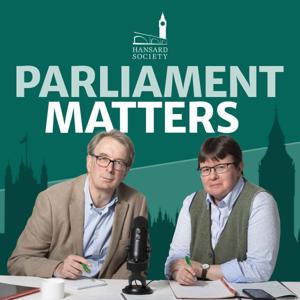
Mark D'Arcy was the BBC's parliamentary correspondent for two decades. Ruth Fox is the Director of the parliamentary think-tank the Hansard Society.
Parliament Matters is a Hansard Society production supported by the Joseph Rowntree Charitable Trust • Founding producer Luke Boga Mitchell; episode producer Richard Townsend.
Hosted on Acast. See acast.com/privacy for more information.
149 Listeners

130 Listeners

171 Listeners

109 Listeners
105 Listeners

663 Listeners
46 Listeners

18 Listeners
34 Listeners

3,030 Listeners
102 Listeners

23 Listeners

148 Listeners

37 Listeners

17 Listeners