
Sign up to save your podcasts
Or



Please help us by completing our Listener Survey. It will only take a few minutes.
Parliament’s Intelligence and Security Committee (ISC) – not a select committee, but a group of senior MPs and Peers appointed by the PM – has a “canary in the coalmine” function, to keep an eye on the security and intelligence services and reassure Westminster that all is well. But last week the canary emitted a loud squawk. The ISC raised concerns about its secretariat being under-funded and too tightly controlled by the Cabinet Office – issues that could hinder its independence and effectiveness.
Ruth and Mark spoke with the Chair of the ISC – former Labour Defence Minister Kevan Jones, now Lord Beamish – about his efforts to ensure robust, interference-free oversight of Britain’s spooks, and the growing threats facing the UK today.
And then there’s the mystery of the missing Ombudsman: why has it taken so long for a new Ombudsman to be appointed to investigate maladministration by Government and the NHS? Veteran Westminster-watcher, journalist David Hencke, untangles the chain of events which culminated in the recent pre-appointment hearing of nominee Paula Sussex before the Public Administration and Constitutional Affairs Select Committee.
We also tackle listeners’ latest questions on a backbench MP’s battle to get a debate on the obscure Royal Albert Hall Bill, whether the next Speaker of the Commons has to be a man, and why MPs don’t use spare time in the House of Commons Chamber more productively.
___
Remember to complete our Listener Survey. It will only take a few minutes.
🎓 Learn more using our resources for the issues mentioned in this episode.
❓ Send us your questions about Parliament:
✅ Subscribe to our newsletter.
📱 Follow us across social media @HansardSociety / @hansardsociety.bsky.social
£ - Support the Hansard Society and this podcast by making a donation today.
Parliament Matters is a Hansard Society production supported by the Joseph Rowntree Charitable Trust.
Presenters: Mark D’Arcy and Ruth Fox
Producer: Richard Townsend
Hosted on Acast. See acast.com/privacy for more information.
Please help us by completing our Listener Survey. It will only take a few minutes.
In this latest episode of our special mini-podcast series, we sit down with Kim Leadbeater MP, sponsor of the Terminally Ill Adults (End of Life) Bill, as the legislation reaches a critical juncture. With Report Stage in the House of Commons now set for Friday 16 May, Leadbeater explains why she postponed it from its original April date, emphasising the importance of giving MPs time to digest significant changes made during Committee Stage. For a Bill dealing with such a complex and sensitive issue, she says, getting it right matters more than moving quickly.
Our conversation explores the procedural hurdles facing Private Members’ Bills – especially at Report Stage, where many stumble. Leadbeater outlines some of the key amendments she plans to table, including stronger conscience protections for healthcare professionals, a ban on advertising, and provisions to ensure the legislation is workable and legally sound.
One of the most debated issues is whether hospices and similar institutions should be allowed to opt out of assisted dying requests. While critics want clearer rules in the Bill, Leadbeater argues for flexibility – preferring to let institutions make their own decisions, with the potential for the system to evolve over time.
Concerns have been raised by some MPs about whether the Bill is being rushed. Leadbeater insists she's proceeding step by step and not looking too far ahead. Still, Ruth and Mark point out that the Government’s own Impact Assessment suggests an extended Session into the Autumn — likely giving the Bill more breathing room.
Beyond the legislative detail, Leadbeater reflects on the emotional toll of championing this Bill. She’s endured online abuse and misinformation but is driven by the moving stories of people who’ve witnessed loved ones suffer or felt compelled to seek end-of-life options abroad.
As the 16 May debate approaches, Leadbeater stresses how vital it is for supportive MPs to attend and vote — both to ensure key amendments are discussed and to maintain public confidence in Parliament’s handling of the Bill.
_____
Remember to complete our Listener Survey. It will only take a few minutes.
🎓 Learn more using our resources for the issues mentioned in this episode.
❓ Send us your questions about Parliament:
✅ Subscribe to our newsletter.
📱 Follow us across social media @HansardSociety / @hansardsociety.bsky.social
£ - Support the Hansard Society and this podcast by making a donation today.
Parliament Matters is a Hansard Society production supported by the Joseph Rowntree Charitable Trust.
Presenters: Mark D’Arcy and Ruth Fox
Producer: Richard Townsend
Hosted on Acast. See acast.com/privacy for more information.
Please help us by completing our Listener Survey. It will only take a few minutes.
As calls grow louder for the UK to withdraw from the European Convention on Human Rights, we talk with Parliament’s in-house human rights watchdog: Lord Alton of Liverpool, Chair of the Joint Committee on Human Rights.
A former Liberal MP who now serves as a crossbench peer, Lord Alton was an unexpected choice to lead the Committee – traditionally chaired by a member of the House of Commons, and usually by a party politician. But his tireless advocacy on human rights around the world, especially his campaigning against China’s treatment of the Uyghur people in Xinjiang, has earned him widespread respect across the political spectrum and many cross-party allies
In a wide-ranging conversation, Lord Alton talks about his ongoing push for a “Hillsborough Law” to impose a duty of candour on public officials involved in future disasters, to prevent cover-ups. He also discusses his Committee's work on the new Mental Health Bill, and his efforts to ensure the government’s flagship green energy initiative, Great British Energy, does not spend public money on equipment like solar panels that are made with forced labour.
Meanwhile, it's been all quiet on the assisted dying bill front at Westminster this week, but not in the Scottish Parliament. Ruth and Mark discuss how the approach to a Members Bill on assisted dying in Edinburgh compares favourably to the handling of Kim Leadbeater’s Private Members Bill at Westminster.
Plus, the appointment of a new Gentleman Usher of the Black Rod brings back memories for Mark of how this key House of Lords official has found themselves caught up at the centre of political controversies in the recent past.
____
Don't forget to complete our Listener Survey. It will only take a few minutes.
Learn more using our resources for the issues mentioned in this episode.
❓ Send us your questions about Parliament:
✅ Subscribe to our newsletter.
�� Follow us across social media @HansardSociety / @hansardsociety.bsky.social
£ - Support the Hansard Society and this podcast by making a donation today.
Parliament Matters is a Hansard Society production supported by the Joseph Rowntree Charitable Trust.
Presenters: Mark D'Arcy and Ruth Fox
Producer: Richard Townsend
Hosted on Acast. See acast.com/privacy for more information.
Please help us by completing our Listener Survey. It will only take a few minutes.
Having cleared detailed scrutiny in a Public Bill Committee, the Terminally Ill Adults (End of Life) Bill faces its next crucial test when it returns to the House of Commons for Report Stage on 16 May.
This stage is often where Private Members' Bills falter. Will opponents of Kim Leadbeater’s proposals to legalise assisted dying win enough support to amend the Bill? Can supporters of the Bill fend off attempts to change it? And could the Bill be lost altogether, because of the procedural hurdles that still stand in its way?
In this edition of Parliament Matters, our resident procedural expert Paul Evans joins Ruth and Mark to unravel the intricate mysteries of Report Stage procedure. Drawing on his experience as a former senior Commons Clerk, Paul highlights the hidden dangers posed not only by opposition to the assisted dying bill but also by a seemingly unrelated Private Members' Bill aimed at regulating the importation of ferrets.
He also explains how amendments are selected and grouped for debate, how the debate itself is structured, and how opponents of the assisted dying bill might exploit parliamentary rules in an attempt to thwart its progress.
Don't forget to complete our Listener Survey. It will only take a few minutes.
Learn more using our resources for the issues mentioned in this episode.
❓ Send us your questions about Parliament:
✅ Subscribe to our newsletter.
�� Follow us across social media @HansardSociety / @hansardsociety.bsky.social
£ - Support the Hansard Society and this podcast by making a donation today.
Parliament Matters is a Hansard Society production supported by the Joseph Rowntree Charitable Trust.
Presenters: Mark D'Arcy and Ruth Fox
Producer: Richard Townsend
Hosted on Acast. See acast.com/privacy for more information.
Please help us by completing our Listener Survey. It will only take a few minutes.
After an extraordinary Saturday recall of Parliament to rush through emergency legislation aimed at saving the steel industry, Ruth and Mark reflect on how scrutiny of the Steel Industry (Special Measures) Bill was sacrificed for speed. No amendments were debated—let alone voted on—even though the Bill handed sweeping new powers to Business Secretary Jonathan Reynolds.
Meanwhile, Speaker Sir Lindsay Hoyle is under growing pressure. Critics accuse him of shielding Sir Keir Starmer by refusing to call outspoken backbenchers like Diane Abbott and Rosie Duffield during Prime Minister’s Questions—even when they were central to the exchanges between the party leaders. Channelling Bond villain Auric Goldfinger, Mark quips that the first time may have been happenstance, the second coincidence, but a third could look suspiciously like enemy action.
Still, the Speaker showed little reaction when Kemi Badenoch claimed the Prime Minister “didn’t have the balls” to confront trans activists—remarks that would likely have earned an ordinary MP a swift rebuke. Will the Leader of the Opposition be quietly warned to mind her language?
And as MPs and Peers rally to block an address to Parliament by President Trump during his upcoming second State Visit, Ruth and Mark ask: who actually decides which foreign leaders can speak to MPs and Peers—and where? While there are doubts over whether Trump even wants to address Parliament, they argue that this is a moment for Westminster to show some solidarity with Congress.
_______
Don't forget to complete our Listener Survey. It will only take a few minutes.
🎓 Learn more using our resources for the issues mentioned in this episode.
❓ Send us your questions about Parliament:
✅ Subscribe to our newsletter.
�� Follow us across social media @HansardSociety / @hansardsociety.bsky.social
£ - Support the Hansard Society and this podcast by making a donation today.
Parliament Matters is a Hansard Society production supported by the Joseph Rowntree Charitable Trust.
Presenters: Mark D'Arcy and Ruth Fox
Producer: Richard Townsend
Hosted on Acast. See acast.com/privacy for more information.
In our latest ‘Whipping Yarn’, we talk with Simon Hart, former Conservative Chief Whip during Rishi Sunak’s Premiership. Hart opens up about his time in one of Westminster’s most demanding and discreet roles, chronicled in his new book, ‘Ungovernable: The Political Diaries of a Chief Whip’.
From late night phone calls about MPs stuck in compromising situations to managing high-stakes parliamentary votes, Hart gives a candid account of navigating one of the most turbulent chapters in British politics. He lifts the lid on the daily challenges of keeping a restless party in line while balancing scandals, shifting alliances, and the relentless demands of government business.
Hart also takes us behind the scenes of the Whips’ Office – a place often shrouded in secrecy. Beyond the headlines and power plays, he gives us a rare glimpse into the day-to-day work of the Whips – part disciplinarian, part therapist – shedding light on their lesser-known pastoral and administrative responsibilities, from safeguarding MPs’ well-being to orchestrating the daily rhythms of Parliament.
Reflecting on his time in office, Hart shares insights into what makes a good MP and why so many arrive in Westminster unprepared for the job and the reality of life as a parliamentarian or minister. He argues that political parties must do more to identify and nurture talent early, to raise the standard of future leadership across the board.
🎓 Learn more using our resources for the issues mentioned in this episode.
❓ Send us your questions about Parliament:
✅ Subscribe to our newsletter.
�� Follow us across social media @HansardSociety / @hansardsociety.bsky.social
£ - Support the Hansard Society and this podcast by making a donation today.
Parliament Matters is a Hansard Society production supported by the Joseph Rowntree Charitable Trust.
Presenters: Mark D'Arcy and Ruth Fox
Producer: Richard Townsend
Hosted on Acast. See acast.com/privacy for more information.
The Government has published “emergency legislation” — the Sentencing Guidelines (Pre-sentence Reports) Bill — to block new guidelines coming into effect that single out differential treatment of ethnic minority offenders when ordering pre-sentencing reports. These reports would then be used by judges to make decisions on sentencing. Critics are calling it a case of “two-tier justice.” The Lord Chancellor Shabana Mahmood says there’s “insufficient democratic oversight” of how the Sentencing Council operates.
In this episode, Ruth and Mark examine Parliament’s limited ability to scrutinise Sentencing Council guidelines — why that’s the case, how it could have been different, and why successive governments have failed to address it. They trace the issue back to a 2009 “Christmas Tree” law that had so many policy baubles it was difficult to scrutinise, an enduring trend of outsourcing decision-making to arms-length bodies, and a culture of “perma-crisis” that has defined UK politics for over 15 years.
Also in this episode: Chancellor Rachel Reeves’ big moment before the Treasury Committee is eclipsed by President Trump’s shock international tariff announcement. At the Transport Committee, Heathrow’s Chief Executive issues a full apology for the massive flight disruption caused by a power station fire that brought the Airport to a halt. Meanwhile, MPs with disabilities and health conditions testify before the Commons Modernisation Committee about the challenges they face navigating Westminster - the building and the procedures.
Plus: Did Hertfordshire Police cross a constitutional line by warning former Deputy Prime Minister Oliver Dowden MP not to look into the arrest of two of his constituents over “disparaging comments” they made in their child’s school WhatsApp group? Ruth and Mark consider how other cases involving vexatious constituents have been handled by MPs and how the issues engage parliamentary privilege.
After Cory Booker’s 25-hour speech in the US Senate, could a filibuster ever happen in Westminster? (Spoiler: absolutely not.) And should MPs be lobbying foreign governments to build airports when they oppose them here in the UK?
🎓 Learn more using our resources for the issues mentioned in this episode.
❓ Send us your questions about Parliament:
✅ Subscribe to our newsletter.
�� Follow us across social media @HansardSociety / @hansardsociety.bsky.social
£ - Support the Hansard Society and this podcast by making a donation today.
Parliament Matters is a Hansard Society production supported by the Joseph Rowntree Charitable Trust.
Presenters: Mark D'Arcy and Ruth Fox
Producer: Gareth Jones
Hosted on Acast. See acast.com/privacy for more information.
In this ninth instalment of our special mini-podcast series, we continue to explore the latest developments in the progress of the Terminally Ill Adults (End of Life) Bill, often referred to as the assisted dying bill. We are joined by Dr Marie Tidball MP to discuss the amendments she has secured for a Disability Advisory Board and an independent advocate for people with learning disabilities.
After more than 90 hours of debate and over 100 votes, the Public Bill Committee has concluded its work on the Terminally Ill Adults (End of Life) Bill.
In this week’s special episode, Ruth and Mark talk to committee member Dr Marie Tidball MP. She shares her insights into the amendments she proposed to ensure disabled people have proper support and protection in navigating the assisted dying process—and reflects on her experience working on the Bill Committee.
The Bill is now set to return to the House of Commons for Report Stage consideration in April. Already, new amendments are being tabled, touching on issues such as the rights of people with neurodegenerative conditions and whether clinicians should be permitted to raise assisted dying as an option with patients.
Ruth and Mark break down the key changes made during Committee Stage and offer a preview of the debates to come.
____
🎓 Learn more using our resources for the issues mentioned in this episode.
❓ Send us your questions about Parliament:
✅ Subscribe to our newsletter.
�� Follow us across social media @HansardSociety / @hansardsociety.bsky.social
£ - Support the Hansard Society and this podcast by making a donation today.
Parliament Matters is a Hansard Society production supported by the Joseph Rowntree Charitable Trust.
Presenters: Mark D'Arcy and Ruth Fox
Producer: Richard Townsend
Hosted on Acast. See acast.com/privacy for more information.
Political storm clouds are gathering over Chancellor Rachel Reeves’ Spring Statement. What does it mean for Parliament, party discipline and the Government’s economic credibility. We speak to Dr Marie Tidball MP about her first months in Westminster - and the accessibility challenges facing disabled MPs. Plus, why did Peers get a vote on postponing local elections, but MPs didn’t?
With MPs facing a bleak economic outlook, proposed welfare cuts, and local elections on the horizon, how long can Ministers hold the line? Ruth and Mark dissect signs of unrest on Labour’s backbenches, with a growing number of voices warning against what they see as a return to “austerity 2.0.” We explore the growing calls for a shift in economic strategy — from a wealth tax to rethinking the triple lock — and the dangers for Reeves if her current path begins to look like a “doom loop”.
Also this week, Dr Marie Tidball MP joins us to share her first-hand experiences as a newly elected Labour MP (for Penistone and Stocksbridge) — and the accessibility hurdles facing disabled parliamentarians in Westminster’s historic (and often inaccessible) corridors of power. She tells us about the challenges of navigating the place of Westminster’s physical and procedural barriers.
We also explore why the unelected House of Lords got a vote on the Goverment’s plans to postpone some local elections — but MPs didn’t? It’s all to do with delegated legislation!
And we answer listener’s questions.
🎓 Learn more using our resources for the issues mentioned in this episode.
❓ Send us your questions about Parliament:
✅ Subscribe to our newsletter.
�� Follow us across social media @HansardSociety / @hansardsociety.bsky.social
£ - Support the Hansard Society and this podcast by making a donation today.
Parliament Matters is a Hansard Society production supported by the Joseph Rowntree Charitable Trust.
Presenters: Mark D'Arcy and Ruth Fox
Producer: Richard Townsend
Hosted on Acast. See acast.com/privacy for more information.
In this eighth instalment of our special mini-podcast series, we continue to explore the latest developments in the progress of the Terminally Ill Adults (End of Life) Bill, often referred to as the assisted dying bill. We are joined by Danny Kruger MP, a leading voice opposing the bill on the Public Bill Committee, to explore the political, procedural, and constitutional complexities of this landmark legislation.
____
Danny Kruger MP discusses how he came to play a central role in opposing the bill and reflects candidly on the intense scrutiny process, the challenges of being out-resourced, and the broader implications of legislating such a deeply controversial issue through the Private Members’ Bill (PMB) process. He raises serious concerns about the lack of judicial oversight following a key amendment, the Government’s behind-the-scenes support despite its neutral stance, and the potential for ECHR (European Convention on Human Rights) considerations to override parliamentary sovereignty.
The conversation also touches on key upcoming stages — Report Stage likely to be on April 25th, potential Third Reading dates, and the importance of robust parliamentary scrutiny in shaping public trust. Kruger calls for improved resourcing, greater transparency, and more time for debate, particularly given the bill’s scope and ethical weight.
With vital clauses still to be debated—particularly around NHS provision and post-legislative review — this episode offers insight into how Parliament is handling one of the most divisive and significant moral issues of our time.
____
🎓 Learn more using our resources for the issues mentioned in this episode.
❓ Send us your questions about Parliament:
✅ Subscribe to our newsletter.
�� Follow us across social media @HansardSociety / @hansardsociety.bsky.social
£ - Support the Hansard Society and this podcast by making a donation today.
Parliament Matters is a Hansard Society production supported by the Joseph Rowntree Charitable Trust.
Presenters: Mark D'Arcy and Ruth Fox
Producer: Richard Townsend
Hosted on Acast. See acast.com/privacy for more information.
From the publisher's feed
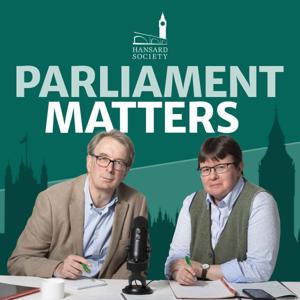
Join two of the UK's leading parliamentary experts, Mark D'Arcy and Ruth Fox, as they guide you through the often mysterious ways our politicians do business and explore the running controversies…
Mark D'Arcy was the BBC's parliamentary correspondent for two decades. Ruth Fox is the Director of the parliamentary think-tank the Hansard Society.
Parliament Matters is a Hansard Society production supported by the Joseph Rowntree Charitable Trust • Founding producer Luke Boga Mitchell; episode producer Richard Townsend.
Hosted on Acast. See acast.com/privacy for more information.

149 Listeners
130 Listeners

171 Listeners

109 Listeners

105 Listeners

663 Listeners
46 Listeners

18 Listeners

34 Listeners

3,030 Listeners

102 Listeners

23 Listeners

148 Listeners

37 Listeners

17 Listeners