
Sign up to save your podcasts
Or



The novelist and island writer Lawrence Durrell believed everyone has a personal landscape, a landscape that resonates with them on some deep tuning fork level. This is where you feel most at home, and where you think your deepest thoughts.
I’ve spent more than 25 years exploring such places as a traveler, and as a writer of magazine features and books.
Like you, I’m also an avid reader. I started this podcast — in my free time and at my own expense — because I couldn’t find a podcast on books about place.
I speak to writers of travel literature to get the story behind some of the greatest books in the genre. I especially like talking to older writers, the ones who inspired me when I was starting out.
I also speak with biographers of long-dead writers, historians, fiction writers, publishers, and even the occasional musician.
Personal Landscapes follows my own curiosity and my own reading, leavened with a long list of ‘big’ episodes on major writers whose work stands the test of time.
You won’t find flavour-of-the-month books here, or new books that rehash tired tropes, gimmicky angles or obsess over identity politics. I don’t read that stuff, and I’m uninterested in talking about it.
What you will find is a carefully curated series of biweekly long form conversations with fascinating people.
I hope you enjoy it. I know you’ll find many books you’ll want to read.
What’s in a name?Personal Landscapes pays homage to a group of poets who were stationed in Cairo during the Second World War: Bernard Spencer, Keith Douglas, and Lawrence Durrell, a writer whose work inspired mine.
They published a journal called Personal Landscapes as an outlet for their writing and the work of their friends, including the Greek exile poet George Seferis, and Olivia Manning, author of the wonderful Balkan Trilogy.
The title of my podcast pays homage to those exiles who understood the spirit of place.
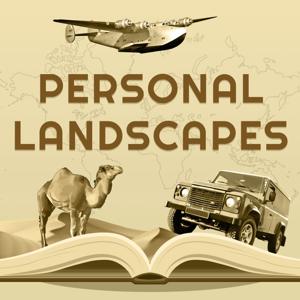
The logo reflects my own personal landscapes. The camel for the desert. The Land Rover for the world’s desolate regions and the freedom to travel through them. And the flying boat for that golden age of travel in the early to mid-twentieth century, a period I never grow tired of reading about.
Want to go deeper? Join me and other curious readers in the members-only Personal Landscapes Club.
Personal Landscapes is a reader-supported publication. To receive new posts and support my work, consider becoming a free or paid subscriber.
I’ve been a working writer of long form narrative magazine features and books for more than 25 years.
I built a strong network of writers and publishers during those years — fascinating people who are passionate about their craft and knowledgeable about their chosen subject — and I want to share their stories with you.
What’s in the Club?The Personal Landscapes podcast offers in-depth long form conversations with the world’s most interesting writers on books about place.
I want to keep the podcast ad-free, so I’ve come up with a fun and exciting set of member-only bonus material for book lovers like you.
When you join the Personal Landscapes Club, you’ll get an exclusive mix of:
weekly long form essays
book reviews
bonus videos
a quarterly Q&A with me
and podcast extras including reading lists from my guests
I started this podcast in my free time and at my own expense. Funding the hosting costs and book budget is a stretch for anyone who scrapes a living as a freelance writer these days.
By joining the Personal Landscapes Club, you’re supporting an independent ad-free podcast that publishes carefully curated conversations backed by decades of reading.
Subscribe now
Stay up to dateYou’ll never miss a podcast episode, essay or extra because every newsletter goes directly to your inbox. It’s free to subscribe to the podcast — you can do so on iTunes, Spotify, YouTube and all the usual platforms.
As long as I can support the costs, podcast episodes will always be ad-free.
Want to keep Personal Landscapes going? Support the show as a club member for just $7 per month and get access to the members-only content I outlined above.
Subscribe now
Thank you for being part of Personal Landscapes — your support allows me to keep doing this work.
If you enjoy Personal Landscapes, please invited your friends to join us by subscribing.
Subscribe now
If you refer friends, you will receive benefits that give you special access to the Personal Landscapes Club.
How to participate
1. Share Personal Landscapes. When you use the referral link below, or the “Share” button on any post, you'll get credit for any new subscribers. Simply send the link in a text, email, or share it on social media with friends.
Refer a friend
2. Earn benefits. When more friends use your referral link to subscribe, you’ll receive special benefits.
Get 1 Free Month for 1 referrals
Get 3 Free Months for 3 referrals
Get 30 minute Zoom chat with Ryan for 25 referrals
Visit the leaderboard
To learn more, check out Substack’s FAQ.
Thank you for helping get the word out about Personal Landscapes!
In 1986, Michael Asher and his wife Mariantonietta Peru set out to cross the Sahara from west to east, by camel and on foot. Their 4,500 mile (7,200 km) journey is the longest trek ever made by Westerners in the Sahara, and the first recorded crossing from west to east by non-mechanical means.
I read Asher’s book about this trip — Impossible Journey — more than twenty years ago, and it’s been in my travel literature top ten ever since.
We spoke about traveling by camel, Saharan cultures, and what it was like to see the Nile after nine desert months.
Arthur Rimbaud turned French poetry on its head in his late teens. His work influenced everyone from the modernists and the Beats to Bob Dylan and Jim Morrison, but he wasn’t recognized or well-liked in his lifetime. He guzzled absinthe, sponged money off friends, and wrecked the life of fellow poet Paul Verlaine. And then he renounced poetry at age 20 and simply walked away.
The last we hear of him, he’s somewhere in Africa living as a trader and gunrunner — and for a while, that was all we knew. The book we’re talking about today reveals what happened next.
Charles Nicholl is the author of Somebody Else: Arthur Rimbaud in Africa 1890-91. He’s a Fellow of the Royal Society of Literature, a recipient of the Hawthornden prize and has won the James Tait Black prize for biography.
We spoke about the allure of Rimbaud the poet, his ‘lost years’ in Africa, and his late reputation as a traveler and Arabist.
The stories in The Vanishing Point, Paul Theroux's new collection, span the globe from Hawaii and the South Seas to Africa and New England. They have all the qualities I love in his fiction: a sharp bite of satire that skewers pretension, crisp dialogue, and an eye for the small, clear detail — an action, a pattern of speech, an element of dress — that reveals someone’s deepest character. He describes the things we all see but don’t mention in polite conversation, and he shines a light on thoughts we actively avoid.
Paul is the author of some 33 works of fiction including The Mosquito Coast and The Bad Angel Brothers, and 19 travel books including The Great Railway Bazaar and Dark Star Safari, books that cemented his standing as our greatest living travel writer.
We had a wide-ranging conversation about the core themes in these stories, including aging, childhood reading, and how taking risks can make you wise.
Pamela Petro is an American writer obsessed with a country she visited by chance. She first went to Wales as a graduate student in her early twenties. The place felt deeply familiar from the moment she arrived, as did the sense of longing that permeates its landscape and stories, both recent and ancient.
The Welsh have a word for this acute presence of absence, an untranslatable term that captures the feeling of something left behind or taken away, irretrievable beyond place and time, but that forever saddens, motivates and marks us. It’s a feeling that resonates deeply with me, and I think you’ll recognize it, too.
We spoke about her obsession with Wales, the presence of absence, and how the sense of loss and longing drives creativity and invention.
Donate to Personal Landscapes.
Eighties movies portrayed East Germany as a vast open-air prison populated by monotonous grey blurs without individuality or agency, but the GDR was not a static land that time forgot.
Katja Hoyer's brilliant book Beyond The Wall tells its story through the lives of ordinary people. She also grapples with the ongoing tension between a Germany that sees the GDR as an aberration, and the desire of East Germans to hold on to their memories of a life they lived in colour.
We spoke about daily life in East Germany, why the Berlin Wall reduced political tensions, and why tinned soup became a modern political controversy.
Donate to Personal Landscapes.
Julian Evans first visited the city of Odesa, Ukraine on a boat journey down the Dnipro River in 1994. He fell in love with its distinct personality as a self-contained world. He also fell in love with a local woman, and for nearly thirty years, her city became his city, too.
His new book, Undefeatable: Odesa in Love and War, weaves memoir with history and literature to give us a haunting portrait of a country struggling against terrible odds to survive.
We spoke about the city of Odesa, his visits to front line combat zones, and what Russia’s war means for Europe.
Donate to Personal Landscapes.
A great biography reveals the raw humanity behind lives of rare genius. In his latest book, Parallel Lives: From Freud and Mann to Arbus and Plath, Jeffrey Meyers draws on Plutarch’s principle of dual composition to shed fresh light on some of the figures who did so much to shape our world.
It’s full of literary feuds, illicit romance, chronic alcoholism and sympathetic attachments between writers, artists, actors, directors, and thinkers —names you’ll recognize, and ‘greats’ you thought you understood.
We spoke about Plutarch’s use of mirror images, literary feuds as spectator sport, and Audrey Hepburn’s connection to Anne Frank.
From the publisher's feed

5,517 Listeners

3,175 Listeners

300 Listeners

4,764 Listeners

581 Listeners

86 Listeners

365 Listeners

3,030 Listeners
337 Listeners

2,433 Listeners

1,115 Listeners

332 Listeners
116 Listeners

1,093 Listeners

638 Listeners